Showing posts with label sculpture. Show all posts

07 February 2021

Cardiff art : Cader Idris

I’ve sat and eaten my lunch on it, I’ve sheltered in its lee from driving wind and rain, but it was only recently that I finally found out more about this hulking artwork.

This is Cader Idris, a sculpture that was first sited in the large square outside Cardiff Central Station in 1999 but was moved ten years later to Cardiff Bay Wetlands Reserve. As the English section of the inscription on the plaque adjacent to the sculpture reads:

The mountains, lakes and valleys of Wales have inspired this sculpture, and in particular Cader Idris, in Snowdonia.

Naturally, many Welsh poets have found similar inspiration and it is those verses which reflect this subject that have been chosen here. All of them are by Welsh poets and in their original language, be it Welsh or English. The englyn is a unique verse form characterised by the particular setting of the lines. Four englynion are included in this selection, and the one by Rhys Dafis was especially composed for this sculpture.

At this point I was somewhat confused by the references to poetry inscriptions as I hadn’t noticed any – more on that below.

Cader Idris was created by William Pye, a London-born artist who studied sculpture at the Royal College of Art from 1961 to 1965, and has since taught and exhibited his work in museums and art galleries around the world. Although the design and dimensions of the Cardiff work were very much influenced by the Welsh mountains, Pye writes that many of his other creations have been inspired ‘by the extraordinary qualities of water and [he is] fascinated by the natural laws of hydrostatics and how these can be manipulated.’ Some of you may have seen the magnificent font he created for Salisbury Cathedral in 2008, or perhaps you’ve seen the shimmering Slipstream as you’ve passed through Gatwick Airport’s north terminal, or you may have encountered Chalice, within the precincts of 123 Buckingham Palace Road in London. Pye is a prolific creator and the list of his works is a long one.   

Returning to Cader Idris, Pye writes that his inspiration came partly from a painting of the mountain by Richard Wilson (1714-82), which Pye says ‘has been a particular favourite of mine since my schooldays and holidays in Wales. This painting has inspired me to create a number of sculptures, the Cader Idris Series.’      

Cader Idris is 13 feet (4 metres) tall and made from a combination of Woodkirk sandstone and Welsh blue pennant slate, which the sculptor explains as follows on his website: ‘Water is inferred at the centre of the structure where the darker pennant stone represents a cwm (circular lake) at the foot of an escarpment.’ Pye goes on: ‘The bronze element of the sculpture suggests a rock outcrop and is set with verses in Welsh and English, all by Welsh poets.’

Now I was even more confused, as it seems I had missed both poetry inscriptions and the ‘bronze element’, so I returned to the sculpture for another look. Still nothing. Then, after much searching, I discovered that the artwork was altered when it was moved. When it was located in central Cardiff, it had a small step built into one side and, more importantly, there was an additional rectangular piece adjacent to the stone ‘mountain’, a piece that was made of bronze and that had the poetry, the englyns, inscribed on one side. (There’s a photo of the original artwork on the VADS website here.)   

I haven’t been able to find any explanation for why the artwork was altered. Nor have I discovered what happened to the ‘bronze element’. To my eye, though Cader Idris still has a significant visual impact in its new setting, the piece has been diminished and much of its meaning obscured by the loss of the 'outcrop' and its poetry, and that seems a great shame.

14 January 2017

Cardiff art: Nereid

Nereid is one of over 200 public artworks to be found in Cardiff, and I think it’s one of the more beautiful. Sculpted in bronze and standing on a base that may be polished granite, she’s an impressive piece that is around 183cm tall, on a base that’s 152cm tall.


Nereids are the sea nymphs of Greek mythology, companions of Poseidon, god of the ocean waves, and helpers of those sailors and fishermen who get caught in dangerous storms (they assisted Jason and the Argonauts in their search for the Golden Fleece).

Tradition tells that there were 50 Nereids, all daughters of Nereus and Doris, but more than 50 have been named in the ancient works of Homer, Hesiod and the like, so, like all mythology, the story is a little flexible.

This particular Nereid has no name. She balances on a wave, above a shoal of fish, and gazes at a seabird that has alighted on her outstretched left hand. She’s the work of British sculptor and Fellow of the Royal British Society of Sculptors, Nathan David, who has a long and impressive list of work to his credit, both public commissions and private work, in Britain and around the world.

I find some of his work rather solid and static but, as in this animated Nereid, he excels at depicting movement. One of his most well-known works is a life-size bronze of ballerina Dame Margot Fonteyn, which can be found at her birthplace in Reigate, Surrey.

10 January 2017

Cardiff: The Abandoned Solider


This evocative 4.5 metre-tall sculpture of a soldier’s face sits on the battlements at Cardiff Castle. Sculptor James Napier described his powerful artwork as his attempt to ‘portray a soldier physically and mentally broken … whilst revealing his inner strength and dignity.’ The piece is called ‘The Abandoned Soldier’ in recognition of those who serve in the military forces, who often suffer severe injuries and mental illness due to their horrific experiences in the line of duty, yet are too often forgotten and neglected when they return home and are discharged from the services.

07 January 2017

Cardiff: Glamorgan Building


Built in the early 1900s, the Glamorgan Building once housed the Glamorgan County Council but is now home to departments of Cardiff University. With its tall Corinthian columns, the classical facade is impressive, though it’s the massive blocks of sculpture that sit on each side of the frontage that the building is most famous for. They are tributes to the origins of Cardiff’s wealth, one group representing navigation, the other mining. It was a very grey winter’s day today so this image doesn’t show the building at its best, but you can see the mining sculpture in more detail in a previous blog

14 April 2016

Cardiff art: Cargoes

If you liked the Beastie Benches, you’ll love Cargoes. This is another of Cardiff Bay’s superb public artworks, though you can’t sit on these ones and, unfortunately, their positioning on building walls in Bute and Stuart Streets, amidst the distractions of restaurant and shop signage, means they are not easily appreciated and frequently overlooked.

Just like the Beastie Benches, the 21 panels of this artwork were inspired by poetry, in this case John Masefield’s poem Cargoes. This is a poem I actually learnt in high school, though it seems an odd choice for the New Zealand school syllabus. And, though John Masefield’s only connection with Cardiff appears to have been a passing one – he caught a ship from here to Chile in 1874, the subject matter is certainly relevant. Cardiff was once one of the largest docks in the world, handling the export of huge quantities of iron and millions of tonnes of coal from the south Wales coalfields, and all manner of cargo passed through its basins and warehouses.

The sculptor of Cargoes, Brian Fell, is one of Britain’s leading artists in steel, and his public artworks can be seen throughout the UK. Cardiff has two more of his major pieces, one of which is a particular favourite of mine – but more on that in a future blog.

As you will see below, Fell’s panels illustrate the various items named (in bold type) in Masefield’s poem (from Salt-Water Poems and Ballads, edited by John Masefield, MacmillanNew York, 1944, p. 124).


Cargoes

Quinquireme of Nineveh from distant Ophir,
Rowing home to haven in sunny Palestine,
With a cargo of ivory,
And apes and peacocks,
Sandalwood, cedarwood, and sweet white wine.


Stately Spanish galleon coming from the Isthmus,
Dipping through the Tropics by the palm-green shores,
With a cargo of diamonds,
Emeralds, amethysts,
Topazes, and cinnamon, and gold moidores.


Dirty British coaster with a salt-caked smoke stack,
Butting through the Channel in the mad March days,
With a cargo of Tyne coal,
Road-rails, pig-lead,
Firewood, iron-ware, and cheap tin trays.


19 May 2015

Auckland sculpture: Birds and Boats

New Zealand is famous for its birds. Not only is it known by ornithologists as the seabird capital of the world, it is also home to many forest birds that are unique to this island nation because of its lengthy period of isolation from the world’s other continental land masses.

Being an island nation, New Zealand is also a boatie’s paradise. Before aeroplanes, shipping was the only means of connection with the rest of the world and, indeed, in the early days of the colony, the only method of transport around the country. These days, shipping remains an important industry, and pleasure boating has become one of our favourite pastimes.

It should come as no surprise, then, that both birds and boats provide important inspiration for New Zealand artists and craftspeople and, as I’ve walked the streets of its biggest city, Auckland, I’ve discovered several magnificent examples of this inspiration. 


Neil Dawson, Birds and Boats, 2013   
Appropriately titled, Birds and Boats, Neil Dawson’s circular sculpture is suspended from a marble wall in the foyer of the ANZ Tower in lower Albert Street, in central city Auckland. My photos give no indication of size but, at 3100mm x 3100mm x 600mm and made of painted steel, it’s a substantial piece and has presence. If you look closely, you can see that the sculpture is made of small origami-like sailboats and its curved shapes are reminiscent of ocean waves.


Greer Twiss, Graftings, 2004 
These are just three of the ten bronze pieces that make up Greer Twiss’s work, Graftings. They fit perfectly into their surroundings in the lush fernery behind the massive glasshouses of the Wintergardens in Auckland Domain. At first glance, they look like real birds, easily recognisable to New Zealanders by their characteristic silhouettes and, for the benefit of overseas visitors, they come with tags inscribed with their common, Latin and Maori names.


Fred Graham, Kaitiaki, 2004
Fred Graham’s massive artwork (above) is also to be found in Auckland Domain, perched shoulder to shoulder with the trees planted on the hillside behind the museum. Although made of steel plate and presumably weighing a ton, its graceful fluid lines make it look as if this gigantic hawk really could fly. The artist notes that birds ‘were the original Tangata Whenua of Aotearoa, and the hawk has figured prominently in the oral traditions of Ngati Whatua and Tainui’. Whether intentional or coincidental, from a certain angle the hawk looks like its about to attack Auckland’s iconic Sky Tower

Brett Graham, Manu Tawhiowhio, 1996
Fred Graham’s son is also a hugely talented sculptor, as witnessed by this large abstract bird (right) that sits outside a building at Auckland University of Technology. Seven metres high and made of copper, wood and river stones, this bird speaks to the way ancient seafarers used migrating birds to guide them to foreign lands. Brett Graham’s skill lies in his ability to use simple forms and natural materials to create extremely powerful works of art.  

Paul Dibble, Waiting for Godot, 2013
The statue at the corner of Wellesley and Kitchener Streets appears continually to change. At first, Paul Dibble’s sculpture of a kereru (native wood pigeon), Woodpigeon on a Circle, was placed in this spot by the folks from the Gow Langsford Gallery to celebrate an exhibition by the artist in 2010. Later, it morphed into Waiting for Godot, (below left) a 2013 bronze of a kereru and an extinct huia. The first sculpture was almost 2.5 metres tall, the second one almost 3.7 metres high. Now both have disappeared. I guess we’ll have to wait for the next Paul Dibble exhibition at the Gow Langsford to see what bird will appear next.  


Paul Dibble, Voyager, 2002
The Voyager (above right) is another stunning piece by master sculptor Paul Dibble. Made of cast patinated bronze in November 2002, this piece sits outside Viaduct Point, at 125 Customs Street West in the central city. Its plaque reads ‘The Voyager acknowledges New Zealand’s long and on-going association with the sea. It stands at a site where fish were unloaded from trawlers for city processing.’


Charlotte Fisher, Arc, 2004
We’ve headed back to Auckland Domain again to check out CharlotteFisher’s contribution to our birds and boats theme. Sitting atop a tall column of granite, its wide bronze arc, a shape synonymous with boats, holds seven vertical shapes – seamen, perhaps? Or immigrants? It is an appropriate symbol for the voyages made by early explorers and settlers immigrating to these fertile shores.


Louise Purvis, Promise Boat, 2005
A short walk down the Centennial Walkway from Fisher’s artwork is Louise Purvis’s bardiglio marble and basalt piece, Promise Boat.  Stone and metal are this sculptor’s preferred materials and she manipulates them into delicate shapes that belie their weight and density. Here, Purvis acknowledges and celebrates the fact that ‘Images of boats are powerful signifiers for island nations, especially for Aotearoa New Zealand, where the land was discovered and rediscovered by many different navigators’.  


Artist unknown, Teddy Bear and Boat
Let’s finish on a whimsical note. This charming piece sits outside the Royal New Zealand Yacht Squadron’s offices at Westhaven Marina, and was commissioned by the family of Lawrence D. Nathan (1919-1987) to recognise his contribution as a successful businessman, a civic leader, a generous philanthropist and a passionate sailor. As a piece on the Distinctly Devonport website explains, Nathan ‘owned three classic yachts, Kotere, Iorangi and … Kahurangi (A30) which he owned for over thirty years and eventually sailed around the world’, hence the model boat with A30 on its sail. Nathan also had ‘a bit of a thing for teddy bears’, apparently. It’s a fun piece that kids young and old can enjoy and a delightful way to commemorate one Aucklander’s love of boats and the sea.

14 September 2013

The frozen people: sculptures of Auckland

A few weeks ago one of my cousins suggested I photograph some of Auckland’s magnificent statues, and I am very glad she did. The commission has opened my eyes both to the wealth of subjects that have been sculpted and to the superb quality of the artworks to be found in the inner city.

I am almost ashamed to say that I had ever seen this magnificent statue until the day I specifically went to photograph it. It's tucked away at the bottom of a gully in a park in the middle of the city but not one I usually walk through and I only noticed the statue when looking out the window of the language school where I was teaching. It's a copy of an internationally known statue by one of the world's greatest sculptors.

The location is Myers Park and the statue is Moses. The plaque reads: ‘This copy of the original sculpture by Michaelangelo was brought to New Zealand for general display by Milne & Choyce Ltd [one of this country’s oldest department stores, now long gone] and was presented by them to the city of Auckland in 1971.’ It is an impressive statue, though I do wonder why Moses is sporting horns.

I don’t think I need to label this statue in Albert Park. She certainly won't be amused if you don't know who she is! The ever-informative, though not always reliable Wikipedia lists 67 statues of Queen Victoria around the world but I’m sure there are many more. Several are very similar to this one – Her Majesty stands erect and regal and unhappy. 

This particular statue was sculpted in 1899 by Francis John Williamson, a British portrait sculptor who was reported to be Queen Victoria’s favourite. He was also responsible for Christchurch’s Victoria statue four years later, as well as many of the versions to be found in Britain.

The athletic-looking bronze pictured below, by New Zealand sculptor Richard Goss, adorns one of the Elliot Memorial entrance gates to the Auckland Domain. Local businessman William Elliot bequeathed £10,000 for the gates’ construction in 1935 and Alan Elliot (no relation), a New Zealand athlete who won a medal at the Los Angeles Olympic Games, was the model for the statue.

I always remember my father telling me that this statue, whose anatomy is all present and correct and in full public view, pees when it rains. I admit I haven’t seen this fascinating phenomenon for myself!

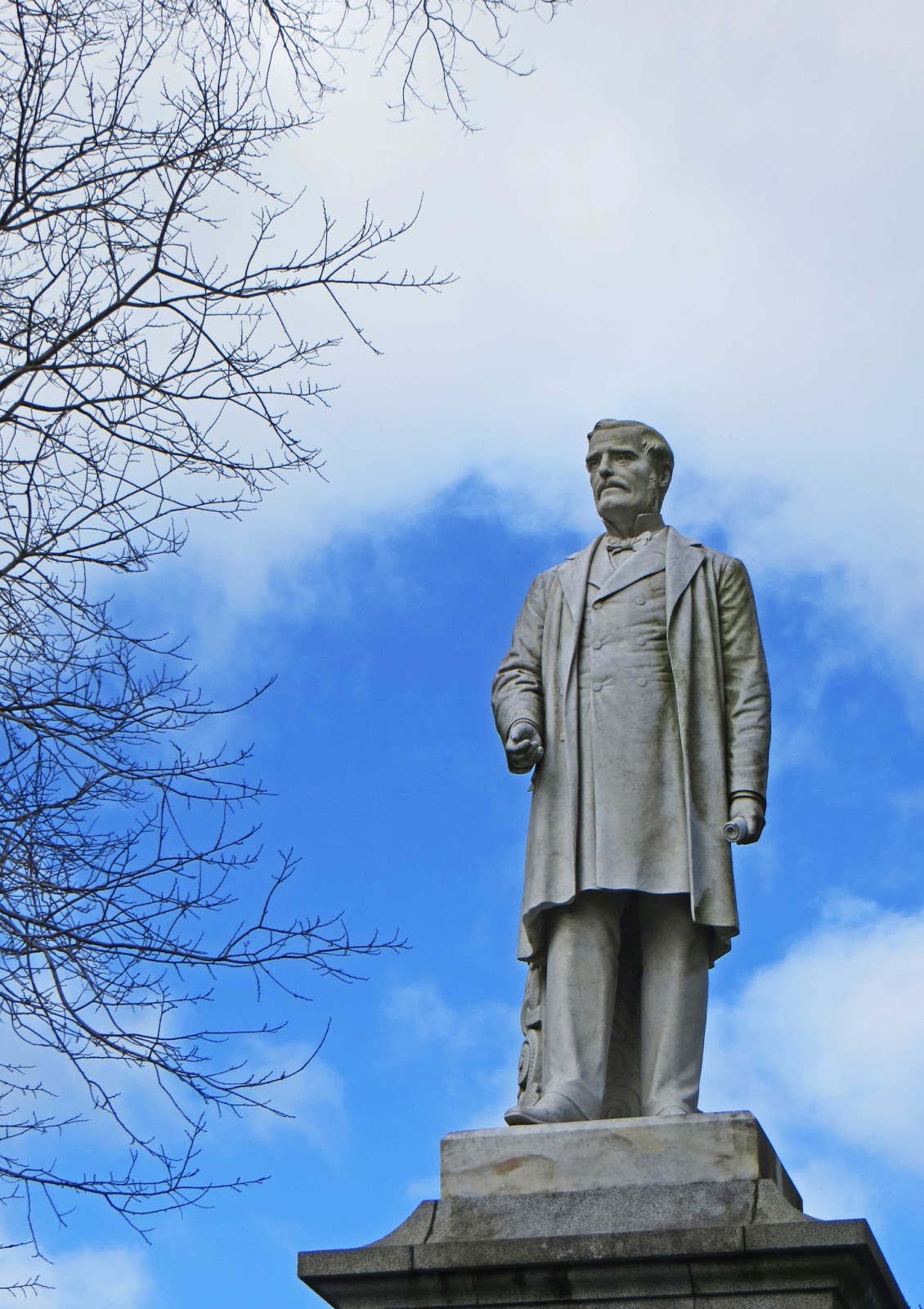
This stately looking chap is one of New Zealand’s most well-known statesmen and was an importance figure in the early governance of this country. Sir George Grey was twice governor of New Zealand, the last superintendent of Auckland and this country’s premier from 1877 to 1879. 

The statue, in marble, was fashioned by Victoria’s sculptor, Francis Williamson, and completed in 1911. It stood originally at the junction of Queens Street and Grey’s Ave but proved an obstacle as traffic flows increased so was moved to its present location in Albert Park in 1922.

The statue below, in Albert Park, was "Erected by the members of the NZ Battery R.A. in memory of their comrades ... who lost their lives in the South African War 1900-1." It was sculpted by an unknown Italian sculptor in 1902 but has since been fenced off due to damage by vandals. 

The bizarre face of the fountainhead below it, which looks to me like an alien creature from some modern sci-fi movie, is, in fact, a lion, a symbol of power and imperial domination than is frequently used in Boer War memorials.

Below right is another artwork I only noticed, though I've walked along the road opposite it very many times. It stands at the bottom of a flight of steps that connects Mayoral Drive with Upper Lorne Street'Aspiration', by New Zealand Roderick Burgess, was donated by the Parisian Neckwear Company that operated in this street between 1919 and 1984. The inscription reads: 'That spirit of his in aspiration lifts him from the earth' from Shakespeare's 'Troilus and Cressida'.


Most sculptures are of famous people but the 2008 bronze (above, left), named ‘Kapa haka’ and created by New Zealand artist Michael Parekowhai, is a powerful depiction of a humble security guard. Located in the grounds of the University of Auckland, the figure was modelled on the artist’s older brother. Parekowhai is an associate professor at the university’s Elam School of Fine Arts. 

These are two of Francis Upritchard's 'Loafers' and they might look large but they're actually quite little figurines - it's all in the camera angle. The figures are perched on three round plinths on Symonds Street, atop the Wellesley Street overbridge. Upritchard is the youngest of the sculptors mentioned here, having been born in New Plymouth in 1976. She represented New Zealand at the 53rd Venice Biennale in 2009 and created these ‘Loafers’ early in 2012.


25 July 2013

Talking Heads?

Locations of some heads are circled
Anton Teutenberg would have had no inkling when he departed Hüsten in Prussia on 11 March 1866 that he would be remembered almost 150 years later, in a small country on the other side of the world, for his stone carvings of famous people and gargoyles.

Born on 4 December 1840, Ferdinand Anton Nicolaus Teutenberg was the son of Ludwig Teutenberg, a gunsmith to King Friedrich Wilhelm IV of Prussia. It was his brother Frederick, who had travelled to New Zealand with Gustavus von Tempsky (a fellow Prussian, and a soldier and painter of some repute), who convinced Anton to come to New Zealand with his two sisters and a nephew.

Perhaps to amuse himself during the long trip out from England, on the Clyde-built ship the Rob Roy, Anton carved some wooden scrollwork for the ship captain’s gig. It was an auspicious amusement, as the captain showed the work to local architect Edward Rumsey, who was impressed enough subsequently to commission Teutenberg to prepare some carvings for Auckland city’s new Supreme Court (now the Auckland High Court) in Waterloo Quadrant in the central city.

The Duke and Duchess of Kent

Queen Victoria and Prince Albert

Though he was an engraver by trade and had never carved in stone before, Teutenberg was paid 15 shillings a piece for a series of limestone heads of foreign and local dignitaries to adorn the label-stops of the grand new building, which sported imposing Gothic-style castellated towers.

According to an article in the Evening Post of 12 October 1926, Teutenberg ‘began with the figures on the colonnade, and moulded the figures of the Duke and Duchess of Kent (father and mother of Queen Victoria), Queen Victoria herself and her beloved Prince Albert, Lord Westbury and Lord Chief Justice Campbell, from sketches and photographs supplied by the architect.’ 

As well as these six heads, the portico features two more, ten heads adorn the windows high on the western side of the building (the side now enclosed in the foyer of the modern extension to the court building), and still others adorn the windows of the tall central tower. I counted thirty heads but there may be more as I can’t see the back part of the central tower. There are, in fact, some duplications: there’s a particularly grumpy-looking woman who’s been reproduced three times, there are two Queen Victorias, and two heads of Blind Justice, amongst others.

The three grumpy old women

The two Queen Victorias

The identification of many of these heads remains uncertain - if only they could talk. In his New Zealand Sculpture, author Michael Dunn states that the other heads included people of importance in New Zealand’s early history, twice-governor Sir George Grey and Edward Gibbon Wakefield. An Auckland Star article, dated 15 February 1936, says Teutenberg

girdled the building with a series of heads, including those of judges many of whom in the present day cannot be identified. There must have been a streak of Puckish humour in this artist of the 'sixties, for it is shown clearly in his arrangement of some of the figures and his personification of some characters, which may even be caricatures. Bossing the label moulds of the Gothic arches at the side of the portico are the partnered heads of Socrates and the Maori warrior Hone Heke, while below them are two other heads similarly opposite in character.

Though Teutenberg himself considered the carvings no more than a hobby, he went on to carve similar heads for at least two more Auckland buildings, the Shortland Street Post Office (now-demolished but catalogued in wonderful detail by local historian Lisa Truttman in her Timespanner blog) and the Pitt Street Methodist Church (watch out for a future blog). 

The simple lines of his work betray his exceptional artist ability, and Supreme Court architect Rumsey was so pleased with Teutenberg’s heads that he then gave the sculptor free reign to design the remarkable gargoyles that adorn the rest of the building … but that, as they say, is another story.

Possibly Lord Westbury and Lord Chief Justice Campbell

Identities unknown

13 February 2012

An art attack!


After I recovered from my initial attack of culture shock at the motorways and new cars, the shopping malls and plate-glass windows, the high-rise apartment blocks and hot running water coming out of the tap, one of the things I’ve enjoyed most here in Medellin, Colombia, is the art.

The city centre, in particular, is full of amazing sculptures. My favourites are the 23 voluminous bronze figures by Colombia’s famous artist, Ferdinand Botero, which are displayed in their own plaza, and a very large section in the Museum of Antiochia, which fronts on to the plaza, is also devoted to Botero’s chubby works. There I discovered Botero’s paintings, which depict equally voluminous people, animals and still lifes. There’s even a chubby Jesus!


In the area around Medellin’s administrative centre, there are several more amazing sculptures. There’s the 38-metre-tall Monument a la Raza, a monument to the people of this region and their struggles against adversity. The lower right part resembles a Greek temple pediment but then the left side soars majestically up into the sky, so that, when photographed from a certain angle, its figures appear to reach out and touch the nearby skyscraper.

Monument a la Raza
The figure work is amazing!


Though this monument is spectacular, I prefer the small bronze figures of local people, by Olga Inés Arango, in the adjoining square in front of the council building. The shoeshine man has an incredibly lifelike face, as has the old woman saleswoman, and the newspaper seller has been caught in mid-voice, yelling out the latest headlines.

The saleswoman ...
and the shoeshine man


and the newspaper seller


Across from the administrative centre is the impressive Plaza Cisneros, with its artificial forest of around 300 light poles, some up to 24 metres tall, which is impressive during the day but must be even more so when lit up at night. The concrete poles are interspersed with stands of tall bamboo, emphasising the idea of an urban forest.


Today I discovered the Madre Monte, the mythical mother nature sculpted by José Horacio Betancur, in the botanical garden. And, after a quick google search, I know that Medellin has so many more amazing sculptures that I haven’t had time to see.


And then there’s the street art ... graffiti on the concrete walls bordering the motorways, images of human figures and huge flower murals adorning the sides of buildings, shops advertising what they sell by painting whole walls with images of their products.


Exploring Medellin has been a totally unexpected visual feast of colour and artistic imagination! I just wish I had time to see more.