Showing posts with label public artworks. Show all posts

19 April 2026

Cardiff Bay: Adventurers Quay artworks

This is Adventurers Quay, a large residential development on the edge of Roath Basin in Cardiff Bay and, as you can see, around the ground floor of the building, at pedestrian eye level, there's an artwork.

The artwork, which was installed in 1999, has two components, one a mosaic of ceramic sails coloured blue and white, the other, perhaps less obvious, the grilles that cover the window openings to the car park inside the building.

The 'Terracotta Sails' mosaic is the work of ceramicist David Mackie (b. 1965), a prolific artist whose website lists completed artworks dating from 1994 to 2024, several of which can be seen in the Cardiff area. As well as the highly glazed sails, there's an undulating row of terracotta bricks fashioned to resemble a rope running along the lower part of the artwork. I quite like this piece, though I think the concept lacks imagination, sails being a very common theme among the artworks around Cardiff Bay.

Passers-by might be forgiven for not realising that the 11 steel grilles covering the car park openings are an artwork, so simple are they. These are the work of Andrew Rowe (b. 1963), whose DAR Design website describes him as a 'designer, sculptor and artist blacksmith', who works 'to commission, providing unique design solutions for public art, architectural metalwork, street furniture and sculpture'.


12 April 2026

Cardiff Bay: Blue Beacon


I'd walked past this artwork many times before I paused to look at it more closely, possibly because it's located outside Bute Town Police Station, and I've never thought it a good idea to be seen lingering outside police stations. 

I've called this blog 'Blue Beacon' but I've also seen this artwork called 'Lighthouse' and 'Blue Light' – I'm not sure which is correct. 

According to his website, this piece was designed by British sculptor Mark Renn (1952–2019), with assistance in the design development and fabrication management from Mick Thacker. 

The 60-foot-tall stainless steel construction is the work of 'A1 Stainless, South Wales Monuments, Richard Williams', and there's also an LED lighting system that produces a pulsing blue light at night. 

The granite base of the structure is inscribed with a poem, 'The Ballast Bank', from the publication Zen Cymru, by Peter Finch. 

You can read the poem in full on Finch's website, which offers the following explanation for the piece and its relevance to the location:

The Ballast Bank is a poem by Peter Finch which has been incorporated into Renn and Thackers' Blue Light public artwork at the entrance to the South Wales Police Headquarters on James Street, Cardiff. This station is built very near where in the early days of Cardiff as a trading port stood a quarter mile bank of off-loaded ballast. This had been dumped by arriving ships making space for their outgoing cargoes of iron and coal. The Bank is clearly visible on John Wood's late 1830s map of the town.

The artwork puts some of that ballast bank back. The poem delineates the races, language groupings, trades and ideas which flowed in and out of the burgeoning industrial town as it exponentially developed. In its original form the poem circled Renn and Thacker's silver tower to run across the station entrance steps, in through the doors, up across reception finishing on the reception desk's surface.


According to the newspaper
Wales Online, there seems to have been some controversy and criticism about the erection of this artwork, not surprising when you consider that upwards of £70,000 of taxpayers' money was used to pay for it in 2013.

15 March 2026

Cardiff Bay: Radio Flat Holm sculpture

In mid 2024 this four-metre-high sculpture of an old-fashioned style of radio appeared on Cardiff Bay Barrage. Financed by a National Lottery Fund Project that's supposed to be about rejuvenating Flat Holm Island, the hardwood artwork was designed and created by Glenn Davidson to celebrate the first radio transmission over open water by Guglielmo Marconi on 13 May 1897. Only that radio transmission was between Flat Holm and Lavernock, not Cardiff, and Marconi is not mentioned on the adjacent plaque because it turns out he was a fascist with close links to Benito Mussolini, and the sculpture has been sited so that viewers looking at it actually have their backs towards Flat Holm. So I fail to see how this sculpture is going to 'act as a symbol and encourage them [viewers] to explore the full range of the island's history', as envisioned by a Cardiff Council spokesperson. 


Almost two years on from its installation, the sculpture is already looking worn, its varnished surface badly affected by the elements, as is to be expected in such an exposed seaside environment. It will be interesting to see if Cardiff Council maintains and/or refurbishes the sculpture, something they have failed to do with almost every other public artwork around Cardiff Bay.

08 March 2026

Cardiff Bay: World Harmony Peace Statue

Given the current state of the world, I thought this peace statue, located next to Mermaid Quay in Cardiff Bay, would be an appropriate post for this week. The statue, sculpted by Kaivalya Torpy and depicting Sri Chinmoy, was erected to celebrate the 25th anniversary of the World Harmony Run.
 

The information on the adjacent plaque explains:

Every year the World Harmony Run carries a flaming torch, as a symbol of harmony, in a relay run around the world. Running from country to country, and across several continents, the torch is passed from hand to hand and from heart to heart.

and

One of the many throughout the world, this statue was unveiled on 11 March 2012 by the Right Honourable, The Lord Mayor of Cardiff, Councillor Professor Delme Bowen, when members of the Urdd Gobatih Cyrmu and the World Harmony Run set out together on the Welsh leg of the World Harmony Run's UK tour.

The Urdd is Wales' leading youth organisation and has for over 60 years shared a message of peace and goodwill with the world.

The plaque suggests: we all need to 'hold the torch [even if metaphorically] and make a wish for peace'. I'm willing to give it a try.

22 February 2026

Cardiff Bay: Panorama Stone

When I first photographed the Panorama Stone, it wasn't where it is now. Thirty years after it was installed in 1993, this artwork was relocated to make way for a much larger sculpture depicting three black Cardiff men, who originally played amateur rugby union in Wales but made the move to play professional rugby league for English clubs. (That sculpture will feature in a forthcoming blog post.)
 

The Panorama Stone wasn't moved very far though; it is in Cardiff Bay's Landsea Square, just around the corner from its initial location. The stone was one of the many public artworks commissioned by the Cardiff Bay Development Corporation around the time the Barrage was being completed and the Bay was being redeveloped as a 'tourist destination', and was designed to show those locations around the world that had strong associations with the Bay, with Cardiff and with Wales. The sculptor was Leonard 'Jonah' Jones (1919 – 2004), known not only for his sculptural works in slate, stone and bronze but also for his calligraphy, painting, and work in art education.

18 January 2026

Cardiff Bay: Bowline Knot

Located off Havannah Street, at one of the entrances to Cardiff Bay Wetland Reserve, partially obscured behind the circle of shrubs that surrounds it and officially called Bowline Knot (according to the Cardiff Public Art Register), but also known as the Rope Knot, this 'cast bronze and mild steel' sculpture was created by Andrew Rowe in 2000.

The sculpture models a length of rope tied to a ring that is set into the ground with a bowline knot, the type that was traditionally used to tie ships to the dock at which they had moored. The art register reports that 'this bronze sculpture reflects Cardiff Bay's heritage as one of the worlds [sic] principal coal-exporting ports.'

You can read about Andrew Rowe's career on the Fresh Air website, and learn more about his current work and see examples of his formidable artworks on the website of DAR Design, the company he founded in 1990.

24 June 2023

Parc Penallta : The Observatory


The Observatory stands on the highest point of Parc Penallta, a country park in the Welsh Valleys built on the spoil heap of the former Penallta Colliery.


Built in 2001, in a combination of Corten steel and stainless steel, The Observatory measures 10 metres high and 25 metres in diameter.
 

The six supporting arms of the sculpture are decorated with cut-out designs, created by the artist in collaboration with the six surrounding communities of Nelson, Ystrad Mynach, Maesycwmmer, Hengoed, Llanbradach, and Gelligaer. Each arm leads the eye in the direction of one of these communities. 

The designs incorporate images that reflect the heritage and wildlife to be found in these six locations, as imagined by children from the local schools. And there are convenient benches where visitors can sit and enjoy the views, and refuel with sandwiches and a drink before exploring the many features of the park that are visible from this high point. 

The creator of this eye-catching artwork was Malcolm Robertson (b. 1951), an artist who, after graduating from the Glasgow School of Art in 1974, has worked primarily as a sculptor but, according to his website, also created 'artworks and murals within a social and environmental context' and ran 'art festivals, youth training schemes and graduate apprenticeships' while working as the Town Artist in the Scottish New Town of Glenrothes. 

Since establishing his own professional practice in 1991, Robertson 'has successfully managed to create an extensive and eclectic portfolio of site specific sculpture and artworks in a wide variety of materials in the UK, Germany, India and the USA', many of which can be seen on his website. 

I find the fact that his art is 'created in response to people and places, is eclectic in character and sympathetic in scale and context' very appealing, and I always make a point of walking up to The Observatory when I visit Parc Penallta.


21 February 2021

Cardiff art: Three Ellipses

If you’ve ever walked over the Cardiff Bay Barrage, you might have noticed splotches of yellow paint, seemingly splattered randomly around the lock area, under your feet, on parts of railings and halves of benches, partially covering life buoys, swiped across fixtures and fittings. It’s really quite bizarre!

As well as being the colour of sunshine and warmth, yellow is also a colour of caution, warning of the need to be careful, to take safety precautions, so painting surfaces yellow can indicate trip hazards, concealed danger, potential obstacles. But that doesn’t seem to be the case here.

The colour yellow is also known for its high visibility, which is why it’s often used on road safety signage, on ambulances, police vehicles and fire engines. The colour can be seen, the painted shapes recognised from a distance. Now maybe we’re getting closer to an explanation of the Barrage blotches?

There’s only one way to solve this mystery, and that’s to stand in one specific spot on the Barrage near the locks and look seaward. Only then can you see, in its entirety, the amazing artwork that is Three Eclipses for Three Locks.

The brainchild of Swiss artist, Felice Varini, who specialises in optical illusional artworks, this piece was painted on the Barrage in March 2007, by a team that included professional mountain climbers to paint the less accessible spaces. I love it for the way it challenges the mind of the viewer to figure out and complete the fragmented puzzle but I do think it’s time the Cardiff Harbour Authority repainted it. It would be a great shame, and a huge waste of the initial cost of £25,000, if this piece was allowed to fade into obscurity.

07 February 2021

Cardiff art : Cader Idris

I’ve sat and eaten my lunch on it, I’ve sheltered in its lee from driving wind and rain, but it was only recently that I finally found out more about this hulking artwork.

This is Cader Idris, a sculpture that was first sited in the large square outside Cardiff Central Station in 1999 but was moved ten years later to Cardiff Bay Wetlands Reserve. As the English section of the inscription on the plaque adjacent to the sculpture reads:

The mountains, lakes and valleys of Wales have inspired this sculpture, and in particular Cader Idris, in Snowdonia.

Naturally, many Welsh poets have found similar inspiration and it is those verses which reflect this subject that have been chosen here. All of them are by Welsh poets and in their original language, be it Welsh or English. The englyn is a unique verse form characterised by the particular setting of the lines. Four englynion are included in this selection, and the one by Rhys Dafis was especially composed for this sculpture.

At this point I was somewhat confused by the references to poetry inscriptions as I hadn’t noticed any – more on that below.

Cader Idris was created by William Pye, a London-born artist who studied sculpture at the Royal College of Art from 1961 to 1965, and has since taught and exhibited his work in museums and art galleries around the world. Although the design and dimensions of the Cardiff work were very much influenced by the Welsh mountains, Pye writes that many of his other creations have been inspired ‘by the extraordinary qualities of water and [he is] fascinated by the natural laws of hydrostatics and how these can be manipulated.’ Some of you may have seen the magnificent font he created for Salisbury Cathedral in 2008, or perhaps you’ve seen the shimmering Slipstream as you’ve passed through Gatwick Airport’s north terminal, or you may have encountered Chalice, within the precincts of 123 Buckingham Palace Road in London. Pye is a prolific creator and the list of his works is a long one.   

Returning to Cader Idris, Pye writes that his inspiration came partly from a painting of the mountain by Richard Wilson (1714-82), which Pye says ‘has been a particular favourite of mine since my schooldays and holidays in Wales. This painting has inspired me to create a number of sculptures, the Cader Idris Series.’      

Cader Idris is 13 feet (4 metres) tall and made from a combination of Woodkirk sandstone and Welsh blue pennant slate, which the sculptor explains as follows on his website: ‘Water is inferred at the centre of the structure where the darker pennant stone represents a cwm (circular lake) at the foot of an escarpment.’ Pye goes on: ‘The bronze element of the sculpture suggests a rock outcrop and is set with verses in Welsh and English, all by Welsh poets.’

Now I was even more confused, as it seems I had missed both poetry inscriptions and the ‘bronze element’, so I returned to the sculpture for another look. Still nothing. Then, after much searching, I discovered that the artwork was altered when it was moved. When it was located in central Cardiff, it had a small step built into one side and, more importantly, there was an additional rectangular piece adjacent to the stone ‘mountain’, a piece that was made of bronze and that had the poetry, the englyns, inscribed on one side. (There’s a photo of the original artwork on the VADS website here.)   

I haven’t been able to find any explanation for why the artwork was altered. Nor have I discovered what happened to the ‘bronze element’. To my eye, though Cader Idris still has a significant visual impact in its new setting, the piece has been diminished and much of its meaning obscured by the loss of the 'outcrop' and its poetry, and that seems a great shame.

20 January 2021

Cardiff art : Celtic Ring

My last blog, Under my feet: a key, was an introduction to today’s post on the public artwork that surrounds that ‘key’, which is both a name plate for the artwork and a waymarker to locate the beginning of the Taff Trail. 


The Cardiff Bay Development Corporation (CBDC) was established in 1987 to regenerate the docklands, which had by that time become a wasteland of disused docks and abandoned buildings. As part of their regeneration plan, the CBDC commissioned a series of public artworks to complement the many new building programmes: the Celtic Ring is one of those commissioned pieces.


It was created by sculptor Harvey Hood in 1993. Though born in Staffordshire and educated both in Birmingham (at the Birmingham College of Art) and London (at the Royal College of Art), Hood has spent much of his adult life in Wales. After completing his MA in London, he moved to the Cardiff College of Art, where he eventually progressed to Head of the Sculpture Department. Though now retired from university teaching, and from his 30 years as director of the Berlanderi Sculpture Workshop near Raglan, Hood continues to create amazing works of sculpture. He has exhibited both nationally and internationally, and his work is held in public and private collections around the world.


On Harvey Hood’s personal website there is an excellent blog post that documents, using many fascinating images, the process involved in the creation of the Celtic Ring. It moves from Hood’s sketching his initial ideas on the shores of the Bay before the Barrage was built, to the intriguing process of manufacturing the artwork, from clay mould to plaster cast to fibreglass to bronze.  


As you can see from my photos of the Ring’s interior, its surface is textured with many features relating to the maritime and industrial environment in which it is located. As well as references to local landmarks like the Norwegian Church, the former Hamadryad Hospital ship, and several of the local docks, there are seafaring instruments and tidal charts. It is a remarkable artwork that has stood well the test of time since its creation almost thirty years ago.


28 December 2020

Penarth : Skytown Gateway

I’m several months late to the party but today I’d like to celebrate the fact that this year Penarth has gained a new public artwork, and, though I think it fails in its aspirations, I rather like the piece itself. 

You might, justifiably, wonder how the Vale of Glamorgan Council managed to fund something like this given the financial challenges of the current global pandemic. In fact, this was part of the development deal, the obligations negotiated under the Section 106 agreement, when Council granted planning permission for the Penarth Heights housing development. 

The Skytown Gateway sits above the central entrance to Dingle Park, on Windsor Road in Penarth. According to the Council’s website, the park’s ‘entrances and boundary railings were considered to be unsightly’ so were ‘identified as requiring an upgrade in order to provide a visually impressive, exciting and high quality gateway into the town.’ A well-meaning sentiment perhaps, and the railings do look much better since they’ve been refurbished, but neither the lower nor upper entrances to the park have changed at all and they are, in fact, the entrances that get most use. And, though I do think the gateway artwork is impressive, its effect as a town rather than a park gateway is lost by its position immediately adjacent to a roundabout, which drivers of passing traffic are, hopefully, concentrating on negotiating rather than glancing around at the scenery. Also, as there is nowhere nearby to park, visitors to the town are unlikely to stop to admire the artwork, so as a ‘gateway into the town’, it fails. 

As a ‘visually impressive’ gateway, though, I think it’s a winner, and the makers, a company called Cod Steaks from Bristol, have done a great job of capturing the character of the town. The Council website page about the Skytown Gateway project includes a link to a report from Cod Steaks on their creation process, including consultations with the local community and workshops with local school children to develop the ideas behind the finished artwork. It’s interesting to note that their workshops initially focused on the local flora and fauna, as you might expect from a gateway to a park, but the end product refers only to the built heritage of the town with no reference at all to the natural environment, a missed opportunity but presumably a deliberate decision by the Council. 
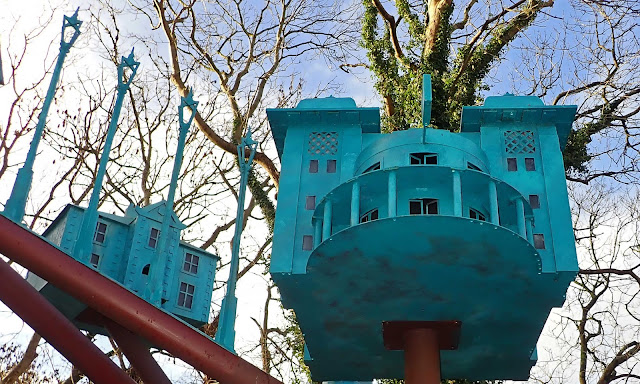
As you can see in my photographs, the gateway includes references to many well-known local buildings and to the town’s maritime history. Residents will recognise St Augustine’s Church, the Penarth Pier Pavilion, the former public swimming baths, and the old Custom House, as well as generic terraced houses and a town house, the town clock and the lamp standards that run along the Esplanade. From the surrounding maritime landscape, there are the lighthouse on the island of Flat Holm and the Pink Shed, formerly used for yachting race officials, that sits on an arm of the Cardiff Barrage, and a tug boat. And representing local tourism and recreational facilities, the artwork includes a yacht and a caravan. 

The Cod Steaks project report notes that the artwork has been constructed from over 4000 pieces of precision-cut steel, finished with blue paint, and includes low-level LED lighting within the buildings, which must look quite lovely at night – I have yet to visit in the evenings so have no visuals of the ‘diffused, charming glow’ of the lighting effects. When I do get some photos, I’ll add one or two to this post.


02 January 2020

Cardiff art : 'Wife on the Ocean Wave'


It seems a shame that this charming sculpture is not better positioned. Sitting between two of the three former Mount Stuart graving docks (once dry, now water filled) in Cardiff Bay, it’s half-way down a dead-end space, where there’s no other reason to venture except for a closer view of the sculpture. And so I seldom see – in fact, have never seen – anyone inspecting the terrific trio in their tiny tub.


Punningly titled, Wife on the Ocean Wave, this wonderful piece was created by sculptor Graham Ibbeson in 1993. In the artist statement on his website, Ibbeson explains the inspiration behind all his artworks:

I have always tried to use humour as a tool to draw people into my work, to enable them to look at themselves through laughter. My work has changed over many years of moving forward through the creative landscape, however, my motivation remains the same. I am influenced by the absurdities of this life and the people who inhabit my world. The small, tiny things that make up the whole picture, hoping as always, that humour opens a path to the truth.

Ibbeson succeeds brilliantly, in this and in the 30-something other sculptures that improve and enhance public spaces throughout Britain. (Click on this link to see a gallery of his public sculptures on the author’s website.)  


Back to the boat, and its three delightful figures, a woman, a man and a young lad. The elderly gentleman looks gleeful, his eyes glinting, a  boyish look of genuine fun-loving joy lighting up his face.


The woman looks more hesitant – there’s no open-mouth smile on her. Perhaps she’s a reluctant passenger in the tub. Perhaps she can’t swim.


And the lad – his face is the hardest to read, as he reaches one hand through the wave. Is he concentrating on something he sees? On grabbing what he has seen? And what is his hand reaching for? Why, a cute little fish, of course. The perfect finishing touch to this charming piece.


Constructed originally in fibre glass, then cast in bronze, Wife on the Ocean Wave stands 152cm tall. Access to it is unrestricted so, next time you visit Cardiff Bay, do make the effort to see it. Opposite Techniquest, on the finger of land between graving docks two and three, under the looming menace of a huge old cargo crane, follow the meandering path for a heartwarming laugh.