Showing posts with label Queen Victoria. Show all posts

01 March 2026

Weymouth: Queen Victoria jubilee bust


Most visitors to the seaside town of Weymouth are there for the sun and the sandy beach and the various forms of holiday entertainment. 

Not me. I go primarily for the wildlife (birds, butterflies, dragonflies, etc., depending on the season) but I also enjoy walking around the older streets near the harbour, admiring the town's architectural and historical features. 

This is one I spotted during my most recent visit: a bust of Queen Victoria, attached to the front facade of the Fairhaven Hotel to celebrate her golden jubilee in 1887. 

It seems the 1897 date was added a decade later, when Queen Victoria celebrated her diamond jubilee.

Nowadays, the Fairhaven Hotel is an amalgamation of five separate properties that were probably all constructed in the 19th century. 


According to the Historic England website, the part of the Fairhaven to which the bust is attached, the Grade II listed building at 41 – 43 The Esplanade, was originally two separate mid-19th-century houses, 'possibly encasing late C18 work', with the addresses 7 and 8 Augusta Place. 

At some point these houses were amalgamated to become the Victoria Hotel, and the building has subsequently been The New Vic Bar and Restaurant, as well as forming part of the complex of buildings that made up the Fairhaven Hotel.

As you can perhaps tell from my photo of the building, it is not currently in use, and looks to be in a state of some disrepair. 

Looking at listings on the Savills property website, for a guide price of £25,000 per annum, you could rent, or possibly even purchase, this 'bar/restaurant situated in prime Weymouth seafront location with panoramic sea views'. The colourful bust of Queen Victoria would be an added bonus!

14 September 2013

The frozen people: sculptures of Auckland

A few weeks ago one of my cousins suggested I photograph some of Auckland’s magnificent statues, and I am very glad she did. The commission has opened my eyes both to the wealth of subjects that have been sculpted and to the superb quality of the artworks to be found in the inner city.

I am almost ashamed to say that I had ever seen this magnificent statue until the day I specifically went to photograph it. It's tucked away at the bottom of a gully in a park in the middle of the city but not one I usually walk through and I only noticed the statue when looking out the window of the language school where I was teaching. It's a copy of an internationally known statue by one of the world's greatest sculptors.

The location is Myers Park and the statue is Moses. The plaque reads: ‘This copy of the original sculpture by Michaelangelo was brought to New Zealand for general display by Milne & Choyce Ltd [one of this country’s oldest department stores, now long gone] and was presented by them to the city of Auckland in 1971.’ It is an impressive statue, though I do wonder why Moses is sporting horns.

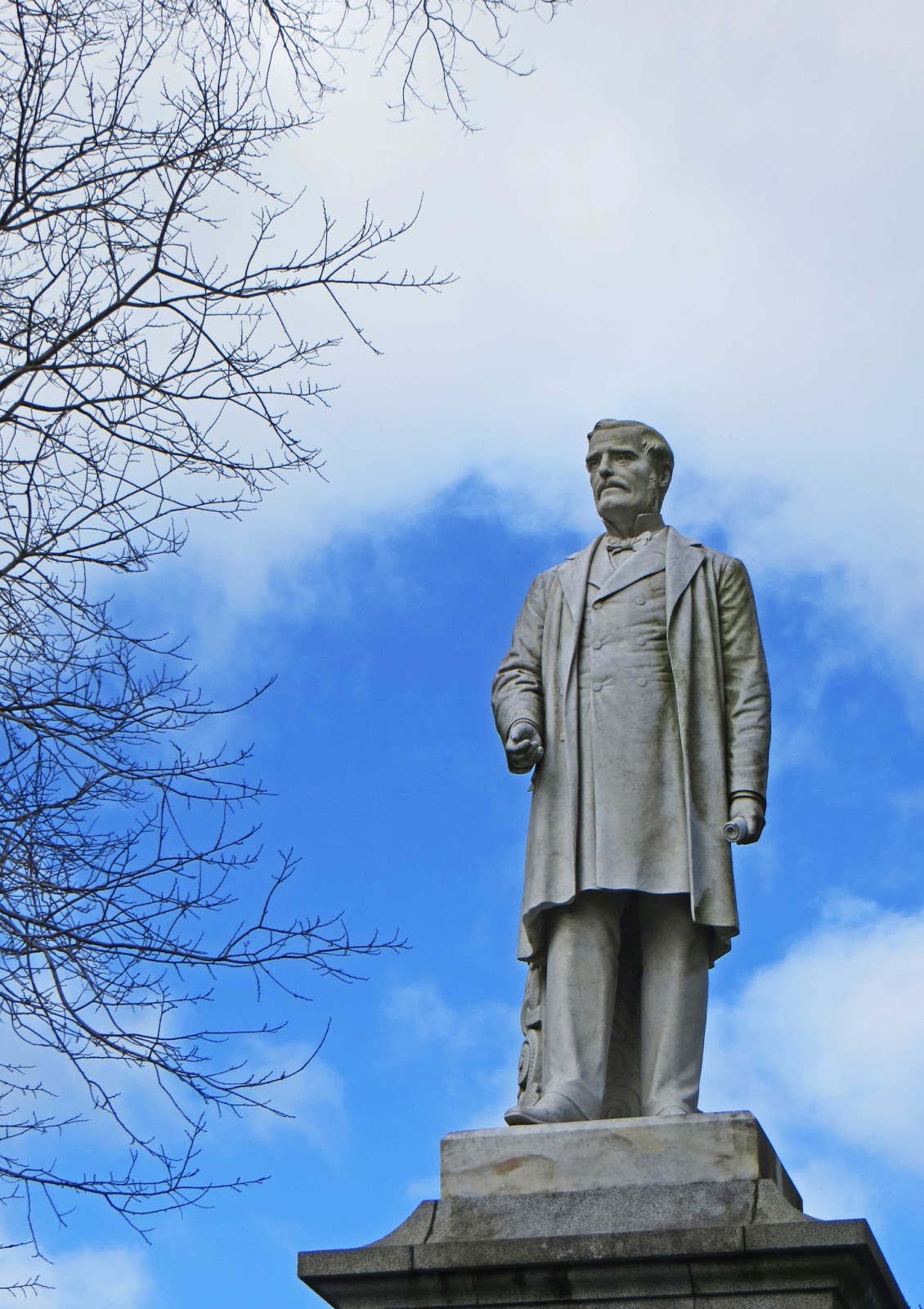
I don’t think I need to label this statue in Albert Park. She certainly won't be amused if you don't know who she is! The ever-informative, though not always reliable Wikipedia lists 67 statues of Queen Victoria around the world but I’m sure there are many more. Several are very similar to this one – Her Majesty stands erect and regal and unhappy. 

This particular statue was sculpted in 1899 by Francis John Williamson, a British portrait sculptor who was reported to be Queen Victoria’s favourite. He was also responsible for Christchurch’s Victoria statue four years later, as well as many of the versions to be found in Britain.

The athletic-looking bronze pictured below, by New Zealand sculptor Richard Goss, adorns one of the Elliot Memorial entrance gates to the Auckland Domain. Local businessman William Elliot bequeathed £10,000 for the gates’ construction in 1935 and Alan Elliot (no relation), a New Zealand athlete who won a medal at the Los Angeles Olympic Games, was the model for the statue.

I always remember my father telling me that this statue, whose anatomy is all present and correct and in full public view, pees when it rains. I admit I haven’t seen this fascinating phenomenon for myself!

This stately looking chap is one of New Zealand’s most well-known statesmen and was an importance figure in the early governance of this country. Sir George Grey was twice governor of New Zealand, the last superintendent of Auckland and this country’s premier from 1877 to 1879. 

The statue, in marble, was fashioned by Victoria’s sculptor, Francis Williamson, and completed in 1911. It stood originally at the junction of Queens Street and Grey’s Ave but proved an obstacle as traffic flows increased so was moved to its present location in Albert Park in 1922.

The statue below, in Albert Park, was "Erected by the members of the NZ Battery R.A. in memory of their comrades ... who lost their lives in the South African War 1900-1." It was sculpted by an unknown Italian sculptor in 1902 but has since been fenced off due to damage by vandals. 

The bizarre face of the fountainhead below it, which looks to me like an alien creature from some modern sci-fi movie, is, in fact, a lion, a symbol of power and imperial domination than is frequently used in Boer War memorials.

Below right is another artwork I only noticed, though I've walked along the road opposite it very many times. It stands at the bottom of a flight of steps that connects Mayoral Drive with Upper Lorne Street'Aspiration', by New Zealand Roderick Burgess, was donated by the Parisian Neckwear Company that operated in this street between 1919 and 1984. The inscription reads: 'That spirit of his in aspiration lifts him from the earth' from Shakespeare's 'Troilus and Cressida'.


Most sculptures are of famous people but the 2008 bronze (above, left), named ‘Kapa haka’ and created by New Zealand artist Michael Parekowhai, is a powerful depiction of a humble security guard. Located in the grounds of the University of Auckland, the figure was modelled on the artist’s older brother. Parekowhai is an associate professor at the university’s Elam School of Fine Arts. 

These are two of Francis Upritchard's 'Loafers' and they might look large but they're actually quite little figurines - it's all in the camera angle. The figures are perched on three round plinths on Symonds Street, atop the Wellesley Street overbridge. Upritchard is the youngest of the sculptors mentioned here, having been born in New Plymouth in 1976. She represented New Zealand at the 53rd Venice Biennale in 2009 and created these ‘Loafers’ early in 2012.


25 July 2013

Talking Heads?

Locations of some heads are circled
Anton Teutenberg would have had no inkling when he departed Hüsten in Prussia on 11 March 1866 that he would be remembered almost 150 years later, in a small country on the other side of the world, for his stone carvings of famous people and gargoyles.

Born on 4 December 1840, Ferdinand Anton Nicolaus Teutenberg was the son of Ludwig Teutenberg, a gunsmith to King Friedrich Wilhelm IV of Prussia. It was his brother Frederick, who had travelled to New Zealand with Gustavus von Tempsky (a fellow Prussian, and a soldier and painter of some repute), who convinced Anton to come to New Zealand with his two sisters and a nephew.

Perhaps to amuse himself during the long trip out from England, on the Clyde-built ship the Rob Roy, Anton carved some wooden scrollwork for the ship captain’s gig. It was an auspicious amusement, as the captain showed the work to local architect Edward Rumsey, who was impressed enough subsequently to commission Teutenberg to prepare some carvings for Auckland city’s new Supreme Court (now the Auckland High Court) in Waterloo Quadrant in the central city.

The Duke and Duchess of Kent

Queen Victoria and Prince Albert

Though he was an engraver by trade and had never carved in stone before, Teutenberg was paid 15 shillings a piece for a series of limestone heads of foreign and local dignitaries to adorn the label-stops of the grand new building, which sported imposing Gothic-style castellated towers.

According to an article in the Evening Post of 12 October 1926, Teutenberg ‘began with the figures on the colonnade, and moulded the figures of the Duke and Duchess of Kent (father and mother of Queen Victoria), Queen Victoria herself and her beloved Prince Albert, Lord Westbury and Lord Chief Justice Campbell, from sketches and photographs supplied by the architect.’ 

As well as these six heads, the portico features two more, ten heads adorn the windows high on the western side of the building (the side now enclosed in the foyer of the modern extension to the court building), and still others adorn the windows of the tall central tower. I counted thirty heads but there may be more as I can’t see the back part of the central tower. There are, in fact, some duplications: there’s a particularly grumpy-looking woman who’s been reproduced three times, there are two Queen Victorias, and two heads of Blind Justice, amongst others.

The three grumpy old women

The two Queen Victorias

The identification of many of these heads remains uncertain - if only they could talk. In his New Zealand Sculpture, author Michael Dunn states that the other heads included people of importance in New Zealand’s early history, twice-governor Sir George Grey and Edward Gibbon Wakefield. An Auckland Star article, dated 15 February 1936, says Teutenberg

girdled the building with a series of heads, including those of judges many of whom in the present day cannot be identified. There must have been a streak of Puckish humour in this artist of the 'sixties, for it is shown clearly in his arrangement of some of the figures and his personification of some characters, which may even be caricatures. Bossing the label moulds of the Gothic arches at the side of the portico are the partnered heads of Socrates and the Maori warrior Hone Heke, while below them are two other heads similarly opposite in character.

Though Teutenberg himself considered the carvings no more than a hobby, he went on to carve similar heads for at least two more Auckland buildings, the Shortland Street Post Office (now-demolished but catalogued in wonderful detail by local historian Lisa Truttman in her Timespanner blog) and the Pitt Street Methodist Church (watch out for a future blog). 

The simple lines of his work betray his exceptional artist ability, and Supreme Court architect Rumsey was so pleased with Teutenberg’s heads that he then gave the sculptor free reign to design the remarkable gargoyles that adorn the rest of the building … but that, as they say, is another story.

Possibly Lord Westbury and Lord Chief Justice Campbell

Identities unknown