18 September 2013

In honour of our women pioneers

Today, 19 September 2013, is the 120th anniversary of women’s suffrage in New Zealand, the first country in the world to give women the vote. It seems appropriate on such a day to pay homage to some of my pioneering women ancestors who lived through those exciting times in our nation’s history, though I doubt many, if any of them found this internationally significant event impacted on them very much, if at all. 

I imagine most were far too busy milking the house cow and churning the butter, tending the garden and baking the bread, handsewing new clothes and handwashing dirty old ones, and caring for their numerous children to even notice the dizzy heights which they and their fellow female New Zealanders had reached. The situation imagined by the cartoonist in the N. Z. Observer and Free Lance of 23 September 1893, that women would be out galavanting till the wee hours while men stayed home and minded the babies, certainly never came to pass for my hard-working female ancestors!

My great-grandmother Jessie Louisa Arthur (nee Bust), known as Louie, was born in 1871 at Blueskin Cove in North Otago, and married John Harold Arthur in 1889 at the All Saints Church in Ponsonby. By the time this photo was taken in 1904, she had already given birth to 9 children, was pregnant with her 10th and was to have 14 children in total. She may also have miscarried several children, as there is a six year gap between child number ten and child number eleven. She fell pregnant almost immediately after her marriage and had her final child in 1915, 25 years later. Amazingly, she lived to be 78, dying of chronic myocarditia and a cerebral haemorrhage in 1946. Her hard life did affect her towards the end of her life: the family had to tie the front gate closed as Granny Arthur would otherwise wander the streets of Ellerslie in her nightie, only to be delivered home with the morning milk by the milkman!


Another of my great-grandmother’s Jane Allen Welsh, nee Gunn, was born in 1875 in Christchurch and was married there in 1899 to Matthew Roger Welsh, a carpenter. I believe this photo is from around that date. Around 1916, Jane and Matthew and their nine children moved to Te Hoe in the Waikato, where they took up a grant of approximately 300 acres of uncleared land. With their children’s help, they struggled to clear enough land to create a viable farm. Life was harsh and they were very poor. My grandmother, one of their children, told me how all the children were dressed in clothes made from one bolt of material.

Jane was another woman who bred well, having 12 children in total. And, though one wee girl died at 6 months and another was born blind and dumb and died at 12 months, seven of the other ten kids lived into their eighties. Sadly, Granny Welsh was not so lucky: she died at the age of 68. The immediate cause of death was acute heart failure with toxaemia but she had suffered from diabetes mellitus for 20 years and had lost a few toes to gangrene caused by the diabetes.

Great-great-grandmother Eliza Rae nee Griffin (below left) was born in Wellington in 1857, and married James Rae in 1875 in Geraldine. Theirs was another large family: Eliza had 13 children between 1876 and 1898. James and Eliza spent most of their married life at Peel Forest, in South Canterbury, where husband James, a Scotsman, was a bushman. Eliza died aged 68, from a bout of pneumonia but she had also been suffering from senile debility for some time.

Eliza’s mother, my great-great-great-grandmother Mary Griffin nee Harris (above right) was born in 1835 in England, and married husband Martin Griffin at Aston, in Warwickshire, in 1856. The following year they emigrated to New Zealand and lived in various places around the Canterbury region, where Martin owned farms and worked as a farm manager. Mary lived to the good age of 84, then died of heart failure, but she too had suffered from senility, for 14 years.

Granny Griffin, with her daughter Eliza Rae and a great-grandson, at the Rae homestead at Peel Forest


My great-great-grandmother Mary Miller Johnstone, nee Little, was born in Castleton in Roxburghshire, Scotland in 1836, married James Johnstone in 1852, and emigrated to New Zealand in 1863. Mary’s is a true pioneering story, which has been told in the book Coal Range and Candlelight:

Among the earliest settlers in the Ashburton Gorge were Scottish immigrants Mary and James Johnstone. Mary Miller (nee Little) was born in New Castleton, Roxburghshire, Scotland in 1836. She married James Scott Johnstone at the Ashkirk Manse, on 9 December 1853. Shielswood Farm, where James was employed as a shepherd, became their home. Their journey to New Zealand began in July 1863, along with just over 300 other assisted immigrants. As they left, an epidemic of sickness was sweeping Britain. Passengers aboard the Brothers' Pride soon fell ill with scarlatina, typhoid and smallpox. The death toll reached 44, including 29 children, one of whom was little John Johnstone aged 15 months.
At the time the trip must have seemed almost endless. The logbook and passengers' diaries reveal that the ship was becalmed for three weeks and unrest flared among the crew. The already cramped conditions became most unpleasant with so many ill.  
On 7 December, after almost four months at sea, they sailed into Lyttelton Harbour. A yellow flag fluttered from the mast, signifying to those on shore that sickness was aboard. Mary, her husband and their three surviving children joined the other passengers in quarantine at Camp Bay. There they spent three weeks in primitive conditions living in tents, before being allowed to move to the Lyttelton Immigration Barracks.  
Their second eldest daughter Mary, later wrote in her memoirs of climbing the Bridle Path. A keepsake of hers was a dressed oak box bearing the inscription 'Brothers' Pride'. It reminded her of the voyage and was with her belongings for many years.  
The Johnstones set out by bullock wagon from Christchurch for Lake Heron, where James had a job as shepherd. They turned inland at Rakaia and followed Thompson's Track across a tussock-covered plain dotted with cabbage trees and matagouri bushes. A night was spent at Thompson's Accommodation House that had been built not far from the boundary of the Winchmore and Springfield Stations. The remaining nights were spent under the stars in the shelter of the wagon.  
At Lake Heron, Mary was kept busy with her young family while her husband was away shepherding. Within two years James was appointed head shepherd on the nearby Clent Hills Station. Mary's new home was a two-roomed cottage, one of a cluster of buildings erected at the foot of a small hill.  
A third daughter, Isabel, was born on 30 October 1864; her birth was registered in Christchurch. Isabel was to become Mrs William Morgan of Methven. Two feet six inches of snow covered the ground at Clent Hills on the July morning in 1868, when Mary gave birth to another son - Christopher John. The name John held a special significance for Mary and James. A son born in Scotland in 1856 had been named John, but he drowned at the age of six. In 1862, another son also named John was born, but died the following year on the voyage to New Zealand.  
The Johnstone family spent 13 years at Clent Hills. The children received lessons from a station employee, except for eldest son Tom, who was educated in Ashburton. By then the family had grown to 10. With children to care for and men to feed, Mary found there was little time for idle hands. At shearing time a cook was hired to feed the extra men. The 'stores', as James called them, arrived by horse-drawn wagon from Mt Somers. Mary had to find a safe place for the flour and sugar away from the mice which sought refuge in the cottage during the cold winter months.  
The children looked forward to family picnics and jaunts out to Lake Emily on the property. Another pastime was to go fossicking in a nearby creekbed for dark grey stones imprinted with tiny ferns. Their visits to the Lambie family at Mount Possession Station resulted in the marriage of Thomas Johnstone to Margaret Lambie.  
Mary's eldest daughter, Margaret, wrote of her mother riding to church on horseback carrying her baby in front of her. In those days services were held in the Mt Somers boarding house. When Clent Hills was sold the Johnstones moved to Springburn where they bought a property on the south bank of Taylors Stream, close to Alford Station. They called their land Roxburgh Farm after their homeland Roxburghshire. Their son Francis Finlay Johnstone was born in 1879 and his brother Norman in 1881. It would appear that 14 children were born to Mary.  
In their later years Mary and James lived in a house built for them near Springburn. They called their home Shielswood after the farm in Scotland where they began their married life. Mary lovingly tended her garden and looked forward to visits from her family, many of whom lived nearby. Mary Johnstone was buried in the family plot in the Mt Somers Cemetery on 3 May 1901. Her age was given as 65. 

14 September 2013

The frozen people: sculptures of Auckland

A few weeks ago one of my cousins suggested I photograph some of Auckland’s magnificent statues, and I am very glad she did. The commission has opened my eyes both to the wealth of subjects that have been sculpted and to the superb quality of the artworks to be found in the inner city.

I am almost ashamed to say that I had ever seen this magnificent statue until the day I specifically went to photograph it. It's tucked away at the bottom of a gully in a park in the middle of the city but not one I usually walk through and I only noticed the statue when looking out the window of the language school where I was teaching. It's a copy of an internationally known statue by one of the world's greatest sculptors.

The location is Myers Park and the statue is Moses. The plaque reads: ‘This copy of the original sculpture by Michaelangelo was brought to New Zealand for general display by Milne & Choyce Ltd [one of this country’s oldest department stores, now long gone] and was presented by them to the city of Auckland in 1971.’ It is an impressive statue, though I do wonder why Moses is sporting horns.

I don’t think I need to label this statue in Albert Park. She certainly won't be amused if you don't know who she is! The ever-informative, though not always reliable Wikipedia lists 67 statues of Queen Victoria around the world but I’m sure there are many more. Several are very similar to this one – Her Majesty stands erect and regal and unhappy. 

This particular statue was sculpted in 1899 by Francis John Williamson, a British portrait sculptor who was reported to be Queen Victoria’s favourite. He was also responsible for Christchurch’s Victoria statue four years later, as well as many of the versions to be found in Britain.

The athletic-looking bronze pictured below, by New Zealand sculptor Richard Goss, adorns one of the Elliot Memorial entrance gates to the Auckland Domain. Local businessman William Elliot bequeathed £10,000 for the gates’ construction in 1935 and Alan Elliot (no relation), a New Zealand athlete who won a medal at the Los Angeles Olympic Games, was the model for the statue.

I always remember my father telling me that this statue, whose anatomy is all present and correct and in full public view, pees when it rains. I admit I haven’t seen this fascinating phenomenon for myself!

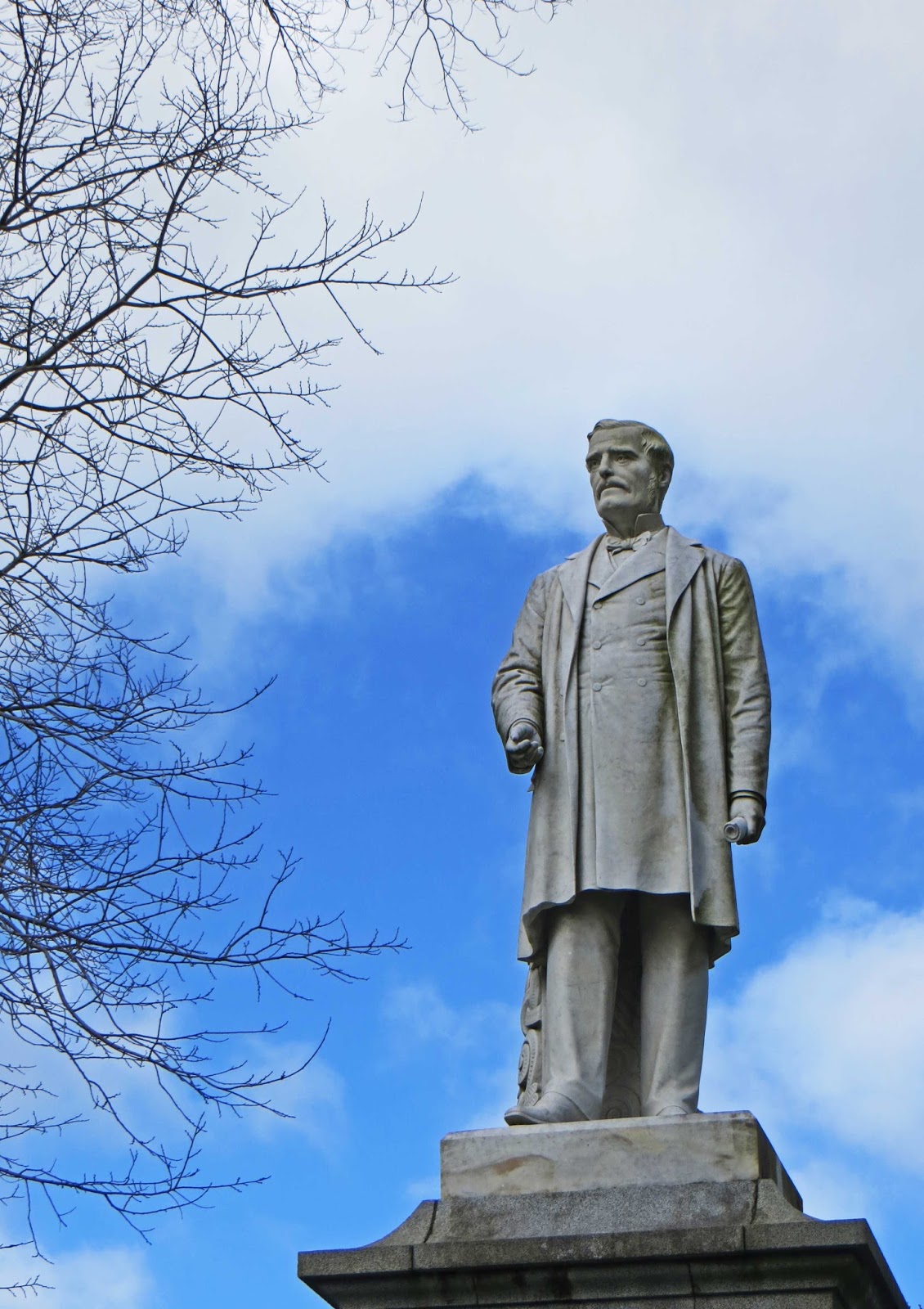
This stately looking chap is one of New Zealand’s most well-known statesmen and was an importance figure in the early governance of this country. Sir George Grey was twice governor of New Zealand, the last superintendent of Auckland and this country’s premier from 1877 to 1879. 

The statue, in marble, was fashioned by Victoria’s sculptor, Francis Williamson, and completed in 1911. It stood originally at the junction of Queens Street and Grey’s Ave but proved an obstacle as traffic flows increased so was moved to its present location in Albert Park in 1922.

The statue below, in Albert Park, was "Erected by the members of the NZ Battery R.A. in memory of their comrades ... who lost their lives in the South African War 1900-1." It was sculpted by an unknown Italian sculptor in 1902 but has since been fenced off due to damage by vandals. 

The bizarre face of the fountainhead below it, which looks to me like an alien creature from some modern sci-fi movie, is, in fact, a lion, a symbol of power and imperial domination than is frequently used in Boer War memorials.

Below right is another artwork I only noticed, though I've walked along the road opposite it very many times. It stands at the bottom of a flight of steps that connects Mayoral Drive with Upper Lorne Street. 'Aspiration', by New Zealand Roderick Burgess, was donated by the Parisian Neckwear Company that operated in this street between 1919 and 1984. The inscription reads: 'That spirit of his in aspiration lifts him from the earth' from Shakespeare's 'Troilus and Cressida'.


Most sculptures are of famous people but the 2008 bronze (above, left), named ‘Kapa haka’ and created by New Zealand artist Michael Parekowhai, is a powerful depiction of a humble security guard. Located in the grounds of the University of Auckland, the figure was modelled on the artist’s older brother. Parekowhai is an associate professor at the university’s Elam School of Fine Arts. 

These are two of Francis Upritchard's 'Loafers' and they might look large but they're actually quite little figurines - it's all in the camera angle. The figures are perched on three round plinths on Symonds Street, atop the Wellesley Street overbridge. Upritchard is the youngest of the sculptors mentioned here, having been born in New Plymouth in 1976. She represented New Zealand at the 53rd Venice Biennale in 2009 and created these ‘Loafers’ early in 2012.


25 August 2013

Homage to home

I’ve had lots of homes in my life – in fact, a quick count reveals that my latest move brings the total to 27.

My first 17 years were spent in the bosom of my family, in the little town of Ngaruawahia, where I was born. The first few years were in a two-bedroom state house, then we moved to a larger state house in the next street soon after my brother was born. That was home for about 14 years and is where my many wonderful childhood memories are based.


Our family home in Ngaruawahia


Dorset St (the red cast is a result of
 using Kodak film in the 70s)
At 17, I went to Auckland for university, and lived a riotous life in a student hostel, before dropping out and heading off to Sydney with a friend for my first, rather short overseas adventure. There were two small, rather grotty flats in Sydney.

After that hot summer, I returned to New Zealand and a flat with 3 others in Kohimarama, followed by my first experience of living alone in half of an old house in Herne Bay. Next came a move with my job at TVNZ to Christchurch, where I lived in 4 different places in the 18 months I spent there. My first home there was in the heritage-listed Dorset Street Flats, which I see from googling suffered some damage in the 2011 earthquake; the others, in old wooden houses, appear to have survived intact.

The Ponsonby house in 2011 (image
from Ray White Realty)
Back in Auckland, I lived first on the waterfront in Kohimarama, in a flat owned by Sir Michael Fay, who lived next door and wasn’t then a ‘sir’. From there I had a few months in a little place in Mission Bay but on the wrong side of the hill, before purchasing my very first home of my own, a wonderful two-storey colonial house in Ponsonby, in the days before the developers moved in. I bought that house for about $27,000 and it’s probably now worth over a million! It was a very social house, the setting for many parties and Sundays ‘at home’. Next was a short interlude of just a couple of months in a concrete-block flat in Parnell, which was very cold but my bedroom had the most wonderful view of the museum and the greenery of The Domain.

And then my next journey to foreign shores got underway, with my first home a bedsit in the Edinburgh suburb of Stockbridge, in a Georgian terrace house that was built before New Zealand was settled – I loved that sense of history, and that marvellous city, particularly as I was footloose and fancy free during the time of the annual festival so roamed the streets enjoying daily doses of culture. But I craved the snow so headed north to the mountains, a job in a hotel and 6 months in their staff hostel. I loved that place too, the daily wilderness walks and the grandeur of those mountains … and the wild whisky-filled winter nights.

Stockbridge, Edinburgh (mine was one of those first floor windows) (image from an Edinburgh realtor)

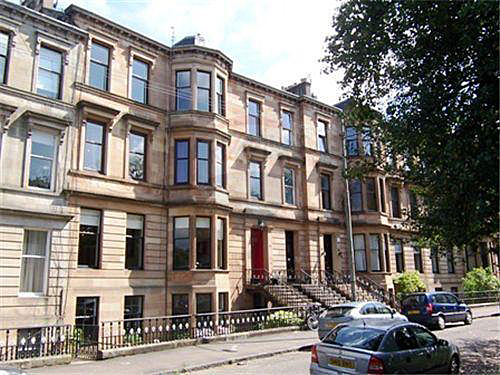
It was in Aviemore that I met my future husband and my next move was in with him, much to his parents’ initial horror, in a bedsit in Glasgow’s Queens Park in a ‘blonde sandstone building of striking architecture c.1900'. That was mostly a cosy little place, though the bizzie-lizzies on the window seat froze solid one particularly freezing mid-winter night when the temperature descended to minus 17!

Queen's Park, Glasgow (ours were the two windows below ground level at the left) (image from a Glasgow realtor)

After a couple of years, by which time we were married, we set off on the longest possible honeymoon … nine months spent travelling back to New Zealand. I haven’t counted any of those places we stayed as homes, though we did get rather attached to a very cheap bedroom in an unfinished hotel run by a Greek named Giorgos on the island of Ios and lingered there a couple of months

In Papakura, I became something of a gardener

Arriving back in New Zealand rather broke, we dossed down with Mum and Dad in Ngaruawahia for a short time (I haven’t counted that either) before moving to Papakura, not by choice but because the ex had a specialised profession and that’s where the work was. We rented for perhaps 18 months, saving every possible penny, before buying our first home together.


The Titirangi house


After 13 years in Papakura, my second-longest abode, we bought our second home, in Auckland’s bush-filled suburb of Titirangi, where I lived for 5½ years, before leaving the marital home and moving into my bachelorette pad in the rather stylish Connaught apartment block in central Auckland city.

The bachelorette pad (images from my latest realtor)
After 5½ years my itchy feet got the better of me once again and my third overseas adventure led me to Peru, where I spent 18 months in a nice little place in Cusco, another physically cold abode but with the spiritual warmth of the friendly locals as compensation. From Peru, I travelled half way around the world to Siem Reap in Cambodia, where I hopped from one guesthouse to another and then one more in the 6 months I was there.

My last abode in Siem Reap


From there back to Auckland, to that dinky little bachelorette pad with its fabulous views over the inner city and down the sparkling Waitemata harbour. And though I returned to sell that place and become a vagabond, I found the opportunity instead to remain in the same building but downsize was too good to pass over, so my latest and current home is in the same building, with almost the same view but much less space. I’m still unpacking my books, settling in, getting cosy, putting my pictures up … but this new home has a really good feeling to it. It may be small but it’s perfectly formed!


My new home


* Please note that many of the photos shown here are not my own but were found seemingly freely available on the internet. I have added acknowledgements where known. If I have unknowingly used one of your photos and you'd like it removed or acknowledged, I apologise and ask that you contact me.