Showing posts with label gravestones. Show all posts

07 May 2017

Grave matters: Penarth Cemetery

Strange as it may seem, I miss not living near Cathays Cemetery, with its depth of history, its park-like grounds, its haven for flora and fauna, and its sense of peace and solitude. I have, however, discovered another cemetery, my local here in Penarth, though it’s only a fraction of the size of Cathays.


According to the Penarth Town Council website, five acres of land for the cemetery were acquired from the Right Honourable Robert George, Lord Windsor, Lord-Lieutenant of Glamorgan and Chief Commissioner of Public Works, on 2 March 1903, though the need for a new cemetery had been signalled many years earlier.


Prior to the opening of the town cemetery, most Penarth burials were in the graveyard around the Church of St Augustine. and as early as 1897 Reverend W. Sweet-Escott wrote to the district council pointing out the need for additional burial space (Evening Express, 20 March 1897). Somewhat surprisingly, the idea of a new cemetery proved to be quite a contentious issue. It wasn’t the cemetery itself that stirred up strong emotions but rather the decision as to whether or not the land would be consecrated, which would affect the cost of a burial. The Nonconformists were not against paying for tombstones, memorials or vaults but disputed the fact that they should have to pay a fee to a rector to perform the burial service.


The cemetery is not mentioned again in the newspapers until 1898, when Cardiff Council tried to amalgamate Penarth with Cardiff, something that was vehemently opposed by the ratepayers of Penarth. Even Cardiff’s promise to provide a new burial ground was not enough to persuade the good people of Penarth (and the town remains separate to this day). 

According to the report in the Evening Express, 21 February 1898,

Mr. A. Mackintosh said that the overtures of Cardiff were premature and pointed to no real advantage. With regard to the cemetery question, Penarth was rich enough to provide its own, and if Penarth people had to take their dead to Cardiff for burial it would simply be adding another terror to death. (Laughter.)

Penarth District Council finally decided to advertise for plans for a new cemetery in April 1901, restricting its call for tenders to Penarth and Cardiff architects only (Barry Dock News, 5 April 1901), though it would appear that nothing came of that advertisement as there is a further report in the Barry Dock News of 11 October 1901 stating that the Council had ‘resolved to re-write the bills of quantity for the proposed new cemetery, and advertise for tenders for same’. It seems much like council matters today – a lot of talk and bureaucracy but not much real action!


The first burial in the new cemetery finally took place in December 1903, and in 1928 the Council acquired a further 2½ acres to bring the total acreage to 7 and the number of burial spaces to 5000. More than one person can be buried in each space, of course, so the most recent burial total stands at over 10,500.


Howver, burial space is once again becoming an issue. On 28 March 2014, the Penarth Times reported that the cemetery was due to run out of burial space in three years – that’s right about now! – so the Council was looking into alternative methods of housing cremated remains. Columbaria, ‘scatter lawns’ and ‘above ground vaults’ were all under consideration, though I haven’t found any reference to a decision in more recent newspapers, and I haven’t noticed any new structures during my visits to the cemetery.

As with most old cemeteries, Penarth’s is an interesting place to explore, for the design and architecture of its buildings and its grave monuments, for the beauty of its wildflowers in the springtime, for the wildlife that inhabits its quiet spaces, and the view from the top of the hill is stunning. I will certainly be visiting again soon.


30 October 2016

Grave matters: Stone birds

I learnt a new word recently, the Welsh word ‘mynwenta’, which translates roughly as ‘graveyarding’. It’s something I seem to spend a lot of my time doing, exploring my local cemetery, for the history and stories of its deceased, for the art and architecture of its monuments, for the wealth of its wildlife and the flourish of its flora.


Today’s post looks at birds in the cemetery – not the birds that fly overhead, perch on the crosses, hunt for worms in the grass or build nests in the trees but rather the birds that adorn the headstones and grave monuments – the stone birds.

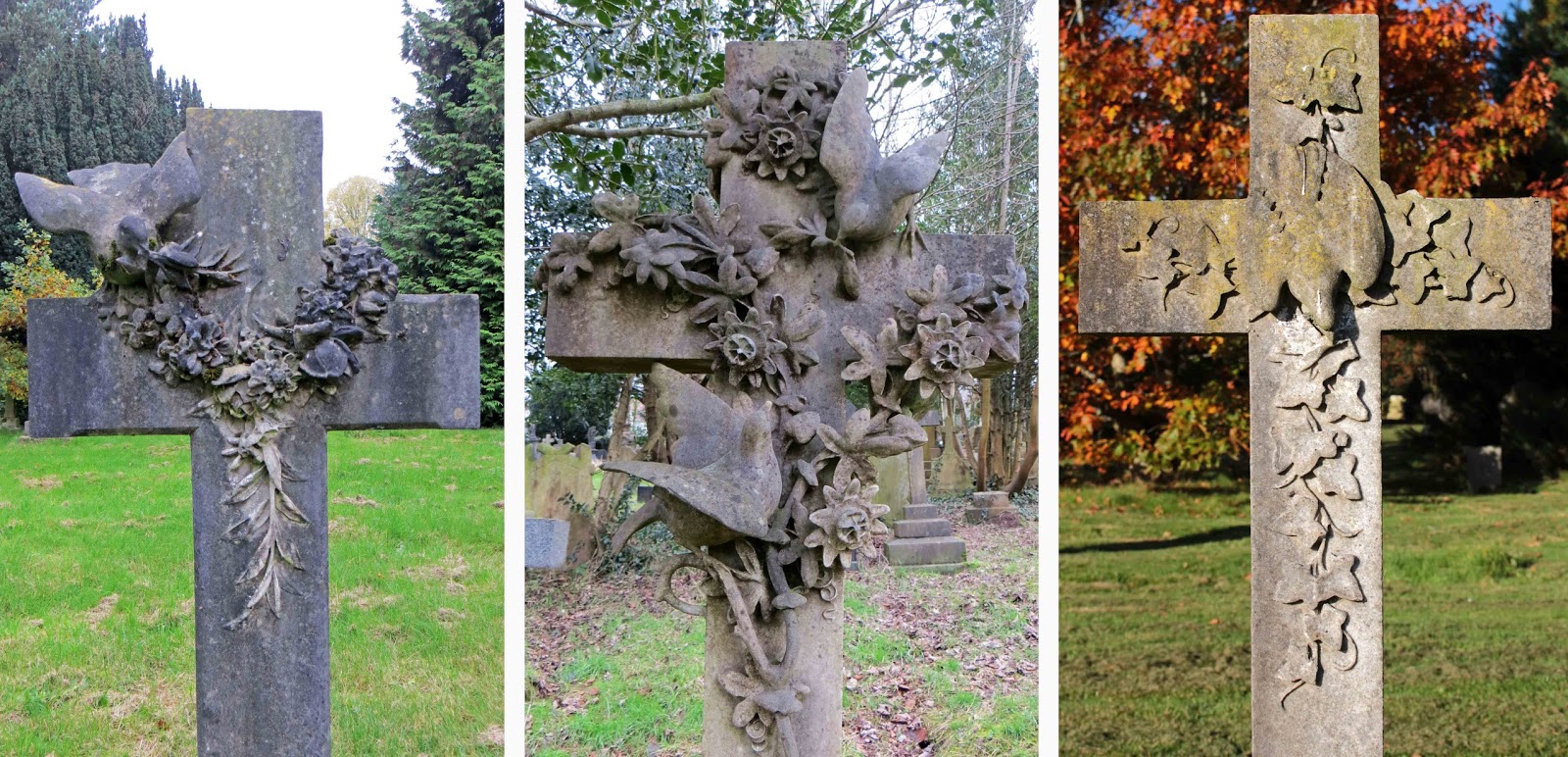
Though some of these birds appear on headstones purely for their aesthetic value, chances are they also have a symbolic meaning as the Victorians were more than a little obsessed with symbolism. 

Birds that are depicted with outstretched wings, as if in flight, may represent souls, winging their way to heaven. Flying birds have also been interpreted as the messengers of God.


The most common bird found on grave monuments in Victorian cemeteries is the dove, that universal symbol of peace, in this case the everlasting peace of death. For Christians it is a biblical reference to Genesis 8:8 and the dove that was sent out from the ark by Noah to find land after the flood. Though it returned empty beaked the first time, it returned the second time with an olive leaf to show that trees had appeared above the flood waters as they receded, and many of the headstone doves are depicted with leaves in their beaks.

Though I found no examples in my local cemetery, other birds can be found on headstones and each has its own meaning. The eagle symbolises a career in the military and stands for courage and bravery; the owl has long been associated with wisdom so can appear on the headstones of scholars and those known for their wisdom and studious character; and the rooster, in Christianity, symbolises the Resurrection (hence the roosters commonly seen on the weathervanes of churches).

One rather intriguing headstone I found has a lovely carved relief of a swan, with outstretched wings, feeding one of two cygnets at its feet. The symbol appears in the centre of a Celtic cross and I have read in Celtic myth that ‘when inhabitants of the Otherworld required passage to the physical land of life ... they would take the shape of the swan’. 

However, this grave is amongst those in the Catholic section of the cemetery and very closely aligned with those of local bishops and priests so perhaps here the swan is more symbolic of a priest ministering to his flock. 

It may also be a reference to the ‘Seven swans a-swimming’ from the ‘Twelve Days of Christmas’ song, which I only recently learnt was, in fact, a rhyme created as a catechism for Catholics unable to practise their faith openly in Britain between 1558 and 1829. The swans in the song apparently represented the sevenfold gifts of the Holy Spirit: prophecy, serving, teaching, exhortation, contribution, leadership, and mercy.  

I also came across a rather delightful headstone inscription referring to our feathered friends: ‘May the birds sing their song on high in your loving praises.’ I rather like the idea of a chorus of birds singing when someone dies, a final serenade to the deceased – much more appealing that some of the songs people choose to play at funerals. 


28 December 2015

Grave matters: The time of angels

Angels are a common sight in Christian cemeteries, carved in stone, standing tall at the heads of graves, carrying the wishes of the deceased’s family that their loved one has gone to heaven to dwell in peace forevermore.

Most of the angels guarding the graves at Cathays Cemetery in Cardiff are female, though depictions of two particular male angels are not uncommon elsewhere and can be indentified by the objects associated with them, Michael with his sword and Gabriel with a horn.


The female angels also appear with objects, often wreaths or flowers, or in specific poses with symbolic meaning. Some angels appear to weep, expressing grief over a life too soon cut short, others gaze sorrowfully skyward, perhaps appealing for God’s mercy. Occasionally, an angel will be shown carrying a child, or perhaps embracing the dead person as they escort them on their final journey to heaven. Angels can be young or old, and a grouping of several angels together is said to represent heaven itself.


Just as we would choose a particular type of headstone from a catalogue today, so the Victorians chose their grave markers from the catalogues of monumental masons. It is quite common, therefore, to find almost exact replicas of angel statues in one cemetery, as you can see from the photograph below. Usually no attempt is made to individualise these statues – most are ‘off-the-rack’ creations – but, occasionally, the faces are different. Whether these are an attempt to recall the deceased person or simply a reflection of each mason’s artistic skills, I’m not sure.


Without meaning to seem disrespectful to the dead, statues of angels always remind me of the television programme Doctor Who and one of its scariest alien races, the Weeping Angels. Resembling the stone statues of winged angels in draped clothing that are so common in Victorian cemeteries, these creatures have the ability to move metres in the blink of an eye, as long as no one is looking at them.

Doctor Who is recorded in Cardiff, and various locations around the city have been used in the filming of outdoor scenes, including Cathays Cemetery. So, I have just one piece of advice for you when looking at the photographs in this blog … don’t blink!


The features of the angels shown in the centre and at right appear more individual than most


06 December 2015

Grave matters: Ivy

Ivy seems almost to be ubiquitous in cemeteries. Either you’ll find it carved into the stone of a grave marker as decoration, or it will be smothering that same headstone so you can no longer read the details of who’s buried beneath, or both!

As you might easily deduce, when the evergreen and almost indestructible ivy is used as a decorative element on a headstone it is intended to symbolise immortality and eternal life, and perhaps also rebirth and regeneration – just think how resilient a plant ivy is and how, even when you think you’ve removed every last piece of it from a stone wall, it soon reappears as if by magic. Some people believe ivy is also symbolic of friendship, faithfulness and fidelity.

The plant itself can be seen both as a blessing and a curse in a cemetery. On the positive side, it is an important plant for the environment, providing nectar and berries, shelter and nesting places for insects, birds, bats and other beasties. A covering of ivy is also thought to protect monumental stonework from weather erosion. On the negative side, however, the roots of ivy can creep between gaps in stonework causing grave monuments and headstones to crack and become unstable; its weight can cause similar instabilities; it frequently covers headstone inscriptions making them impossible to read; and if inexpert attempts to remove ivy can lead to further headstone damage.


How to deal with ivy is an issue for all authorities who have responsibility for heritage buildings and monuments, not just those in charge of cemeteries. One of the problems is that ivy can usually only be effectively eradicated through the use of herbicides and many heritage authorities have policies not to use chemicals within their grounds.

I don’t have the answers to the problems caused by ivy so I’ll let that literary master Charles Dickens have the last word here. This is the poem that appeared in his novel, Pickwick Papers, which was originally published in serial form between March 1836 and November 1837.

‘The Ivy Green’

Oh, a dainty plant is the Ivy green,
That creepeth o’er ruins old!
Of right choice food are his meals, I ween,
In his cell so lone and cold.
The wall must be crumbled, the stone decayed,
To pleasure his dainty whim:
And the mouldering dust that years have made
Is a merry meal for him.
        Creeping where no life is seen,
        A rare old plant is the Ivy green.

Fast he stealeth on, though he wears no wings,
And a staunch old heart has he.
How closely he twineth, how tight he clings,
To his friend the huge Oak Tree!
And slily he traileth along the ground,
And his leaves he gently waves,
As he joyously hugs and crawleth round
The rich mould of dead men’s graves.
        Creeping where grim death has been,
        A rare old plant is the Ivy green.

Whole ages have fled and their works decayed,
And nations have scattered been;
But the stout old Ivy shall never fade,
From its hale and hearty green.
The brave old plant, in its lonely days,
Shall fatten upon the past:
For the stateliest building man can raise,
Is the Ivy’s food at last.
        Creeping on, where time has been,
        A rare old plant is the Ivy green.


21 October 2015

Grave matters: Celtic crosses

The elaborate knotwork of Celtic art has long beguiled me.


I have a lovely gold ring shaped in a knot pattern; I have a book full of charted embroidery patterns adapted from such exquisite works as the stone Crosses of Moone and Muiredach, the metalwork of the Petrie Crown and the Ardagh Chalice, and the incredible illuminated manuscripts of the Books of Kells and Durrow; and I have used simplified versions of these patterns in my knitting designs.

So, during my wanderings around the graveyard that sits adjacent to Llandaff Cathedral and through the extensive grounds of Cathays Cemetery, both here in Cardiff, I find myself attracted again and again to the many fine Celtic cross headstones.


This design is a combination of a cross, with a ring the surrounds the intersection of the two branches of the cross. Though usually labelled a Celtic cross, its origin is something of a mystery. Some sources claim it comes from the 6th century Coptic Church because it resembles the Egyptian Ankh (or key of life); others see its roots in pagan religions, with the circle symbolising both the sun and the eternal circle of life; while the Romans believed it developed from the draping of victory wreaths across the horizontal bars of crosses.

There’s also a popular legend that attributes St Patrick with the idea of combining the Christian cross with the Sun cross to create the Celtic cross, in an effort to convert the Druids and Pagan Irish to the new Christian religion. Whatever its origins, it was adopted by the Celtic tribes of Ireland, Scotland and Wales in medieval times, and is now most often associated with those peoples. It is also the official cross of the Church of Scotland.


In the mid nineteenth century, the Celtic cross became popular as a grave marker, often in conjunction with decorative bands of intricate Celtic knotwork. It was not only used for people of Celtic origin but also for the general public, so it’s not surprising to find many examples in graveyards dating from Victorian times.

All the photographs included here are of crosses I found in the Llandaff Cathedral cemetery. The structural designs, the complex patterns, and the construction materials vary but each cross is a work of superb craftsmanship and intricate beauty.


10 October 2015

Grave matters: passionflowers


Draped over a wall just around the corner from where I live is a passionfruit vine. I pass this way almost daily and always marvel at the beauty of its flowers.

Then, during one of my frequent walks through Cathays Cemetery, I noticed how often the passionflower appears on the headstones there. These are mostly stones from the late 19th century, though one is from as recently as 1924. The passionflower sometimes appears alone, sometimes in conjunction with other flowers, like roses and lilies, sometimes with foliage like ivy. It is carved on the stones of both men and women.


I guessed the flower’s presence was something to do with the passion of Christ but didn’t realise how specific the symbolism was until I researched it further. 

Working from the outside inwards, the flower has ten petals which represent the ten apostles. The rays that circle the flower form a nimbus, which, for Christians, is symbolic of the divine glory of Christ. Next come the five stamens representing the five wounds Christ received on the cross. The flower’s ovary is shaped like the hammer that was used to drive the nails into Christ’s hands and feet, and the stigma is divided into three parts which equate to the three days Christ lay in the tomb prior to his resurrection. Coincidentally, the passionflower only blooms for three days. And, lastly, the leaf of the passionfruit vine is shaped like a spearhead, representing the spear that pierced Christ’s side.


Not all stone masons seem to have understood the symbolism, I notice, as not all of their flowers have the precise numbers of petals and stamens but, still, I find it fascinating how much meaning has been attributed to this one little flower and will look with new eyes as I pass that passionfruit vine each day.