Showing posts with label Cuckmere haven. Show all posts

03 September 2016

It’s a sign: East Sussex

You know I just can’t resist a well-designed / interesting / lovely / intriguing / memorable / fascinating sign when I see one so, of course, I photographed a few during my recent short break in East Sussex. Here they are:

The Kings Head, Battle
The Kings Head is reputed to be the oldest pub in Battle but I don’t know if that’s actually true. The English Heritage website says it’s a Grade II-listed timber-framed building, dating from the 17th century or earlier, though it has at some point been modernised and had a new front attached. When researching this piece, I found a fascinating reference to documents, pertaining to the building, that are held at the East Sussex Record Office

The will of William Easton of Battle gent., dated 1783, proved PCC 1789, among other property devises a freehold messuage in Battle to John Longley the elder of Battle bricklayer and then to his son John ... In a mortgage of Nov 1810, the property is called Delveday ...

In Nov 1833, Ann Longley conveyed this property to her mother Mary ... who in Oct 1837 sold it to Thomas Wickham of Battle, miller for £650 ... The property passed to his daughter Elizabeth, wife of William Austin of Battle, victualler ... In June 1845, they sold the property, now known as the Kings Head Inn, for £735 to William Miskin of Broad Street, Horselydown, Surrey and others ... [and there is more]

The pub obviously has a long and interesting history. It also does reasonable food, as we discovered when we stopped off here for an early dinner on our way home from Rye Harbour.

The Cuckmere Inn, Cuckmere Haven
This was our lunch stop on the day we spent at the Seven Sisters Country Park, and a very pleasant one it was too. Conveniently situated at Exceat, on the road between Seaford and Eastbourne, and overlooking the Cuckmere River, the outdoor terraces proved a very pleasant place to eat and sparrow watch – a rather large flock has discovered the joys of human leftovers.

Though I haven’t been able to date the Inn, I imagine it is quite old. It is perfectly sited as a transfer point when the nearby beach at Cuckmere Haven was used by smugglers in the Middle Ages. The top part of the sign includes part of the coat of Arms of the nearby port of Seaford: the ‘lion-hulks’ (half lion half ship) appear in the heraldry of many of the Cinque Ports towns, and the eagle comes from the coat of arms of the d'Aquila family, former landowners in medieval times. The lower part of the sign shows the meandering Cuckmere River, and the motto ‘E ventis vires’ means ‘From the wind, strength’, a reference to the days of sailing ships.

The Cuckmere Inn used to be called the Golden Galleon, an allusion to Drake’s galleon the Golden Hind perhaps or to the Famous Five book? Who knows. I do know lunch was delicious!

Unstable ground
This sign appears at the start of the Seven Sisters cliff-top walk and other similar warning signs have been hammered into the ground all along the cliff tops. Unfortunately, the warnings are frequently ignored by walkers, who range perilously close to the cliff edges, as you can see from my photo. They’re mad! The chalk is crumbly and, with constant encouragement from wind and rain, large slices of cliff fall off on a regular basis.

The Ram, Firle
Another day, another scrumptious pub lunch. The Ram is in the tiny historic village of Firle and is part of the 500-year-old Firle Estate, owned by the Gage family. The inn is a Grade II-listed, brick and flint building that used to be a regular rest stop for the Lewes to Alfriston coach – that’s horse and coach, not motorised bus! The building was also once used as the village court room where the rents for tenant farmers were set and collected. Nowadays, it’s a popular lunch stop and also has boutique accommodation if you fancy a weekend away in a delightful setting.

Metal detecting prohibited
After our lunch at the Ram in Firle, we drove to the top of the hills above and walked a few miles of the South Downs Way. This sign hung on a gate into farmland at the beginning of our walk. In case you can’t quite make it out the sign reads: ‘Firle Estate. METAL DETECTING ON THIS LAND IS A CRIMINAL OFFENCE. To Report an incident Please Call the Estate Office on xxx or Sussex Police on xxx.’ It’s the first time I’ve seen anything like this but, as the hilltops are dotted with ancient Bronze Age barrows and Neolithic earthworks, I can certainly understand the prohibition on amateur metal detecting.

16 August 2016

East Sussex: Seven Sisters Country Park


Gigantic chalk cliffs that can crumble and drop in an instant.
The Cuckmere river that snakes and winds and meanders its way to the sea.
Sheep chewing, gulls cawing, waves crashing.
Cliff tops carpeted in a myriad of blooming wildflowers.
Water birds so well camouflaged that you scarcely notice them until they scurry down to the water’s edge to wash the mud from their next mouthful.
Wave-rounded pebbles of flint and chalk and limestone that scrunch with every foot fall.
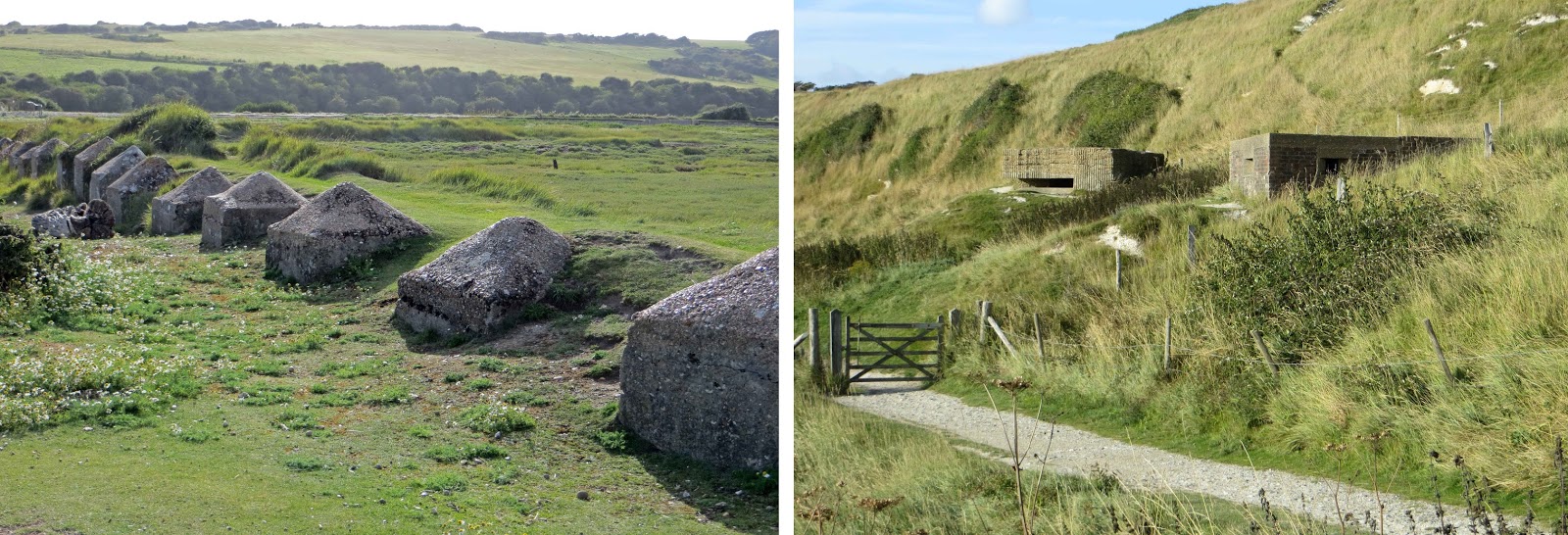
Huge concrete bollards and hollow pillboxes that remind of war and grief and devastation.
Stunted trees that grow sidewise from the force of the prevailing winds.
A landscape so grand and a sky so wide that you feel humbled by the sheer majesty of the place ... 

This is the Seven Sisters Country Park. This is a little slice of heaven on earth!

To walk the landscapes of the Seven Sisters Country Park as they appeared in August 2014, click here, and to see some of the wildlife we discovered last week, follow this link


18 October 2014

England: A stroll with Seven Sisters

Let’s go for a stroll … a rather long stroll that might take all day so bring a hat, sunscreen, water and a picnic lunch. You may sweat a little but the effort will be worth it because the countryside is stunning and the panoramic views sublime.

We’ll park the car at Birling Gap, where serious erosion threatens and frequently causes huge sections of the cliff to fall into the sea. 


Now, let’s walk up to the top of the hill on our left to check out that lighthouse and the view from the top. This is part of the South Downs Way

Looking inland, we have wonderful views over the South Downs.

When we get to the top, we could stop for a coffee at Belle Tout lighthouse, now a cafĂ© and very luxurious B&B, but no, let’s check out the view along the coast. That’s the Beachy Head lighthouse way down below – it’s been warning seafarers about the dangerous coastline here since 1902. 


When we do an about-turn, fighting to keep upright in the teeth of a fierce southerly wind, we can see quite a long way along the coast in the other direction. They’re the Seven Sisters, the seven peaks of the white chalk cliffs that stretch between Birling Gap and Cuckmere Haven. We’ll be heading to the Haven next.


Let’s live dangerously and walk out onto that viewing platform before we get back in the car for the short drive along the coast.

What a stunning sight as the car rounds the bend! You can instantly see why this is called the Cuckmere Meanders

We’ll leave the car at the Seven Sisters Country Park, check out the visitor centre there, walk up the hill behind for another view over the Meanders (where the kayakers are enjoying the waters), then head off along one of the tracks leading down to the sea (see the map).

The Cuckmere River flows into the English Channel here and we get our first close-up glimpse of the famous chalk cliffs called the Seven Sisters.

These are the coastguard cottages we could see far in the distance from Birling Gap. Let’s have our picnic lunch and sit a while enjoying the fresh sea air.


We’ll follow the South Downs Way up past the cottages a short distance towards Seaford Head.

And then we can enjoy spectacular views like these. But don’t go too close to the cliff edge!

When we zoom that camera lens in, we can see Birling Gap and the Belle Tout Lighthouse in the distance.

Heading back to the road, this time we're walking along part of the Vanguard Way, and it’s easy to see which way the prevailing wind blows.

The car’s parked near those buildings in the distance. Are your feet sore yet?


No? Then let’s go down to the sea again, along a different track on the other side of the Cuckmere River.

Getting closer. There’s plenty of bird life hereabouts and lots of sheep grazing in the fields.

Here on the beach, it’s easy to see the gleaming white chalk that formed millions of years ago under the sea from tiny marine organisms and, if the tide’s right, there are plenty of rock pools to explore.


Seeing people at the bottom of the cliffs helps get an idea of their height.


Heading back inland again, the Second World War defences are a bit of a surprise. Dragon’s teeth tank obstacles and pillboxes dot the landscape as this place would have been an ideal invasion point. 

Let’s take one last look back towards the coast before we farewell this amazing countryside and head home for a hot shower. I hope you’ve enjoyed our stroll as much as I have (and my photos have inspired you to visit in person).