16 August 2015

Wisconsin: Downtown De Pere

During my recent short visit to Wisconsin I was staying with friends in De Pere, officially a suburb of Green Bay but a town with an interesting history and rich heritage. Native Americans had long been settled on this idyllic spot. by a series of shallow rapids on the Fox River, when the first European, Jean Nicolet, sailed his canoe here from Montreal in 1634, though modern De Pere didn't really begin to develop until around 1829, when one William Dickinson, anticipating the power potential of the river water, developed the De Pere Manufacturing Coy. That water is still being utilised today, by the huge paper mill that sits on the western river bank in the centre of town.

I was particularly fascinated by the nineteenth-century commercial buildings in downtown De Pere, in the streets surrounding Broadway on the eastern side of the river, and my friend Trudey and I spent a few hours one very hot July afternoon on a photowalk around this area.


According to the De Pere community website  

The South Broadway Historic District contains the most intact concentration of nineteenth century commercial buildings on the east side of the river. By 1882, small, mostly wooden commercial buildings lined the 100 and 200 blocks of N. and S. Broadway. On the night of April 23, a devastating fire destroyed all of the buildings on both sides of the 100 and 200 blocks of S. Broadway. Work on their replacements began almost as soon as the ashes were cold and by the end of the year, five of the District's six contributing buildings were ready for their first occupants. These consist of one and two-story cream brick-clad buildings that all face west onto the 100 block of South Broadway.

The unusual circumstances surrounding their construction can still be discerned by the way the facade of one building blends seamlessly with the one adjacent to it. Normally, buildings like these display clear dividing lines that show where one building ends and the other begins, but in this case, since almost all of these buildings were under construction at the same time and their builders were all using the same cream brick to build them, the results were buildings whose main facades have no visible edges.


As many buildings have subsequently been painted, this seamlessness is not as apparent as perhaps it once was, though you can see from the above images how well some of the buildings fit together.


Notice how wonky this building is - no straight lines here!

It’s the brickwork, in particular, that I admired. The patterns created by those inventive bricklayers are intricate and praiseworthy.

The Julius Krause Store Building (left) is one that was built after the 1882 fire destroyed the previous building on the site. Krause once operated a shoe store in the building but it now the superbly maintained premises of a local photographer.

Not all the buildings date from 1882. The C.A. Lawton building (below) dates from 1880. This firm of ‘Engineers & Patternmakers. Founders and Machinists’ has been ‘casting solutions since 1879’. 

Fortunately, the building was rescued from demolition in the 1990s and has since been converted into a 70-unit complex of apartments, lofts and townhouses. 

According to their website, ‘the original foundry building and subsequent additions follow the Astylistic Utilitarian industrial design of the late nineteenth and early twentieth centuries.’ It certainly looks like a nice place to live.


The J. Steckart & J. Falck double block (above) was constructed by Joseph LeClair in 1888, in the more elaborate High Victorian Italianate style, using both cream- and orange-coloured bricks to create the polychromatic appearance. Apparently, ‘Each of the two halves of the building originally contained two stores in the first story and five apartments in the second. John Steckart operated a meat market in one of the stores in his half, while Jacob Falck operated a saloon and liquor store in one of the stores in his half.’


The Robert McGeehan building (above) was also built in 1888 and shows the same two-colour brick decorating style in the façade as the Steckart and Falck block. It was particularly interesting looking at the side view of this building, where a careful inspection revealed the changes to the structure over the years, with various additions, alterations and repairs, and windows filled in. An architectural historian would have a field day examining a building like this.


The 1903 John Baeten Store harks back to the one-colour brick buildings built twenty years previously but has a lovely decorative garland frieze running along the top. I also liked the inset porch with its three entrance doors.


The other aspect of these buildings that fascinated Trudey and I was the ‘ghost signage’: the often faint traces of the advertisements for businesses that had previously operated within. But that’s a subject for another day, another blog. I’ve just added a couple of photos here (above and below) to show you what I mean.


14 August 2015

Wisconsin: Road trip to Washington Island

Karen, Karen, Sandy, Mary and Liz, along with my friend Trudey, are The Bridgettes, a fun group of women who play bridge, and enjoy events and excursions together. I was delighted to be invited along on one of their excursions, a road trip to Washington Island in Lake Michigan. What a hoot the day was! A day of constant smiles and laughter, of easy camaraderie, of shared fun, of beautiful scenery.

We all met up and climbed aboard Mary’s people carrier then, after first stopping for a delicious breakfast in Algoma, headed north into Door County. This narrow peninsula has 298 miles of coastline so is a Mecca for tourists and holidaymakers. During the summer months the population explodes from around 28,000 to as many as 250,000, with people flocking from cities like Milwaukee and Chicago to enjoy all the county has to offer, from sightseeing, swimming and hiking to fishing, kayaking and biking, to name just a few of the local attractions.

Here's comes the ferry 
Though it would’ve been tempting to linger along the peninsula, we were women on a mission, so headed straight to the car ferry at Northport for the 20-minute ferry crossing to Washington Island.

Five of The Bridgettes

Arriving on Washington Island
Once on the island, our first stop was at a local pub called Nelsen’s Hall, world famous as the home of the Bitters Club. It seems I was to be inducted! There were no intricate rituals, no fancy costumes, no special knowledge requirements – all you had to do was swig down a shot glass of Bitters in one go. Considering you would normally add just a drop or two of Bitters to a drink, that’s no mean feat, but I passed the entrance test with flying colours and have my Bitters Club membership card to prove it. And considering Bitters was originally developed as a patent medicine, full of aromatic herbs and other medicinal botanicals, it’s got to be good for you, right?

Induction complete!

That drinking is not the reason I am lying flat out on the ground in this next photo! After some of our group had followed up their Bitters with more flavoursome mojitos, we moved on from Nelsen’s Hall to the Fragrant Isle Lavender Farm and Shop so that the photographers amongst us could get some photos. We were a little disappointed to find just one field of lavender but it was still a pretty place to shoot.


Next stop was the picturesque Stavkirke, a replica of a stave church (a post-and-lintel wooden construction) in Borgund, Norway, accessed via a prayer path through the woods opposite the Trinity Evangelical Lutheran Church. The setting is very pretty and the building impressive, another perfect stop for photographs.


Trudey and I at the Stavkirke
Our last stop on the island (except for a refreshment stop for ice creams and sodas), was at another gorgeous spot, Schoolhouse Beach. It is named for the first island school built on this shore in the 1850s and is famous for its limestone pebbles. In years gone by, the stones were piled high, extending all along the shoreline and several yards into the cedar woods that edge the beach. ‘By ones and twos, by pocketful, purse full, by box full, trunk full or truckload, the limestone gems so beautiful to look at, so soothing to hold, are being taken from their natural environment,’ so reads the signboard. Nowadays, in an effort to preserve what little is left of this beautiful place, there’s a fine of $250 for removing a single stone from the beach – so, don’t!


We caught a late afternoon ferry back to the mainland and headed for one of the local cherry orchards, partly for photos and partly for a spot of shopping, for anyone who wanted, at the attached farm market. The geography and climate of Door County make it the perfect place to grow cherries and there are around 2500 acres of orchards. I can only imagine how stunning the orchards must look when full of blossom in the springtime.


By this time, tummies were rumbling so our last stop of the day was for dinner at Juniper’s Gin Joint in Fish Creek, before heading back, weary but content, to our starting point. It was such a delightful day out, an entertaining road trip with enchanting and highly amusing new friends. And I’d love to go back to Door County one day to see more of all it has to offer.

10 August 2015

Wisconsin: Bristol Renaissance Faire


Here’s what the Bristol Renaissance Faire’s website has to say about this extraordinary event:

Every Faire day recreates a time when knights were noble, maids were merry and turkey legs were titanic. Once you enter the portal gates, you travel back in time to the year 1574, and you've walked right into an exciting village festival day. … Revelry is the order of the day!
For 9 glorious weekends starting in early July, each Saturday and Sunday, plus Labor Day Monday, visitors take a rollicking romp through Elizabethan England, complete with 16th Century games, rides, arts, crafts, food, music and one-of-a-kind encounters with a spectacular cast of characters. The Faire boasts a beautiful 30-acre site with open-air stages featuring Swordfighters, Minstrels and Jesters. …
Nearly 200 artisans display their wares in the Bristol Faire Marketplace. Potters, glass blowers, jewelers and forgers busily go about their work, as shoppers discover rare finds around every corner. Offerings range from sterling silver jewelry, hand-thrown pottery and fine crafted leather works to hickory walking sticks, rich tapestries to hammered pewter.


Before we even got inside the gates it was apparent that the day was going to be anything but boring! One of the things I loved best about the Faire was the audience participation. From small children to the elderly, people came dressed up in the most amazing costumes. I’m not so sure all these weird and wonderful creatures would’ve roamed the streets of Elizabethan England but who cares? The idea was simply to have fun and be whoever you wanted to be.


Setting the scene ...


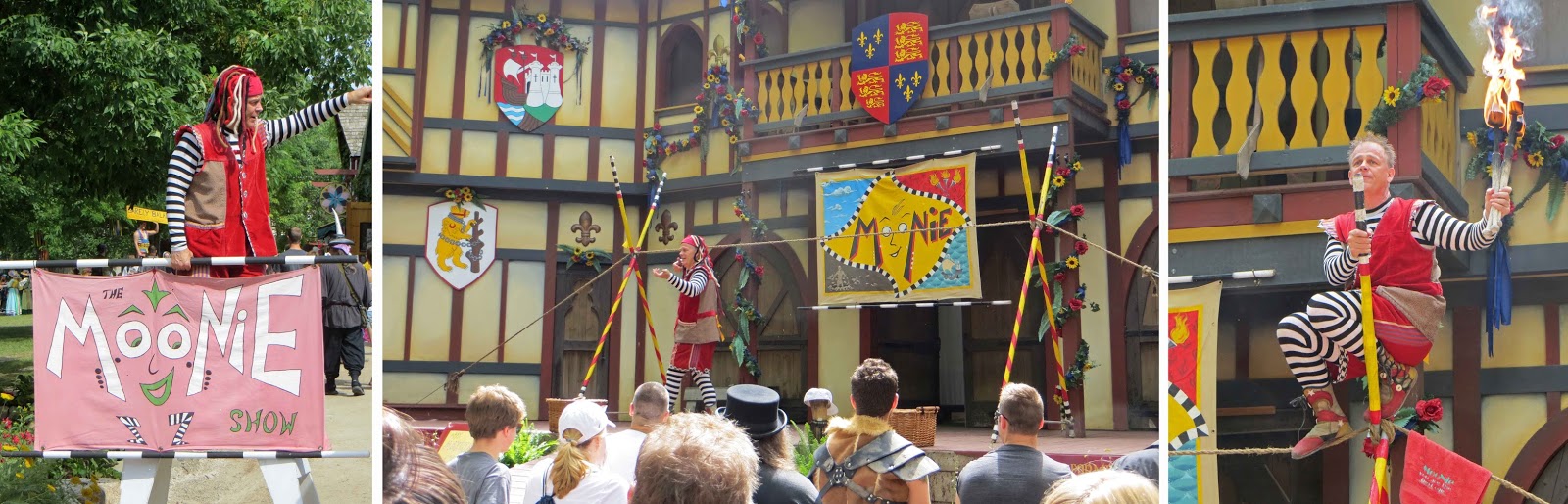
Moonie was our first show of the day – a silent clown / rope walker / juggler. He was hilarious, possibly more than usual because the ‘assistant’ he chose from the audience was really dumb and Moonie was able to play on that. I don’t think the assistant was a plant as his girlfriend seemed genuinely embarrassed and kept calling out, telling him what he should be doing!


And there was singing …


Barely Balanced: they may look just like two guys and a girl on stilts …

But, wait, there’s more. Large, Medium and Small, as they call themselves, were the best acrobats and jugglers I’ve ever seen! Their strength and skills were astounding, especially as they never did gymnastics at school and only became performers as adults. They presented two different shows so we made sure to watch both.


And there were fairies, silent, ethereal, gliding about amongst the trees, communing with flowers, constructing webs, assembling tiny piles of twigs, enchanting children young and old.


Did I mention the dressing up?


Adam Winrich, the Firewhip guy (above left), who pranced about in tights producing sonic booms with his whip, and Vegetable Justice (right), where you paid to get insulted then tried to hit the insulter with the vegetables you threw.


Some of the outlandish characters that were wandering about …


And let’s finish off a most delightful day with more singing …

If you ever get the chance, do go to the Faire. Make the effort to dress up and abandon yourself to the fun and frivolity. You won't regret it!