19 January 2011

A week of farewells

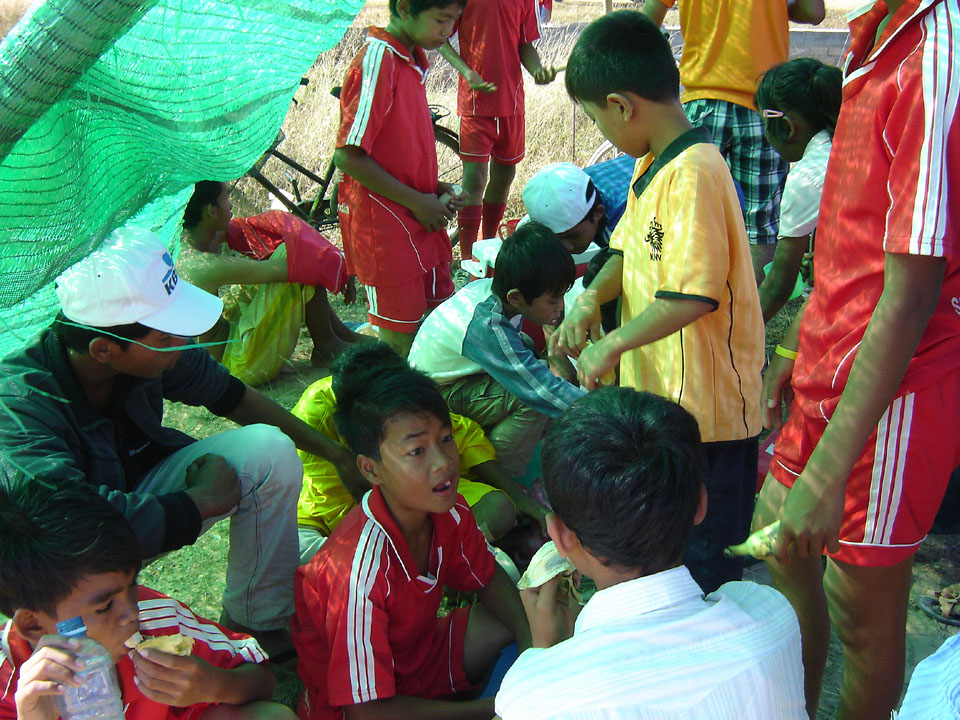
Sunday 9 January was the first day of the 2011 Globalteer Siem Reap Junior Soccer League season so M and I headed off at 9am to watch the Anjali Under 15s play their two matches. Although their first game was supposed to start at 9.30, it had, in fact, begun at 9 – ah, Cambodian time! – so we missed the first half. We cheered the boys on throughout the second half and during their later match against another team but, unfortunately, they lost both games 1 – 0. They are all very competitive so were looking quite disappointed as they climbed up onto the back of the truck that was their transport home.

Marianne and I headed into town to catch up with Rotha, the young woman who had been our waitress at the Globalteer restaurant last year but is now working at the Funky Monkey. It was lovely to see her again – and enjoy a long cold drink after the heat of the football field. After lunch, M headed for a relaxing couple of hours by the swimming pool while I retired to my room to rest. 

That night we had a farewell dinner with M’s Khmer family. What a great pleasure and privilege it had been to spend time with them and share their knowledge of Cambodian life. I have been invited back to attend Narong’s brother Soria’s wedding – he’s only just met his girlfriend so the wedding may be a while off yet, but I am delighted with the invitation. 

On Monday morning M and I said a tearful farewell. We have become firm friends and I have very much enjoyed our time together. I’m not sure when we’ll meet again as I have no plans to go back to Cambodia in the near future, nor can I afford a holiday in the south of France, where she lives. But if the wish I made when she tied a friendship bracelet on my wrist comes true, we shall meet in some exotic place before too long.

My last week at Anjali went by far too quickly. In English lessons we finally started the text book and I taught some lessons alone as Billy the Khmer teacher was sick a couple of days. The kids worked hard and made good progress. We revised telling the time as well as vocab and verbs to describe their daily routines, so by the end of the week they were each able to give a talk about what they do every day.

In General Studies we covered healthy eating and the food pyramid, how not to eat too many fats and dairy products – actually, they eat no dairy here at all. Perhaps rural villagers milk their own cows, but the climate and lack of refrigeration means you can’t buy milk in shops and so there are also no dairy products, except those imported for tourists to eat. Still, the abundance of fresh fruit and vegetables means the children are mostly healthy, if small by Western standards. Thursday’s task was to pretend they were restaurant owners and design a healthy menu for their customers to enjoy.

Workshops were fun. A German woman, Brigitta, had arrived to teach theatre workshops twice a week to each level of students, so we learnt how to warm up our bodies, mime some simple actions, sing an animated song, and played various games like Chinese whispers. Courtenay had the great idea to carve cakes of soap into animals and faces (and use the shavings to make more soap, so nothing was wasted), and the other day the children coloured in detailed pictures of birds and faces, which they always seem to enjoy.
Thursday was my last day and quite sad. I thought I’d be fine but when I read the letters the children had written for me, and saw the little presents – a handmade bracelet, a lovely drawing –  I became quite emotional. And some of the girls were clinging to me like little limpets. It was very hard to walk away, especially as I have no immediate plans to return to Anjali. At least some of the older children and Khmer staff are friends on Facebook, so I can keep in touch in a small way.

I enjoyed a lovely dinner that night with a small group of volunteers, then we tried our luck at the Funky Monkey pub quiz. We only came 8th out of about 12 teams but, more importantly, the quiz raised another $159 for Grace House.

18 January 2011

Faces

As a keen amateur photographer, I am always drawn to photographing faces. They show us the full gamut of human emotions as well as reflecting a person’s life experiences and heritage.

Here I shall let the faces of Cambodia speak for themselves …


Templed out!


Another two days of templing – a verb invented specifically for Cambodia.

On 7 January, Victory over Genocide Day, our group of four barang and four Khmer set out early for the three-hour drive south. Marianne and I joined Marilyn and Marg from Grace House, together with Tola (who also volunteers at Grace House) and one of their teachers, Loung, plus a driver and our tour guide Noun, to explore yet another temple complex. This was Sambor Prei Kuk, a pre-Angkorian temple complex dating from the beginning of the 7th century, with some of the oldest structures in Cambodia amongst its 100 temples.

We were a merry band of travellers. Loung had brought along his English dictionary and kept asking questions: ‘What’s the difference between expensive and expansive?’, ‘What’s the difference between coast and beach?’, and ‘Can you embalm a fish?’. He was a good student! When I tested him on the journey home, he remembered everything we’d discussed. In return, he told us stories from Khmer culture … or were they? I do wonder whether he was inventing the stories just to amuse us. For example, do you know why the cashew seed grows outside the fruit, rather than within it as is more usual? Well, it seems the fruit went out to a party one night and got very drunk. When it finally made its way home, all the doors and windows were shut, so it had to sleep outside … and it’s been sleeping outside ever since.

After 30 minutes driving, we stopped for breakfast at a roadside restaurant. I was tempted to photograph the toilet facilities. There were 3 toilets, each with a sign in English above the doors: Toilet (male), Toilet (female), and Welcome. This didn’t confuse only me – a local man, who obviously couldn’t read English went into the female cubicle. I crossed my legs rather than tempt fate.

Our journey continued south on the main road to Phnom Penh. This is a busy highway and traffic is always chaotic. Officially there are road rules in Cambodia, but they seem to be more suggestions than rules. Vehicles drive on the right, but it’s not unusual to see traffic driving in four directions at once on the same piece of highway. The centre line seems also to be just a suggestion – perhaps it’s there to help the drivers steer straight. At one stage I was convinced there must be a mattress sale in the next village as we first passed a truck stacked high with mattresses and then two motorbikes, with three mattresses each strapped behind the driver. These were double-size mattresses, not single. I’m not sure how the moto drivers kept their balance.
At Kompong Thom, we turned off the main highway and continued for perhaps 20 minutes on a relatively good dirt road. But then we turned off again and the last 14km were on the best example of a dancing road I’d experienced in Cambodia. By the time we arrived at the temples, our van had developed an alarming knocking sound and we had decided a new road sign was required for this type of road – something like ‘Sports Bra Required’!

The temples of Sambor Prei Kuk are surrounded by jungle and have delicate carvings, much damaged by weathering. They are brick-built structures, rather than stone, and have impressive towers, many of which are threatening to fall apart at the seams. Various archaeological groups have added wooden support structures to stop their destruction. The name of the largest structure, Prasat Tao, means ‘Lion Temple’, hence the two large lions guarding its entrance.

The temples were almost deserted, though as soon as we arrived we attracted the usual group of Khmer sales-children, who accompanied us for the two hours we spent exploring. Their patience was amazing; I guess they knew that their perseverance almost always defeats barang tourists. As we wandered, tiny voices would pipe up: ‘Octagonal temple. Eight-sided’, and ‘Careful the stones’, and ‘Bomb crater’ – these temples had been bombed by the Americans. At the end of our tour, we lined the girls up and bought one scarf from each of them to share the day’s sales evenly between them. None of us needed yet another scarf; it was more like a donation towards their education. Noun also gave an elderly local man a small payment for sharing his knowledge with us. It was yet another great day (and we had just enough energy to go to Rosy’s pub quiz that night – the proceeds of the quiz went to Grace House, so we couldn’t possibly not go.)


Slaves to culture, or suckers for punishment, Marianne and I spent the following day templing as well. To be honest, it was as much for the tuk tuking, which we both adore, but each temple is so different that we couldn’t resist exploring another six – yes, six! With Vibol as our driver, we set off at 8.30.

First were three temples in the Angkor Wat area, East Mebon, Ta Som and Banteay Samre. East Mebon is like a temple mountain, though its moat is now dry. It has impressive elephant statues at each corner and was ‘silent except for the distant chatter of Koreans’ (Marianne’s words). I circled the complex while Marianne climbed up, and yet again I was sought out by a young female salesgirl. She had an amusing sales technique; when I said I didn’t want one of whatever she was selling, she replied ‘Well, buy two then’. I managed not to!

Next came Ta Som, which has beautiful Bayon-style faces and a huge, strangling tree above its gates. Intriguingly, a Korean girl asked to take our photo posed amongst the ruins – we still don’t know why. We had an early lunch (of spring rolls again) before heading down a quiet country road to Banteay Samre, an isolated and so sparsely touristed temple. It was very beautiful but very hot, so the cooling interiors of the shrines and galleries were very welcoming.

From there, we set off across country to the temples of the Roulos group. Lolei is very ruined, with five towers that are now surrounded by rural village buildings and a pagoda. Preah Ko is quite a small complex, with six towers and three impressive kneeling bull sculptures sitting patiently in a row out front. They give the temple its modern name of ‘The Sacred Bull’. Its brick towers have been partially rebuilt so you could easily see the contrast between their construction materials of small pink bricks and large grey slabs of stone. And last, but certainly not least, was Bakong, a five-tier pyramid-type structure, surrounded by a walled enclosure, which is in turn surrounded by a water-filled moat. The countryside round about is very lush and the temple complex includes a range of interesting shrines, gopuras and galleries.


It was an impressive end to my Cambodian temple explorations but I confess to being exhausted by the end of the day and, though I hate to admit it, after exploring 12 temples in just 17 days, I was templed out!