Showing posts with label clock. Show all posts

15 February 2026

Cardiff Bay: Willows clock

I imagine very few people even notice this modern-looking clock, designed by Andrew Hazell in 2000, as they shop or dine in the retail outlets and eateries beneath the small roof-top tower in which it sits, in Cardiff Bay’s Mermaid Quay.

As the clock is inaccessible, passers-by would neither be able to see the clock properly nor read what is written around the two faces: ‘E T Willows Pioneer Aeronaut 1886 1926’, though the 2 in 1926 seems to have fallen off the western face of the clock.


The clock celebrates the life and achievements of one of Cardiff’s lesser known inhabitants, Ernest Thompson Willows (1886 – 1926), and the two faces of the clock were apparently intended to represent Cardiff and London, a nod to Willows’ historic airship flight between the two cities in August 1910. (You may notice, in the photo below, that the times shown on the two faces are different; there is no time difference between Cardiff and London, of course, so I presume this is a fault in one of the clocks. My clock photos were taken some years apart.)


There is an excellent biography of Ernest Willows on the Roath Local History Society website so I won't repeat his details here. Instead, I thought I'd use a couple of images from the Welsh newspapers of the time to highlight one of his most notable achievements, that 1910 airship flight to London. The caption for this first image, published in The Cardiff Times on 25 December 1909, reads: 'The Willows Airship Tests. The picture shows one of Mr Willows' flights, at Cardiff on Saturday. (Metropole studio, Cardiff.)'


And this second image, from the Evening Express and Evening Mail of 8 August 1910, documents

THE START OF MR. E. T. WILLOWS' RECORD FLIGHT.
(1) Mr. Willows ready to start. It will be seen that the young balloonist is wearing a lifebelt in case of a mishap whilst crossing the Bristol Channel. (2) The airship leaves the shed at 7.50 p.m. (3) Final examination of the motor and machinery. (4) The start. Mr. Willows heads for London.


You can read Roath Local History Society's biography to learn more of Willows' career but, suffice to say, his achievements were barely recognised during his lifetime and his short life was ended by an aerial accident; Willows and four others were killed when the basket beneath their balloon disintegrated and they plummeted to the ground.


Ernest Thompson Willows is buried in Cardiff's Cathays Cemetery; his grave is number 20 on the Cathays Cemetery Heritage Trail. As his headstone notes, Willows shares the plot with his infant daughter and his parents.


08 December 2019

London : clocking on


A couple of weeks ago I wrote about some of London’s more famous clocks; today, I have a mixture of the less well known and the downright quirky.  


First up is Southwark Cathedral, a building that also featured in my recent blog about gutter hoppers. There is a long history of religious buildings on this site, from a 12th-century Augustinian priory to a church dedicated to St Mary Overie, a later church named St Saviour’s and, from 1905, the building’s current status as an Anglican cathedral, with much construction and renovation, many restorations and additions along the way. I have found no information about when the clock was added but, if you’re in the area, don’t set your watch by it – the clock has been showing 12 o’clock for at least the last 10 years!


I find the combination of clock and sundial on Chelsea’s Old Church simply fascinating and, if you look carefully, you can see that both methods are telling the same time, though I assume that would change when the clock is adjusted for daylight saving during the summer months. As you might also notice in the photo, the original sundial was dated 1692 but was remade in 1957. This is because, on the night of 16-17 April 1941, the church was completely destroyed by German bombs. According to the A London Inheritance website, Old Church was made anew, a faithful reconstruction of the original, and ‘The building was reconsecrated by the Bishop of London in the presence of HM Queen Elizabeth the Queen Mother on 13 May 1958.’   


Now for something completely different. This is the Furniture and Arts Building, at 533 King’s Road in Chelsea. I have no information about the history of the building or its clock but, with that bright green paint job, it certainly does stand out in the urban landscape.     


Here’s another oddball, the clock on the World’s End Shop, at 430 King’s Road, Chelsea. We were on the opposite side of the road and my companions on this walk had gone inside a shop to check something out but I couldn’t take my eyes off the clock, the hands of which revolve constantly backwards at high speed on a face that has not 12 but 13 points. Apparently, the shop is owned by world famous fashion designer Vivienne Westwood and has a truly colourful history – you can see a pictorial history of the shop’s various incarnations on its website and read an article about it on the Fashion Pearls of Wisdom website here.  


Now back to something more traditional to finish, the clock on the National Audit Office building in Buckingham Palace Road. This stunning Art Deco building wasn’t always the National Audit Office: the Beauty of Transport website has the story:

... when it opened in 1939 this building was the Empire Terminal, headquarters and passenger check-in for Imperial Airways.

... A central clock tower of some 10 storeys is flanked by curved wings of five storeys, with pavilions at the ends.

... The Empire Terminal’s clock tower is still easily visible on the approach to Victoria station, and is sometimes confused with Victoria Coach Station by people who know only that they are looking for an Art Deco building in the vicinity.

05 November 2019

East Sussex : Clocking on


I’ve just returned from a brief visit with friends in East Sussex and in London so there’ll be a few blogs about some of the architectural features I noticed on my travels. The first of these concerns clocks.

I wondered why so many churches have clocks on their towers but, as a friend pointed out, in times past many people wouldn’t have had clocks or watches, so a clock in a prominent position provided a public service – and possibly helped ensure the congregation was on time for church services.


Hailsham: Parish Church
Hailsham Parish Church dates from the mid-fifteenth century but its clock was installed much later, to celebrate Queen Victoria’s Diamond Jubilee. The church’s website says ‘Until that time the tower had a single diamond shaped clock face which had the distinction of having only one hand, the intervals between the numerals being divided into four quarters instead of five minutes.’


Lewes: Dial House, 221 Cliffe High Street
Dated 1824 and restored in January 2009, this stunning metal sun dial carries the motto Nosce Teipsum, which translates as ‘Know thyself’. Though I don’t know the original purpose of this building, which was built in the mid-17th century, I did discover that it housed a Quaker School for young women a couple of years after the date of the sundial, in 1826. In 2019, the building is home to the local branch of Waterstone’s bookshop.  


Lewes: St Michael’s Church
According to the Sussex Parish Churches website, this grand clock dates from the 19th century. The clock is not attached to the church itself but projects on decorative cast-iron brackets from the neighbouring church hall.

Lewes: Trinity Church, Southover (below, left)
The Trinity Church website has an excellent guide to the history of this magnificent old church – unfortunately, the guide makes no mention of the clock on the tower.


Lewes: Market Tower (above, right)

Lewes’s Market Tower, a Grade-II listed building, was constructed from red and brown brick in 1792. The crest below the clock depicts the arms of Lewes.


Pevensey: St Nicolas Church
Though this Anglican church is old, completed in 1216, its clock is rather more modern. According to Wikipedia, the two-sided tower clock was manufactured by Smiths of Derby and installed in 1908.   


Bexhill: Clock Tower
Though intended as a memorial to the coronation of Edward VII in August 1902, this clock tower was not completed until two years later. Except for the garish colour scheme, it is a rather plain construction of imitation Bath stone, with clock faces on all four sides. The Public Sculptures of Sussex website reports that the clock is not the original one.  

01 April 2014

Time waits for no man (or woman)

I feel a bit like I’ve been running on automatic over the last few months, idling but not moving forward. So, it seems appropriate on the first day of the new month to start moving forward again. After all, the clock is ticking!

University of Auckland clock tower


I must govern the clock, not be governed by it. ~ Golda Meir

One of the many former Auckland Railway Station clocks
 A watched clock never tells the time. ~ Welsh proverb

Auckland Art Gallery
Don't watch the clock; do what it does. Keep going. ~ Sam Levenson

On a building in Fort Street in Auckland
By putting forward the hands of the clock you shall not advance the hour. ~ Victor Hugo

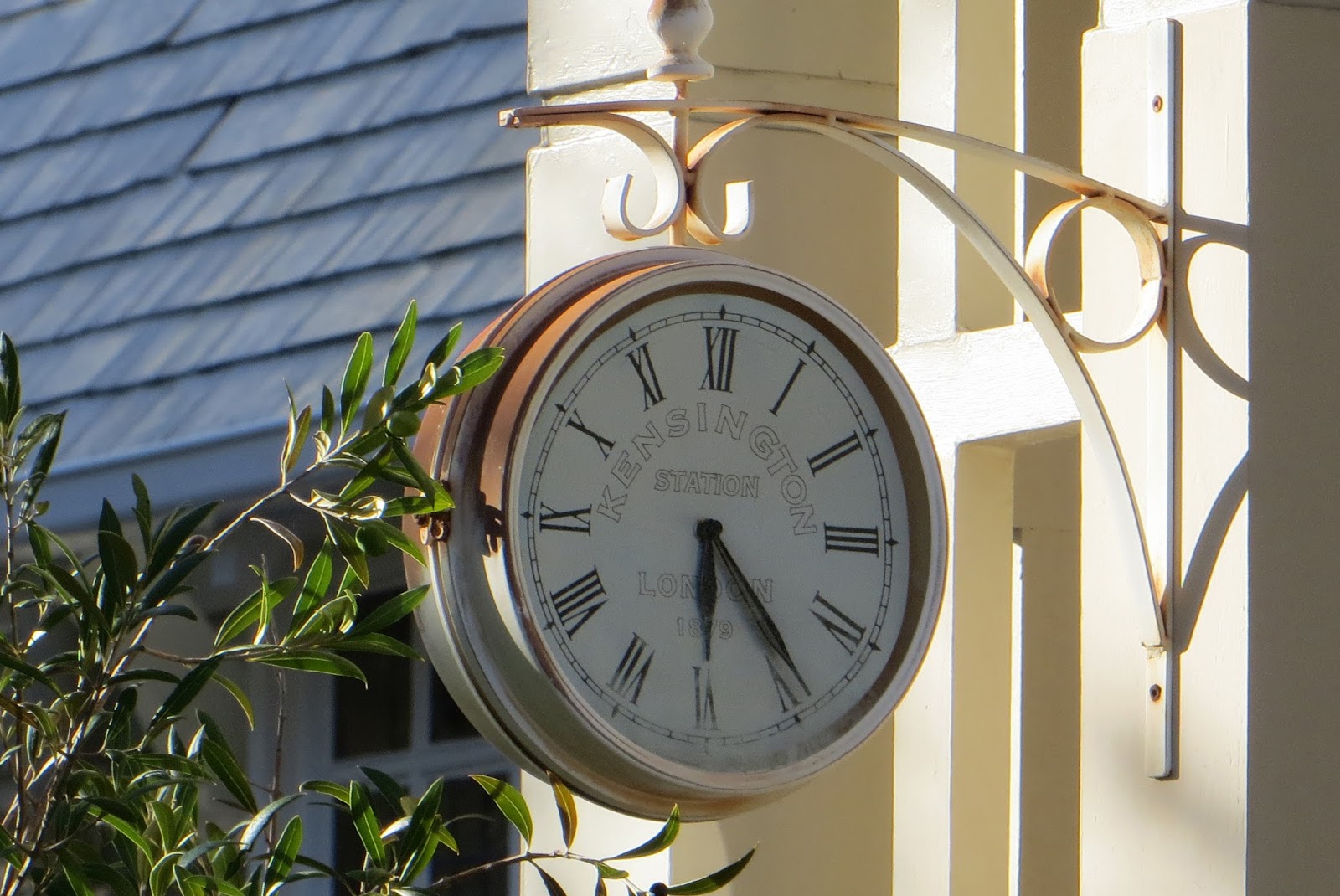
This clocks hangs outside a private house in a Parnell Street
Even a stopped clock is right twice a day. ~ Marie von Ebner-Eschenbach

Another of the many former Auckland Railway Station clocks
Even the most expensive clock still shows sixty minutes in every hour. ~ Jewish proverb

As the clock face reads, this one hangs outside a clock shop in Parnell
The mind of man is like a clock that is always running down, and requires to be constantly wound up. ~ William Hazlitt

The old Ponsonby Post Office

You never want to have that ticking clock and know that you had all this time and didn't use it. ~ J. J. Abrams

The old Chief Post Office, now Britomart Transport Centre

Clocks slay time … time is dead as long as it is being clicked off by little wheels; only when the clock stops does time come to life. ~ William Faulkner

A clock tower on an office block at Viaduct Harbour

“Stands the clock at ten to three? And is there honey still for tea?” ~ Rupert Brooke,The Old Vicarage, Grantchester

Over the entrance to the 1928 General Building in Shortland Street

The hours of folly are measured by the clock, but of wisdom no clock can measure. ~ William Blake

The New Zealand Guardian Trust building

Memory is life's clock. ~ Spanish proverb

Yet another of the former Auckland Railway Station clocks

No clock is more regular than the belly. ~ French Proverb

Auckland Town Hall clock