Showing posts with label Auckland. Show all posts

27 January 2017

Flashback Friday: Auckland, 2014

Happy Anniversary weekend to all my Auckland friends!

I hope the sun shines for you this long holiday weekend and you have as much fun as I did the last time I spent Anniversary weekend in Auckland in 2014. (For that story and those photos, click here.)


03 January 2016

2015: a life-changing year

I started 2015 in England, finished it in Wales, and in between there were New Zealand, the United States and Nicaragua – an interesting year, to say the least, and a life-changing one for me!


My lovely friend Sarah was kind enough to let me board with her during the six months I spent in Cheshire and we enjoyed some lovely days out together. This was one of them: a long walk beside the River Weaver to Dutton Locks, followed by lunch at a riverside pub. (You can see more photos here.)


My favourite thing about living in Wincham, in Cheshire, was the range of places I could easily walk to and I quickly developed some favourite circular routes that took me around lakes and alongside a canal, across fields and over streams, through woodlands and along a lime avenue. This long lime avenue was one of my favourite places, for the trees, for the daffodils in the springtime, for the way its character changed with the seasons. (Great Budworth’s lime avenue features in two blogs, this one about lime avenues and this photo blog showing the changing seasons.)


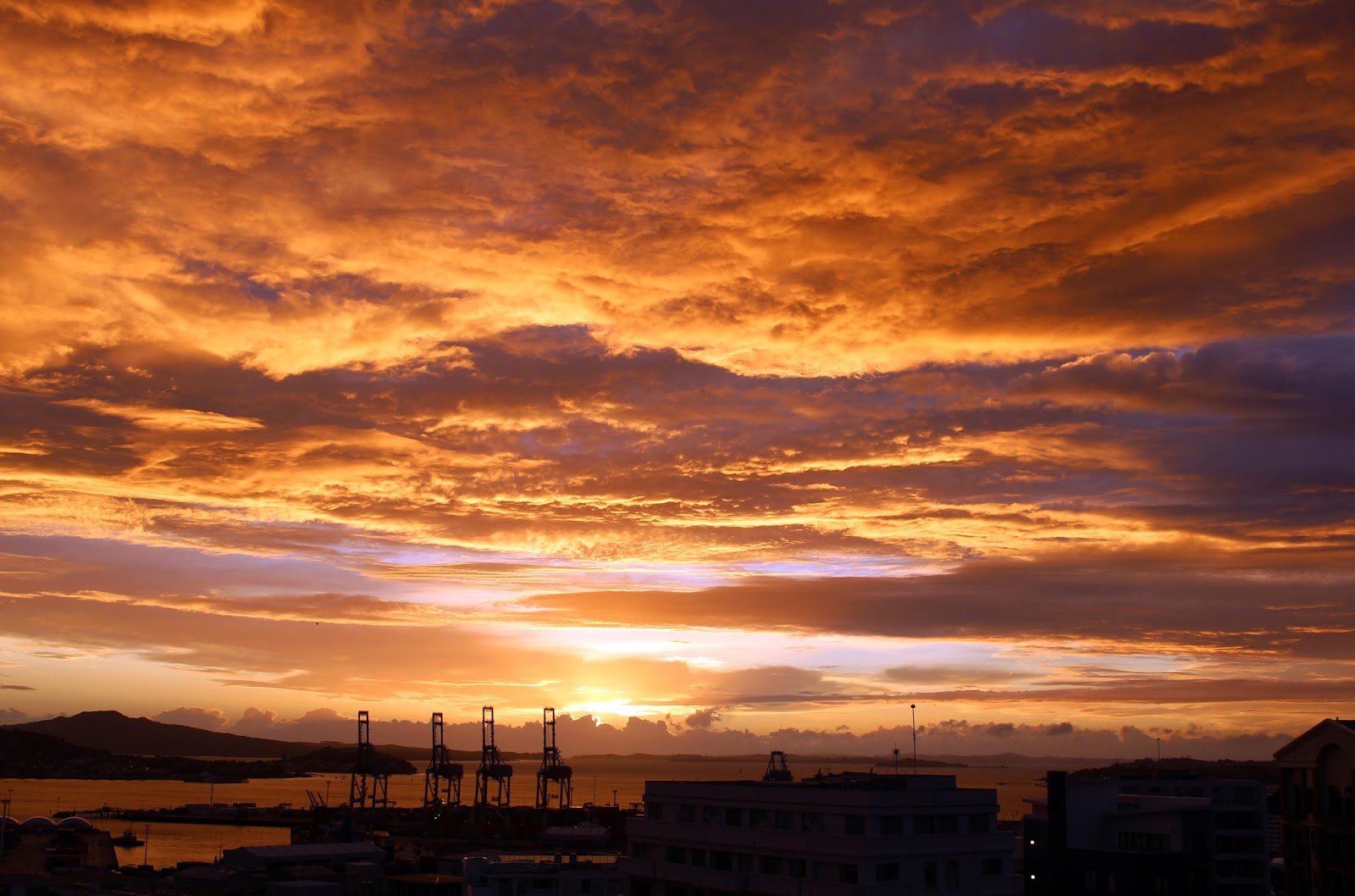
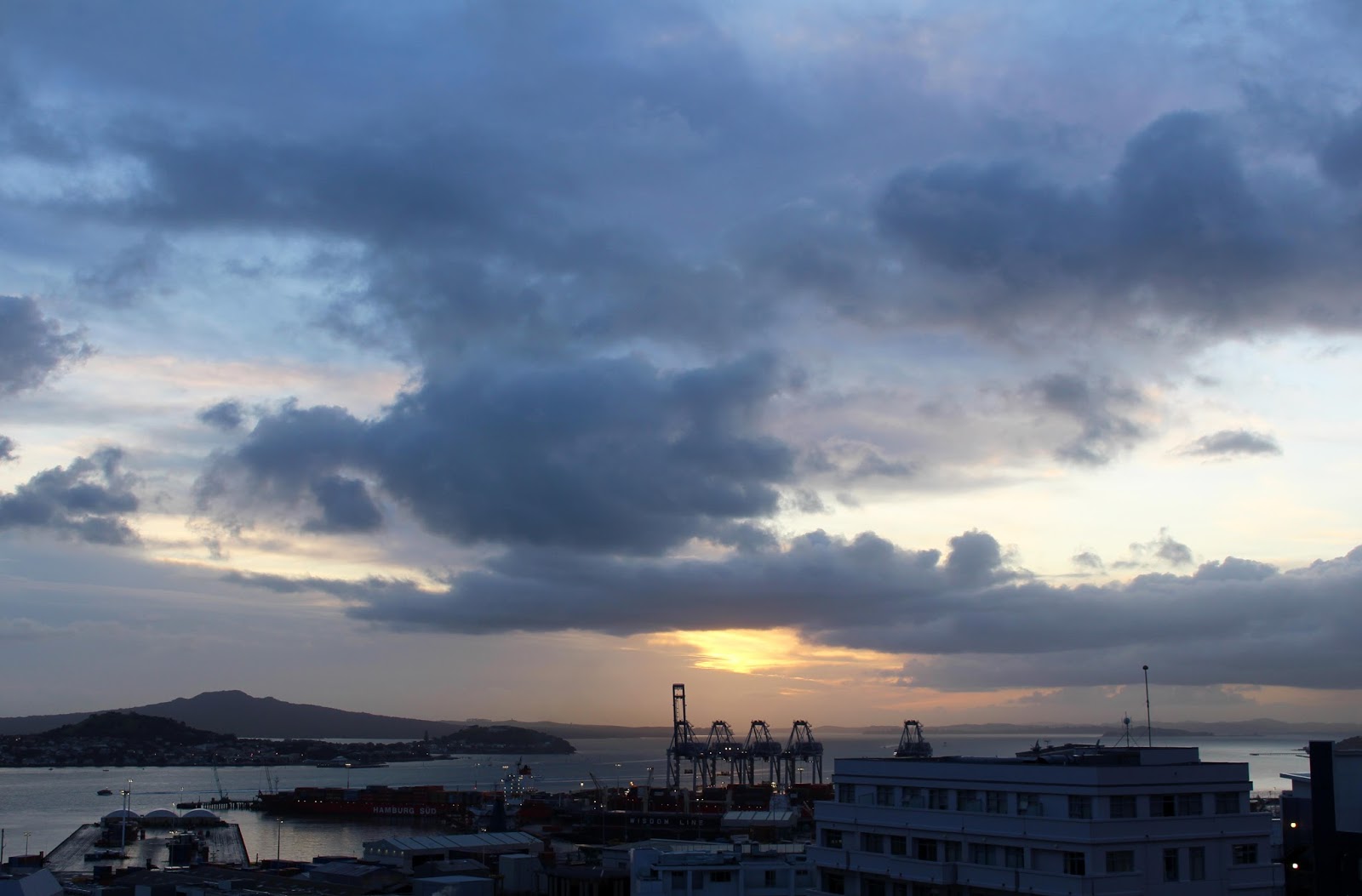
Once I had made the big decision to relocate to Britain, I headed back to New Zealand to sell my apartment,  pack up all my worldly possessions, and say goodbye to my fabulous friends and favourite places. One of the best things about my apartment in Auckland city was the view and I will never forget these amazing sunrises. (More of these stunning scenes here.)  


This is the quintessential Auckland to me, with the easily recognisable harbour bridge in the background, just a few of the huge wealth of boats lined up at Westhaven Marina, bright blue skies and a cabbage tree (Cordyline australis), albeit a cultivar, in the foreground. A walk around the harbour side and coastal beaches is always good value. (Here’s a walk I always enjoyed.)  


And so it was farewell Auckland, hello Wisconsin, for a far-too-short week-long visit with my wonderful friend Trudey and her equally wonderful husband Roy. And what an incredible week it was, with road trips across the state to visit family, to Washington Island with a group of Trudey’s lovely women friends, and a fun day out at the Bristol Renaissance Fair, plus many delightful hours spent watching these juvenile Bald Eagles. As I’m a keen birder, these were very special times for me.


Next stop, a three-day visit to Chicago, a city I’ve always wanted to visit. It was superb. I cruised on the river, walked miles, caught up with fellow photographer and internet friend Lauri … and so much more. I loved this amazing city. I must go back!


From Chicago to Granada, in Nicaragua, for a week of photography, in workshops organised by the great team at The Giving Lens, helping to mentor these incredibly talented young adults from Empowerment International, a charitable organisation that helps the impoverished children of Nicaragua achieve a better future for themselves. It was an unforgettable week of making new friends; enjoying beautiful scenery and amazing experiences; of learning and giving back; of laughter and smiles and tears. (You can see a selection of my photographs here.)   


When I arrived in Britain, I stopped over briefly in London – always a treat and always so much to see and explore. Though it was unplanned, this time I spent hours walking in London’s wonderful and enormous inner-city parks.


Cardiff is my new home, at least for now. It's a beautiful city, close to the sea, not far from the mountains in the Brecon Beacons National Park, and with amazing parks; it has a castle and is chock-a-block full of history; it has all the conveniences of big-city living yet has the friendliness of a small town. The photo shows Roath Park lake, just ten minutes’ walk from where I’m living.


In September I had a delightful visit back with Sarah in Cheshire, partly to catch up and partly to collect a suitcase full of winter woollies I had left with her. We had a couple of great days out, to the mighty Beeston Castle with its panoramic countryside views, and a day at the seaside at Formby Sands and Southport.


Back in Cardiff, I enjoyed the halcyon days of a long Indian summer and then the incredible beauty of autumn, with daily walks to enjoy the ever-changing colours of the beautiful British trees, dressed in their autumn finery.    


Discovering the good places to birdwatch in and around Cardiff has been great fun. The huge variety of birds here is a constant delight, and I seem to see something new every week, but it’s the charming little robin that is my particular favourite. That flash of red breast on a grey wintery day, its pretty little song, and its friendliness are a constant source of joy.

09 July 2015

Auckland walks: From the city to Mt Eden and back

Fancy a walk? Okay, then pull on those hiking shoes and grab some water ‘cause we’ll be pounding the pavements for about 9 kilometres and we’re going to head up a volcano so you might feel the heat.

At 196 metres, Mt Eden is the highest point in central Auckland so a great place for spectacular panoramic views over the city, its harbours and suburbs. And when we walk there, and back, from the central city, there’s a lot to see along the way, including a historic cemetery, two old churches, some street art, assorted historic buildings, significant places in Maori history, old villas and a huge park.

I’ve plotted our route on a map (just click on it to see it full screen) and numbered the points of interest along the way. These are just a few of the things that have caught my eye on past walks -- you will no doubt see other things that capture your interest and imagination.

1. A convenient place to start, and end, is at the corner of Symonds Street and Grafton Road, right in the centre of the University of Auckland’s huge complex of buildings. We could easily spend a whole afternoon exploring the university grounds … but that’s for another day. We’ll head up Symonds Street, past the towering blocks of student accommodation and offices and pause briefly for a look at Symonds Street cemetery. (For more on this fascinating place, check out my previous blog.) 


2. Church of the Holy Sepulchre
After a left turn at Khyber Pass Road, we find one of the historic highlights of our walk on the corner of Khyber Pass and Burleigh Street. The Church of the Holy Sepulchre dates from 1880 and is renowned for its wooden interior, one of the best in the world. Unfortunately, the only way to see that interior is to attend a Sunday service as the church is not open for public viewing.


3. Cityside Baptist Church
At the bottom of Burleigh Street, on the corner with Mt Eden Road, is another old church, not nearly so distinguished but with its own history and the most gorgeous little bell(-less) tower perched on top.


4. Snippets of Mt Eden history
After turning left along Boston Road, then right at Normanby Road, a glance to our right before we cross the railway line will bring a glimpse of some of Auckland’s street art, in this case the running squirrels of BMD. To our left is Mt Eden jail – not a place we want to enter – and further along Normanby Road, we find some historical links to Mt Eden’s past: the Colonial Ammunition Company's shot tower, the old bluestone building (now the CAC Bar & Eatery), and Normanby pub, to name a few.


The whau tree, from which this mountain takes its Maori name
5. Mt Eden
There are many paths up Mt Eden: sometimes I head up the dirt paths, sometimes I sweat up the steps old and new, sometimes I go up the roadway. It’s worth several visits to check the different routes as the trees and the views are all different. Maori named this volcanic cone Maungawhau (mountain of the whau tree), and archaeologists have discovered that as many as 3000 people lived on its slopes in the 1600s. We can still see the pits and depressions in the landscape, where kumara and taro would have been stored after harvest and houses would have nestled. And now we’re at the top, check out how deep the crater is. Impressive, eh? And look at the magnificent panoramic views – without a doubt, the best in Auckland.


6. Heading down
We’ll head back to the city by a different route. First, we veer off the road and down the steps bordering Government House. I used to think you might be able to get a sneak peek at visiting dignitaries from these steps but the trees are too tall and lush: many were planted as long ago as the 1870s.

We turn left at Mountain Road and our stroll takes us past some very lovely and very expensive real estate, some charming historic villas, past Mercy Hospital and a plethora of villas that now house medical specialists, and then alongside the splendid Spanish Mission-style buildings of Auckland Grammar School.  


7. Auckland Domain
After crossing Khyber Pass Road, we head up the appropriately named Park Road towards Auckland Domain. Today we’re just going to walk past the Duck Ponds and down the pohutukawa-lined Centennial Walkway but the Domain really deserves more time to explore. Check out some of its highlights in my earlier blog here

Once we exit the Domain, we simple head up the slope opposite, up Grafton Road, between the buildings, old and new, of the University of Auckland, and hey presto! we’re back where we started a few hours ago. I hope you enjoyed today’s walk.


05 July 2015

Auckland architecture: Let there be light

I’m a big fan of the architecture of the Art Deco era, which flourished around the world through the 1920s, ‘30s and ‘40s. There’s something about its combination of bold geometric shapes and exuberant ornamentation, and that blending of ‘Machine Age’ imagery and materials with more traditional craft motifs, that I find pleasing to the eye.

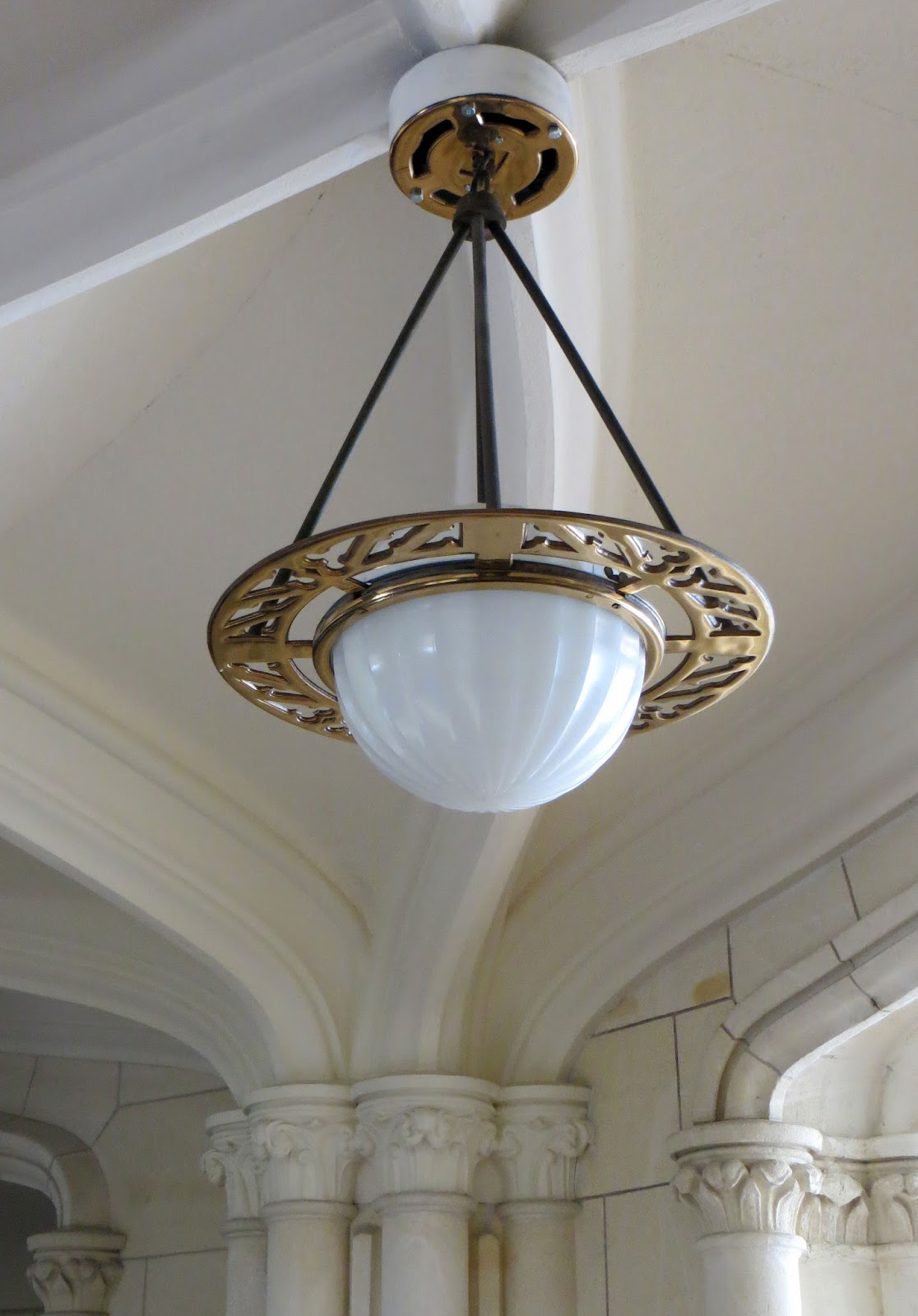
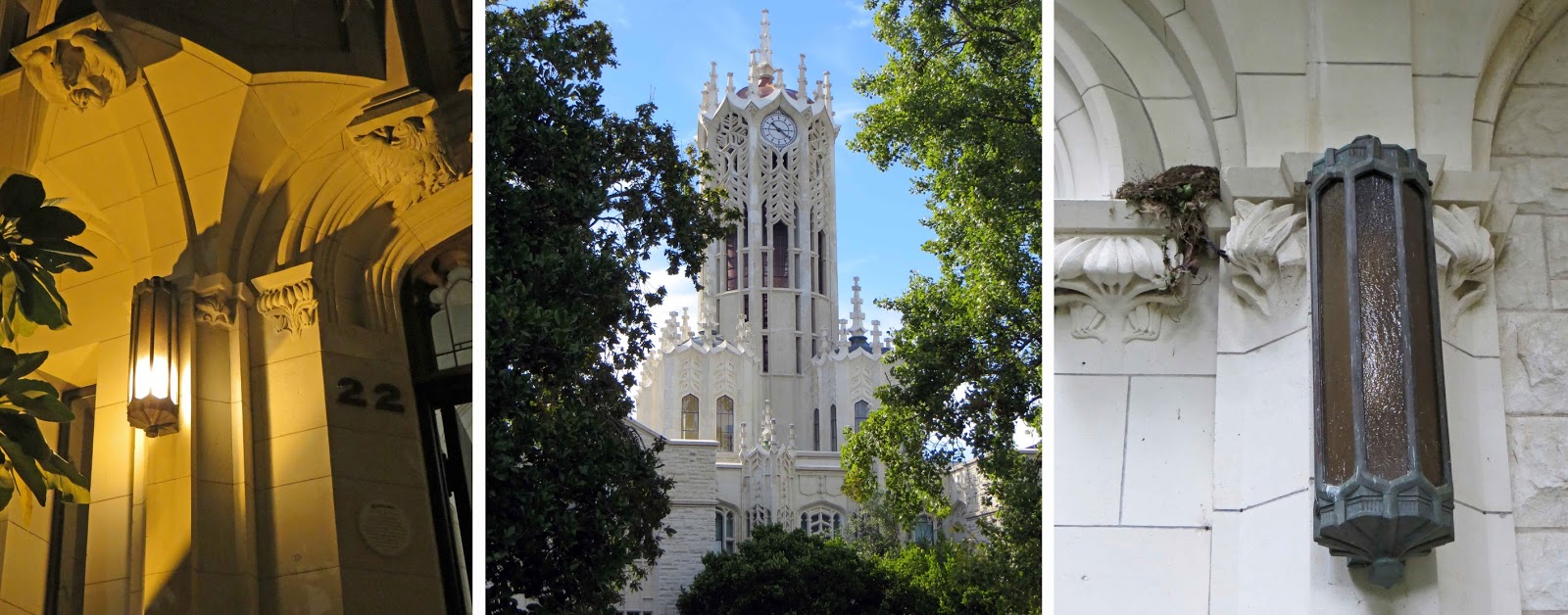
I like to focus on the minutiae of different architectural styles, in this case the lights, lamps and lanterns that adorn some of the Auckland’s Art Deco buildings and, during my wanders around the inner city, I’ve found some fabulous examples. And I’ve included one red herring to finish.


Former South British Insurance Building, Shortland Street, Auckland central
Is this magnificent or what? It's one of a pair, each about a metre tall, that flank the main entrance of the former South British Insurance Building, built in lower Shortland Street in 1927-28. 

Not surprisingly, this is a heritage-listed building, described thus on the Heritage New Zealand website:  

… a fine example of a 1920s 'Chicago-style' office block … Such high-rises marked a considerable shift in design and business organisation from the smaller, single-tenancy offices used in the mid to late nineteenth century. … [This] building was one of the tallest structures in Auckland, and of self-consciously 'modern' design. … Its interiors include some of the finest Art Deco ornamentation in the city centre, and it makes an important contribution to the urban streetscape.


Former Parnell Library, Parnell
The same man who designed the former South British Insurance Building – M. K. Draffin of Grierson, Aimer of Draffin – also designed the former Parnell Library building. 

A New Zealander by birth, Malcolm Draffin (1890-1964) completed his architectural apprenticeship in Auckland in 1910, served with the NZ Field Engineers in the First World War, then completed additional training at the Architectural Association School in London

As well as these two buildings, his design work also included the Auckland War Memorial Museum.  

In 1996, Parnell Library was relocated to larger premises in the Jubilee Building, and this building was sold into private ownership. 

It has subsequently, and very sympathetically, been turned into a private home, with business premises at street level and living accommodation above.


Courtville Apartments, Auckland central

These Art Deco beauties sit either side of the main entrance to the 1919 Courtville apartment block (also known as Corner Courtville because it’s located on the corner of Waterloo Quadrant and Parliament Street, to distinguish it from Middle Courtville, in Parliament Street).

This building was one of Auckland’s earliest high-rise apartment blocks and, according to the Heritage New Zealand website, ‘shows the influence of the architecture of Louis Sullivan and Frank Lloyd Wright of the Chicago School’.

It was one of several inner-city apartment blocks to be designed by Australian Arthur Sinclair O'Connor (c.1884-1943), who came to New Zealand about 1908.


Westminster Court, Auckland central
Once again we have links between the apartment block this light adorns and the previous one. Not only is Westminster Court just along Parliament Street from Courtville but they were also designed by the same man, though this building is more recent, having been designed by A. Sinclair O’Connor in 1934. 

It’s an eight-storey block, originally contained 50 apartments, and is still much sought-after by city dwellers. The building’s facilities include an indoor heated pool, a spa pool and a sauna, a games room and a barbecue area. 

As you might have guessed, apartments in this stylish building do not come cheap – here’s a recent sale.  


Old Arts or Clock Tower Building, University of Auckland, Auckland central
Despite its rather flamboyant design, this is one of my favourite Auckland buildings and it’s also one of the most recognisable. 

Nowadays, the Clock Tower you can see in my photo (above) is symbolic of the University of Auckland but the building was controversial when first built in 1926, being described as ‘un-British and out of harmony with our national character’ – this, obviously, before New Zealand had really developed a character of its own! 

Once again we see the influence of Chicago style in an Auckland building, as it was designed by Chicago-trained architect Roy Lippincott. Considering the rest of the building, the external lights are really very restrained but the internal light (left) has a little more flair.


Grey Lynn Library, Grey Lynn
To another library building now, and this one still functions as a library and is very much the central hub of the Grey Lynn community. Designed by notable Auckland architect William Henry Gummer (1885-1966), the library opened on 13 December 1924, it cost £8,534 to construct and included a reading room, a lending department, a lecture hall and a committee room. Although the building itself is described as Georgian-style, those lamps look very Art Deco to me.


Ports of Auckland Red Fence, Auckland central
And we finish with that red herring I mentioned: one of the lamps from the magnificent red-painted wrought iron fence that separates Auckland’s wharves from neighbouring Quay Street. The Red Fence, its wonderfully ornamental gates and lamp stands were constructed in stages between 1913 and 1923, partly by Manchester-based company G. Wragge Ltd, and partly by James Allen Sen & Son Ltd, of Elmbank Foundry, in Glasgow. There were originally 25 of these wonderful lamps – I haven’t counted to see if they all still remain, as some parts of the original fence were removed when modern buildings were constructed on Princes Wharf. 

These lamps may be a little early to count as Art Deco but, with those splendid lions and heads (of Neptune / Poseidon?), they are such impressive statements of power, strength and authority that I just had to include them.

02 July 2015

Auckland walks: Discovering lichen in Cornwall Park

One of the recent free guided walks around Cornwall Park covered the fascinating topic of lichen, a subject I knew next to nothing about – and still don’t! But I did learn a few interesting snippets from our most knowledgeable guide, Dr Dan Blanchon, a lecturer at Unitec and New Zealand’s only lichenologist.  


The basalt rock of Cornwall Park’s ancient lava flows provides a good environment for lichen so the park is rich in species and plentiful in examples. Lichens actually help to erode the rock they live on but this happens so very slowly that any change to the rock would only be noticeable over hundreds, if not thousands of years. Also, for those of you who have lichen living on their garden trees, the lichen won’t kill the trees – they are, apparently, a sign of the tree’s decline.

Some lichens also live on metal, as you can see on this drainage grate. I thought Dan said this was called the ‘sexy path’ lichen, but perhaps I mis-heard (imagined?) that as I can’t find that name anywhere. I do recall though that he said this particular lichen has a chemical in it that has Viagra-like properties.

Lichens seem to contain quite a diverse range of chemicals, which is one excellent reason for studying them. The lichens themselves use chemicals (and smothering) to try to kill each other – lichen warfare, who knew? Many lichens contains chemicals that are used in dyes – there is, for example, one particular lichen in Thailand that is cultivated specifically for the pretty pinkish purple dye it produces. Some lichens are used in the manufacture of sunscreens as they contain chemicals that protect against UV-B irradiation, and others have anti-fungal and anti-biotic properties. One example of this was the Old Man’s Beard we saw growing on a kauri tree. Several of the different varieties of Old Man’s Beard (Usnea) contain antibiotics, something recognised by indigenous cultures around the world – American Indians used a local variety to bind wounds and, here in New Zealand, Maori also realised the lichen’s special properties, naming it angiangi. (It is still used in a herbal dietary supplement, according to the Kiwi Herbs website.)

Don’t go nibbling on the next lichen you see though. Lichens are mostly indigestible, though reindeer and caribou are known to eat some lichens in the harsh conditions of a northern winter when there is little other food available.

A lichen is a complicated beastie – it is not actually one single organism but rather a fungus living in a symbiotic relationship with a photosynthetic partner, which might be a green alga or a cyanobacterium or both. The fungus is the farmer and the alga and/or bacterium produce/s the food it survives on.


Lichens don’t grow near soil – the nutrients in the soil are too rich and kill the lichen, which is why you don’t usually see lichens growing on the lower parts of walls, as soil nutrients get splashed up on to the wall surface during rainfall. Some lichens are sensitive to the nutrients in urine, so are killed by dogs peeing on walls and the bases of trees. Lichens are also highly sensitive to air pollution so will not grow in polluted places. If you see lots of lichens growing on the trees, rocks, etc., in your area, take it as a sign of clean air.

As you see, no lichens are growing on the lower portion of this wall

If you get the opportunity to look at lichens under a microscope, you’ll be amazed to find they are teeming with life: tiny mites, snails, and weevils are just some of the little creatures you’ll see. And, because of these micro-organisms, lichens are also beneficial to other creatures, like the birds that eat all those little bugs, so try to resist the temptation to kill the lichen you find growing on the rocks and trees around your home and garden.


Although we were told the names of many of the lichens we discovered during our two-hour wander around Cornwall Park, I’m not going to include the names here for fear of wrongly identifying the lichens in my photos. Suffice to say, New Zealand has an exceptionally rich lichen flora, with over 2000 species already named and probably twice that number still to be discovered, categorised and named. Considering the potential benefits to humankind of the chemicals in lichens, I think this country needs more than one lichenologist!

If you want to discover more about these incredible organisms, our guide recommended Allison Knight’s Lichens of New Zealand: An Introductory Illustrated Guide, published by the Botanical Society of Otago and available as a pdf download.  


27 June 2015

Morning glory: the sun rises over Auckland

Sunrise, sunup, dawn, daybreak, cockcrow, first light, the crack of dawn, aurora, the dawning … as usual, the English language uses several different words and phrases to describe that time when the dark of night is replaced by the light of the day.

Whatever you prefer to label it, this is my favourite time of each and every day. It is a time of fresh promise and potential, a time of renewal and hope, a time of beautiful light.

Over the last couple of months, as I’ve been preparing to leave New Zealand for a new start in another country, I’ve been photographing the sunrise from the balcony of my 9th-floor apartment in central Auckland. Here are some of those images.


‘What breaks in daybreak? Is it the night? Is it the sun, cracked in two by the horizon like an egg, spilling out light?’ ~ Margaret Atwood


‘Morning glory is the best name, it always refreshes me to see it.’ ~ Henry David Thoreau


‘And even the sun / in dawn chorus sings, / a celestial melody to the earth / below.’ ~ Tjaden


‘When you arise in the morning, think of what a precious privilege it is to be alive - to breathe, to think, to enjoy, to love.’ ~ Marcus Aurelius


‘The breeze at dawn has secrets to tell you. Don’t go back to sleep.’ ~ Rumi


‘There's a sunrise and a sunset every single day, and they're absolutely free. Don't miss so many of them.’ ~ Jo Walton


‘It is well to be up before daybreak, for such habits contribute to health, wealth, and wisdom.’ ~ Aristotle


‘Even the darkest night will end and the sun will rise.’ ~ Victor Hugo, Les Misérables