Showing posts with label Wisconsin. Show all posts

03 January 2016

2015: a life-changing year

I started 2015 in England, finished it in Wales, and in between there were New Zealand, the United States and Nicaragua – an interesting year, to say the least, and a life-changing one for me!


My lovely friend Sarah was kind enough to let me board with her during the six months I spent in Cheshire and we enjoyed some lovely days out together. This was one of them: a long walk beside the River Weaver to Dutton Locks, followed by lunch at a riverside pub. (You can see more photos here.)


My favourite thing about living in Wincham, in Cheshire, was the range of places I could easily walk to and I quickly developed some favourite circular routes that took me around lakes and alongside a canal, across fields and over streams, through woodlands and along a lime avenue. This long lime avenue was one of my favourite places, for the trees, for the daffodils in the springtime, for the way its character changed with the seasons. (Great Budworth’s lime avenue features in two blogs, this one about lime avenues and this photo blog showing the changing seasons.)


Once I had made the big decision to relocate to Britain, I headed back to New Zealand to sell my apartment,  pack up all my worldly possessions, and say goodbye to my fabulous friends and favourite places. One of the best things about my apartment in Auckland city was the view and I will never forget these amazing sunrises. (More of these stunning scenes here.)  


This is the quintessential Auckland to me, with the easily recognisable harbour bridge in the background, just a few of the huge wealth of boats lined up at Westhaven Marina, bright blue skies and a cabbage tree (Cordyline australis), albeit a cultivar, in the foreground. A walk around the harbour side and coastal beaches is always good value. (Here’s a walk I always enjoyed.)  


And so it was farewell Auckland, hello Wisconsin, for a far-too-short week-long visit with my wonderful friend Trudey and her equally wonderful husband Roy. And what an incredible week it was, with road trips across the state to visit family, to Washington Island with a group of Trudey’s lovely women friends, and a fun day out at the Bristol Renaissance Fair, plus many delightful hours spent watching these juvenile Bald Eagles. As I’m a keen birder, these were very special times for me.


Next stop, a three-day visit to Chicago, a city I’ve always wanted to visit. It was superb. I cruised on the river, walked miles, caught up with fellow photographer and internet friend Lauri … and so much more. I loved this amazing city. I must go back!


From Chicago to Granada, in Nicaragua, for a week of photography, in workshops organised by the great team at The Giving Lens, helping to mentor these incredibly talented young adults from Empowerment International, a charitable organisation that helps the impoverished children of Nicaragua achieve a better future for themselves. It was an unforgettable week of making new friends; enjoying beautiful scenery and amazing experiences; of learning and giving back; of laughter and smiles and tears. (You can see a selection of my photographs here.)   


When I arrived in Britain, I stopped over briefly in London – always a treat and always so much to see and explore. Though it was unplanned, this time I spent hours walking in London’s wonderful and enormous inner-city parks.


Cardiff is my new home, at least for now. It's a beautiful city, close to the sea, not far from the mountains in the Brecon Beacons National Park, and with amazing parks; it has a castle and is chock-a-block full of history; it has all the conveniences of big-city living yet has the friendliness of a small town. The photo shows Roath Park lake, just ten minutes’ walk from where I’m living.


In September I had a delightful visit back with Sarah in Cheshire, partly to catch up and partly to collect a suitcase full of winter woollies I had left with her. We had a couple of great days out, to the mighty Beeston Castle with its panoramic countryside views, and a day at the seaside at Formby Sands and Southport.


Back in Cardiff, I enjoyed the halcyon days of a long Indian summer and then the incredible beauty of autumn, with daily walks to enjoy the ever-changing colours of the beautiful British trees, dressed in their autumn finery.    


Discovering the good places to birdwatch in and around Cardiff has been great fun. The huge variety of birds here is a constant delight, and I seem to see something new every week, but it’s the charming little robin that is my particular favourite. That flash of red breast on a grey wintery day, its pretty little song, and its friendliness are a constant source of joy.

21 August 2015

Wisconsin: Downtown Green Bay

My knowledge of American geography is hazy at best – after all, the USA is a huge country – but, when my friend Trudey invited me to visit her, even I had heard of Green Bay, Wisconsin, if only because it’s home to the Green Bay Packers football team.

Turns out Green Bay is also the county seat of Brown County, and sits right at the mouth of the Fox River, situated appropriately enough on Green Bay, an offshoot of the mighty Lake Michigan. It’s an industrial city, known for its meat-packing plants and paper mills and … that football team.

I didn’t spend a lot of time in downtown Green Bay during my visit but I did find a few architectural gems during a photo-wander one hot July afternoon.


Brown County Courthouse
Undoubtedly the most impressive building was the three-storey county courthouse, with its shining copper-clad dome. Designed by Charles E Bell and constructed between 1908 and 1911, this beautiful building was created in the classical-inspired Beaux Arts style that was popular prior to the First World War. I didn’t get to see the interior but, apparently, the artworks contained within the building are just as impressive as its architecture, with various murals depicting scenes from Wisconsin’s past and the interior of the dome painted with the themes of Justice, Agriculture, Industry and Commerce.


Jefferson Court
This Greek Revival-style building started its life back in 1903 as one of Andrew Carnegie’s libraries, though it was officially named the Kellogg Public Library because, although Carnegie donated the $45,000 required for its construction, Rufus B. Kellogg, president of the Kellogg National Bank, magnanimously agreed to fund the annual operating costs. An additional wing was added to the building in 1926 to house the Neville Public Museum, and the whole lot was restored during 1983-84 to become the Jefferson Court building, which now houses the United Stated District Court – Eastern District of Wisconsin.


Columbus Community Club
The Columbus Community Club was built in 1924, as a recreation and social centre, by the Knights of Columbus, now the world’s largest Catholic fraternal service organisation. The building is Neo-classical in design and cost at least half a million dollars to construct. The building has seen many uses during its long life: in 1941 the Knights of Columbus sold it to the Norbertine Order and it became the Green Bay Central Catholic High School. A decade later, the building changed hands again, with WBAY radio moving in, and it was from here, on 17 March 1953, that WBAY made the first Green Bay television broadcast.


Northern Building
This may look like a fairly bland exterior but look more closely at the architectural details. This 1930 office building is Art Deco at its finest, from its restrained clean straight lines to the superb highly stylised floriated frieze running along the top of its six-storey façade just below the parapet. And just look at those wall lights (below) – simply stunning.


St Willebrord Catholic Church
Designed in the High Victorian Gothic style and constructed in 1891, the St Willebrord Catholic Church was built to accommodate the large number of Dutch immigrants who had settled in Green Bay and wanted to form their own separate Dutch church. The main façade originally contained a single large stained-glass rose window but that was later filled with the large cut stone design you can see in the centre photo. The central cross is surrounded by eight large petals, which are in turn surrounded by eight large leaves to form one enormous flower. It’s a remarkable piece of masonry.


St Francis Xavier Cathedral
Not far from St Willebrord’s is the cathedral church of the Roman Catholic Diocese of Green Bay, St Francis Xavier. Built in 1876, with additions in 1903, 1917 and 1959, the style is Romanesque Revival. The twin steeples are particularly splendid, as is the decorative brickwork. Like the church of St Willebrord, this building also has a large circular window in the front façade, this one with a central rounded cruciform shape surrounded by eight large round windows.


Captains Walk Winery
Something entirely different now, just because it caught my eye as we were driving from one street to another. Though this is now a venue for educating the palate on the finer aspects of wine-tasting, it was originally built in 1857 as the private house of local businessman Elisha Morrow. This is apparently an ‘excellent late example of the transition that took place between the Greek Revivial style and the succeeding Italianate style’. Personally, I just liked that cute little cupola perched on top.


Green Bay Packers Memorial
No blog about Green Bay would be complete without some tribute to the Packers and here it is. This is the Packers Heritage Trail Plaza, the centrepiece of the heritage trail, a self-guided walking tour that leads you around the streets of Green Bay to discover where the history of the city intersects with the team and its players.    


If you’re a Green Bay local or a visitor with an interest in historic buildings and architecture, the Neville Public Museum is running an exhibition, from 16 April 2015 to 13 March 2016, to celebrate 100 years of architecture and design in Brown County


Most of the detail about the buildings shown above was extracted from the records of the Wisconsin Historical Society which has an exemplary website containing a wealth of information about the families and properties, culture and history of the state.


16 August 2015

Wisconsin: Downtown De Pere

During my recent short visit to Wisconsin I was staying with friends in De Pere, officially a suburb of Green Bay but a town with an interesting history and rich heritage. Native Americans had long been settled on this idyllic spot. by a series of shallow rapids on the Fox River, when the first European, Jean Nicolet, sailed his canoe here from Montreal in 1634, though modern De Pere didn't really begin to develop until around 1829, when one William Dickinson, anticipating the power potential of the river water, developed the De Pere Manufacturing Coy. That water is still being utilised today, by the huge paper mill that sits on the western river bank in the centre of town.

I was particularly fascinated by the nineteenth-century commercial buildings in downtown De Pere, in the streets surrounding Broadway on the eastern side of the river, and my friend Trudey and I spent a few hours one very hot July afternoon on a photowalk around this area.


According to the De Pere community website  

The South Broadway Historic District contains the most intact concentration of nineteenth century commercial buildings on the east side of the river. By 1882, small, mostly wooden commercial buildings lined the 100 and 200 blocks of N. and S. Broadway. On the night of April 23, a devastating fire destroyed all of the buildings on both sides of the 100 and 200 blocks of S. Broadway. Work on their replacements began almost as soon as the ashes were cold and by the end of the year, five of the District's six contributing buildings were ready for their first occupants. These consist of one and two-story cream brick-clad buildings that all face west onto the 100 block of South Broadway.

The unusual circumstances surrounding their construction can still be discerned by the way the facade of one building blends seamlessly with the one adjacent to it. Normally, buildings like these display clear dividing lines that show where one building ends and the other begins, but in this case, since almost all of these buildings were under construction at the same time and their builders were all using the same cream brick to build them, the results were buildings whose main facades have no visible edges.


As many buildings have subsequently been painted, this seamlessness is not as apparent as perhaps it once was, though you can see from the above images how well some of the buildings fit together.


Notice how wonky this building is - no straight lines here!

It’s the brickwork, in particular, that I admired. The patterns created by those inventive bricklayers are intricate and praiseworthy.

The Julius Krause Store Building (left) is one that was built after the 1882 fire destroyed the previous building on the site. Krause once operated a shoe store in the building but it now the superbly maintained premises of a local photographer.

Not all the buildings date from 1882. The C.A. Lawton building (below) dates from 1880. This firm of ‘Engineers & Patternmakers. Founders and Machinists’ has been ‘casting solutions since 1879’. 

Fortunately, the building was rescued from demolition in the 1990s and has since been converted into a 70-unit complex of apartments, lofts and townhouses. 

According to their website, ‘the original foundry building and subsequent additions follow the Astylistic Utilitarian industrial design of the late nineteenth and early twentieth centuries.’ It certainly looks like a nice place to live.


The J. Steckart & J. Falck double block (above) was constructed by Joseph LeClair in 1888, in the more elaborate High Victorian Italianate style, using both cream- and orange-coloured bricks to create the polychromatic appearance. Apparently, ‘Each of the two halves of the building originally contained two stores in the first story and five apartments in the second. John Steckart operated a meat market in one of the stores in his half, while Jacob Falck operated a saloon and liquor store in one of the stores in his half.’


The Robert McGeehan building (above) was also built in 1888 and shows the same two-colour brick decorating style in the façade as the Steckart and Falck block. It was particularly interesting looking at the side view of this building, where a careful inspection revealed the changes to the structure over the years, with various additions, alterations and repairs, and windows filled in. An architectural historian would have a field day examining a building like this.


The 1903 John Baeten Store harks back to the one-colour brick buildings built twenty years previously but has a lovely decorative garland frieze running along the top. I also liked the inset porch with its three entrance doors.


The other aspect of these buildings that fascinated Trudey and I was the ‘ghost signage’: the often faint traces of the advertisements for businesses that had previously operated within. But that’s a subject for another day, another blog. I’ve just added a couple of photos here (above and below) to show you what I mean.


14 August 2015

Wisconsin: Road trip to Washington Island

Karen, Karen, Sandy, Mary and Liz, along with my friend Trudey, are The Bridgettes, a fun group of women who play bridge, and enjoy events and excursions together. I was delighted to be invited along on one of their excursions, a road trip to Washington Island in Lake Michigan. What a hoot the day was! A day of constant smiles and laughter, of easy camaraderie, of shared fun, of beautiful scenery.

We all met up and climbed aboard Mary’s people carrier then, after first stopping for a delicious breakfast in Algoma, headed north into Door County. This narrow peninsula has 298 miles of coastline so is a Mecca for tourists and holidaymakers. During the summer months the population explodes from around 28,000 to as many as 250,000, with people flocking from cities like Milwaukee and Chicago to enjoy all the county has to offer, from sightseeing, swimming and hiking to fishing, kayaking and biking, to name just a few of the local attractions.

Here's comes the ferry 
Though it would’ve been tempting to linger along the peninsula, we were women on a mission, so headed straight to the car ferry at Northport for the 20-minute ferry crossing to Washington Island.

Five of The Bridgettes

Arriving on Washington Island
Once on the island, our first stop was at a local pub called Nelsen’s Hall, world famous as the home of the Bitters Club. It seems I was to be inducted! There were no intricate rituals, no fancy costumes, no special knowledge requirements – all you had to do was swig down a shot glass of Bitters in one go. Considering you would normally add just a drop or two of Bitters to a drink, that’s no mean feat, but I passed the entrance test with flying colours and have my Bitters Club membership card to prove it. And considering Bitters was originally developed as a patent medicine, full of aromatic herbs and other medicinal botanicals, it’s got to be good for you, right?

Induction complete!

That drinking is not the reason I am lying flat out on the ground in this next photo! After some of our group had followed up their Bitters with more flavoursome mojitos, we moved on from Nelsen’s Hall to the Fragrant Isle Lavender Farm and Shop so that the photographers amongst us could get some photos. We were a little disappointed to find just one field of lavender but it was still a pretty place to shoot.


Next stop was the picturesque Stavkirke, a replica of a stave church (a post-and-lintel wooden construction) in Borgund, Norway, accessed via a prayer path through the woods opposite the Trinity Evangelical Lutheran Church. The setting is very pretty and the building impressive, another perfect stop for photographs.


Trudey and I at the Stavkirke
Our last stop on the island (except for a refreshment stop for ice creams and sodas), was at another gorgeous spot, Schoolhouse Beach. It is named for the first island school built on this shore in the 1850s and is famous for its limestone pebbles. In years gone by, the stones were piled high, extending all along the shoreline and several yards into the cedar woods that edge the beach. ‘By ones and twos, by pocketful, purse full, by box full, trunk full or truckload, the limestone gems so beautiful to look at, so soothing to hold, are being taken from their natural environment,’ so reads the signboard. Nowadays, in an effort to preserve what little is left of this beautiful place, there’s a fine of $250 for removing a single stone from the beach – so, don’t!


We caught a late afternoon ferry back to the mainland and headed for one of the local cherry orchards, partly for photos and partly for a spot of shopping, for anyone who wanted, at the attached farm market. The geography and climate of Door County make it the perfect place to grow cherries and there are around 2500 acres of orchards. I can only imagine how stunning the orchards must look when full of blossom in the springtime.


By this time, tummies were rumbling so our last stop of the day was for dinner at Juniper’s Gin Joint in Fish Creek, before heading back, weary but content, to our starting point. It was such a delightful day out, an entertaining road trip with enchanting and highly amusing new friends. And I’d love to go back to Door County one day to see more of all it has to offer.

10 August 2015

Wisconsin: Bristol Renaissance Faire


Here’s what the Bristol Renaissance Faire’s website has to say about this extraordinary event:

Every Faire day recreates a time when knights were noble, maids were merry and turkey legs were titanic. Once you enter the portal gates, you travel back in time to the year 1574, and you've walked right into an exciting village festival day. … Revelry is the order of the day!
For 9 glorious weekends starting in early July, each Saturday and Sunday, plus Labor Day Monday, visitors take a rollicking romp through Elizabethan England, complete with 16th Century games, rides, arts, crafts, food, music and one-of-a-kind encounters with a spectacular cast of characters. The Faire boasts a beautiful 30-acre site with open-air stages featuring Swordfighters, Minstrels and Jesters. …
Nearly 200 artisans display their wares in the Bristol Faire Marketplace. Potters, glass blowers, jewelers and forgers busily go about their work, as shoppers discover rare finds around every corner. Offerings range from sterling silver jewelry, hand-thrown pottery and fine crafted leather works to hickory walking sticks, rich tapestries to hammered pewter.


Before we even got inside the gates it was apparent that the day was going to be anything but boring! One of the things I loved best about the Faire was the audience participation. From small children to the elderly, people came dressed up in the most amazing costumes. I’m not so sure all these weird and wonderful creatures would’ve roamed the streets of Elizabethan England but who cares? The idea was simply to have fun and be whoever you wanted to be.


Setting the scene ...


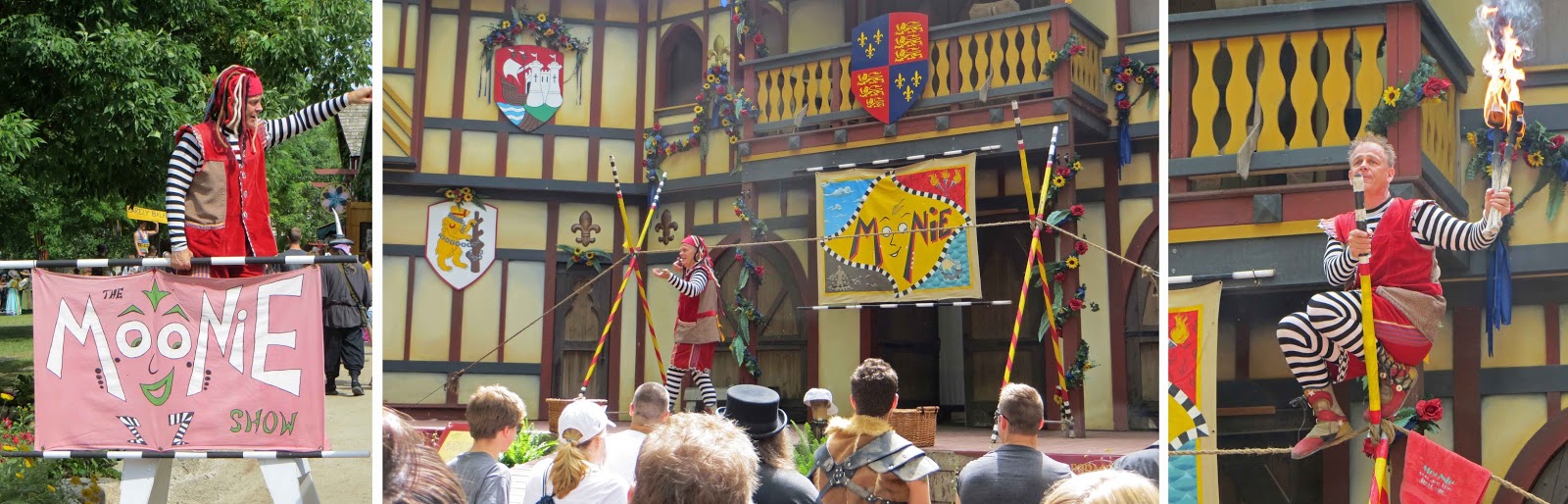
Moonie was our first show of the day – a silent clown / rope walker / juggler. He was hilarious, possibly more than usual because the ‘assistant’ he chose from the audience was really dumb and Moonie was able to play on that. I don’t think the assistant was a plant as his girlfriend seemed genuinely embarrassed and kept calling out, telling him what he should be doing!


And there was singing …


Barely Balanced: they may look just like two guys and a girl on stilts …

But, wait, there’s more. Large, Medium and Small, as they call themselves, were the best acrobats and jugglers I’ve ever seen! Their strength and skills were astounding, especially as they never did gymnastics at school and only became performers as adults. They presented two different shows so we made sure to watch both.


And there were fairies, silent, ethereal, gliding about amongst the trees, communing with flowers, constructing webs, assembling tiny piles of twigs, enchanting children young and old.


Did I mention the dressing up?


Adam Winrich, the Firewhip guy (above left), who pranced about in tights producing sonic booms with his whip, and Vegetable Justice (right), where you paid to get insulted then tried to hit the insulter with the vegetables you threw.


Some of the outlandish characters that were wandering about …


And let’s finish off a most delightful day with more singing …

If you ever get the chance, do go to the Faire. Make the effort to dress up and abandon yourself to the fun and frivolity. You won't regret it!