Showing posts with label Auckland Domain. Show all posts

09 July 2015

Auckland walks: From the city to Mt Eden and back

Fancy a walk? Okay, then pull on those hiking shoes and grab some water ‘cause we’ll be pounding the pavements for about 9 kilometres and we’re going to head up a volcano so you might feel the heat.

At 196 metres, Mt Eden is the highest point in central Auckland so a great place for spectacular panoramic views over the city, its harbours and suburbs. And when we walk there, and back, from the central city, there’s a lot to see along the way, including a historic cemetery, two old churches, some street art, assorted historic buildings, significant places in Maori history, old villas and a huge park.

I’ve plotted our route on a map (just click on it to see it full screen) and numbered the points of interest along the way. These are just a few of the things that have caught my eye on past walks -- you will no doubt see other things that capture your interest and imagination.

1. A convenient place to start, and end, is at the corner of Symonds Street and Grafton Road, right in the centre of the University of Auckland’s huge complex of buildings. We could easily spend a whole afternoon exploring the university grounds … but that’s for another day. We’ll head up Symonds Street, past the towering blocks of student accommodation and offices and pause briefly for a look at Symonds Street cemetery. (For more on this fascinating place, check out my previous blog.) 


2. Church of the Holy Sepulchre
After a left turn at Khyber Pass Road, we find one of the historic highlights of our walk on the corner of Khyber Pass and Burleigh Street. The Church of the Holy Sepulchre dates from 1880 and is renowned for its wooden interior, one of the best in the world. Unfortunately, the only way to see that interior is to attend a Sunday service as the church is not open for public viewing.


3. Cityside Baptist Church
At the bottom of Burleigh Street, on the corner with Mt Eden Road, is another old church, not nearly so distinguished but with its own history and the most gorgeous little bell(-less) tower perched on top.


4. Snippets of Mt Eden history
After turning left along Boston Road, then right at Normanby Road, a glance to our right before we cross the railway line will bring a glimpse of some of Auckland’s street art, in this case the running squirrels of BMD. To our left is Mt Eden jail – not a place we want to enter – and further along Normanby Road, we find some historical links to Mt Eden’s past: the Colonial Ammunition Company's shot tower, the old bluestone building (now the CAC Bar & Eatery), and Normanby pub, to name a few.


The whau tree, from which this mountain takes its Maori name
5. Mt Eden
There are many paths up Mt Eden: sometimes I head up the dirt paths, sometimes I sweat up the steps old and new, sometimes I go up the roadway. It’s worth several visits to check the different routes as the trees and the views are all different. Maori named this volcanic cone Maungawhau (mountain of the whau tree), and archaeologists have discovered that as many as 3000 people lived on its slopes in the 1600s. We can still see the pits and depressions in the landscape, where kumara and taro would have been stored after harvest and houses would have nestled. And now we’re at the top, check out how deep the crater is. Impressive, eh? And look at the magnificent panoramic views – without a doubt, the best in Auckland.


6. Heading down
We’ll head back to the city by a different route. First, we veer off the road and down the steps bordering Government House. I used to think you might be able to get a sneak peek at visiting dignitaries from these steps but the trees are too tall and lush: many were planted as long ago as the 1870s.

We turn left at Mountain Road and our stroll takes us past some very lovely and very expensive real estate, some charming historic villas, past Mercy Hospital and a plethora of villas that now house medical specialists, and then alongside the splendid Spanish Mission-style buildings of Auckland Grammar School.  


7. Auckland Domain
After crossing Khyber Pass Road, we head up the appropriately named Park Road towards Auckland Domain. Today we’re just going to walk past the Duck Ponds and down the pohutukawa-lined Centennial Walkway but the Domain really deserves more time to explore. Check out some of its highlights in my earlier blog here

Once we exit the Domain, we simple head up the slope opposite, up Grafton Road, between the buildings, old and new, of the University of Auckland, and hey presto! we’re back where we started a few hours ago. I hope you enjoyed today’s walk.


21 June 2015

Auckland trees: New Zealand’s first royal tree planting

Tree planting has been used for centuries to mark and celebrate both historical and royal occasions. In New Zealand, the first such occasion was in 1863, to celebrate the wedding of Albert Edward, the Prince of Wales, to Princess Alexandra of Denmark. Although the wedding took place at Windsor, in England, on 10 March 1863, the news of the happy event took a couple of months to reach New Zealand, and it was a further couple of months before the various local authorities decided how, if at all, to celebrate the occasion.

In the end, it was only in Christchurch that the royal wedding was marked in any formal way, with the planting, on 9 July 1863, of an oak tree, the very first tree to be planted in the park that went on to become the Botanic Gardens. The ‘Albert Edward oak’ still survives; the Notable Tree Register has photos and a map.

The first tree plantings by an actual member of the royal family took place during New Zealand’s first ever royal tour, in 1869, when Queen Victoria’s second son, Prince Alfred Ernest Albert (1844–1900), Duke of Edinburgh, came to visit. As Captain of the HMS Galatea, he first visited Wellington, then sailed on to Nelson, Christchurch, Dunedin and finally Auckland. Along the way, he was a prolific tree planter.

I don’t have any photos of the trees planted in Wellington or Christchurch but can pass on what the local newspapers of the time reported about Prince Alfred’s efforts. The report at left is from the Hawke's Bay Herald, 23 April 1869, page 3.

The common name for Abies Nordman is Nordmann or Caucasian fir, the Podocarpus totara is a New Zealand native that we simply call totara, the Cedrus pensilis is no longer recognised in the taxonomy of trees but must have been some kind of cedar, and the Arancaria excelsa is mis-spelt; it should be Araucaria excelsa or Araucaria heterophylla, the Norfolk Island pine. 

The Duke of Edinburgh was also an energetic tree planter during his visit to Christchurch. The Press (on 26 April 1869, page 2) reported that ‘On Saturday His Royal Highness Prince Alfred, attended by His Excellency the Governor, His Honor the Superintendent, several officers of the Galatea and Blanche, and other members of the Royal Suite, visited the Government Domain.’

As you can see from the report (at left), this time the Duke planted an oak tree, a Wellingtonia gigantea, which we now know as a Sequoiadendron giganteum or Giant redwood, a totara, a deodara (also known as a Cedrus deodara or Deodar cedar), and a Cedar of Lebanon (Cedrus libani).

Next stop on his New Zealand tour was Auckland and here I can show you photographs of HRH’s trees, as most have survived and, indeed, thrived. The Prince obviously had green fingers!

The first planting took place on 18 May 1869, as reported by the New Zealand Herald (19 May 1869, page 3):

The Giant Redwood
Yesterday afternoon, at about half-past two, his Royal Highness the Duke of Edinburgh, accompanied by Sir George and Lady Bowen, planted two Norfolk Island pines and a Wellingtonia Gigantea [Sequoiadendron giganteum or Giant redwood] on the lawn in front of the Government House [now known as Old Government House, in the grounds of the University of Auckland]. The spots were well selected, so as not to interfere with any view from the house when the trees are more fully grown, and will, we should hope, be respected and allowed to remain in their present position by the fortunate individual or corporate body that may eventually become possessed of the property, as, no doubt, the Southern members of the Assembly, doubting the necessity of a Government House and grounds in this province, will be of opinion that they should be sold for the benefit of the colony generally. After his return from the Kawau His Royal Highness intends to plant some two or three more trees in the Domain and in the grounds of the Auckland Acclimatization Society, and a Ponga (the male New Zealand fern tree), in the grounds at Government House.

Though there are several Norfolk pines planted at Old Government House, only one has a plaque saying it was planted by Prince Alfred (and that mis-reports the planting date as 14 May 1869), so I’m not sure if the second tree is one of the others or if it has not survived.

The enormous Norfolk pine Prince Alfred planted at Old Government House

A week after his first tree planting efforts, the Prince was at it again, this time in Auckland Domain. Here’s the article from the Daily Southern Cross, (27 May 1869, page 3):

ACCLIMATISATION SOCIETY. PLANTING OF TREES BY H.R.H. THE DUKE OF EDINBURGH.
Yesterday morning the committee of the Acclimatisation Society received an intimation from his Royal Highness that he would visit the Domain, and attend at their gardens at half-past eleven to plant the four trees which had been selected to stand in that delightful place of recreation as memorials of his visit.
As it had been determined that the operation should be performed in an unostentatious and private manner, very few of the citizens were enabled to be present, and those fortunate exceptions who witnessed the ceremony were merely such as had been accidentally strolling about the grounds at the time.

HRH's oak tree

Shortly before noon his Royal Highness, accompanied by his Excellency the Governor, Captain Pitt, A.D.C, Major Hamley, and escorted by H.R.H.'s orderlies, cantered up to the gate [how amazing to canter about the city!], where the party was received by the Hon. F. D. Fenton, on the part of the Domain Board; Captain Hutton, President of the Acclimatisation Society and Messrs J. T. Mackelvie, D. L. Murdoch, W. Morrin, members of Council. These gentlemen, with Mr. Brighten, the energetic curator, accompanied the Prince through the garden.
After viewing the various specimens of natural history confined in the cages {there used to be a small zoo in the Domain], and commenting favourably on the aspect of the gardens, which the Prince said he thought were in a most creditable condition considering the short period which he had been given to understand had elapsed since their first formation, H.R.H. proceeded to discharge the self-imposed task.
The trees, which were fine healthy young plants, comprised a specimen of each of the varieties Dammara robusta [Queensland Kauri], Araucaria Cookii [Captain Cook’s Pine], Araucaria glauca [also known as Araucaria cunninghamii or Hoop pine], and though last not least, a tall symmetrical plant of English Oak. The spades employed were the common ones in daily use in the garden, and his Royal Highness in handling them showed the result of some practice in the horticultural art. Mr. Brighton held the tree upright while the Prince shovelled the earth about the roots.

I love how the reporter almost sounds surprised that Prince Alfred used ‘common’ spades – no gold-plated spades for this prince, and I have to admire a royal who didn’t mind getting stuck in and getting his hands dirty. One hundred and forty-six years later, we continue to enjoy the fruits of his labours. Long live the royal tree-planting tradition!

At left, the Captain Cook's pine and Hoop pine and, at right, the Queensland kauri


26 December 2013

Auckland walks: The Domain

Auckland Domain is the city's oldest park (established in 1845) and one of my favourite places. Its 80-odd hectares are where I walk most days and they are never boring. The atmosphere of the grounds changes with the weather – it can be quite eerie under a layer of fog in the winter and it can be swelteringly hot for a game of cricket in the summer.

The grandstand was built in 1898 and is still well used today.

It actually sits right on top of one of Auckland’s older volcanoes – the Auckland War Memorial Museum is built on one side of the crater rim, Auckland Hospital is on the opposite side. The duck ponds are one of the products of the volcano – they are natural freshwater springs, from groundwater that pools in the lava fractures and the scoria that fills the ancient crater. More information about the geology of the area can be found in Auckland University Press’s publication Volcanoes of Auckland.

Maori named the scoria cone of the volcano Pukekaroro or Pukekaroa (‘hill of the black-backed gull’) and the remnants of a former Maori pa can be seen on its flanks. It is topped by a totara tree planted by Princess Te Puea Herangi, which is surrounded by a manuka palisade with traditional Maori carvings. The remains of an early scoria quarry on the north side of the cone are now a lush fernery garden, behind the massive glasshouses of the Wintergardens.

Pukekaroro (or Pukekaroa) hill

But enough from me … you can read more about the diverse facilities of the Domain on the Auckland City Council website or, even better, explore the extensive grounds for yourself. Take a stroll along the bush walks and lanes or enjoy one of the many festivals held in the natural amphi-theatre of the volcanic crater (like ‘Christmas in the Park’), take advantage of the high location to fly a kite or relax to the sounds of a jazz band in the band rotunda on a summer Sunday afternoon, be delighted by the splendid displays of the colourful garden beds or take tea in the Kiosk alongside the duck ponds. 

During my many wanderings, I have photographed some of the places marked on this map from one of the park’s signboards. I hope they tempt you to enjoy the Domain for yourself.

#1 this athletic-looking bronze, by New Zealand sculptor Richard Goss, adorns
one of the Elliot Memorial entrance gates to the Auckland Domain 


#2 the fernery in the old scoria quarry
#4 the cool glasshouse at the Wintergardens
Left, #5 the flock of geese who live in the duck ponds and, right, #7 the band rotunda
#8 the Auckland War Memorial Museum beneath this morning's stormy skies
#9 the Cenotaph sits in an area of consecrated ground in front of the museum
#11 the formal gardens are colourful year round, with permanent beds and seasonal plantings
#15 the totara grove
Left, #16 the Valkyrie Fountain and, right, #17 the Robert Burns Memorial
#19 the Cain and Abel statue
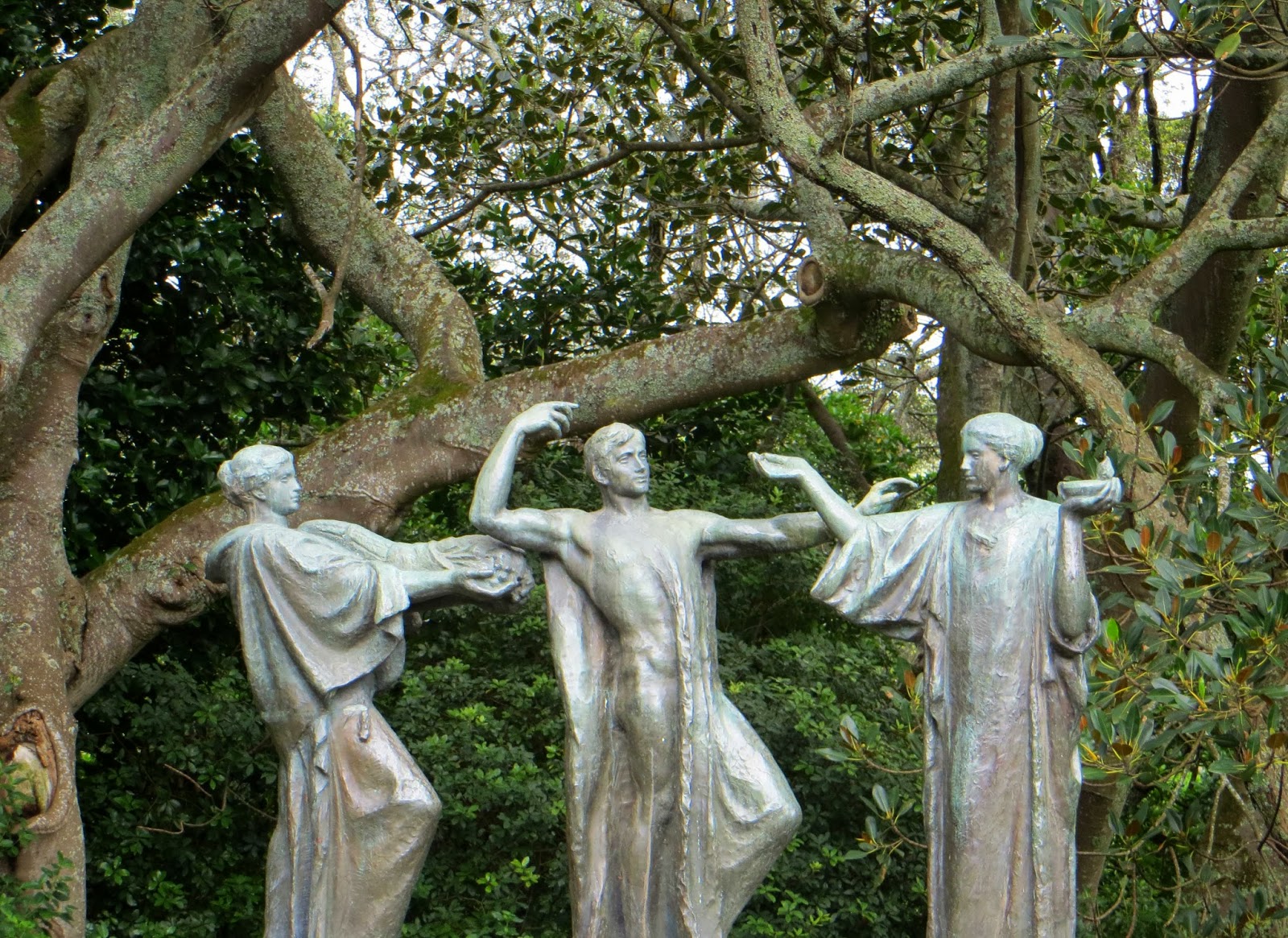
#20 the three bronze figures representing wisdom, fertility and strength