Showing posts with label Little Moreton Hall. Show all posts

01 January 2015

2014: the year that was

As 2014 drew to a close, I couldn’t help but look back at my year through the lens of my camera to see the memories I’d captured. It was my ‘gap year’, a year of travel and exploration and adventure, a year when I made so many amazing memories and visited some truly incredible places, and a year of renewing old friendships and discovering many wonderful new friends. Here is just a small selection of my magical moments from 2014.

24 March Westhaven and harbour bridge, Auckland, New Zealand
The Waitemata harbour this morning was as flat as a millpond, not a wave, not even a ripple to be seen, unless it was caused by man and his transportation. It was the perfect morning for a long walk around the harbour’s edge … so that’s what I did.

28 May Hauraki Gulf from Mt Victoria, Auckland, New Zealand
It was a magnificent winter’s day today so I took a ferry ride across the harbour to Devonport and walked up one of the two volcanic cones there, Mt Victoria. From the top I took this shot of the other cone, North Head, and looking down towards the islands of the magnificent Hauraki Gulf.

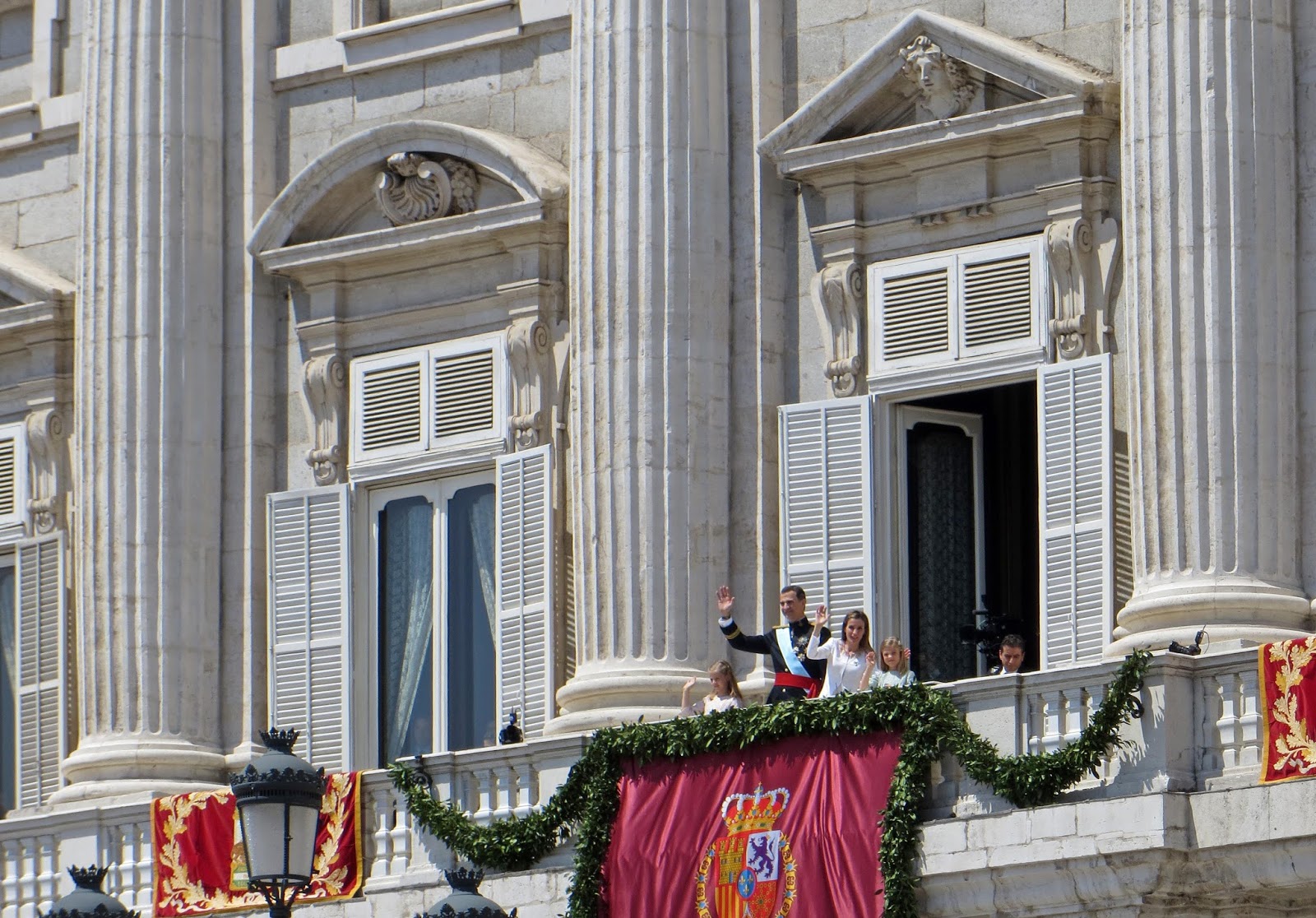
19 June Coronation of King Felipe in Madrid, Spain
By sheer coincidence, I witnessed a moment in Spanish history today as Felipe succeeded his father Juan Carlos as king. I joined the large crowds at the Royal Palace, waiting under the hot Spanish sun for their visit sight of their new leader. It was actually quite moving to be amongst so many patriotic, flag-waving and cheering Spaniards. Viva Felipe!


27 June Camel safari into the Sahara, Morocco
Bob Marley was my camel, and a placid, laid-back beast he was too, luckily, as this was my first-ever camel ride. We rode for an hour into the Western Sahara desert for our overnight camp under the stars. I can’t say I’ll be racing to ride another camel – some of my unmentionable parts are hurting – but it was an incredible once-in-a-lifetime experience.

17 July Little Moreton Hall, In England’s Cheshire
Built in stages between 1504 and 1610, Little Moreton Hall is an amazing moated half-timbered manor house. The Moretons, wealthy landowners, built the house as a symbol of their prosperity – and it certainly is impressive. What I loved most though was how wonky everything was – though now strengthened with an invisible steel support structure, the Long Gallery that runs along the top front range of the building is particularly uneven. The whole place seems to have been lifted straight out of a fairy tale!

8 August Exploring Devon’s Dartmoor
An 8 mile walk today, back to the glorious rolling green hills of Dartmoor, but this time to an ancient part of the moor, Ugborough, where there are Bronze Age hut circles dating from 2000BC, a 2-kilometre-long row of stone boundary markers dating from c.1700 BC, a Neolithic barrow, and several prehistoric stone burial mounds. The Dartmoor ponies and sheep, the magnificent view from the top of Western Beacon, and the good company were an added bonus!

12 August Beachy Head lighthouse, East Susse
I took so many photos today that it’s been exceedingly difficult to pick just one to share – others will follow when I finally get to blogging about this. I’ve settled on this image of the lighthouse (constructed in 1902) below the chalk cliffs at Beachy Head because the small size of the people walking along the hills on this part of the South Downs Way gives a good idea of the grandeur and enormity of the landscape and, hopefully, also an idea of the danger presented by coastal erosion. You wouldn’t want to get too close to those cliff edges!


24 August Hanging out with Masaai warriors in Tanzania
After visiting their school and meeting the village chief yesterday afternoon, today we spent a full day with the Masaai and stayed the night in a boma in the their village. A goat was slaughtered and eaten, the men and women danced for us, we watched the goats coming home from their daily grazing and the cattle going out again the next day. The Masaai are very special people and we were privileged to be welcomed into their homes.


24 September Auckland’s museum in the springtime
As I walked up the grass in front of Auckland Museum today, I found this glorious sight in front of me. These are Cape daisies (Arctotheca calendula) and are considered a weed by most people as they ‘spoil’ the look of a lawn. Personally, I think they’re wonderfully bright and cheerful, and they’re certainly putting on a lovely show at the museum right now.

29 October Super trees in Singapore
By jings, it’s hot here in Singapore – almost too hot for strolling around the magnificent Gardens by the Bay but it had to be done. With the incredible artificial Super Trees and the two conservatories, Flower Dome and Cloud Forest, as well as all the lovely outdoor gardens and sculptures, it is a botanical paradise. My favourite was the Cloud Forest, especially the breathtakingly high walkways – not for the vertigo-challenged!

8 December A country lane in Pickmere, Cheshire
We had a high of just 4 degrees again today and the odd spot of hail but I needed some photos to finish off my latest blog so braved the cold for a 4-mile walk. It was exhilarating and I do find the country lanes here in Cheshire very lovely … when it isn’t hailing!

13 December Deer at Tatton Park in Cheshire
We had a hard frost overnight so I was out walking again today, this time at Tatton Park Estate at nearby Knutsford. It was really chilly but when you’re well rugged up it’s such a delight to be out in the fresh air. It was perfect for frost photos, and the estate has some beautiful old trees and large expanses of water. They also farm fallow and red deer so walkers share the rolling fields with these beasties and you can get relatively close to them. Magnificent creatures!

14 September 2014

England: Little Moreton Hall, Cheshire

This must surely be my favourite of all the historic places I visited in the UK on this trip!


The Tudor-era Little Moreton Hall, a wonky black-and-white complex of buildings, was built progressively from the late 1400s to around 1610. As the Moreton family’s wealth accumulated and they wanted to impress their peers and betters, they added extra wings to their manor house, which now ranges around three sides of a central courtyard.


We took a guided tour so had an informed introduction to some of the history and features of the house. In the Great Hall sits the trestle table where the lord of the manor would have sat to eat. The table consists of two separate pieces, the supporting trestle and the one long wide piece of wood that sits on top, the board. As our guide explained, a lot of modern English expressions originate from that board. For example, when you played games on it, you were playing ‘board games’. To ensure you didn’t cheat at those board games, you had to keep your hands ‘above board’.

Actors would stand on top of the table so everyone could see them perform, hence the expression ‘treading the boards’. A couple of smaller planks would be fixed to the walls to hold the cups, hence the word ‘cupboard’. ‘Board and lodging’ refers to food and accommodation because the guests’ food was served on the board. ‘Half board’ and ‘full board’ comes from the same idea and depended on how much food was placed on the board for the lodger to eat. ‘Sideboard’ came from moving the board and trestle to the side of the side of the room to make space for other things, like dancing. Fascinating stuff!


There were many more interesting things to be found in the sparsely furnished interior. The bed is a modern reconstruction of a traditional Tudor four-poster, with a truckle bed alongside that was pulled out from under the main bed at night for the occupant’s servant to sleep in. The drapes on the four-poster were for privacy, as much as for keeping out the drafts! Next to the bedroom is one of the house’s toilets, an exceedingly drafty garderobe. Did you know clothes were stored next to these rooms because the stink of ammonia (from the urine) helped keep the moths and other insects at bay?

One particularly striking feature, to be found in the Parlour adjacent to the Great Hall, is the wall paintings, dating from c. 1575-80, which were only discovered behind the Georgian wood panelling in 1976. The paintings include imitation marble and Biblical scenes, some painted directly onto the plaster and others painted on paper which was then pasted on to the walls.


Two impressive fireplaces can be seen by visitors, both dating from Elizabethan times. The one in the Upper Porch Room (above right) depicts the figures of Justice and Mercy, on either side of the Moreton coat of arms and those of the Macclesfield family – John de Moreton married Margaret de Macclesfield in 1329.

Little Moreton Hall was almost completely constructed of green oak, which is partly why nothing is square or right-angled, with undulating floors and skewed window-frames. It’s the Victorians who were responsible for the black and white colour of these old buildings – originally the oak was just left to weather so would have ranged in colour from brown to silvery-grey and the plaster, which includes cow dung, would have been a more creamy colour.


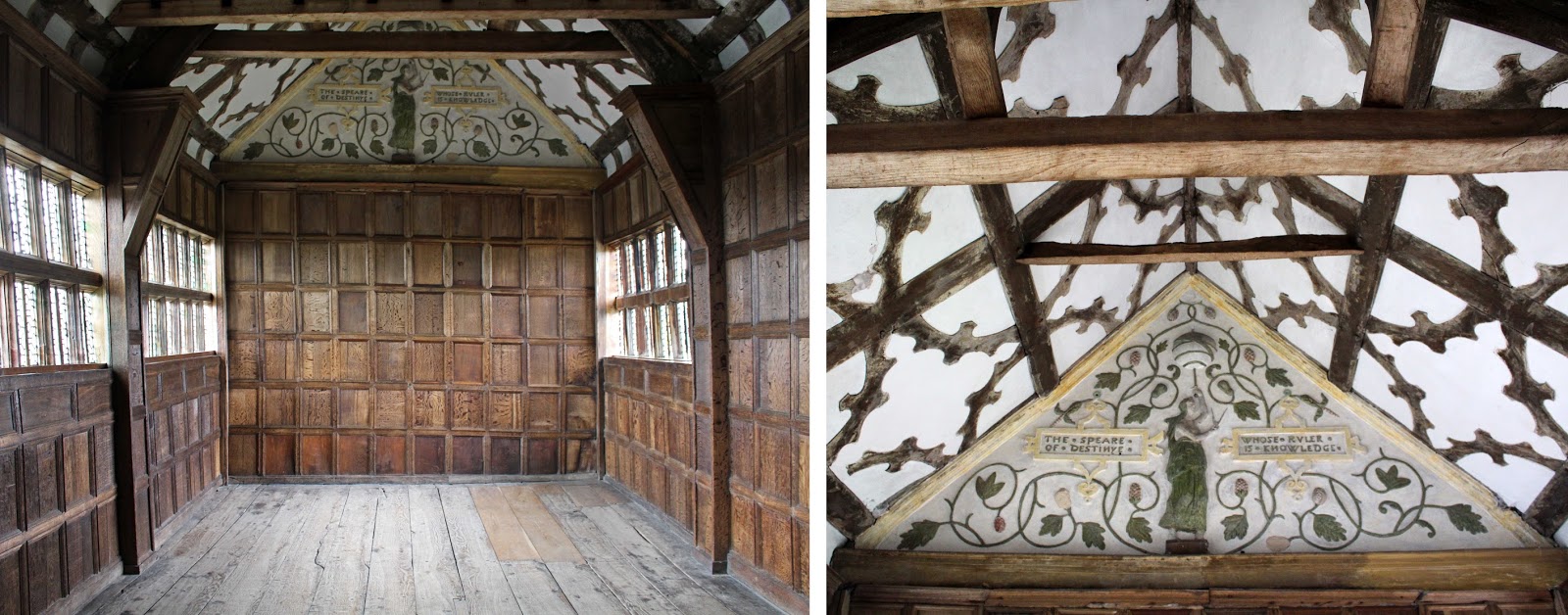
The 68-foot-long Long Gallery (above) was a late edition at the top of the southern range, meaning the two floors underneath it were not intended to carry its weight, meaning its floor is extremely wonky and the whole has had to be reinforced with an ‘invisible’ steel support structure to prevent the house from falling down. The Long Gallery became popular during Elizabethan and Jacobean times, as a place to entertain guests and a place to walk for exercise when the weather outside was inclement.


The Hall Porch (above left), constructed around 1480, has some particularly fine examples of the type of decorations popular in those times. According to a signboard at the house: ‘The Elizabethans delighted in “grotesques” – an unnatural or un orderly composition for delight sake, of men, beasts, birds, flowers, etc ... They also loved “dainty” and intricate patterns, derived from the Moslem “moresque” and Flemish strapwork, and used them to embellish everything from friezes, windows and ceilings to gardens.’ In this photo of the porch, you can see trailing vine designs, cable mouldings in the columns on either side of the doorway, and the very popular quatrefoil patterns that were carved out of solid wood.


I particularly liked the wide range of window designs to be found throughout the house, with patterns of rectangles and squares, circles and triangles that all seem to complement the decoration of the timber framing. 

The large bay windows (above) were added to the Great Hall in 1559, as you can tell from the words that run along their tops: "God is al in al thing: This windous whire made by William Moreton in the yeare of oure lorde MDLIX” and above one of the windows on the ground floor (shown here at left): “Richard Dale Carpeder made thies windous by the grac of God." 

Note the small line above and between the letters ‘e’ and ‘d’ in the word ‘carpeder’ – this indicates that the person painting the inscription realised they’d left a letter out.


Little Moreton Hall is one of the most fascinating, atmospheric, intriguing, pretty, evocative, engrossing, and enchanting places I have ever visited. If it’s possible to fall in love with a house, then I did that day. The whole place seems to have been lifted straight out of a fairy tale!