Showing posts with label Auckland War Memorial Museum. Show all posts

25 April 2014

Anzac Day 2014

For those who live outside New Zealand and Australia, 25 April is Anzac Day, the day we remember and honour all those who have served in our armed forces, in particular those brave men and women who lost their lives in the service of their country. 

I have memories of cold, often rainy days from my childhood and teenage years, when I joined my parents to watch the Dawn Service, and, when I was a Girl Guide, we joined the march with soldiers, old and young, to the local cenotaph to join in the commemorations. At both primary and high schools, we always had a memorial service and I remember, as head prefect, having to recite to a full assembly those poignant words from the Ode of Remembrance:

They shall grow not old, as we that are left grow old:
Age shall not weary them, nor the years condemn.
At the going down of the sun and in the morning,
We will remember them.

In 2008, I was privileged to attend the Anzac Day commemorations at Gallipoli, in Turkey – you can read more about that in an earlier blog

This year, for the first time, I attended the Anzac Day service at Auckland War Memorial Museum in Auckland Domain. As expected, it was a very moving event but what struck me in particular was the setting, in front of what must surely be New Zealand's biggest war memorial.


This War Memorial Museum, opened in November 1929, is a living, functioning memorial to all the men and women from the greater Auckland region who have lost their lives in a military conflict. According to an article in the New Zealand Herald of 11 October 1920, the building’s purpose was to ‘preserve relics of the conflict … establish a permanent record of effort and achievement by the Dominion’s youth … treasure the memories of fallen soldiers, and … preserve for future generations the inspiration of the war’s heroism and self-sacrifice.’

The design of the Museum Cenotaph is a direct replica of the Cenotaph in Whitehall, in London.

A local firm of architects, Grierson, Aimer and Draffin, designed the Museum with a façade of Doric columns that resemble the Parthenon in Athens, and a small hillock was removed from in front of the building, so the Museum could be seen from the sea, just like the temples the returning servicemen had seen on the shores of the Mediterranean countries where they had been fighting.

Stained glass ceiling above main foyer, depicting the Coat of Arms of all British Dominions & Colonies during the First World War (Gibraltar, Kenya, South Africa, New Foundland, Canada, Great Britain, New Zealand, Australia, India, Ceylon, Malaya and the Straits Settlements, the Channel Islands, Fiji, Jamaica and Malta).


The First World War Sanctuary
The First World War Sanctuary and the Roll of Honour which lists the full name and service details of each serviceperson from the Auckland province who died as a result of that war. The pages are still turned daily.
In the early 1960s, the Museum was expanded, both to increase the Museum’s display, storage and work space and also to expand the war memorial to include those killed in the Second World War. In 1991, the Second World War Hall of memory was expanded once more, this time to include the Roll of Honour for servicemen and women killed in the Korea, Malaya-Borneo and Vietnam conflicts.

Stained glass windows at either end of the World War Two Hall of Memory commemorating the Battles of Britain and the River Plate, and honouring the airforce and navy respectively.

World War Two Hall of Memory

Second World War shrine in the Hall of Memory. The globe represents the worldwide theatre of the war. The  stained glass windows depict the insignia of various units, including the WAAFs, WAACs, and WRNZNs.
The second floor of the Museum is devoted to memorials of war. The Rolls of Honour for the First and Second World Wars are engraved in white Sicilian marble set into the walls, as well as being contained in handwritten leather-bound volumes. 

The ‘Scars on the Heart’ exhibition covers the New Zealand civil wars and the 19th-century Anglo-Boer War, as well as the First and Second World Wars, the conflicts in Asia and the New Zealand military’s involvement in more recent United Nations peacekeeping missions. There is also a military information centre, The Armoury, with copious resources for researchers of military history and for families wanting to trace their own ancestors’ military service.

One of the displays

The exterior of the building is also an integral part of the war memorial, conveying information about the battles in which New Zealanders fought and honouring those brave men and women who served their country in those bloody and difficult times.

Around the exterior of the building is a frieze. The First World War frieze depicts 44 battle scenes; the Second World War frieze depicts members of the armed services, including nurses.

Engraved above each window is the name of a battle or campaign in which New Zealanders fought.
Unlike modern wars, one third of the 18,166 New Zealanders who died in World War One have no known grave. The Auckland War Memorial Museum serves as a place where a grateful society can honour their sacrifice, and their friends and family can remember them. Lest we forget.


The water feature in front of the Cenotaph is engraved with the Ode of Remembrance.

26 December 2013

Auckland walks: The Domain

Auckland Domain is the city's oldest park (established in 1845) and one of my favourite places. Its 80-odd hectares are where I walk most days and they are never boring. The atmosphere of the grounds changes with the weather – it can be quite eerie under a layer of fog in the winter and it can be swelteringly hot for a game of cricket in the summer.

The grandstand was built in 1898 and is still well used today.

It actually sits right on top of one of Auckland’s older volcanoes – the Auckland War Memorial Museum is built on one side of the crater rim, Auckland Hospital is on the opposite side. The duck ponds are one of the products of the volcano – they are natural freshwater springs, from groundwater that pools in the lava fractures and the scoria that fills the ancient crater. More information about the geology of the area can be found in Auckland University Press’s publication Volcanoes of Auckland.

Maori named the scoria cone of the volcano Pukekaroro or Pukekaroa (‘hill of the black-backed gull’) and the remnants of a former Maori pa can be seen on its flanks. It is topped by a totara tree planted by Princess Te Puea Herangi, which is surrounded by a manuka palisade with traditional Maori carvings. The remains of an early scoria quarry on the north side of the cone are now a lush fernery garden, behind the massive glasshouses of the Wintergardens.

Pukekaroro (or Pukekaroa) hill

But enough from me … you can read more about the diverse facilities of the Domain on the Auckland City Council website or, even better, explore the extensive grounds for yourself. Take a stroll along the bush walks and lanes or enjoy one of the many festivals held in the natural amphi-theatre of the volcanic crater (like ‘Christmas in the Park’), take advantage of the high location to fly a kite or relax to the sounds of a jazz band in the band rotunda on a summer Sunday afternoon, be delighted by the splendid displays of the colourful garden beds or take tea in the Kiosk alongside the duck ponds. 

During my many wanderings, I have photographed some of the places marked on this map from one of the park’s signboards. I hope they tempt you to enjoy the Domain for yourself.

#1 this athletic-looking bronze, by New Zealand sculptor Richard Goss, adorns
one of the Elliot Memorial entrance gates to the Auckland Domain 


#2 the fernery in the old scoria quarry
#4 the cool glasshouse at the Wintergardens
Left, #5 the flock of geese who live in the duck ponds and, right, #7 the band rotunda
#8 the Auckland War Memorial Museum beneath this morning's stormy skies
#9 the Cenotaph sits in an area of consecrated ground in front of the museum
#11 the formal gardens are colourful year round, with permanent beds and seasonal plantings
#15 the totara grove
Left, #16 the Valkyrie Fountain and, right, #17 the Robert Burns Memorial
#19 the Cain and Abel statue
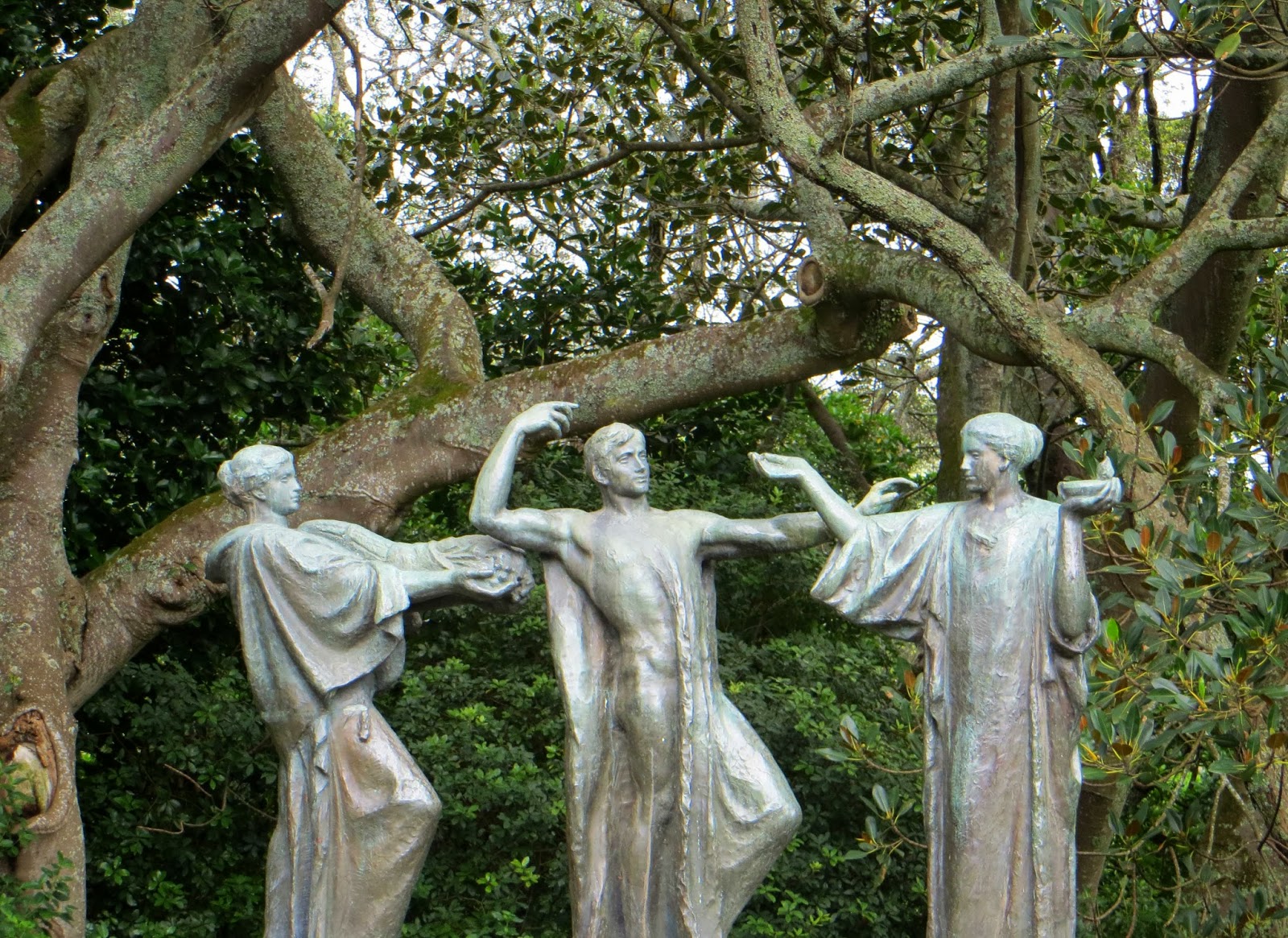
#20 the three bronze figures representing wisdom, fertility and strength