Showing posts with label symbolism of gravestone decoration. Show all posts

30 October 2016

Grave matters: Stone birds

I learnt a new word recently, the Welsh word ‘mynwenta’, which translates roughly as ‘graveyarding’. It’s something I seem to spend a lot of my time doing, exploring my local cemetery, for the history and stories of its deceased, for the art and architecture of its monuments, for the wealth of its wildlife and the flourish of its flora.


Today’s post looks at birds in the cemetery – not the birds that fly overhead, perch on the crosses, hunt for worms in the grass or build nests in the trees but rather the birds that adorn the headstones and grave monuments – the stone birds.

Though some of these birds appear on headstones purely for their aesthetic value, chances are they also have a symbolic meaning as the Victorians were more than a little obsessed with symbolism. 

Birds that are depicted with outstretched wings, as if in flight, may represent souls, winging their way to heaven. Flying birds have also been interpreted as the messengers of God.

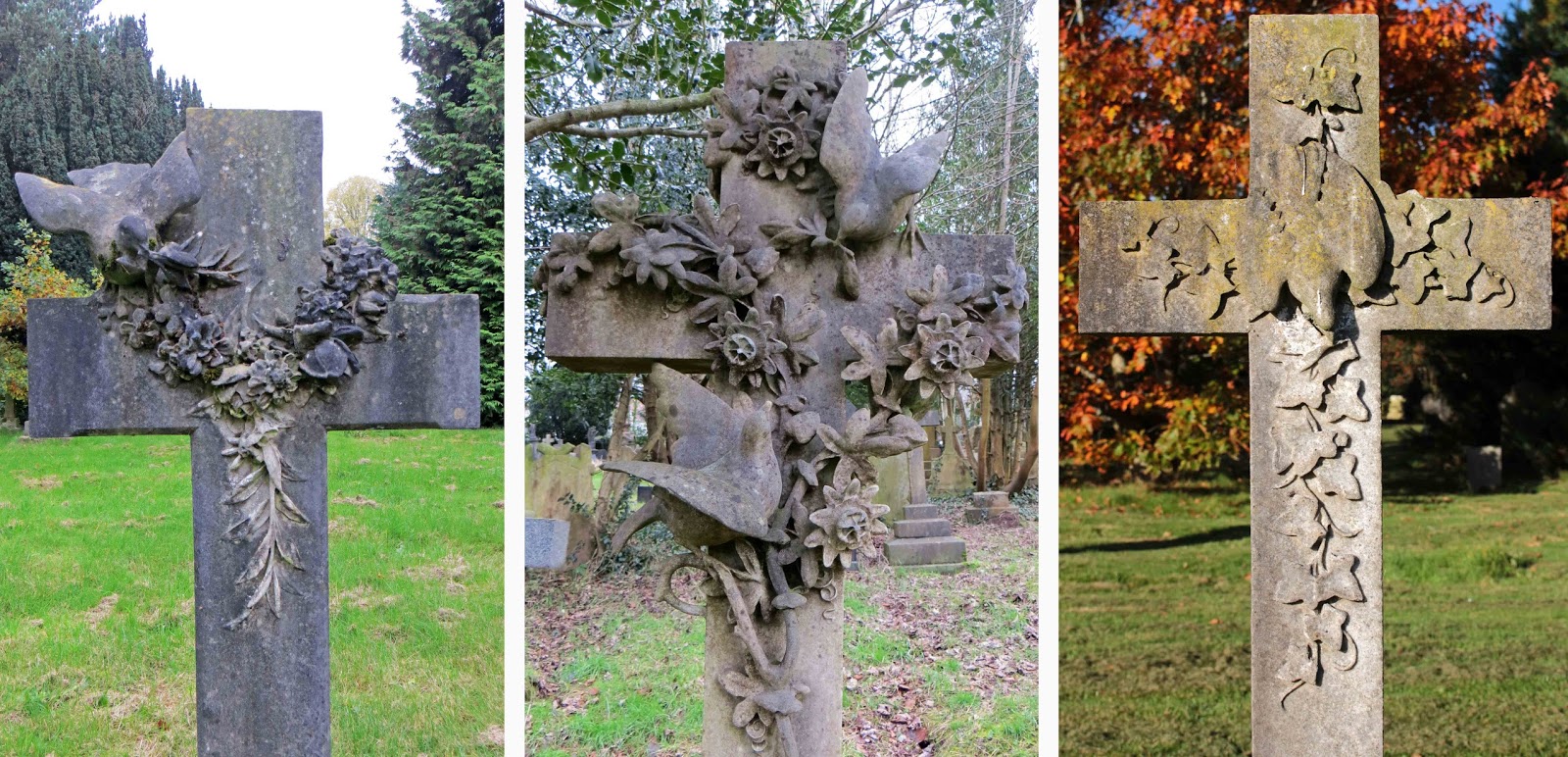
The most common bird found on grave monuments in Victorian cemeteries is the dove, that universal symbol of peace, in this case the everlasting peace of death. For Christians it is a biblical reference to Genesis 8:8 and the dove that was sent out from the ark by Noah to find land after the flood. Though it returned empty beaked the first time, it returned the second time with an olive leaf to show that trees had appeared above the flood waters as they receded, and many of the headstone doves are depicted with leaves in their beaks.

Though I found no examples in my local cemetery, other birds can be found on headstones and each has its own meaning. The eagle symbolises a career in the military and stands for courage and bravery; the owl has long been associated with wisdom so can appear on the headstones of scholars and those known for their wisdom and studious character; and the rooster, in Christianity, symbolises the Resurrection (hence the roosters commonly seen on the weathervanes of churches).

One rather intriguing headstone I found has a lovely carved relief of a swan, with outstretched wings, feeding one of two cygnets at its feet. The symbol appears in the centre of a Celtic cross and I have read in Celtic myth that ‘when inhabitants of the Otherworld required passage to the physical land of life ... they would take the shape of the swan’. 

However, this grave is amongst those in the Catholic section of the cemetery and very closely aligned with those of local bishops and priests so perhaps here the swan is more symbolic of a priest ministering to his flock. 

It may also be a reference to the ‘Seven swans a-swimming’ from the ‘Twelve Days of Christmas’ song, which I only recently learnt was, in fact, a rhyme created as a catechism for Catholics unable to practise their faith openly in Britain between 1558 and 1829. The swans in the song apparently represented the sevenfold gifts of the Holy Spirit: prophecy, serving, teaching, exhortation, contribution, leadership, and mercy.  

I also came across a rather delightful headstone inscription referring to our feathered friends: ‘May the birds sing their song on high in your loving praises.’ I rather like the idea of a chorus of birds singing when someone dies, a final serenade to the deceased – much more appealing that some of the songs people choose to play at funerals. 


28 December 2015

Grave matters: The time of angels

Angels are a common sight in Christian cemeteries, carved in stone, standing tall at the heads of graves, carrying the wishes of the deceased’s family that their loved one has gone to heaven to dwell in peace forevermore.

Most of the angels guarding the graves at Cathays Cemetery in Cardiff are female, though depictions of two particular male angels are not uncommon elsewhere and can be indentified by the objects associated with them, Michael with his sword and Gabriel with a horn.


The female angels also appear with objects, often wreaths or flowers, or in specific poses with symbolic meaning. Some angels appear to weep, expressing grief over a life too soon cut short, others gaze sorrowfully skyward, perhaps appealing for God’s mercy. Occasionally, an angel will be shown carrying a child, or perhaps embracing the dead person as they escort them on their final journey to heaven. Angels can be young or old, and a grouping of several angels together is said to represent heaven itself.


Just as we would choose a particular type of headstone from a catalogue today, so the Victorians chose their grave markers from the catalogues of monumental masons. It is quite common, therefore, to find almost exact replicas of angel statues in one cemetery, as you can see from the photograph below. Usually no attempt is made to individualise these statues – most are ‘off-the-rack’ creations – but, occasionally, the faces are different. Whether these are an attempt to recall the deceased person or simply a reflection of each mason’s artistic skills, I’m not sure.


Without meaning to seem disrespectful to the dead, statues of angels always remind me of the television programme Doctor Who and one of its scariest alien races, the Weeping Angels. Resembling the stone statues of winged angels in draped clothing that are so common in Victorian cemeteries, these creatures have the ability to move metres in the blink of an eye, as long as no one is looking at them.

Doctor Who is recorded in Cardiff, and various locations around the city have been used in the filming of outdoor scenes, including Cathays Cemetery. So, I have just one piece of advice for you when looking at the photographs in this blog … don’t blink!


The features of the angels shown in the centre and at right appear more individual than most


06 December 2015

Grave matters: Ivy

Ivy seems almost to be ubiquitous in cemeteries. Either you’ll find it carved into the stone of a grave marker as decoration, or it will be smothering that same headstone so you can no longer read the details of who’s buried beneath, or both!

As you might easily deduce, when the evergreen and almost indestructible ivy is used as a decorative element on a headstone it is intended to symbolise immortality and eternal life, and perhaps also rebirth and regeneration – just think how resilient a plant ivy is and how, even when you think you’ve removed every last piece of it from a stone wall, it soon reappears as if by magic. Some people believe ivy is also symbolic of friendship, faithfulness and fidelity.

The plant itself can be seen both as a blessing and a curse in a cemetery. On the positive side, it is an important plant for the environment, providing nectar and berries, shelter and nesting places for insects, birds, bats and other beasties. A covering of ivy is also thought to protect monumental stonework from weather erosion. On the negative side, however, the roots of ivy can creep between gaps in stonework causing grave monuments and headstones to crack and become unstable; its weight can cause similar instabilities; it frequently covers headstone inscriptions making them impossible to read; and if inexpert attempts to remove ivy can lead to further headstone damage.


How to deal with ivy is an issue for all authorities who have responsibility for heritage buildings and monuments, not just those in charge of cemeteries. One of the problems is that ivy can usually only be effectively eradicated through the use of herbicides and many heritage authorities have policies not to use chemicals within their grounds.

I don’t have the answers to the problems caused by ivy so I’ll let that literary master Charles Dickens have the last word here. This is the poem that appeared in his novel, Pickwick Papers, which was originally published in serial form between March 1836 and November 1837.

‘The Ivy Green’

Oh, a dainty plant is the Ivy green,
That creepeth o’er ruins old!
Of right choice food are his meals, I ween,
In his cell so lone and cold.
The wall must be crumbled, the stone decayed,
To pleasure his dainty whim:
And the mouldering dust that years have made
Is a merry meal for him.
        Creeping where no life is seen,
        A rare old plant is the Ivy green.

Fast he stealeth on, though he wears no wings,
And a staunch old heart has he.
How closely he twineth, how tight he clings,
To his friend the huge Oak Tree!
And slily he traileth along the ground,
And his leaves he gently waves,
As he joyously hugs and crawleth round
The rich mould of dead men’s graves.
        Creeping where grim death has been,
        A rare old plant is the Ivy green.

Whole ages have fled and their works decayed,
And nations have scattered been;
But the stout old Ivy shall never fade,
From its hale and hearty green.
The brave old plant, in its lonely days,
Shall fatten upon the past:
For the stateliest building man can raise,
Is the Ivy’s food at last.
        Creeping on, where time has been,
        A rare old plant is the Ivy green.


10 October 2015

Grave matters: passionflowers


Draped over a wall just around the corner from where I live is a passionfruit vine. I pass this way almost daily and always marvel at the beauty of its flowers.

Then, during one of my frequent walks through Cathays Cemetery, I noticed how often the passionflower appears on the headstones there. These are mostly stones from the late 19th century, though one is from as recently as 1924. The passionflower sometimes appears alone, sometimes in conjunction with other flowers, like roses and lilies, sometimes with foliage like ivy. It is carved on the stones of both men and women.


I guessed the flower’s presence was something to do with the passion of Christ but didn’t realise how specific the symbolism was until I researched it further. 

Working from the outside inwards, the flower has ten petals which represent the ten apostles. The rays that circle the flower form a nimbus, which, for Christians, is symbolic of the divine glory of Christ. Next come the five stamens representing the five wounds Christ received on the cross. The flower’s ovary is shaped like the hammer that was used to drive the nails into Christ’s hands and feet, and the stigma is divided into three parts which equate to the three days Christ lay in the tomb prior to his resurrection. Coincidentally, the passionflower only blooms for three days. And, lastly, the leaf of the passionfruit vine is shaped like a spearhead, representing the spear that pierced Christ’s side.


Not all stone masons seem to have understood the symbolism, I notice, as not all of their flowers have the precise numbers of petals and stamens but, still, I find it fascinating how much meaning has been attributed to this one little flower and will look with new eyes as I pass that passionfruit vine each day.


01 May 2015

It’s a sign: England, part three

I am blessed with inquisitiveness. I don’t recall being the child who always asked ‘Why?’ but I have become the adult who very often asks ‘What is it?’. When I come across something I don’t know anything about, don’t understand, or find interesting or unusual, I’m always motivated to investigate.

$-type symbol on gravestones
So, when I saw how frequently this symbol – what I had visually imagined as the ‘triple dollar’ sign – appeared on the gravestones of the local churches, I had to investigate further. (As a genealogist, I have something of a fascination with graveyards.)  

Of course, it’s got nothing to do with money – all these folks weren’t memorialising the fact that they’d been wealthy during their lifetimes. Rather than a ‘triple dollar’, the symbol is made up of the three letters I, H and S superimposed one upon the other, and the letters abbreviate the Latin phrase In hoc signo vince. This translates as ‘In this sign you will conquer’ and refers to a vision experienced by Roman General Constantine. His sighting of these words, and a vibrant cross, above the sun were interpreted as a positive omen for a forthcoming battle so he had the ‘Chi Rho’ symbol painted on his soldiers’ shields. Constantine won the Battle of the Milvian Bridge against Maxentius to become supreme ruler of Rome, and Christianity was subsequently legalised in Rome though, interestingly, Constantine himself wasn’t baptised until on his death bed.

Country Landowners Association Farm Buildings Award
I found this sign while exploring some of my favourite paths in and around the estate at Arley Hall. Starting in the early 1970s the Country Landowners’ Association (now renamed the Country Land and Business Association, though still using the abbreviation CLA) ran a biannual Farm Buildings Award scheme ‘to recognise excellence in farm buildings, structures which give the farmer what he needs to run his farm business easily and efficiently, but which also blend with the surrounding farmstead and with the countryside itself’ (as reported in the Glasgow Herald, 20 February 1987).

In the 1990s, when the trend for converting old farm buildings to non-agricultural and residential use really took hold, the scheme’s name changed to the Countryside Buildings Award, reflecting the fact that there had been ‘more entries for the conversion of old farm buildings to new uses than for the erection of totally new farm buildings’.    

The scheme changed again in 2002 to the Country Land and Business Association Farm and Rural Buildings Award Scheme – a bit of a mouthful! – and the last mention I found of it was in 2008, when it had morphed into the Rural Buildings Award Scheme. So, what fascinates me about this one small sign, located at the Arley Moss Equestrian Centre, is how it gives a small indication of the evolving uses of, support for and attitudes towards traditional and modern farm buildings over the years.


Old AA sign at Lower Whitley
The Automobile Association (the AA) was formed in London in 1905 by a group of like-minded motoring enthusiasts, initially with the aim of championing ‘the cause of the motorist and particularly to help motorists avoid police speed traps’ – my emphasis, their anti-police intentions! 

By 1939, the AA’s membership had mushroomed to 725,000 and, as well as providing trusty patrolmen to fix that pesky broken-down vehicle and producing guide books advising which hotels to stay at during your long car journeys, the organisation had erected thousands of direction, village, roadside danger and warning signs. The village sign shown here, found at Lower Whitley in Cheshire, was probably erected more than 80 years ago and, like others found scattered throughout Britain, is a wonderful salute to the AA’s contribution to British motoring. I particularly like its emphasis on ‘Safety First’!

Milestone near Great Budworth
Amazingly, although almost every old man-made construction in and around the village of Great Budworth is heritage listed, this milestone is not. The original milestones were actual stones, laid by the Romans to mark every one thousandth double-step, their way of calculating distance. The Latin for thousand was mille, hence the word ‘milestone’. Though one thousand Roman double steps equated roughly to 1618 yards, the eventual British standard measurement for a mile was 1760 yards.

This particular milestone dates from 1896 and is made of cast iron. According to the Milestone Society, it is one of around 9000 waymarkers that still survive in the UK, though many thousands more have been lost to thieves, collisions with car, destruction by hedge-cutters, or removal during the Second World War in order to baffle the Germans if they invaded. The notion of reaching a significant point along the road has, of course, led to our more modern idea of a milestone as an important event or stage in life, progress or development.

Fingerposts in north Cheshire
Another common waymarker to be found in the UK is the fingerpost (also known as a guide post.). These post were usually made from cast iron or wood, their poles were painted in black and white, and the fingers showed village names and the distances to them painted in black on a white base.

Although the earliest still-existing fingerpost in the UK, near Chipping Campden in Gloucestershire, dates from 1669, it wasn’t until the Highways Act of 1766 and the Turnpike Roads Act of 1773 that fingerposts on turnpike roads were made compulsory. Following the introduction of the standardised Traffic Signs Regulations in 1964, local councils were initially encouraged to remove traditional fingerposts like those shown here. Luckily, many did not, and the existing old-style waymarkers are now recognised for their historic value and, supposedly, maintained by the local councils. I think the Cheshire Councils need a little reminder of their responsibilities!


05 October 2013

Auckland walks: Symonds Street Cemetery

Our rather dapper-looking guide, dressed in period costume
Two hours meandering around a cemetery may not be everyone’s idea of a fun Sunday afternoon but it is mine! With a knowledgeable guide to explain the history of the site, to point out heritage flora, to tell the tales of interesting pioneers and to clarify the meanings of gravestone decorations, this resting place of the dead was magically brought to life … and there wasn’t a ghost or zombie to be seen!

The guided walk was part of the Auckland Heritage Festival, an annual event which this year runs from 28 September to 13 October. There’s a programme of events throughout Auckland  – so many, in fact, that it’s difficult to choose which to attend as they all sound great. I’ve chosen to learn more about inner-city Auckland where I live so this will be the first of a few blogs about these heritage meanderings.

With burials dating from the early 1840s, Symonds Street Cemetery was Auckland’s first, though it was closed after just 40 years and, except for additional members of families already buried at the cemetery, deceased central Aucklanders were later interred at the newly opened Waikumete Cemetery instead. This was partly because the city was growing at such a pace that the cemetery grounds were soon surrounded by houses and businesses and partly because the Victorians had become aware of the dangers of disease caused by decaying remains contaminating their ground water.

The cemetery is not as unified as its name implies: there are, in fact, five separate cemeteries, one each for the Jews, Roman Catholics, Anglicans, Presbyterians and Wesleyans, and they are each quite different in character, a reflection of the individual religions’ beliefs about idolatry and the use of decoration. The gravestones of the Wesleyan section, for example, are relatively plain, in keeping with the conservative nature of the religion itself. The Wesleyans were, however, very inclusive – they allowed the burial in their consecrated grounds of those who had committed suicide, which in earlier times was not permitted by Catholics and Anglicans.

The material used for grave-markers ranges from local stone to fine Italian marble, with many graves also surrounded by fences of finely worked wrought iron. Most are not local creations but were brought from Europe – apparently, after the introduction of the refrigerated ships that carried New Zealand produce to Britain, the practice was to fill the hulls of these ships with heavy items like gravestones and iron for the return journey to New Zealand, so much of the ornate marble decoration was actually carved in Italy and only the names of the deceased were added by Auckland masons.


Some years ago I completed a university paper called ‘The Art of Death’, about the iconography of death in Ancient Greece, so I found our guide’s explanations of the gravestone decorations particularly fascinating. For example, did you know that a broken column signifies a life cut short and, if that column has a wreath of flowers or leaves carved around it, then the grave is almost certainly for a young woman? Were you aware that a draped urn was a symbol for the uncertainty of life, or that images of hands being shaken indicate the hands of the deceased and the living clasped in farewell? Did you know that the unusual shape of the passionfruit flower was interpreted as symbolic of the crucifixion, or that the depiction of the tree of life, symbolising a family of several generations, is quite common on Victorian gravestones?

As well as flora carved in stone, the Symonds Street Cemetery also contains some heritage plants, escapees from funeral wreaths and survivors of plants planted by loved ones. Roses ramble over rusty railings (sorry, couldn’t resist the alliteration), camellias have grown into huge trees, and you can even find the occasional burst of bright pink oxalis flower – not the invasive weed all gardeners’ dread, but an ornamental variety commonly grown in Victorian flowerbeds.

The passionfruit flower, symbolic of the crucifixion

I have no personal connection to any of the people buried in the Symonds Street Cemetery – at least, not any more. A 19-year-old great-great uncle was buried in the Anglican section in 1869 but his body was one of the thousands disinterred during motorway construction in the 1960s. But the cemetery is the final resting place of some famous early New Zealanders and of many of Auckland’s founding families. Governor William Hobson lies here, as do many early mayors and businessmen and their families. The remains of Baron de Thierry and several members of his family were amongst those disinterred in the 60s.

As a family historian, I have spent many hours walking around cemeteries looking for ancestors’ graves but these two hours exploring the Symonds Street Cemetery were by far the most interesting yet.