Showing posts with label white-faced heron. Show all posts

10 May 2014

Auckland walks: Panmure Basin


As you walk along the banks of this tranquil tidal lagoon today, it’s difficult to imagine the ear-piercing roar and life-threatening explosions that created it at least 18,000 year ago. For the Panmure Basin is a 1.5-kilomtre-wide explosion crater, yet another example of Auckland’s earth-shatteringly violent past.

According to that most excellent book Volcanoes of Auckland, the almost perfectly circular basin was formed by a series of wet eruptions that spewed out a large quantity of the broken-up sandstone through which it erupted, as well as huge clouds of volcanic ash. The sandstone formed the 25-metre-high tuff ring that can still be seen encircling the basin, though most of the rock is now covered by shops and houses.

The basin from nearby Maungarei -- Mt Wellington.
Following the wet eruptions came a period of dry fire-fountaining, though the scoria cone this formed is now buried under mud and silt within the water-filled explosion crater. Water accumulated in the crater after the volcano ceased erupting, initially forming a freshwater lake but, after the north-eastern corner of the tuff ring eroded and sea levels rose at the end of the last Ice Age (about 8000 years ago), sea water entered the crater and Panmure Basin became the tidal lagoon we see today.

Maori people named the basin Te Kopua Kai a Hiku (‘the eating place of the guardian taniwha Moko-ika-hiku-waru’) as they believe a taniwha (a water monster) guards these waters. Over time, this title was shortened to Mokoia, which was the name given to the pa (fortified or defensive settlement or village) situated at the northern entrance to the lagoon in the early 1800s.

After the local Maori people were killed by marauding tribes from the north in 1821, the pa lay abandoned until a European settler, James Hamlin, began to farm the fertile land in the late 1830s. Other settlers followed, including, from 1848, one of the groups of Irish military pensioners (known locally as the Fencibles) who were brought to New Zealand to establish a military base for the defence of the expanding city of Auckland. The name Panmure was bestowed on the growing village by then-Governor Sir George Grey, after Fox Maule, the Lord Panmure, the English War Secretary from 1855 to 1858.

Today, Panmure is an interesting mix of large industrial factories, ethnically diverse and cheap shops and restaurants, and domestic residences, the more upmarket of which can be seen around the southern side the lagoon.

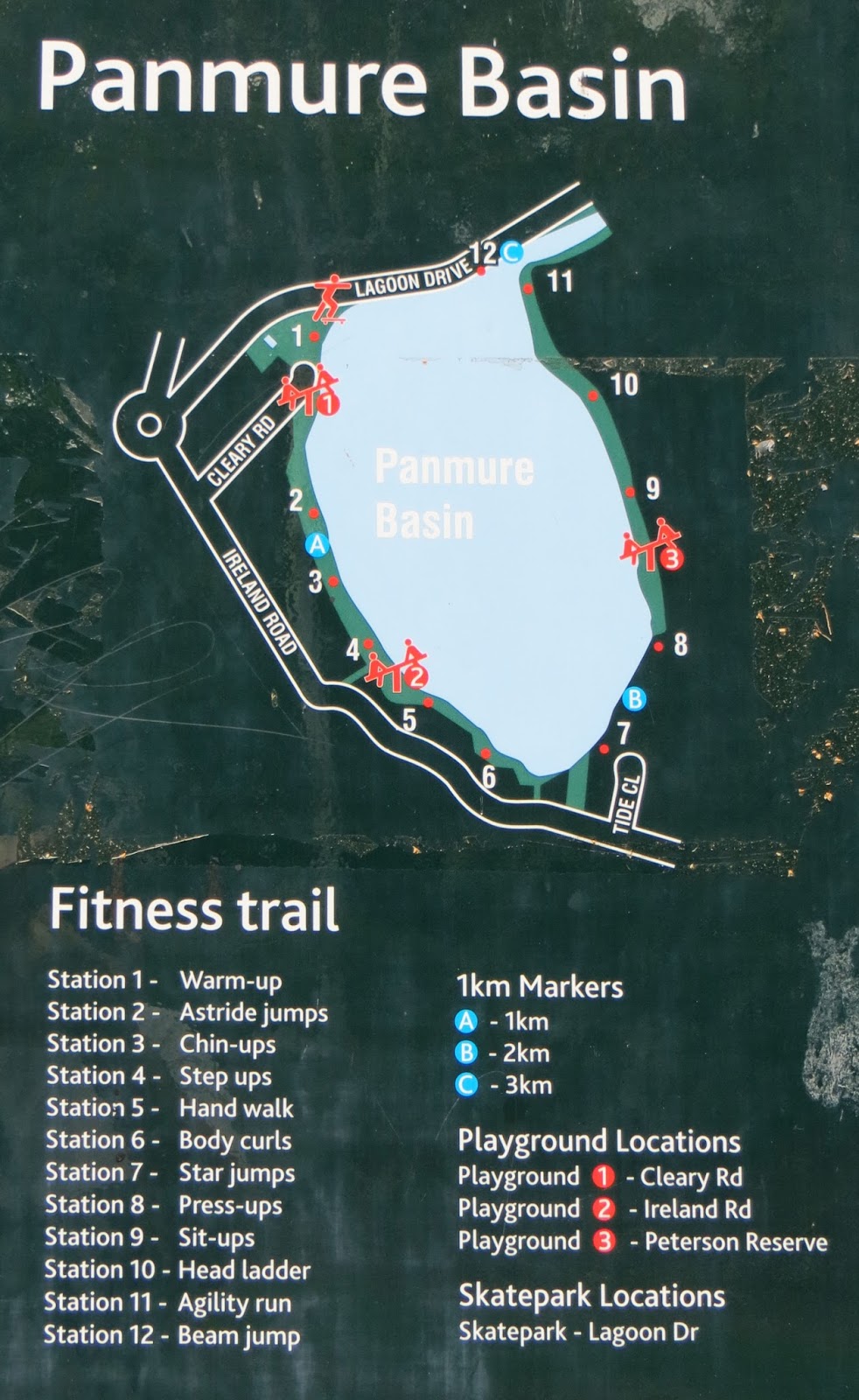
The walkway around the basin can be accessed from several places in the surrounding streets, from the aptly named Lagoon Drive, at the end of Cleary Street, at several places along Ireland Road, and from Peterson and Watene Roads. A broad concrete pathway makes walking easy and the going is mostly level, with one short uphill area on the southern side. Various, rather basic types of fitness equipment have been placed alongside the path for those in need of a greater physical challenge.

Mature trees line the path in many places, providing a pretty display of autumn colour at this time of year, and patches of mangrove forest dot the water around the edges of the basin. The clubrooms of the Panmure Lagoon Sailing Club sit on the north-western shore and the Auckland Society of Engineers on the south-eastern shore – the latter operates a miniature railway on Sunday afternoons, weather permitting. The only blot on the landscape is a series of large electricity pylons plonked right on the southern side of the basin – what planning idiot made that decision?!

Birdlife is plentiful and a delight to watch. As well as the more common birds found in every Auckland garden, I saw perhaps 6 white-faced herons, several ducks, both red-billed and black-backed seagulls, some little pied shags successfully fishing, and a flock of about 40 little pied stilts. According to the signage, white heron have been known to roost in the trees around the basin and there is a well-established colony of pied shags nesting in the trees adjacent to the outlet channel.

A small flock of pied stilts


Left, a white-faced heron and, right, a little pied shag
Panmure Basin is, then, a bird-watchers delight, a peaceful haven amidst the hustle and bustle of a rather industrial suburb, an interesting area for geologists to investigate our explosive past, a place to please the photographer’s eye, has playgrounds to amuse the children, and is an excellent venue for a power-walk or simply a pleasant stroll.


24 September 2013

Birds of New Zealand: part one

Even though I live on the 9th floor of an apartment block in central Auckland city, I still wake up to the sounds of birds singing … and I like that … a lot! Sparrows and starlings, blackbirds and thrushes, and tui in the right season, are all cheeping, chirping and warbling well before I stir at around 6am. In fact, due to the intensity and permanency of artificial light in the inner city, some of them start their morning chorus as early as 4am!

Gulls entertain me riding the thermals between apartment buildings, and those cheeky little Australian interlopers, the rosellas, provide a bright burst of colour as they sweep through the trees in the park across the road. In the late afternoon, starlings rush in their hundreds to their favourite roosting trees just down the road, so many of them that it’s best to avoid walking beneath those trees if you want to stay poop-free! And, as Auckland abounds with magnificent parks, I regularly see ducks and geese, herons and pukeko during my frequent walks.

I’ve shared photos of the birds I found in Siem Reap and in Kuala Lumpur. Here now are just a few of my frequently sighted feathered friends from Auckland. (Notice I have titled this blog part one; with so many birds to share, rather than make this blog too long, I will soon add a part two.)

I was rather surprised to discover that the White-eye or Silvereye is actually not a New Zealand native, having been first recorded here in 1832 ... though that does make me wonder if it arrived much earlier and there was simply no European here to record it! In the intervening years, it has certainly made itself at home and now lives comfortably throughout the country, from sea shore to forest edge, feeding on copious quantities of fruit. Its scientific name, zosterops, from the Ancient Greek words Zoster, meaning belt or girdle, and ophthalmos, meaning eye, obviously refers to the white marking that surrounds its eyes, making it easy to identify.

The Mallard is another bird that has made itself right at home in New Zealand since being introduced some time between 1865 and the 1920s. In fact, it’s so comfy here that it’s hybridised with our native grey duck! This photo, of course, shows the female – the male has a brilliant green head and white collar ring – but I think she’s a beauty even if her colour is a basic brown. I have no wish to offend vegetarians but these little ducks taste delicious. My Dad was a duck-shooter, with a maimai on a small lake near my hometown. I recall many winter mornings sitting plucking ducks in our carport, I got my first anatomy lessons from Dad during the gutting process, and I can still taste the rich flavour of my Mum’s perfectly roasted wild duck.


Though most of us have grown up feeding bread to the ducks at our local lakes or rivers, it’s actually not the smartest thing to do. The ducks usually have plenty of natural food to go around and those bits of bread the ducks don’t eat help to nurture Avian botulism, which can paralyse and kill both the ducks and other birds. So, next time you’re planning to take that stale bread to your local pond, think again!

I remember being surprised during a visit to the Amazon jungle in Peru to see a bird I recognised from home – their Purple Gallinule (Porphyrio martinicus) looks remarkably like our Pukeko (Porphyrio melanotus melanotus). They make the same noisy squawk and have that same cheeky strut, flashing their white undertail. I was also surprised to find Pukeko living right here in the central city, in a small area of untidy shrubs and long grass, right next to a busy motorway. But they obviously thrive there, as I was delighted to watch the antics of a breeding pair with their two half-grown chicks as I passed by just last weekend.

In fact, last Sunday’s walk was a good one for bird sightings, perhaps because of the rain from Saturday night’s storm. On a grassy slope behind Auckland Museum in the Domain, I chanced upon another beautiful creature, the White-faced heron (below, left). Once again, I was surprised to learn that this bird was self-introduced in the 19th century and that sightings were rare until the 1960s. The blue-grey body and white face plumage is such an elegant combination, I feel, and the bird in my photo is apparently wearing its alternate breeding plumage, as witnessed by the longer, blue-grey filoplumes on its breast and back.


The ponds at the Domain are a great place to watch the antics of another introduced bird, the Greylag Goose (above, right). James Cook brought these first to our islands in 1773, and they are now feral in both the North and South Islands. Don’t be fooled, as I was, into thinking the white and brown are different species; they are not. The all-white plumage is a result of domestication but the geese revert after a couple of generations to their original brown ancestral plumage once humans stop interfering with their breeding. Fascinatingly, the word goose is one of the oldest words in the Indo-European languages – perhaps an indication that the birds have been domesticated for a very long time indeed.

If you’re wondering where I got all these fascinating snippets of avian information, well, one of the huge benefits of working for Auckland University Press, even temporarily, is receiving a free copy of their publications. And, hot off the press this month comes Birds of New Zealand, the definitive guide to all our feathered friends and a must-have for every Kiwi household. As well as all the pertinent facts and figures, it has amazing images, making species identification a breeze. And it’s not too big to bundle into your backpack when you’re off for a hike. The perfect Christmas pressie for friends and family!