Showing posts with label Sucre. Show all posts

07 December 2011

My, what big knockers!


Urubamba church
Cusco has a lot of big knockers. So do many of the other towns I’ve visited in Peru.

Typically, they are found on the doors of large old constructions, like municipal buildings and churches.

Door knockers are, of course, attached to doors so that people outside can let those inside know they’re there. But most of the large knockers here are purely ornamental – some are placed so high on the door that only a giant could possibly reach them. And most are very ornate, with grotesque faces, naked cupids, and fantastical creatures. 

Here is a sampling ...

A church in Sucre, Bolivia
Another Sucre church door


Cusco cathedral
 
In Potosi

Another Cusco building


A church in Potosi

20 November 2011

Bolivia day 9: Cristina and the Yampara


Sunday morning and a little sleep in, then breakfast and a quick internet check, before a 9am pickup for a half day outing to the farming and craft community at Jatun Yampara, about 45 minutes outside Sucre – a chance to see the local indigenous people and their traditional lifestyle.

Her donkey
First we visited an 85-year-old woman called Cristina. She lives alone, with only her little puppy, a pig and a donkey, and a few chickens for company, in a ramshackle collection of small mud and stone huts placed around a central yard.

One hut was the kitchen, where the fire was burning and water was boiling. There were no shelves, just small bits of mud brick jutting out to place things on. Another hut was the storeroom, for farming tools and sacks of seeds and grains, but it also doubled as a bedroom, as there was a single bed against one wall and some clothes (including one pretty pink and another lacy white petticoat) hanging over a wooden ceiling beam.

Another hut was a second bedroom and storage place – maybe for when the family come from Sucre to visit. The fourth hut seemed to be another storeroom. None of the huts had big windows so it was easier to see their interiors through photos taken with the camera flash, rather than with the naked eye.

When we arrived, Cristina was nowhere to be found. We yelled out for her and looked carefully around the property but there was no sign of her. The driver wondered if she’d died (!), the tour guide thought she might be out behind a wall, following the call of nature! We left half the bananas and bread we’d bought the previous day, as a gift for her, got into the car and started to drive away, when Cristina was spotted walking down one side of a field.
Pretty petticoats
Cristina's homestead

Cristina and her puppy
She farms two large fields, one currently planted with corn, just sprouting, the other with potatoes. She had been to fetch two plastic jerry cans full of water from the local well – not the clearest or cleanest water I’d ever seen, but it was all that was available – no piped water or electricity or sewage system out here!

The driver helped Cristina carry her heavy cans of water back to the house, then she tottered back with him, carrying some weaving she’d done to sell to the tourists. I didn’t really want the woven belt, but I did want to give her some financial assistance in a way that wouldn’t offend her, so I bought the belt. And she let me take lots of photos of her and her dog.

What a face she has! I wondered what sights those eyes had seen. And what an amazingly strong woman to be surviving – and farming – in such a harsh environment. If I had a hat, I’d take it off to her.

Next we visited the Yampara cultural centre, a little further down the road and then across country in the 4-wheel drive. Yampara is the name of the local Indian people, one of the oldest groups of indigenous people on the continent, and the centre has been built by Tourism Sucre to showcase Yampara culture. The project aims to rescue, preserve and protect the identity, and cultural and artistic values of these people.

There’s a collection of mud and stone buildings: 4 huts with bunk beds and bathrooms, where tourists can stay (I didn’t know about that option – it would have been interesting); a separate dining and living hut; another hut where the women demonstrate weaving (and I got photographed wearing a traditional hat); a bar, where we enjoyed a small sampling of non-alcoholic chicha (made from maize) (after first making an offering to Pachamama, the earth mother, by tipping a smidgen onto the dirt floor); a small museum, showcasing traditional clothing and with a display of locally grown medicinal herbs; and a small chapel – the locals are essentially pagan, but the tourism people felt religion should be introduced. Personally, I don’t approve of this, so was pleased to hear the people don’t actually attend the chapel and no priest comes to preach to them.

The Yampara headman


One of the weavers
Another weaver
Me modelling a traditional hat

There was also some livestock: llamas came to a whistle, spindly legged sheep nibbled at the sparse grass and a few goats roamed the fields, which were awaiting the onset of the rainy season to be planted with maize, potatoes and various legumes.

The headman had shown us around and we then gave him a ride to the main road so he could travel to the nearest town, Tarabuco, for some meetings with local authorities. He is trying to get electricity for his community. I gave him a donation to buy books for the small school we could see on the opposite hillside. Despite the chapel, the community centre is a good way to showcase Yampara culture and earn some income for the people, though, sadly, the young people are drawn to the bright lights of the city and the traditional way of life may well die out with the old people. I hope not.

We arrived back in Sucre around midday and, after dropping some of my things at the hotel, I strolled the city streets taking more photos. When hunger started to gnaw at my stomach lining, I headed to the Joy Ride cafe near the plaza, where I enjoyed a delicious panini and salad on their plant-filled rooftop terrace, and wrote up the details of my morning excursion. It was a very enjoyable hour or so.
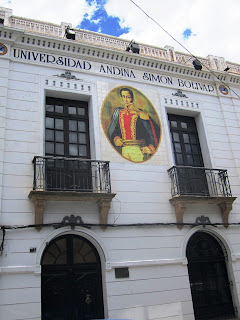

A building at the university
Agate and a church


I then walked the streets some more, some streets twice as I needed to buy some water but even the street sellers were absent, presumably at home enjoying their Sunday with family. I finally got a bottle of water at the central market, which I explored a little, though the majority of the stalls there were also closed. For a while I sat under the shady trees in the plaza, people watching and enjoying the warm sunshine. Later, I spent some more time enjoying the geranium-filled courtyard at the hotel. It was a wonderfully relaxing afternoon, something I needed as my holiday had been quite full on up to this point. I could quite happily have spent several more days soaking up the delights of sunny Sucre.

The cathedral tower
The Supreme Court - the reason Sucre is
Bolivia's capital

19 November 2011

Bolivia day 8: sweet Sucre

The lovely courtyard at my hotel
By 7.15am I was on the bus to Sucre. The woman in the seat next to me wanted the curtain shut against the sun so she could snooze, so after a while I also snoozed, though I peeked out occasionally. I saw enough to know we went up hill and down dale. It got gradually greener, with real grass and a lot more trees – and that was my initial impression of Sucre – it was very green. I stayed in the old, colonial part of the city, where the government has decreed the buildings be painted every year. And the hotel, Hostal Sucre, had a beautiful courtyard, with a central fountain and lots of flowering geraniums.

After settling in at the hotel, I had a sandwich and tea at a little cafĂ© next door, and a chat to a Canadian girl, who’s travelling around South America for a few months. Then, I sat in the courtyard, enjoying the sunshine and surroundings until my city tour at 2.30.

It was a great tour. Maribel, the vibrant young tour guide was full of details about Sucre, and Bolivia in general, the driver was a real gentleman, opening the door and providing extra information, and, with my permission, a young language student also came along to listen to our conversation. We were a chatty cheerful party!

A view over Sucre


First stop was La Recoleta, an area where lovers go in the evenings, for a fine view over the city. Next was an artisan’s workshop and store nearby. There are two local indigenous peoples, whose craftwork is quite distinct one from the other: one group produce textiles only in red and black, the other’s are multi-coloured. I would have liked to have bought something but it was beyond my budget – wall hangings were several thousand pesos each (at the moment, there are about 6.5 pesos to the US dollar). One of the women weavers was wearing a very ornately decorated hat, which marked her as single and available!

Next was the Museo del Convento de la Recoleta, once a cloistered convent, now partly a Franciscan monastery, partly museum. It is a beautiful building, with three separate cloistered courtyards each containing beautiful gardens – you could smell the roses and jasmine as you walked in. It was a quiet peaceful place and easy to imagine living there a life of prayer and contemplation – plus, I do like the Latino way of inside-out living, of high solid walls facing outward to the world, with, inside, rooms opening on to a cloister and courtyard for private enjoyment.


The museum housed memorabilia of the monks, many religious paintings, and much silver – gifts from the parents of sons and daughters who joined the religious orders. Apparently, the family tradition in the past was for the first-born daughter to become a nun and the first-born son a monk, at the age of 15, and neither could ever leave. Now, though most Bolivians would say they were Catholic if asked, few actively practice their religion. Many of the paintings were in desperate need of restoration, but the Franciscans are self-supporting, though tickets sales to the museum and some donations, so the restoration has to wait till sufficient funds are accumulated. Outside, there was an orangery, which used to the stable area when the monks used to ride around the countryside spreading the word of God, and terraced gardens, still in use, with the excess produce being donated to the school next door. In the chapel, a first communion was in progress, which we observed from the upstairs area, which now houses beautifully carved choir stalls. Most of the wood in the old buildings is cedar. The trees used to cover the hills around Sucre, until the Spaniards cut it all down for building purposes.


Next was the city cemetery, a busy place just days after Todos Santos. Over the entrance is a large ornate gateway, with the Latin inscription HODIE MIHI CRAS TIBI: ‘It is my lot today, yours tomorrow’ or, more simply, ‘Today me, tomorrow you’. A sobering thought! It was a beautifully landscaped and maintained cemetery, but it is subdivided by class. Near the entrance are the tombs of the rich families, those with enough money to buy a relatively large plot of land and build on it an ornate mausoleum to house all family members. Next are the multi-storey graves of the middle class, not grouped together by family but rather in random order. They are also well maintained, with glass fronts like windows, with flower arrangements inside. Some even have mini awnings to protect them from the sun! Some were decorated with coloured streamers from the 1 November commemoration, blue and white for boys, pink and white for girls, and purple and black for older people. At the rear of the cemetery were the graves of the poor; the sort of burials we have in Western countries, but huddled much closer together. Nearby were new buildings where members of the same profession can choose to be buried together; for example, there was one building for truck drivers, another for teachers.

Tombs of the rich
Graves of the middle class

As we were leaving, a funeral procession was entering: a hearse, with a group of people walking slowly behind. There is a small chapel near the entrance gate where Mass is held, then the body is buried – no cremations in this country – then close family and friends return to the house of the deceased for food and drink. Another mass is held one month later, then a further Mass – with food and rather a lot of drink and sometimes music – one year later, at which time the women also stop wearing the black clothes of mourning.

Graves of the poor


Next on the tour was a walk through the main city park, Parque SimĂłn Bolivar, where locals walk, play, sit and study. On Saturdays and Sundays, it has lots of things to entertain children – mini roundabouts and bouncy castles. In the centre the park has a mini Eiffel Tower – quite a bizarre construction – and, at one end, a pool which has a fountain light display on weekend evenings – equally bizarre, but apparently a favourite with lovers.

Next was a quick walk through the central market, just one block from the main plaza and the place to buy anything. We bought bananas and bread, gifts for the indigenous people we would visit the next day. There were fruit and vegetable stalls, toiletries and electrical goods, nuts and spices and flowers, as well as a whole floor of food stalls and juice makers. I learnt there are two local food specialties: one is a pork dish which sounds similar to Peru’s chicharon, and the other, various versions of spicy pork sausage. Sadly, I didn’t get to try either.

Last stop of the day was the Convent of San Felipe Nery, now a religious school for girls, and another beautiful old building. From the rooftop, there was a glorious view both of the courtyards below and the city skyline. Afterwards, I walked along to the main plaza to have tacos and a coke for an early dinner. On the way back to the hotel, I took photos of more lovely buildings. It had been a wonderful day. Sucre had a good feeling to it – I liked it there.
Convent of San Felipe Nery
View from the rooftop