Showing posts with label cusco. Show all posts

25 August 2013

Homage to home

I’ve had lots of homes in my life – in fact, a quick count reveals that my latest move brings the total to 27.

My first 17 years were spent in the bosom of my family, in the little town of Ngaruawahia, where I was born. The first few years were in a two-bedroom state house, then we moved to a larger state house in the next street soon after my brother was born. That was home for about 14 years and is where my many wonderful childhood memories are based.


Our family home in Ngaruawahia


Dorset St (the red cast is a result of
 using Kodak film in the 70s)
At 17, I went to Auckland for university, and lived a riotous life in a student hostel, before dropping out and heading off to Sydney with a friend for my first, rather short overseas adventure. There were two small, rather grotty flats in Sydney.

After that hot summer, I returned to New Zealand and a flat with 3 others in Kohimarama, followed by my first experience of living alone in half of an old house in Herne Bay. Next came a move with my job at TVNZ to Christchurch, where I lived in 4 different places in the 18 months I spent there. My first home there was in the heritage-listed Dorset Street Flats, which I see from googling suffered some damage in the 2011 earthquake; the others, in old wooden houses, appear to have survived intact.

The Ponsonby house in 2011 (image
from Ray White Realty)
Back in Auckland, I lived first on the waterfront in Kohimarama, in a flat owned by Sir Michael Fay, who lived next door and wasn’t then a ‘sir’. From there I had a few months in a little place in Mission Bay but on the wrong side of the hill, before purchasing my very first home of my own, a wonderful two-storey colonial house in Ponsonby, in the days before the developers moved in. I bought that house for about $27,000 and it’s probably now worth over a million! It was a very social house, the setting for many parties and Sundays ‘at home’. Next was a short interlude of just a couple of months in a concrete-block flat in Parnell, which was very cold but my bedroom had the most wonderful view of the museum and the greenery of The Domain.

And then my next journey to foreign shores got underway, with my first home a bedsit in the Edinburgh suburb of Stockbridge, in a Georgian terrace house that was built before New Zealand was settled – I loved that sense of history, and that marvellous city, particularly as I was footloose and fancy free during the time of the annual festival so roamed the streets enjoying daily doses of culture. But I craved the snow so headed north to the mountains, a job in a hotel and 6 months in their staff hostel. I loved that place too, the daily wilderness walks and the grandeur of those mountains … and the wild whisky-filled winter nights.

Stockbridge, Edinburgh (mine was one of those first floor windows) (image from an Edinburgh realtor)

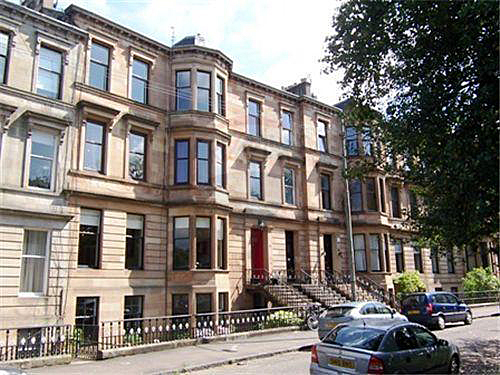
It was in Aviemore that I met my future husband and my next move was in with him, much to his parents’ initial horror, in a bedsit in Glasgow’s Queens Park in a ‘blonde sandstone building of striking architecture c.1900'. That was mostly a cosy little place, though the bizzie-lizzies on the window seat froze solid one particularly freezing mid-winter night when the temperature descended to minus 17!

Queen's Park, Glasgow (ours were the two windows below ground level at the left) (image from a Glasgow realtor)

After a couple of years, by which time we were married, we set off on the longest possible honeymoon … nine months spent travelling back to New Zealand. I haven’t counted any of those places we stayed as homes, though we did get rather attached to a very cheap bedroom in an unfinished hotel run by a Greek named Giorgos on the island of Ios and lingered there a couple of months

In Papakura, I became something of a gardener

Arriving back in New Zealand rather broke, we dossed down with Mum and Dad in Ngaruawahia for a short time (I haven’t counted that either) before moving to Papakura, not by choice but because the ex had a specialised profession and that’s where the work was. We rented for perhaps 18 months, saving every possible penny, before buying our first home together.


The Titirangi house


After 13 years in Papakura, my second-longest abode, we bought our second home, in Auckland’s bush-filled suburb of Titirangi, where I lived for 5½ years, before leaving the marital home and moving into my bachelorette pad in the rather stylish Connaught apartment block in central Auckland city.

The bachelorette pad (images from my latest realtor)
After 5½ years my itchy feet got the better of me once again and my third overseas adventure led me to Peru, where I spent 18 months in a nice little place in Cusco, another physically cold abode but with the spiritual warmth of the friendly locals as compensation. From Peru, I travelled half way around the world to Siem Reap in Cambodia, where I hopped from one guesthouse to another and then one more in the 6 months I was there.

My last abode in Siem Reap


From there back to Auckland, to that dinky little bachelorette pad with its fabulous views over the inner city and down the sparkling Waitemata harbour. And though I returned to sell that place and become a vagabond, I found the opportunity instead to remain in the same building but downsize was too good to pass over, so my latest and current home is in the same building, with almost the same view but much less space. I’m still unpacking my books, settling in, getting cosy, putting my pictures up … but this new home has a really good feeling to it. It may be small but it’s perfectly formed!


My new home


* Please note that many of the photos shown here are not my own but were found seemingly freely available on the internet. I have added acknowledgements where known. If I have unknowingly used one of your photos and you'd like it removed or acknowledged, I apologise and ask that you contact me.

23 November 2012

Adios Peru


So, after 555 days it’s time to leave Cusco and Peru.

This has been the first stop on my ten-year global odyssey, working as project manager, South America for UK charity Globalteer. My job was to oversee all Globalteer projects in South America, which meant managing Picaflor House, Globalteer's project for underprivileged children in the small town of Oropesa, not far from Cusco, and coordinating the independent projects partnered with Globalteer in Peru and in Colombia. My responsibilities included such diverse duties as fundraising and social media marketing, staff and volunteer management, accounts and general administration, as well as teaching classes in English and Art.

It has been an extremely rewarding job and I am very proud of the progress made at Picaflor House under my management. I can’t take all the credit, of course, as I've had the support of a small but dedicated staff and Picaflor House has played host to some magnificent volunteers, all of whom contributed hugely to the success and growth of the project.

A few months ago, when I was writing Picaflor’s annual report, we interviewed some of our children to get their impressions. Their feedback was heartwarming. They spoke of the beauty and colour of our flower gardens; of how much easier their schoolwork was because of the extra support and tuition provided by our Picaflor House staff; of their love for our classes in arts and crafts – they are very creative; of the usefulness of learning English from native speakers; and of the fun they had on the days when we played games and sports, allowing our kids just to be kids.

Peru is an incredibly vibrant country to live in. It is a country rich in traditional festivals and colourful events, treating the visitor to a visual symphony of colour, energetic traditional dancing in the streets, delicious morsels of native cuisine and humbling displays of religious fervour. From the frequent booming of fireworks and barking of dogs, the almost deafening cacophony of seemingly constant music, the lung-busting challenges of life at high altitude, the impressive Inca ruins that dot the beautiful mountainsides of the Andes, to the incredible biodiversity of the Amazon jungle, and the tempting array of traditional arts and crafts for sale, Peru has it all.

I have taken full advantage of my 18 months to see and experience as much of the country and the culture as I could. I sweated in the jungle of the Manu Biosphere. I hauled my aching leg muscles up the thousands of steps at Machu Picchu. I marvelled at the soaring flight of the huge condors at Colca Canyon and I met the original Paddington Bear in the sanctuary of the Chappari Nature Reserve. I sailed the sparkling blue waters of Lake Titicaca and bounced as I walked on the floating man-made reed islands of Uros. I visited more churches and cathedrals than I ever had in my life before, and was enthralled by their magnificence and their architecture. I was fascinated by mummies and lines at Nazca, and captivated by ancient pyramids and glorious grave goods in the north of Peru.


I also explored a little of the rest of South America. The frequent need for new visas led to three trips to Bolivia, a couple of long weekends in the sleepy lakeside resort town of Copacabana and a ten-day tour that included the mesmerising salt flats at Uyuni and the superlative scenery of the Reserva Nacional de Fauna Andina Eduardo Avaroa further south, the picturesque capital of Sucre and bustling metropolis of La Paz. And I survived the heart-stopping road trip down Bolivia’s notorious Death Road.

I loved the wonderful week I spent in Medellin, Colombia, visiting Globalteer’s partner projects and exploring that vibrant city. As well as my meetings with enchanting Colombian children and hard-working project staff, the highlights were my visit to the lush tropical paradise of the botanical gardens and the art, in particular the voluminous bronze figures of Colombia’s famous artist, Ferdinand Botero.

It has been an incredible 18 months. When I came to Peru, I really had little idea what to expect but my new life has exceeded all my expectations. I have met some wonderful people, I have seen amazing landscapes and architecture, animals and birds. Each and every day has brought some new sight, smell, taste or unique experience, and I have felt more alive than I have in many years. Thank you, Peru. I hope we meet again one day.
With my co-workers Luis, Johan and Sarah at Picaflor House

With our Picaflor kids, on my birthday


11 November 2012

A Pre-Columbian art attack!


The pre-Columbian artisans of Peru produced some exquisite artworks, particularly ceramics, and I have now been lucky enough to see many of the places where these ancient cultures of Peru built their cities, worshipped their gods and buried their dead, near Chiclayo and Trujillo in the north, near Nazca in the south and here in Cusco.

This afternoon I spent a delightful couple of hours once again admiring their skill, their dexterity, their fine rendering of birds and animals, and the apparent simplicity of their human representation, all in one place. If you ever come to Cusco and you appreciate the art of ancient civilisations, you simply must visit the Museo de Arte Precolombino in Plaza de las Nazarenas, just a short walk from the Plaza de Armas in the central city.
Casa Cabrera, the building that houses the museum, is itself beautiful, and a fine example of colonial architecture, with exhibition rooms on the ground and first floors surrounding a central courtyard. Built in the 1550s, the building originally housed the convent of Santa Clara, then passed into the hands of Don JerÏŒnimo Luis de Cabrera and Cerda, a city official, hence the name of the building and the coat of arms on its facade. The earthquake that devastated Cusco in 1950 caused major damage to the building but, luckily, the Continental Bank bought Casa Cabrera in 1981 and has since restored it to its former glory.
The museum’s exhibitions include rooms of gold and silver craftworks, shell and bone jewellery, and colonial paintings but, for me, the ceramics of the formative epoch, the Nazca civilisation, the Mochica, Huari and Chimu cultures, as well as those Johnny-come-latelies, the Inca, were the highlight. So, let me take you on a visual tour through Peru’s early art history, from 1250BC to 1632AD.
Cupisnique, formative period, 1250BC - 1AD
Viru, formative period, 1250BC - 1AD


The sculpted bottle on the left depicts a beheaded man, probably symbolic of some religious ceremony. The lips of his inverted head form the mouth of the bottle. On the right, the body of this pitcher is adorned with geometric patterns and a wonderful animal head - probably a feline - decorates the upper body.

These bowls are from the Nazca culture, dating from 1 to 800AD, and they represent trophy heads, taken from the enemy in times of war. The artist didn't possess great sculptural skills but his painting was superb, expressing perfectly the ferocity, pain and strength of the doomed men.


The Mochica culture also existed from 1 to 800AD, but their artisans introduced a radical change into the art of ceramics, attaining high levels of sculptural excellence and pictorial design, as these three bottles clearly show. They are representations of the same individual, presumably someone of high importance, but were crafted by different artists. The Mochica ceramics are the most beautifully sculpted works of Peruvian antiquity. 


These bottles in the shape of cormorants are also from the Mochica period. Their graceful shapes are superb and so fluid. The artist obviously had a talent for observation and for transforming his observations into such fine pieces.

I can't resist including just one more piece from the Mochica culture. This humanised figure of a deer is just so  exquisite, with its plastic shape, its huge ears and bulging eyes, its finely rendered antlers and that wonderfully cheeky tongue. 

The Huari civilisation succeeded that of the Nazca and the Mochica, and spanned the period from 800 to 1300AD. The Huari people spread through much of Peru, from Chiclayo in the north to Nazca in the south, and extending inland to Cusco and beyond. Their civilisation saw the beginning of nationhood in Peru, with their domination in religion and politics.  


The influence of the Mochica culture is obvious in Huari artworks, as you can see with these llama-head vessels. As beasts of burden and producers of wool and meat, llamas were important to the economy of the Huari, so it is no surprise that they were frequently represented on their ceramics. These particular examples are outstanding, for the fluidity of their shapes, the liveliness  of their design and, of course, I just love that tongue.


When the Huari empire came to an end around 1300AD, the Chancay-Chimu culture arose in northern and central coastal Peru. For some unknown reason, their artisans chose to reject the use of colour in their artworks and focused instead on form and on achieving perfect harmony in the proportions of their pieces. Though it may not be entirely realistic in its depiction, the pelican above is a perfect example of this. 

At the same time as the Chancay-Chimu civilisation was flourishing, so was the Inca culture and, eventually, their empire, which lasted from 1300 to 1532 AD, stretched all the way from modern-day Ecuador to southern Chile. Most people know of the Incas' incredible ability to construct magnificent cities, but their artworks are not as well known. Their craftsmen worked in wood, in clay, and in stone, producing stunning works that blend the beauty of art with the practicality of ritual use. Their style is a synthesis of the magnificence of the Pre-Columbian cultures that preceded them.

The influence of the Chimu can be seen in the sculpted bottle, pictured at right. The simplicity of design in this representation of a condor is a good example of Inca ceramic work, and the stylised stone llamas shown below are fine exemplars of Inca stonework. 
Known as conopas, these llama sculptures were created as offerings to the gods and symbolised the importance to the Inca of the submission of man to the immensity and power of nature. 


04 September 2012

Northern Peru: getting there

Cusco's symbol, on a wall at Cusco airport
The flight from Cusco to Lima went smoothly. I saw more snow-capped mountains than on my previous flights, presumably due to the time of year. It is rugged landscape – these are the Andes, after all! – and, with the rainy season just about to start, it was brown, brown, brown. The roads are interesting when viewed from on high – they curl back and forth, winding back on themselves in order to negotiate the steep terrain, the lines scarring the landscape to create Nazca-like designs. I’m sure I saw the head of a duck, a very stylised condor, the legs of a deer. Would aliens think the roads were offerings to some sky-living gods, I wonder?

Sorry, I have no photos from the flight. The windows of the Peruvian Airlines plane were too scuffed and dirty to make photography possible.

From Lima airport, we caught a taxi across town to the Cruz del Sur bus station. It always feels a bit odd being back in a big city after living in Cusco. Busy motorways, skyscrapers, huge electronic billboards all seem a little strange at first. The drivers are even more crazy than in Cusco, missing other cars by mere inches as if they have an in-built proximity alert sensor.


Cruz del Sur is probably the best bus company in Peru. Their motto, El placer de viajar en bus (the pleasure of travelling by bus), is accurate and well-founded. There are two options on their buses, which are almost all double-deckers. You can choose the cheaper, semi-reclining seats upstairs, or the almost fully reclining, plush seats downstairs. For the 12-hour overnight journey to Chiclayo, we chose downstairs and it was definitely worth it. You also get a hot meal (or box lunch or breakfast, depending on what time of day you travel), pillow and blanket, and there is a bus attendant to cater to your needs. There is also video entertainment – tourist videos, followed by movies, but you can easily switch those off and just snooze away the miles.


But I’m getting ahead of myself. As it was only 3pm and we had 4½ hours till our departure, we checked in our bags, had some lunch at the good bus station café, then went wandering to find Museo de la NaciÏŒn, Peru’s National Museum. It’s only about five blocks from the bus station so a good solution to kill some waiting time.

It’s a huge, cavernous building, with as much empty as exhibition space and little signage to direct the visitor but, what we saw of it, was interesting. There was a photographic exhibition honouring the negro people of Peru, remnants of the African people brought here to work in mines and plantations by the Spanish colonials; there was an exhibition, and sale, of contemporary crafts and furniture; and there was a fascinating display of finds from local archaeological excavations. Then we were kicked out!

A replica bust from the Peru archaeology exhibit

Although the sign at the front door said the museum was supposed to be open till 6pm, the staff herded up the few visitors and kicked us all out at 4. Perhaps they’d collectively decided to have an early finish. It was disappointing, and many Peruvians were visibly annoyed and vocal about it, but that didn’t make any difference.

A huge Japanese-style vase in the grounds of the museum

So, we wandered back towards the bus station, stopping at a McDonalds – Sarah first-ever visit inside a golden arches establishment – for a drink. At the bus station, we killed time watching TV and people and reading and then, before we knew it, it was time to board and settle in for the journey north.

21 July 2012

Inti Raymi II


I promised more about Inti Raymi in my last post … but the time came and went, and life and work got busy, so I’m only just getting back to that promise. And, in fact, I blogged about Inti Raymi last year – see here http://sconzani.blogspot.com/2011/06/inti-raymi.html – so I won’t actually write much about the event this year.

Instead, I’ll share some photos of the sacred yet profane, solemn yet noisy, almost overwhelmingly colourful event that is the modern re-enactment of the Inca mid-winter solstice celebrations here in Cusco.


The day began at what used to be the Intikancha or Temple of the Sun, but is now called Qorikancha. A large crowd of tourists and locals gathered on all available vantage points to watch the festivities.

This is the WillaqUma, the high priest of the Inca empire. His place was at the top of the only existing wall of the original Inca temple – labelled the apse in my Inti Raymi guide book. He performed various sacred rites, scattering water and food items, presumably as offerings to the gods.


These are some of the sub-priests, who were performing rituals at the foot of the apse.

The Inka (i.e. the Inca emperor) then appeared on top of the apse, to cheers and applause from the Peruvians in the crowd. After scattering seeds, he chanted the salute to the sun: ‘My sun! My father! With great joy we salute you, delighting in the solace of your great light. My sun! My father! My sun! My father! You give strength to the whole world. Sharing with us your warmth! My sun! My father!’

He then tossed his small bowl of corn to the priests stationed below the apse, who broke off kernels of that corn and gave them to the Peruvians who crowded forward to receive these sacred offerings.

This concluded the ceremonies at the Intikancha and the performers then processed to the Plaza de Armas for the next stage of the re-enactment. The company consisted of the imperial army, the Inka and Qoya (the empress, wife and sister of the Inka) and their royal entourage, chosen women and princesses, the priests, musicians of various kinds (including the qhepa – flute – trumpet players and the pututeros – conch shell blowers), and those charged with sweeping the ground and strewing flowers in the street before the Inka.

A mummy from the Qorikancha museum was also brought out for an airing, as well as various bones from other dead Inca ancestors (you could see the small exhibit numbers written on the sides of these).

Whether or not this is a faithful re-enactment of the ancient solstice celebrations is debatable but it was certainly an extremely colourful procession.


Members of the imperial army
One of the army leaders rallying his troops
Qhepa players

A pututero, a player of the large trumpet-sounding conch shells

The man who played the Inka was a splendid performer - good looking, with a proud stance and noble bearing.

Members of another cohort of the imperial guard


17 June 2012

When the saints go marching in …

We have just enjoyed the amazingly colourful spectacle of Corpus Christi here in Cusco, so I just had to use that title – because it’s true. The saints get marched out from their home churches and processed to the cathedral, where they remain for a week. Then, on the “octave”, the eight day, they get marched back to their home parishes again.


The Corpus Christi celebrations in Cusco are an unusual and complex blend of Catholic ceremony and Inca tradition. The timing of the Catholic festival, celebrated 60 days after the resurrection of Easter Sunday so falling between May and June, coincides with the high point of the Inca ceremonial calendar, when crops are being harvested and ceremonies are held to honour the Sun gods and Inca ancestors for their bounty. In fact, in Cusco the tradition of parading special beings dates back to the Inca festival of Q’ochakuy, when the mummified bodies of the ancestors were taken out and paraded through the streets. The Spaniards assimilated this Inca ceremony into their Catholic Corpus Christi ceremony and thus Cusco’s peculiar version of the celebration was born.


Fifteen saints and virgins from various parishes in and around the city are included in the processions: Saint Anthony from the San Cristobal parish; Saint Jerome from the suburb of San Jeronimo; Saint Christopher from the San Cristobal parish; Saint Barbara from the village of Poroy; Saint Anne from Santa Ana parish; Saint James the Greater from Santiago parish; Saint Blaise from the suburb of San Blas; Saint Peter from the parish of San Pedro; Saint Joseph from the parish of Belen; the Nativity Virgin from Almudena parish; the Remedies Virgin from the Santa Catalina monastery; the Purified Virgin from the parish of San Pedro; the Bethlehem Virgin from Belen; and the cathedral’s Immaculate Conception Virgin.


The religious of each parish honour their particular saint or virgin by adorning them with beautifully embroidered robes, and gold and silver jewellery, and each year one believer takes on the much-envied position of mayordomo, the person who organises the festival and cover the expenses it involves. The celebrations begin the day before Corpus Christi, when the various saints and virgins, some obviously extremely heavy, are carried from their parish churches sometimes many miles into central Cusco.


On Thursday, thousands of people flock to the Plaza de Armas to watch the main procession. From around 11am, a full Mass is celebrated outside the cathedral by Cusco’s archbishop and the various parish priests, then the procession begins. Leading the way is an impressive silver carriage carrying the monstrance from the cathedral, its golden sun representing the Holy Sacrament. Apparently, the original silver tower was built in 1733, of beaten silver over a cedar frame. These days it seems very incongruous to see this sacred object transported around the Plaza de Armas atop a motorised float, accompanied by the archbishop, his priests and various city and municipal authorities.


Next follow the fifteen saints and virgins, each carried by their faithful believers and accompanied by the mayordomo and the faithful of the parish, as well as musicians and dancers. It is a long, noisy and extremely colourful procession, combining the sacred traditions of Catholicism with the more lively celebrations of the Incas. At the end, the saints and virgins are returned to the cathedral, while the celebrants drift off to local plazas to feast on the traditional food of this time, chiriuchu (cold cuts of guinea pig, chicken, a kind of beef jerky and sausage on top of a bed of corn, with cheese from the Puno region, an omelette, and sea weed and fish eggs from the Pacific coast), and drink copious amounts of the local home brew, chicha.


Eight days later, on the "octave", the fifteen saints and virgins are marched back to their original parishes, amidst more music and dancing, and followed by plenty more feasting and drinking. And you’d think that would be it for another year … but, no! Each parish has its own special feast and celebration days during the year and, in Cusco, the festivities continue as, in just eight days, it will be Inti Raymi, the re-enactment of the Inca mid-winter solstice celebrations. More on that as it happens.