Showing posts with label Meknes. Show all posts

17 July 2014

Morocco day 4: Meknes and Volubilis and Fes

Though it’s difficult to compare days that were each very different, looking back now I think this was probably my favourite day in Morocco.

It started with breakfast at the hotel in Meknes, then Rhonda and I set off in a little blue taxi to the Granaries of Moulay Ismail, which were supposed to open at 9am but didn’t, for no apparent reason. Thinking we didn’t have time to hang around, we had a look at the adjacent Agdal Basin, a huge reservoir built for irrigation and as a pleasure lake by Moulay Ismail, then set off to follow the self-guided walking tour in our little Intrepid brochure.


It was a walk of perhaps 30 minutes from the granaries to the Mausoleum of that same Moulay Ismail, past impressively high walls guarding, on one side, the Royal Golf Course and the local Palace (there seems to a palace in every city) and also past the remains of the Old Imperial Palace, with the ubiquitous storks nesting on the high parts and small birds of prey roosting in the holes in the walls.


At the mausoleum we were highjacked by a wonderful old character called Mohammed, who said there would be no charge for his guiding services but, of course, it later turned out that there was. For a small fee, we saw the sarcophagus where the sultan is buried and, as always in these places, the decoration was superb: stucco incised with verses from the Koran, wonderfully carved cedar-wood panels, columns of Carrera marble (exchanged years ago with Italian merchants – 1kg of marble for 1kg of sugar), and intricate tiling.

Across from the mausoleum was a series of shops where Mohammed steered us next to see the metalwork being done by Berber craftsmen – tin inset with silver decorations – gorgeous work, which was demonstrated for us by a local man, first incising the design on the metal, then beating in silver thread with a small hammer, followed by various firing processes to seal and fuse the two. We each bought a plate for a relatively small sum, considering the amount of effort involved in the making.

Next, we passed through a fancy gate and into a square where we visited the underground Prison of the Christian Slaves, a series of vaults covering seven hectares lit only by the light that filtered down from holes in the square above. Various movies have featured scenes set in this atmospheric place, apparently. And then we climbed up the steps again for a quick look at the Koubba el Khayatine, a reception hall decorated with tiles and used to greet ambassadors visiting the royal court.

We thought we still had some walking to do to reach the main square where we were to meet our Intrepid tour leader Issam and the rest of the group but, when we passed through the next set of gates, we realised we had arrived at our destination, the Place el Hedim, a large square bordered on two sides by stalls and cafes and with entrances in to the covered market. We had time to spare so explored the market, then ventured further, into the medina itself.

These places are almost overwhelming in their assault on the senses – huge stacks of the incredibly sweet confections made especially for Ramadan, which was to start in a few days, the sweets covered in bees attracted by the cloying smell of the honey; a butcher’s section which was not for the faint-hearted where we saw a rabbit being skinned, a chicken having its neck wrung and bloody goats' heads lying on the floor (I’ll spare you any photos of those, though I do have some); huge mounds of fresh fruit and vegetables, some recognisable, some not, all looking succulent and tasty. The sights and smells hadn’t put us off our lunch so, once the group had assembled, we headed in to the medina for our lunchtime 'real life experience’ of camel burgers. Delicious!

Afterwards, our new transport, a large mini-bus, and our friendly and very competent driver Jamal collected us and our luggage and we set off once more into the countryside. Our next stop was Volubilis, the largest Roman ruins in Morocco, a UNESCO World Heritage site and a fabulous place for a Classics scholar like myself. This largely unexcavated 42-hectare city contains a section of the Appian Way lined with the remains of arcaded shops and their pictorial advertising signage, many in situ and very splendid mosaics, many standing columns and a huge archway, amongst other things. It is to be hoped that UNESCO’s recognition of the site’s importance will bring the money for further excavations and for preservation.

Though the site was quite simply amazing, the most memorable part of our visit was the huge thunderstorm that swept through as we explored the site with a local guide. This sent us scurrying for columns to shelter behind and bent over to try to protect our precious cameras from the driving rain. Our cameras may have stayed dry but most of us got totally soaked in the process – but, along with the thunderclaps, wild winds and horizontal rain, there was hysterical laughter and complete enjoyment of the drama of the situation. An experience never to be forgotten!

From Volubilis it was two more hours to Fes, through rolling fertile hills patch-worked in golden harvest colours, interspersed with the precise lines of the olive groves and with the whole irrigated by water from one of the huge dams that have recently been built as part of a scheme to ‘Green Morocco’.


Fes is an enormous city, which we would see more of the following day but this evening we were to experience just a little of its culinary perfection. In their residence in the city’s medina, a local family have created a restaurant where the excellence of the food is matched by the splendour of the decoration. The mother of the family was responsible for the taste sensations and one of the sons, working with a team of 15 craftsmen, had spent a whole year designing and creating the most breathtakingly beautiful ceilings in the series of dining rooms. The combination of the two, together with the good company and stimulating conversation of our group, created the perfect end to a truly incredible day.


16 July 2014

Morocco day 3: Rabat and Meknes

On this first day of our Intrepid Travel ‘Best of Morocco’ tour, we had to be in the hotel foyer, checked out and ready to go at 10.20am for the minivan transfer to the train station for the 1-hour train journey to Rabat. It was modern double-decker train, with aircon, so a pleasant journey that I spent getting to know Rhonda, a retired teacher from Australia.

In Rabat we walked two minutes across the road from Gare Rabbatville to a restaurant where we had lunch and were able to store our bags for a few hours while we explored the city. Rabat is the capital of Morocco and looked quite modern but 10 minutes’ walk to the end of the main street found us inside the medina (the old, walled city) where life continues as it has done for hundreds of years.
One of the huge entrances into the Casbah at Rabat
We followed our tour leader Issam through the maze of streets, emerging near the Casbah, which is perched high on a cliff overlooking gorgeous beaches thronged with holidaymakers on one side and the river with its mass of fishing boats on the other. Inside the Casbah is now a residential area, a picturesque labyrinth of white-washed buildings with blue walls, doors, window frames and shutters – I later found out that the indigo blue colour is used to discourage mosquitoes. It was so photogenic.


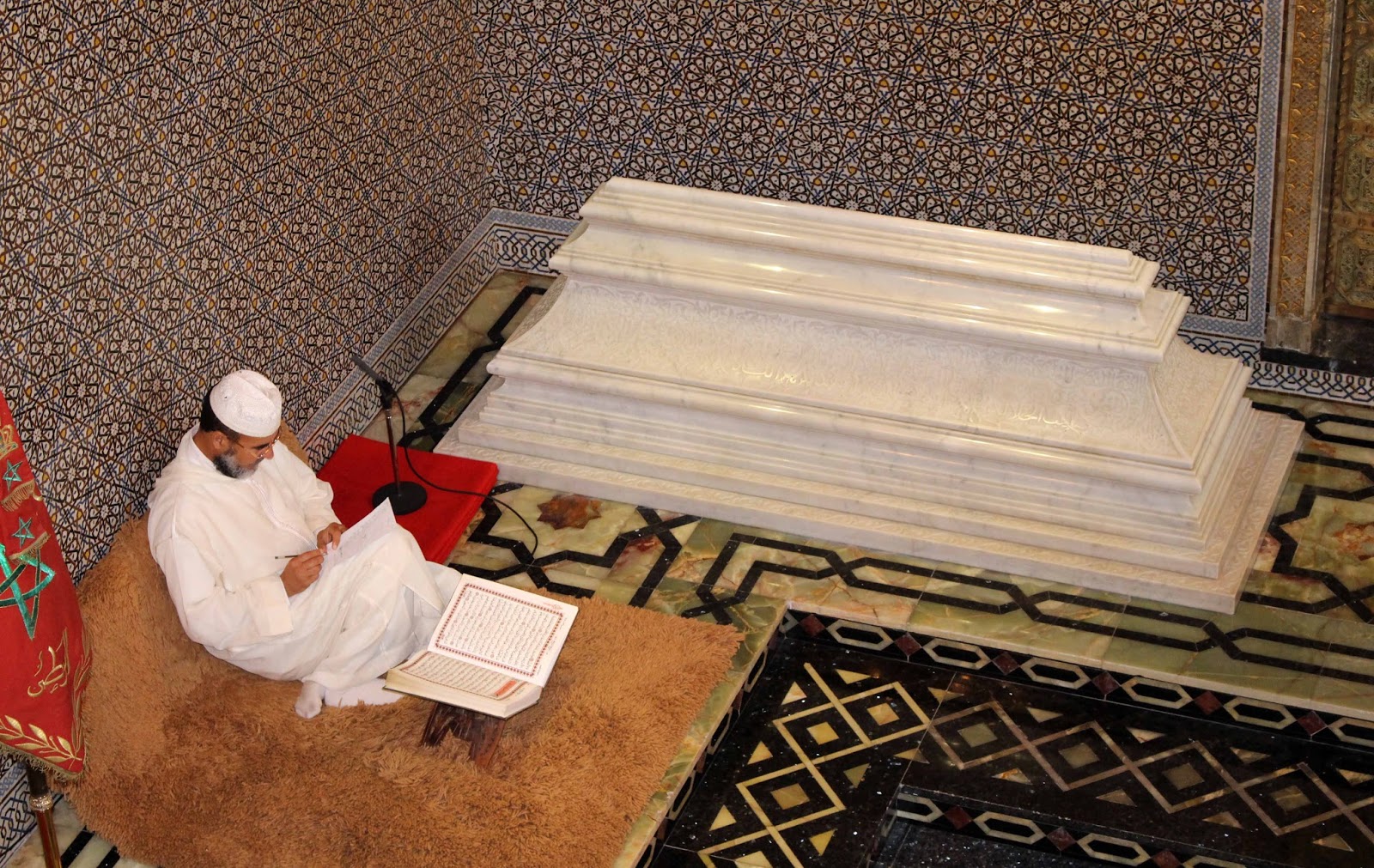
This was the end of our orientation tour so, supplied with maps and informed about local points of interest, we were told to be back at the restaurant at 4.45pm and were then left to explore on our own. Rhonda and I decided on a plan and, not having much time, headed off at a cracking pace in the hot afternoon sun to a nearby unfinished mosque, with the huge Hassan Tower and a field of columns that would have supported a massive roof if the 12th-century ruler financing the construction hadn’t died. Adjacent to the mosque is the exquisitely designed Mausoleum of Mohammed V, built of white marble, intricately decorated and housing the tombs of three former Moroccan royals.

The Mausoleum is one of the few places in Morocco where you're allowed to photograph the guards 
A reader of the Koran sits with the tombs

We then caught a cab across town to Chellah, part Roman ruins, part cemetery, part ancient walled city, all much damaged by an earthquake in the 18th century. For once I was less fascinated with the ruins and much more interested in watching the storks that were nesting on every high point within the complex, both ruined buildings and trees. Their nests were huge piles of sticks, some with chicks present and a parent or two in residence, and storks also circled overhead. My camera was working overtime for the next hour!

By then it was time to return to the meeting place, luckily not too difficult to find. Issam had threatened to leave us behind if we didn’t make it back to the train station on time! Our next train, to Meknes, was very full so we blocked the aisles with our bags until locals alighted at the following stops to allow us all, eventually, to find a space to sit down. Luckily, Issam was in my carriage so acted as interpreter as we enjoyed some conversation with a young mother and her two children for the following couple of hours.

The scenery began to change about 30 minutes before our arrival in Meknes, our overnight stop. We moved away from the coast and climbed up through more hilly much-cultivated countryside, where golden fields were dotted with baled hay and long straight rows of olive trees, and shepherds tended their flocks of grazing sheep and goats.

In Meknes, we ate in a local restaurant – one of Intrepid’s much touted ‘real life experiences’, which are actually an excellent way to see and experience first hand how the local people live – and the food was good. We were back at the hotel around 9.30pm, which just left time to download and back up the days’ photos and write my journal before heading off to the land of Nod!