Showing posts with label Intrepid Travel. Show all posts

06 September 2014

Morocco day 14 & more: Marrakech

Marrakech – mere mention of the name conjures up images of the exotic!

We arrived on the public bus from Essaouira around 6pm, taxied to our hotel for refreshing showers, then headed out just after 8pm for the 40-minute walk to Djemaa el Fna, the huge square that forms the very heart of this great city. The square is a busy place during the day but it’s at night that it truly comes alive, pulsating to the beat of musicians and acrobats; full of snakecharmers and men with monkeys urging tourists to pay for photos; with women who will henna your hand with a pretty design for just 20 dirhams; containing orange juice sellers and food stall holders, enticing you to drink and eat their freshly cooked local produce. Scrumptious!


That dinner and another, at the hotel the following night, marked the end of the organised part of our Intrepid travel ‘Best of Morocco’ tour but I had booked an extra 3 nights to explore this exotic city. So, what attractions did I visit in Marrakech?


My sightseeing started with a visit to Le Jardin Majorelle. Frenchman Jacques Majorelle began to landscape this garden in 1924 and opened it to the public in 1947. After his death in 1962, Yves St Laurent and Pierre Berge acquired and restored the property to ensure its continuing existence. It’s a shady haven in the 40 degree heat and, as well as enjoying the magnificent plantings, I found the use of bright colours on pots and walls very picturesque. As well as a small but exquisite Berber Museum, there is a memorial to Yves St Laurent within the grounds, plus, if you fancy a little retail therapy, boutique shops selling his artwork and garments.

The following day, we explored two former royal residences, the first of which was the Bahia Palace, whose name means magnificent. And it certainly was! Constructed between 1894 and 1900, it includes a selection of beautifully decorated rooms surrounding courtyards planted with lush gardens. The decoration includes zelliji (mosaic tile work) and finely sculpted and painted plaster and wood, as you can see from these images.

It wasn’t much further on to the Bardi Palace, which, though now mostly a ruin, was still fascinating. The palace was constructed in the 16th century by the Saadian dynasty, by Sultan Ahmed el-Mansour Saadi, to celebrate his victory over the Portuguese army in 1578 in the ‘Battle of the Three Kings’. The tall earthen walls, on top of which storks have built huge nests, enclose a large central pool surrounded by four sunken gardens planted with orange trees.


Later that day, I had some time to myself so walked around the Koutoubia Mosque, close to the main square. I didn’t go inside but could still admire its beautiful Islamic architecture – the curved windows and arches, the ceramic inlay. Built in the reign of Yaqub al-Mansur, who reigned from 1184 to 1199, the mosque has an impressive 77-metre-high minaret. The mosque looks very picturesque when floodlit at night and, as it was Ramadan, it was flooded with Muslims every time the call to prayer rang out over the central city.


The next day my fellow tour members had all departed so I had a day to explore Marrakech on my own. Rather than walk from place to place in the 40 degree heat, I bought a ticket for the Hop-on Hop-off tourist bus. First stop was the Menara, a 12th-century 100-hectare park, or rather a gigantic olive grove. Though redesigned in the 19th century, the Pavilion dates from the time of the Saadians, and contains the beautiful tile work and painted ceilings I had come to love in Moroccan architecture. It fronts on to a large water reservoir, which serves to irrigate the gardens and would provide nice reflections of the Pavilion, if it was better tended – the pond and water were looking rather dirty when I visited though did still create an illusion of coolness in the overwhelming heat.

Camels parked in La Palmerie, for tourists to sit on and have their photos taken
As well as touring around the central city attractions, one of the tourist buses does a circuit of La Palmerie, a huge area of date palms covering about 12,000 hectares, not far outside the city. Legend has it that, after eating dates brought back from the Sahara, the soldiers of the 11th century Almohad Sultan Youssef ben-Tachfine spat out the stones around their encampment, the stones germinated and thus began La Palmerie. Nowadays, the area contains the expensive houses of diplomats and princesses, all set within patrolled and secure gated communities. Not my idea of a pleasant place to live.

Did I mention the bazaars and the shopping?


That night was my last in Morocco – the next day I was off to Manchester, to begin 5 weeks visiting friends in various parts of England. Morocco had been on my list of places to visit for many many years so my expectations when I arrived had been high. I’m happy to say I was not disappointed – the Intrepid Travel tour was excellent, we had visited some amazing places and enjoyed some wonderful activities and experiences, and the people of Morocco were friendly and welcoming. I would love to return for a much longer time, to work and live in this magnificent country. 

05 September 2014

Morocco days 12 & 13: Essaouira

The day started with a cold splash – no hot water in the gite at Aroumd, followed by breakfast at 7.30, then the half-hour hike zigzagging across the river and down a mule track to Imlil, where we retrieved our luggage and climbed back into our trusty van for another day on the road. We retraced our route through the winding gorge to the main road, then continued on mostly long, smooth roads from there to the coast.

After stopping briefly for drinks and a toilet break in an area where pink-flowering oleander bushes were growing wild along the riverbanks, we headed on to the outskirts of Marrakech, to a large supermarket to buy supplies for a picnic lunch. Olives, gherkins, camembert, bread, potato chips, tomatoes and nectarines – more than enough for 3 people – cost about US$8.50. The fresh food was particularly cheap and so tasty – it didn’t have the flavour bred out of it, as so much food in the West seems to these days.

Our lunchtime picnic stop was about 30 minutes outside Marrakech, at a roadside restaurant that allowed us to use a long table on the grass under their shady trees. The setting seemed almost Mediterranean, the ubiquitous cat appeared about a minute after we sat down, and chickens grazed in the grass for any crumbs we let fall.


Onwards once again, with another stop about 20 minutes before we reached the coast, to visit a women’s co-operative where they produce oil from the seeds of the argan tree, labouring hard to remove the nut from its hard shell and crush it by hand in stone grinders to make the various cooking, hair and beauty products they then offer for sale. It was very labour intensive but the women work shifts, just a few hours at a time, and rotate the various tasks so each takes a turn at the more strenuous and onerous. The light wasn’t good for photos, sadly, as the women had amazing faces – maybe that’s the argan oil at work!


Next stop, Essaouira! 

I fell in love with this place – being near the sea with refreshing sea breezes to lower the temperatures but still with plenty of sunshine; the hustle and bustle of the port in the mornings when the fishing boats come in with their catches; the freshest possible seafood, bought in one section of the fish market, cleaned in the next section, cooked and eaten at a tiny restaurant in the corner – SO delicious!

There is a long sandy beach stretching off south of the old city and, along the seaward side of the old city, a Portuguese-constructed bastion, with impressive towers and canon dating back to 1700s. The medina had been planned around a basic grid of several, relatively wide main streets but still includes a maze of narrow, winding alleyways, with beautiful carved wooden doors or blue-painted window shutters around every corner. The shops were full of tempting produce, from fresh fruit and pyramids of spice to colourful clothing and gorgeous paintings. The people were friendly, welcoming, always smiling and they all love cats. Indeed, the whole town seems dedicated to feeding and caring for the thousands of local cats – I saw a young guy patiently feeding tiny sardines to a sad-looking stray at the port, and we saw a box of abandoned kittens with a carton of milk and a syringe next to it so people could feed them.


On our first afternoon, our tour leader took us on an orientation walk, then we sipped cocktails while watching the sun set over the Atlantic Ocean before enjoying a delicious, if expensive dinner at a local restaurant, while being entertained by local musicians singing hauntingly beautiful tunes in Arabic.

Our second day started with a walking tour around the old city with a friendly local guide. I always find it difficult to remember afterwards all the fascinating things these guides tell us but here are a few: Orson Welles shot the movie Othello here in the 1950s so there are hotels/restaurants/places named after him and the movie. The Jewish quarter of the medina can be identified by the Stars of David carved above the doorways. The buildings are no more than 4 or 5 storeys high as they’re not allowed to build taller than the tower on the mosque. The Portuguese had a trading and military settlement here in the 15th century but the Phoenicians were here as early as the 3rd century BC and the Romans came in the 1st century BC to harvest murex, a mollusc from whose shell they produced the purple dye used to colour the clothing of their imperial families.


We ended our tour at the artisan’s workshop for the local woodworkers – some beautiful marquetry and inlay work and intriguing puzzle boxes – and the silversmiths, where we were dazzled by the almost overwhelming array of silver jewellery. Time to shop!

Before and after!
For lunch, our leader Issam took a bunch of us to the local fish market to enjoy some of the wide range of local seafood. Finger-licking good! And then we each headed off to explore the city further, alone or in small groups. My cousin Julie and I lost ourselves in the alleyways of the medina, she got a traditional Berber design hennaed onto her hand, we shopped a little, we enjoyed ice creams at a café alongside the main square. Later, we joined a few others for more sunset cocktails and another delicious dinner.


The next day our bus to Marrakech wasn’t till 2.30pm so a few of us went down early to the port and spent a couple of hours there, taking photos of the fishing boats coming in. The place was buzzing – fishermen were unloading their catches and tending to their boats and nets, then sitting around chewing the fat with their comrades, and the air was alive with seagulls, looking for an easy feed. It was a vibrant scene, full of sounds and smells and the vitality of daily life. I didn’t want to leave that place. I didn’t want to leave Essaouira – it was definitely my favourite of all the places we visited in Morocco.


Morocco day 11: Aroumd

We made an early start this morning as this was another long travel day – and, for the first time, I snoozed a little in the bus, though luckily I did manage to stay awake for the most spectacular parts of the drive. In fact, this particular road is rated one of the world’s top 10, according to our tour leader, and it certainly is impressive.

We drove across the High Atlas Mountains via the Tizi ‘n Tichka pass, at 2260 metres the highest mountain pass in North Africa. Surprisingly – or perhaps not! – the top of the pass was covered in souvenir shops, whose staff raced out to try to entice us in as soon as our van stopped. Shops also clung precariously to every available inch of space alongside the road as it wound its way back down the other side of the mountains.

Our drive continued into the Toubkal region to the small town of Imlil, where we unloaded and locked away our larger pieces of luggage, then set off with just our overnight things on a hike to the village of Aroumd (also called Armed or Aremd). Though I am reasonably fit, it was a tough hike for me, up 250 metres in 45 minutes in the midday heat after a tiring drive and little sleep the previous night. Some of the team had hired mules but I think riding them along the narrow path would have freaked me out and my bones were still recovering from our camel rides.

After the strenuous exercise, we all tucked in to a large delicious lunch after arriving at our gite, the large family home where we would spend the night. The setting was sublime – al fresco dining at its best, on a terrace set high above the river, with spectacular views of Morocco’s highest mountains all around. Toubkal, at 4167 metres the tallest mountain in North Africa, was within walking distance, while Jebel Aguelzim (3428 metres) was even closer. Not surprisingly, the village is used as a base for the even-more-intrepid travellers who hike and climb in this area.

The afternoon was free – some of the group chose to go on a 4-hour hike around the valley and surrounding hills, I chose to catch up on writing my journal and then to snooze. I must have slept quite deeply as I also missed the 6pm 1-hour village walk and didn’t awaken until 7pm, when I heard the chatter of the various walkers on the terrace below my window. I had been feeling a little sniffy, with a scratchy throat and a bit of cough, but the rest refreshed and revived me.

We enjoyed a wonderful dinner of tagines and vegetables, bread and fruit, and chatted away till late evening, when I sloped off to bed once more. I left the window open, to enjoy the cool mountain breeze – it felt good to snuggle under a thick blanket after the heat of previous days – and I delighted in the sparkling display of stars until my eyes would no longer stay open. 

Aroumd, from the other side of the valley

18 August 2014

Morocco day 10: Ouarzazate and Ait Benhaddou

After two nights at Todra Gorge, it was back on the road, with quite a long travel day but plenty of stops to entertain us and a need to rehydrate often, as the temperatures were consistently in the 40s now that we were in southern Morocco.


We left the Gorge at 8.30am and made our first stop at Tinghir for a short wander around the local market. Most towns have a weekly market where everyone buys and sells, everything from fresh fruit and vegetables to bulk grains, clothes and all manner of strange bits and pieces. As our guide Issam explained, there’s a different method of recycling here – everything is offered for sale and someone will find a use for everything.

As we continued, we drove along a plateau with the Central High Atlas Mountain range on our left and the Ante High Atlas mountains on our right. It was an impressive landscape and, at one point, we could see a huge grey-coloured scar on the mountainside off to the left. It was the largest silver mine in Africa, where the silver sits right on the surface of the earth waiting to be dynamited and trucked away.

As we passed another gorge similar to Todra, we discovered we were on the Road of One Thousand Kasbahs. A Kasbah is a fortified house, characterised by four towered corners, which, in times past, would have been occupied by a local warlord. Many of the older Kasbahs are decaying ruins, collapsing over time due to weathering by wind and water but, fortunately, the style has been maintained – and even expanded on – in some of the more modern constructions.

We stopped briefly for refreshments at Kelaat M’Gouna, the rose capital of Morocco. The harvest of the all-pink roses takes place in April/May each year and culminates in a huge celebratory festival. All types of products are produced from the roses, like the rose water used in cooking and to make ointments and lotions to beautify the skin. I might have bought something if all the products hadn’t been a rather garish pink colour.

Our lunch stop was at Ouarzazate, the movie capital of Morocco. It’s a prosperous city, where the locals earn good money catering to the film crews and actors, building movie sets, and acting as extras. The Moroccan government encourages the business through financial concessions and the local authorities also do their best to co-operate with the film companies. We checked out the outside of the local movie museum, though didn’t go in, and drove past the Atlas Corporation studios and, though we didn’t stop for the tour, we could see some of the larger sets as we passed, including the ‘city’ in front of which The Kingdom of Heaven was filmed. 

And our movie experience didn’t there. When we reached our overnight hotel at Ait Benhaddou and walked through to the patio at the back of the hotel, our view was of the Ksar that has been used as a backdrop in movies like Lawrence of Arabia (1961) and The Man Who Would Be King (1975), and more recently, Russell Crowe’s Gladiator and Prince of Persia


Our host was a bit of an actor but the other locals were very cute!


Once we had settled in to our rooms, Issam took us on a stroll around this fabulous World Heritage site, dating from the early 18th century – though the granary building on top of the hill is thought to be even older, and it really was like walking back in time. The mud-brick buildings, the narrow alleys that twisted and turned, the crumbling walls, the magnificent views from the top – it was all amazing and I would have loved longer to explore.


Our dinner that night was served on the rooftop patio of our hotel overlooking the Ksar – a magical setting in which to end our day.


Morocco days 8 & 9: Todra Gorge

I was up at 5.30am to watch the sun rise over the Sahara – a serene sight, to be sure. When everyone was compos mentis, we clambered aboard our ships of the desert for the one-hour trek back to civilisation, old hands now at riding camels up and down the dunes. Breakfast followed and teeth-brushing but there was no time for showers and it was hot in the van that day, so the smell of our camels lingered a little longer than expected.


We were heading for Todra (also spelt Todgha) Gorge about 4 hours’ drive away but we stopped a few times along the way. First up was Adarissa ATL, a fossil factory, museum, exhibition and shop. A quarry about 15 kms away produces fossils and fossilised marble dating from between 300 and 600 million years ago, which is sliced and chiselled and polished to produce everything from table- and desk-tops to hand basins showing sea anemones, trilobites and the ancestors of the modern squid in fossilised form. Shopping, though I couldn’t exactly fit a slab in my bag!


We also stopped briefly to check out the local water supply system, an ancient series of underground aquifers uncannily similar to the system I had seen in Nazca, Peru. It always amazes me how our ancestors came up with similar inventions in such diverse and widely separated places around the world.

The aquifer system ... oh, and did I mention the rather handsome local shopkeeper?
Just before lunch, we stopped at a small Ksar, the name for a fortified mud brick town, for a fascinating glimpse of traditional Berber life in the small local museum, where the exhibits included everything from domestic and agricultural utensils, clothing and religious items to doors and window frames. The traditional Berber omelette I had for lunch was very good, as well.


At last, we reached the beginning of the gorge where we would spend the following two nights – and it was spectacular, bordered by cliffs with a strip of buildings perched along the tops and bottoms, and a central green belt nurtured by the river running through the centre. As we drove the 14 kms in to our hotel, the cliffs grew ever steeper and more precipitous until the gap between them allowed just one row of buildings either side of the river. And our hotel was situated below one of these towering cliffs across the river – a very picturesque setting.


Refreshing showers followed – swims for some, as this hotel had a pool – and a sumptuous dinner – I had a tagine of chicken with prunes, both delicious and cleansing! By 9.30pm, my eyes were closing. After a long hot day’s travel and not much sleep the previous night, my bed beckoned.

For the morning of our second day at Todra there were several options: a strenuous guided hike up the narrow paths and scree slopes of the gorge to visit a Beber settlement, a guided walk along the gardens and trails bordering the river, or relaxing at the hotel. I chose the latter – and it was a good choice. After a week of fairly intensive travelling, a relaxing morning, catching up on chores and journal writing was exactly what I needed.

At 11.30am, most of our group set off in the van for the 10-minute drive towards the end of the gorge, from where we walked a kilometre or so into the steep-sided and narrowest final section, with 200-to-300-metre cliffs towering over us. It was a dramatic landscape but the height of the cliffs provided shade and the river was shallow enough and very cooling to walk in.

From the gorge, it was just 5-minutes’ drive back to the village where we enjoyed a traditional Berber lunch in local household, where they also just happened to sell rugs. Everyone agreed that their lunch was rated the best of the trip so far and, from the flash of credit cards, I think the shopping probably the most enthusiastic to date. The rugs were certainly very beautiful and I was sorely tempted to indulge but the reality is that I don’t need another rug, so I enjoyed being enchanted by all their gorgeous colours and patterns and watching my tour mates bartering for their choices. I think they got some good bargains!


We were back at the hotel by 3pm and, while many chose to watch the latest World Cup football match, I couldn’t think of anything worse to do so took myself off for a walk through the palmeries and fields near the hotel, where I was entertained by the birds and bees and enjoyed some quiet time under the shady trees. The first week of our ‘Best of Morocco’ tour seemed to have passed very quickly and I looked forward to what the next part of our Intrepid adventure would bring.

Speedy, on the right, was our friendly 'go-to' guy at the hotel

16 July 2014

Morocco day 3: Rabat and Meknes

On this first day of our Intrepid Travel ‘Best of Morocco’ tour, we had to be in the hotel foyer, checked out and ready to go at 10.20am for the minivan transfer to the train station for the 1-hour train journey to Rabat. It was modern double-decker train, with aircon, so a pleasant journey that I spent getting to know Rhonda, a retired teacher from Australia.

In Rabat we walked two minutes across the road from Gare Rabbatville to a restaurant where we had lunch and were able to store our bags for a few hours while we explored the city. Rabat is the capital of Morocco and looked quite modern but 10 minutes’ walk to the end of the main street found us inside the medina (the old, walled city) where life continues as it has done for hundreds of years.
One of the huge entrances into the Casbah at Rabat
We followed our tour leader Issam through the maze of streets, emerging near the Casbah, which is perched high on a cliff overlooking gorgeous beaches thronged with holidaymakers on one side and the river with its mass of fishing boats on the other. Inside the Casbah is now a residential area, a picturesque labyrinth of white-washed buildings with blue walls, doors, window frames and shutters – I later found out that the indigo blue colour is used to discourage mosquitoes. It was so photogenic.


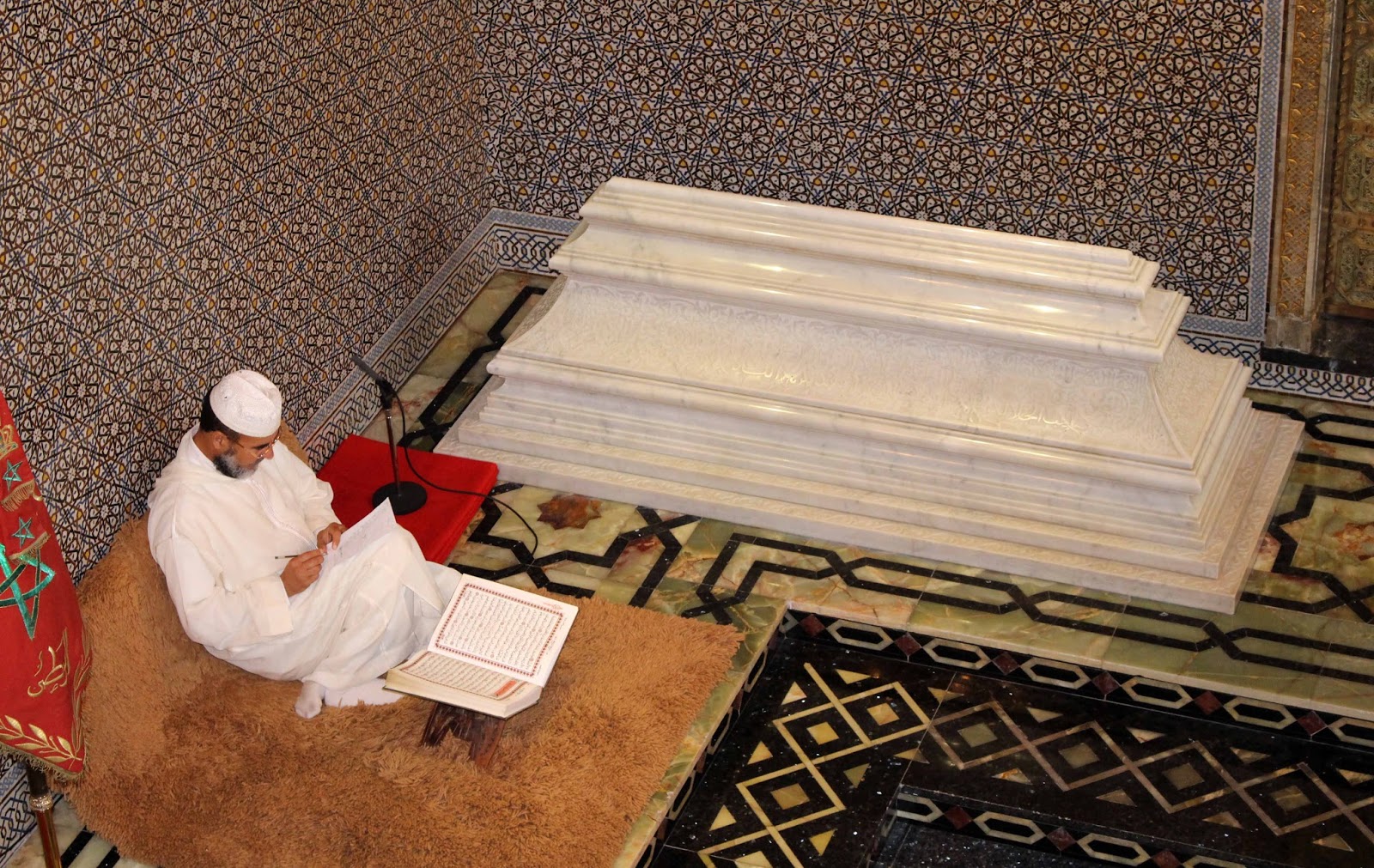
This was the end of our orientation tour so, supplied with maps and informed about local points of interest, we were told to be back at the restaurant at 4.45pm and were then left to explore on our own. Rhonda and I decided on a plan and, not having much time, headed off at a cracking pace in the hot afternoon sun to a nearby unfinished mosque, with the huge Hassan Tower and a field of columns that would have supported a massive roof if the 12th-century ruler financing the construction hadn’t died. Adjacent to the mosque is the exquisitely designed Mausoleum of Mohammed V, built of white marble, intricately decorated and housing the tombs of three former Moroccan royals.

The Mausoleum is one of the few places in Morocco where you're allowed to photograph the guards 
A reader of the Koran sits with the tombs

We then caught a cab across town to Chellah, part Roman ruins, part cemetery, part ancient walled city, all much damaged by an earthquake in the 18th century. For once I was less fascinated with the ruins and much more interested in watching the storks that were nesting on every high point within the complex, both ruined buildings and trees. Their nests were huge piles of sticks, some with chicks present and a parent or two in residence, and storks also circled overhead. My camera was working overtime for the next hour!

By then it was time to return to the meeting place, luckily not too difficult to find. Issam had threatened to leave us behind if we didn’t make it back to the train station on time! Our next train, to Meknes, was very full so we blocked the aisles with our bags until locals alighted at the following stops to allow us all, eventually, to find a space to sit down. Luckily, Issam was in my carriage so acted as interpreter as we enjoyed some conversation with a young mother and her two children for the following couple of hours.

The scenery began to change about 30 minutes before our arrival in Meknes, our overnight stop. We moved away from the coast and climbed up through more hilly much-cultivated countryside, where golden fields were dotted with baled hay and long straight rows of olive trees, and shepherds tended their flocks of grazing sheep and goats.

In Meknes, we ate in a local restaurant – one of Intrepid’s much touted ‘real life experiences’, which are actually an excellent way to see and experience first hand how the local people live – and the food was good. We were back at the hotel around 9.30pm, which just left time to download and back up the days’ photos and write my journal before heading off to the land of Nod!