Showing posts with label George VI pillar box. Show all posts

10 July 2019

Penarth : a royal assortment of post boxes


If you’re looking to post a letter in the lovely Glamorgan town of Penarth, you can choose from a wide variety of post boxes in which to place that letter for collection. There are pillar and wall boxes of various shapes and sizes, all bearing some version of the royal cypher of the king or queen who reigned at the time they were installed. The cypher usually consists of the monarch’s initials and a number in Roman numerals to indicate which monarch they are to have used that name, sometimes but not always surmounted by a crown.


The oldest post boxes date from the Victorian era (pillar boxes have been in use in Britain since 1852), when Penarth was an extremely popular seaside resort. There are at least three VR (Victoria Regina) pillar boxes, two tall and one slightly shorter and fatter (these would all have particular design names but I’m not so fascinated by post boxes as to have researched them). Penarth also has at least one wall box – there may be more lurking in the older streets that I haven’t yet walked along. Interestingly, this doesn’t show the official royal cipher in cursive script; instead, it simply has the letters VR, with a crown between, along the top of the box.


The next British monarch to reign after Victoria’s death in 1901 was her oldest son Albert who became Edward VII. 

So far I’ve located one post box from his nine-year reign, the pillar box shown at left. 

Edward VII certainly wins the prize for most elegant cypher, I think.

Next up was George V. Interestingly, his cypher does not include the Roman numeral V – it is simply GR. 

I have not discovered why this was. (The royal cyphers are apparently designed by the College of Arms and subsequently approved by the monarch.) Penarth has at least one pillar box and one wall box from this 25-year reign (1910 – 1936).
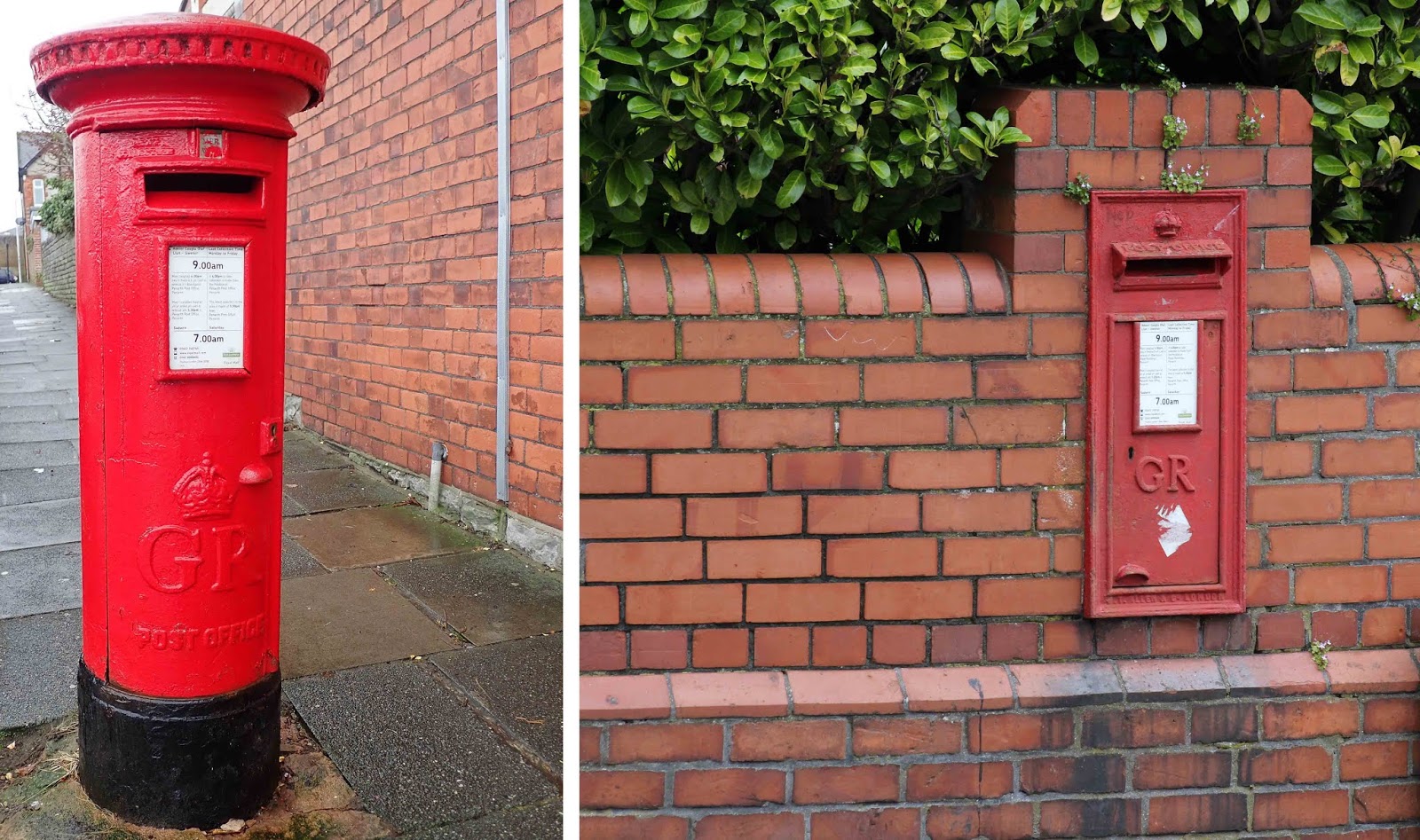

George V’s replacement was, of course, Edward VIII, the king who famously abdicated, after just 326 days on the throne, to marry American divorcee Wallis Simpson. 

Although post boxes were issued with his cypher, they are few and far between, and Penarth does not have one. (There is an Edward VIII pillar box in Cardiff though – see here.)


Replacing his brother, George VI became king on 11 December 1936 and served as monarch for the following fifteen years, until his death on 6 February 1952. Penarth has at least one pillar box and one wall post box from this period.


Last and longest of the British monarchs to be represented on the local post boxes is, of course, the current queen, Elizabeth II. Perhaps because of the length of her reign, Penarth boosts several different post boxes showing her royal cypher. I suspect, both from its design and its condition, that the pillar box on the right is the oldest of these. The box on the left was a ‘modern’ design that dates from 1980, but that type was replaced in 2000 by the pillar box shown in the centre, which has the words ‘Royal Mail’ emblazoned below the cypher instead of the more traditional ‘Post Office’. And that’s it until Britain gets its next monarch.

11 February 2018

Dorset: post boxes


My Christmas holiday host is well trained – she knows my predilection for old-looking post boxes and is happy to (safely) slam on the brakes when she spots one, or I yell “post box” in her ear. These are a few we spotted as we gadded about the highways and country lanes of Dorset (and the lucky last is from a hop over the border to Somerset).

First up (below left) is this slightly-the-worse-for-wear Edward VII box (DT2 73) that was attached to a post by the side of the road near the little hamlet of Up Sydling, a rather out-of-the-way place to be but we were chasing up my friend’s ancestors’ habitations.


In a much better state of repair and looking very photogenic in its old stone wall, was this lovely old Victoria wall box (DT2 52) (above right, and below) in the historic town of Cerne Abbas.


In the wall of a house in Sherborne, we found this rather unusual Victoria wall box (DT9 6). Named after its makers, James Ludlow & Son of Birmingham, it’s called a Ludlow wall box, and, unlike most old post boxes, which were traditionally made of cast iron, the Ludlows’ were made of wood, though they did usually have an enamel name plate on the front and a thin sheet of steel covering the door.


Moving forward in time, we found this George V wall box (DT9 37) (below left) conveniently positioned underneath the town’s notice board in a small village with the intriguing name of Ryme Intrinseca. And, below right, here’s another from Cerne Abbas, a George VI pillar box (DT2 98), also conveniently situated, in the town's main street.


This last (DT9 67) is the intruder from Milborne Port in Somerset and a relatively modern wall box from the reign of Elizabeth II. It looked freshly painted, in that wonderfully vibrant Post Office red that everyone recognises.


17 April 2017

Caerleon: an alternative view

Caerleon may well have the best Roman ruins in Wales but that’s not all it has to offer. Here’s a small selection of the other local attractions that caught my eye.

First up, the lovely historic Church of St Cadoc that sits in the heart of the town, typically plonked by the early Christians right on top of important Roman ruins. Small parts of the church’s interior date from the 12th century – we weren’t able to see inside as the church was in use when we visited – and the 16th century tower is extant but most of the building was reconstructed in the 19th century. I particularly liked this ornate old lamp stand near the front door and the hinges on the old wooden side door.


The post and pillar boxes – always a favourite of mine – were a real mixed bag. Standing just outside the church yard was the finest Victorian pillar box I’ve ever seen, of such elegant design and very well maintained. Further down the main street, outside the small post office was a nice pillar box from the reign of George VI. But then, tucked away in a small side alley, was the saddest Victorian wall box I’ve ever seen, with paint peeling off it and partially obscured by scaffolding. The sign says it dates from c.1880 and had been ‘recovered from an old smithy in Llandeilo’. Such a shame it hasn’t been looked after.


Easily missed, on a side wall of a building in the main street, we discovered this intriguing sign. I’ll just copy here what’s written on it:
The Mynde Wall
Chartist Uprising
In the last quarter of the 21st century we have taken the Right to Vote for granted. This was not always so, and in 1839 after the failure of petitioning the Government of the day, the men of Britain and South Wales sought to change the system through marches and demonstration – this was known as The Chartist Uprising. John Jenkins the owner of Mynde House and Master of the Ponthir Tin Plate Works, concerned for his property, constructed the Mynde Wall in order to keep marauding demonstrators out. The wall in front of you is what remains of his efforts.


Down by the river side ... Caerleon sits on the western shores of the River Usk, a tidal river hence the colour of the water and those high muddy banks. The narrow old stone bridge you can see in the photo was built in the early 19th century. Though we couldn’t see any signs of it, a Roman harbour was discovered here during excavations in August 2011, and Caerleon continued to be a major river port until docks were built in Newport during the Victorian era.


Also down by the river side we found an interesting old stone tower, but there was nothing to explain its history. Turns out this may be all that remains of Caerleon Castle, which was built around 1219, though the British Listed Buildings website also mentions the possibility of it being a chain tower for controlling access to the upper river. I liked the silver knight standing guard on top.


Next, a couple of random bits of sculpture. Caerleon has some lovely old buildings, with beautiful pieces of architectural adornment like this carving of a head. And, down another side alley, where we found a cafe for tea and cake, there was also a sculpture garden full of bizarre artworks, large and small. It was very cluttered so I didn’t take many photos but I did rather like this bull’s head attached to one wall.

And lastly, to finish off this alternative look at Caerleon, I just had to include this shop sign because, well, I’m Annie and this blog is definitely one of the Vintage Annie variety!