Showing posts with label George V pillar box. Show all posts

10 July 2019

Penarth : a royal assortment of post boxes


If you’re looking to post a letter in the lovely Glamorgan town of Penarth, you can choose from a wide variety of post boxes in which to place that letter for collection. There are pillar and wall boxes of various shapes and sizes, all bearing some version of the royal cypher of the king or queen who reigned at the time they were installed. The cypher usually consists of the monarch’s initials and a number in Roman numerals to indicate which monarch they are to have used that name, sometimes but not always surmounted by a crown.


The oldest post boxes date from the Victorian era (pillar boxes have been in use in Britain since 1852), when Penarth was an extremely popular seaside resort. There are at least three VR (Victoria Regina) pillar boxes, two tall and one slightly shorter and fatter (these would all have particular design names but I’m not so fascinated by post boxes as to have researched them). Penarth also has at least one wall box – there may be more lurking in the older streets that I haven’t yet walked along. Interestingly, this doesn’t show the official royal cipher in cursive script; instead, it simply has the letters VR, with a crown between, along the top of the box.


The next British monarch to reign after Victoria’s death in 1901 was her oldest son Albert who became Edward VII. 

So far I’ve located one post box from his nine-year reign, the pillar box shown at left. 

Edward VII certainly wins the prize for most elegant cypher, I think.

Next up was George V. Interestingly, his cypher does not include the Roman numeral V – it is simply GR. 

I have not discovered why this was. (The royal cyphers are apparently designed by the College of Arms and subsequently approved by the monarch.) Penarth has at least one pillar box and one wall box from this 25-year reign (1910 – 1936).
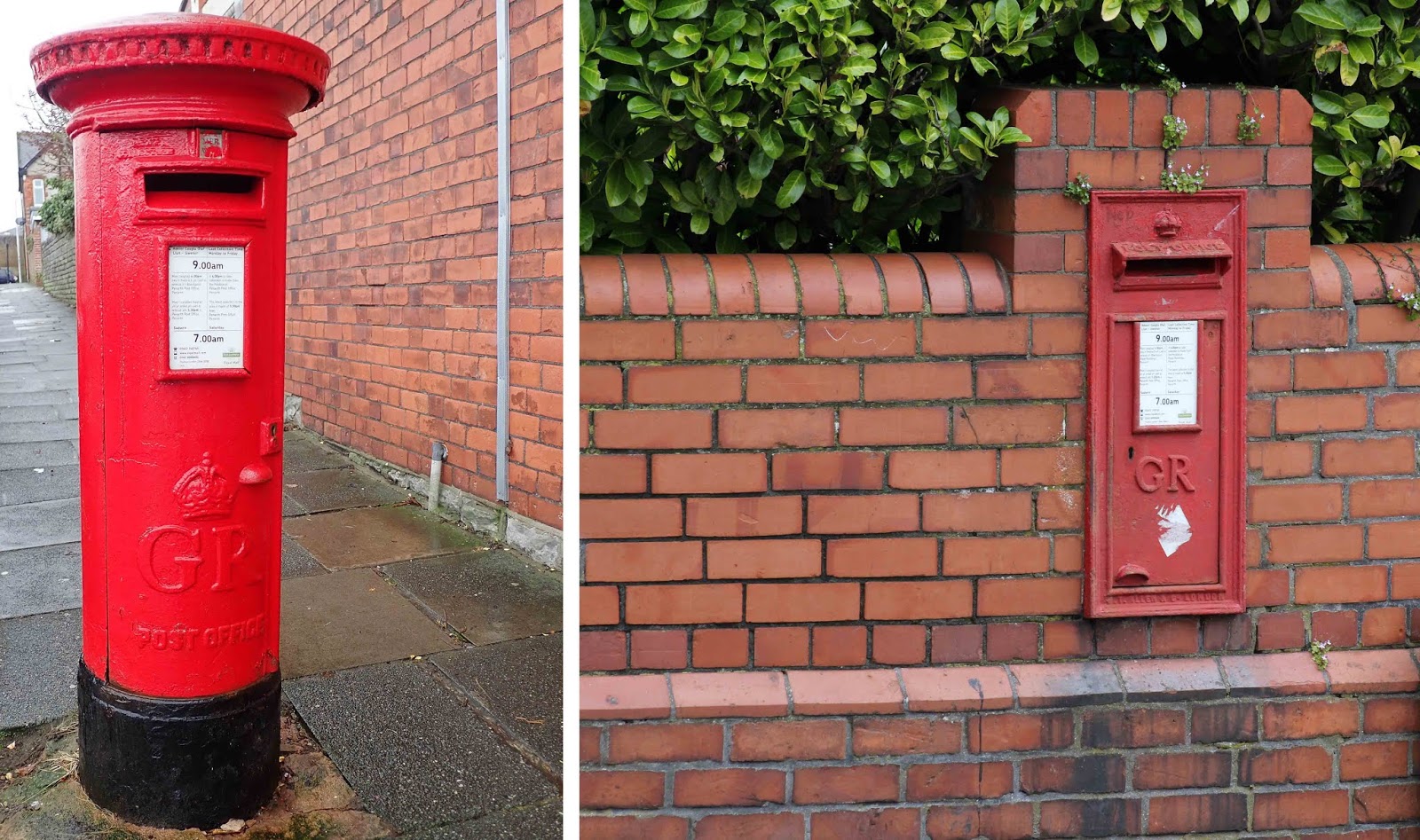

George V’s replacement was, of course, Edward VIII, the king who famously abdicated, after just 326 days on the throne, to marry American divorcee Wallis Simpson. 

Although post boxes were issued with his cypher, they are few and far between, and Penarth does not have one. (There is an Edward VIII pillar box in Cardiff though – see here.)


Replacing his brother, George VI became king on 11 December 1936 and served as monarch for the following fifteen years, until his death on 6 February 1952. Penarth has at least one pillar box and one wall post box from this period.


Last and longest of the British monarchs to be represented on the local post boxes is, of course, the current queen, Elizabeth II. Perhaps because of the length of her reign, Penarth boosts several different post boxes showing her royal cypher. I suspect, both from its design and its condition, that the pillar box on the right is the oldest of these. The box on the left was a ‘modern’ design that dates from 1980, but that type was replaced in 2000 by the pillar box shown in the centre, which has the words ‘Royal Mail’ emblazoned below the cypher instead of the more traditional ‘Post Office’. And that’s it until Britain gets its next monarch.

25 February 2017

Cornwall: Matters philatelic

I say ‘matters philatelic’ though, in truth, this post is not about stamps but rather about the objects into which we place our stamped articles in order to have them collected and whisked away to their destinations, i.e. the various types of post and pillar boxes I spotted in Cornwall – and one phone box, for good measure, for no good reason other than the fact that I liked it. So, jumping right in ...


This first box dates from the reign of George V, so would have been installed some time between 1910 and 1936. Though George V’s post and pillar boxes only used the initials GR, they can be distinguished from the later George VI’s by the mere fact that they don’t show a regnal number. This box is slotted into the front wall of the Post Office at St Mawes but it appears to be front opening so mail collection would presumably be by a P.O. van driver rather than by local Post Office staff.


Sadly, this wall box in Porthscatho is now out of service, and the interior of the building to which it is attached is empty. A little googling resulted in the information that the quay-side Post Office at Porthscatho was closed and the services re-assigned to a local shop in early 2015, despite a significant protest by the local community. This box also dates from George V’s era but is a different design to the one in St Mawes: the king’s initials are placed lower on the box and are more prominent.

Next up is this typical example of a George V pillar box that I found just uphill from the old harbour at Newquay. As I have written previously, pillar box design was initially quite random but was standardised from 1859, though there have been many modifications to the basic design over the years. And, of course, as the kings and queens have changed, so have the royal initials on the front of the boxes. 

These boxes are made of cast-iron so, as long as they’re given a regular coat of paint, they will last a long time, as this box bears witness.


This lamp box (those designed to be fitted to lamp posts or on their own free-standing pedestal) takes the prize as the newest box I’ve ever seen. It looked like it had never been used. 

To be honest, the box looked very incongruous as it was located in Mevagissey, one of Cornwall’s gorgeous historic fishing villages, where I would have expected to see much older boxes being preserved and used.

However, I may have found a clue to why this new box is there: I found photos online (from the St Austell Voice, issue 545, dated 28 September 2016) showing contractors illegally removing a post box from the Grade-II listed former Post Office building (illegal as they did not having planning consent to do this) and a story about the catastrophe on another website

Perhaps this modern lamp box is the replacement. A sad tale indeed!

My last two boxes were found in the historic village of Tintagel. No, they don’t date from the time of King Arthur, but not only is there a very nice George VI wall box (at right; note the king’s regnal number subtly placed between his scripted initials, which is how you know this is George the sixth not the fifth), there is also a wall box dating from the reign of Queen Victoria (above), not something you see very often these days. 

This looks to be one of the earliest wall box designs as it doesn’t have a pediment to prevent rain entering the mail slot (an early design flaw), though it does have that rather odd-looking rectangular attachment along the top (perhaps a modern-day modification). As you may be able to read, the box can only be used during the summer months.

But wait, there’s more. Not only is this a wonderful VR wall box, this box is set into the wall of Tintagel’s Old Post Office, a building that is now owned and administered by the National Trust

As you can probably tell from that wavy roof line, this building is old: it is believed to date from the 14th century, beginning life as a humble farmhouse and gradually being added to over the centuries to become a manor house. One room of the house was used as the village post office from around the 1870s and summertime visitors can still see that room, with its old post office equipment. Obviously, that’s yet another reason for me to return to Tintagel.


And last but not least, a fun addition to this post – a charming old phone box I saw in St Ives. I couldn’t see if it was still functioning but I liked the addition off the hanging plant, clock and flag.

Quite recently I read in a newspaper article (The Telegraph, 3 January 2016) that ‘even in a country (England) famous for its eccentric past-times, photographing and cataloguing post boxes is the most niche and inexplicable of all hobbies’. Obviously, I cannot possibly agree but what do you think?