Showing posts with label Chiclayo. Show all posts

11 September 2012

Chiclayo day three: the good, the bad and the beautiful


In some ways, day three of our gad about northern Peru was a little disappointing. We had booked ourselves on another archaeological tour, this time to see more ruins and artefacts of the Sican culture, dating from 800 to 1350 AD. Unfortunately, there were no English-speaking guides available and the substitute was 23-year-old Christian, only 6 months into his guide training, and he had only been learning English one month. He was enthusiastic but spoke rapid and slightly mumbled Spanish, which was almost impossible for us to follow. And, to top that off, our driver overused his power steering so much that the constant swaying back and forth made me feel a little nauseous.

The Pomac Forest, from a nearby hill

Also, we only got a 4½-hour tour, rather than the 5 hours we had paid for, and, with no lunch break, we were starving by the end of it. We also missed out on visiting the two pyramids we were supposed to see, Huaca las Ventanas and Huaca el Oro, supposedly because the river between them and us was too full, an excuse we found very hard to believe at the end of the dry season.

The 1000-year-old tree

But, to focus on the positive … We saw a fox as we drove through the Bosque del Pomac, the Pomac Forest, though it was too far away to photograph, and a couple of scurrying lizards that were too fast to capture. I hugged the Arbol Milenario, a 1000-year-old tree, and got some photos of egrets (I think), when we asked our driver to stop as we passed the copse of trees where a small colony was nesting.


We also stopped to photograph a bridge, which had collapsed due to torrential El niño rain causing a torrent that undermined its foundations. As the river bed is now dry, we crossed over that – I’m not sure what the locals will do when the rains come again.

Having fun with reflections in the museum's plate-glass facade
The best part of the morning was spent at yet another imposing museum, the Museo Sican


The finds contained in this museum came from the pyramids we had seen two days earlier at Túcume (see my previous blogand other such pyramid structures in the surrounding area, and they are magnificent. Judging by their grave goods, the elite of Sican society were obviously very wealthy, with death masks, representing the face of their Sican god, made of gold and tumbaga (an alloy of copper, silver and low carat gold). The museum’s well-presented exhibits provided a clear and vivid image of the daily life of the Sican people, who may have numbered as many as 1.5 million at the height of their civilisation. Their metalwork and ceramics were particularly impressive and, once again, there were many reconstructions to help the visitors visualise how graves were found and how the people may have lived.

This is not my photograph. Photographer: Rosemania, http://en.wikipedia.org/wiki/File:Sican_funerary_mask_in_the_Metropolitan_Museum.jpg

Once back in Chiclayo, we enjoyed a delicious lunch at a restaurant right on the Plaza de Armas, then visited our tour agency to organise our next excursion. Unfortunately, we ended up cancelling our visit to Kuelap, known as the Machu Picchu of the north, as it’s actually a 3-night/2-day tour, rather than the 1-night/2-day that was advertised – the extra 2 nights are 9-hour overnight bus journeys to get there and back, and we just didn’t have the time to do the trip. We also had to fight the travel agent to avoid paying a cancellation fee, eventually going with him to the bus company to help him get his refund, and then placated him by booking a 2-day/1-night tour to Trujillo instead.

In the late afternoon, we spent a fun hour exploring Chiclayo’s central market area. It is huge, and there was some great banter between the stallholders.

As few tourists come to northern Peru, gringas are a real novelty here, and many people were happy to greet us, answer our questions, share a laugh or simply stare at the strange white women walking around their market. 

In fact, people in general seemed happier in the north, more open and friendly than in Cusco, perhaps because they’re more prosperous, or maybe it's the warmer weather. They are also much more Westernised – there was almost no sign of any traditional culture, neither in the clothing they wore, nor anything in the market in the way of arts and crafts.

Meet Carmen Rosa Nancy, one of the lovely market stallholders

We returned to the Plaza, as the sun was going down. The dusk light and a glorious herringbone sky combined to produce some nice photographs of the beautiful cathedral and municipal buildings. These, plus a delicious dinner at the Mama Mia restaurant, provided a fine ending to our last day in Chiclayo.

Chiclayo Cathedral
The Municipal building, looking lovely in its night-lighting


08 September 2012

Hello, Paddington Bear!


I must have had a deprived childhood – I never read the Paddington Bear books and I didn’t even know Paddington came from “deepest, darkest Peru” until one of our volunteers mentioned it many months ago. Since then, I have been planning a blog on the dear bear. I even contacted the official PaddingtonBear website to ask why author Michael Bond chose Peru for his bear’s country of origin. The response:

When Michael Bond wrote the very first Paddington book back in the 1950s, he said that Paddington came from Africa. Before it was published his agent pointed out to him that there aren't any bears in Africa so he had to change it. He did some research and discovered that there were a few bears living in the foothills of the Andes in Peru, known as Spectacled or Andean bears. He decided that Peru sounded like an exotic and interesting country and so he decided that it would make a perfect place for Paddington to come from.

However, when I finally met Paddington in real life, he wasn’t wearing a red hat or a blue duffel coat. But then, the Spectacled Bears I met weren’t wearing spectacles either! But they are the cutest creatures, perhaps even more cute than Paddington.


On our second day in Chiclayo, Sarah and I took a tour to the Chaparri Nature Reserve. It was a rapid ride south from Chiclayo with a Speedy Gonzales driver who only spoke Spanish but tried his best to communicate with us and, as 2 part-Spanish speakers are better than one, we understood at least the gist, if not every detail, of what he said.

The land became more fertile as we headed south; there was even more sugar cane, lots of maize, incredibly green rice fields, and tobacco. There was more water too, in a well-constructed irrigation system of ditches and canals, and we had a short stop at a reservoir for some photos.


At the little settlement of Chongoyape, we turned inland and picked up a member of the reserve staff, who was our guide around the tracks in the reserve. After a 30-minute bumpy ride over dirt roads, we began our 3-hour walk around the trails. This was a dry forest area at the end of the dry season so there was very little water in the river beds we crossed and the landscape was quite brown. It reminded me of what I imagine parts of Africa to be like and half expected to see an elephant or giraffe around every corner.


Despite the dry, there was an abundance of stunning bird life including another Burrowing Owl, a Turtupilin Macho, hummingbirds on yellow-flowered knopfia (hot pokers), mocking birds (that imitate the calls made by other birds, hence the name “mocking”), the White-winged Guan or Pava Aliblanca (a bird thought to be extinct for 100 years then rediscovered in 1977), and Antshrikes, amongst others.


The highlight of the day, of course, was our time with the Osos de Anteojos, the Spectacled Bears. Twenty-five-year-old Papa Bear came from a circus where he had been so badly mistreated that he cannot be rehabilitated into the wilds of the reserve. He lives with Mama Bear and Baby Bear, who will soon be released into the reserve to fend for himself. Wild bears live in the hills behind the area where the tourist trails and accommodation are located, so visitors rarely see them, except in September, when one particular tree flowers and fruits, drawing the bears down from the hills to enjoy these treats.


The bears may not wear spectacles but are so-named because many have lighter-coloured circular markings around their eyes. Every face marking is different so individuals are easily identifiable. The bears live to about 30 years or age and are mostly vegetarian - they really liked the sweet potatoes our guide was feeding them.


Although we didn’t see any, there are many other animals living within the reserve: puma, ocelot, deer, llamas and another type of camelid, the huanaco. There are also snakes, iguana and other lizards, many beautifully coloured butterflies that were just too fluttery to photograph, and there are spiders, in particular the whip spider, which I bravely, or foolishly – I haven’t yet decided which – allowed to sit on my hand.


It was a delightful day, away from the city and people, with just Mother Nature’s beautiful creatures and our lovely guide for company. One day, I would love to go back and stay in the eco-lodge accommodation and spend a week enjoying the wildlife, the peace and tranquility of Chaparri.

05 September 2012

Chiclayo day one: pyramids and glorious grave goods

We hit the ground running in Chiclayo!

After a good sleep on the bus and a taxi to Hotel Embajador (highly recommended – lovely staff, smallish but clean, comfy room), we quickly got settled in and, feeling really refreshed after a nice hot cup of tea, made for us by the hotel owner’s wife, we booked ourselves on a full-day sightseeing tour.

The tour guide and driver collected us at 10am and our small group of intrepid travellers headed north to Túcume, the Valley of Pyramids. No, this isn’t about a trip to Egypt. Almost everyone has heard of the Incas but almost no one knows about the civilisations that existed in Peru prior to them, and northern Peru is full of incredible adobe pyramids built by the pre-Inca Sican, Moche and Chimú civilisations.


Sadly, these pyramids have been badly affected by water erosion, evidence of the ferocity of the rainy season from December to March. They have also partly been plundered and destroyed over the centuries by tomb robbers. There were once 26 pyramids at this huge site, covering approximately 540 acres; now, only 6 remain.

Model of what the site would originally have looked like
Archaeologists speculate that the Túcume site was originally occupied by the Sican people (from 800 to 1350 AD), who were then conquered by the Chimú (from 1350 to 1450 AD), who were subsequently overthrown by the Inca (from 1450 to 1532 AD). There was a museum at the site, but it was primitive, and the few replica sculptural reliefs we saw didn’t really provide a good idea of the apparently sophisticated societies that once existed here.


The landscape was desert-like, with vultures circling overhead and heat-crazed dogs chasing lizards amongst the scrub. We were shown carob trees, evidence that there is water deep underground as the roots of these trees can delve as deep as 70 metres in search of water, and we climbed a short way up the side of the La Raya mountain to get good views of the surrounding landscape.

Lunch was a welcome respite from the noon-day sun and delicious to boot! We dined at El Rincόn del Pato in Lambayeque, where we thoroughly enjoyed the local delicacy arroz con pato (rice with duck).

Then it was on to one of the best museums I have ever visited, the Museo Tumbas Reales de Sipán (the Museum of the Royal Tombs of Sipan). It is shaped like one of the original pyramid structures and full of the amazing finds excavated from the tombs we were to visit later in the day. In particular, it houses the huge collection of gold, silver and copper grave goods recovered from the tomb of El señor de Sipán, the Lord of Sipán, who ruled over this area during the time of the Moche civilisation. The objects on display were dazzling in their magnificence, and the exhibits included reconstructions of the tombs so you could see how things would have looked at the time of burial.


Unfortunately, photography was not allowed within the museum but our next stop was to the actual tomb site, the Temple of Sipan, 33 kilometres south east of Chiclayo and about an hour’s drive from Lambayeque through mile after mile of sugarcane fields, and cameras were allowed in the local site museum, the Museo de Sitio Huaca Rajada. The finds were again impressive, from ritual ceramics and reconstructed tombs to the very scary-looking death masks recovered from the tombs of warriors and priests.

The temple itself is another large pyramid structure, much weathered but well displayed, with the excavated areas now covered to provide protection from the rain and some of the excavation holes reconstructed to give visitors an idea of what the burials looked like.


It had been a fascinating, if long and tiring day, and it was topped off by a very co-operative Burrowing Owl obligingly remaining still long enough for me to grab some photos and a huge red sun setting over the not-so-distant ocean on the drive back to Chiclayo.

Understandably, we were exhausted, so we got the hotel owner’s wife to make us some dinner and crashed early as we had another full-day tour booked for the following day.

27 August 2012

Terrific tortas: a finger-licking-good tour of northern Peru


Peruvians collectively have a huge sweet tooth. Kids are constantly seen sucking on lollipops or fizzy drinks, cake shops proliferate and display the most garishly coloured examples of cake decoration ever seen anywhere, and street vendors sell sweet treats like churros, a deep-fried honey-filled pastry, revolución caliente, crunchy, spicy cookies and the rice and milk combination, arroz con leche. Dulce de leche, a sweet made by heating sweetened milk, is a big favourite here, both eaten on its own and as a filling in pastries or an icing on cakes. It is just a little addictive! And, of course, Peru grows its own cacao beans, so people have been making chocolate here for over a thousand years.

All that being said, is it any wonder that Sarah and I decided we needed to eat our way around northern Peru? Or, to put it a little more delicately, we embarked on a gastronomic torta tour, sampling the cakes of the towns and cities we visited.


Cake number one:
This was the first cake of the tour, a dessert of chocolate cake that Sarah enjoyed at the Mama Mia Restaurant in Chiclayo. For some unknown reason, I didn’t have any dessert that night – I think I had simply eaten too much Chicharron de pollo, deep-fried chicken and chips, to fit in anything else.


Cakes two and three:
These are typical examples of the vivid and gaudily decorated cakes I described above. We had gone for a wander through the huge local market in central Chiclayo and saw these cakes in a shop specialising in kids’ birthday cakes. This is the sort of cake we buy for our birthday parties at Picaflor House. They are super sweet and the kids love them.


Cakes four and five:
After a 3-hour early morning bus ride from Chiclayo to Trujillo, Sarah and I had a wonderful time walking round inner-city Trujillo with our lovely guide, Henry. But, little breakfast and all that walking made us hungry so, after our city tour and before our afternoon tour to one of the local archaeological sites, we enjoyed a sumptuous three-course lunch for the tiny sum of S/16.50 – that’s about US$6 – at Romana Restaurant. After a delicious salad entrée and a main course of chicken, I had a slice of crema volteada, a little like crème caramel, and Sarah had delicia de chocolate, a rather decadent concoction that would please even the fussiest of chocoholics!


Cake six:
I wasn’t exactly sure what this cake was made of when I ordered it – the usual procedure was to go to the cake counter and point – but it turned out to be carrot cake. And it was a very moist and quite delicious cake but I’m used to carrot cake with a cream cheese frosting and I found the dulce de leche filling and icing far too sweet – so sweet, in fact, that I left most of it. I kid you not!


Cakes seven and eight:
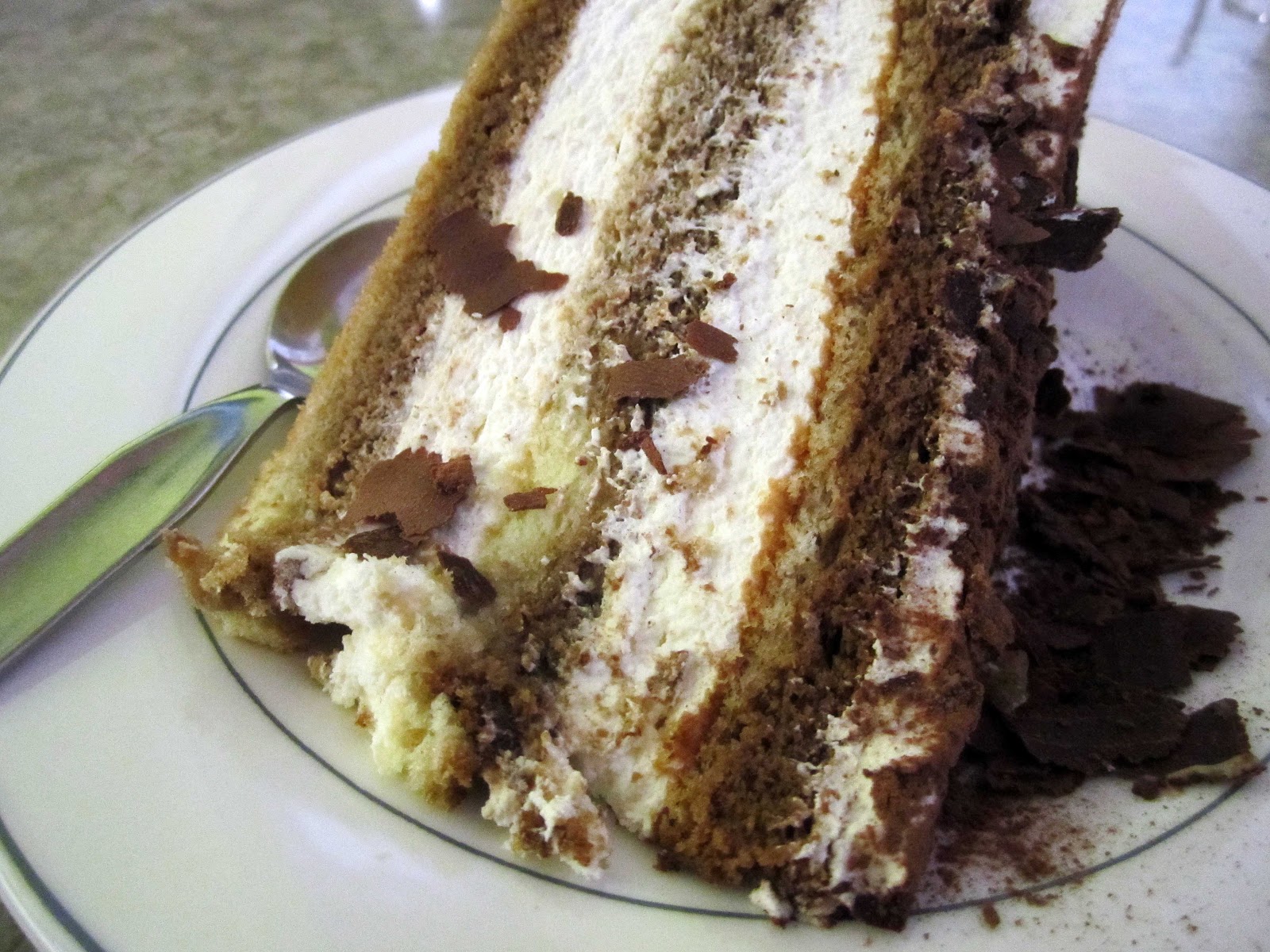
This was a relatively lazy day for us – every other day we had tours booked, starting early, but this day we slept in and, only later, booked ourselves tickets to a performance of the local horses and dancers (more on that in a future blog). Back in town later, we checked out the exhibits in the local toy museum, then decided it must be time for cake! This time I chose a divine tiramisu, an international classic, and Sarah had delicia de almendra, or almond delight. I’m reliably told it was indeed delightful!


Cake nine:
I don’t know why I don’t have a photo of cake ten – Sarah must’ve gulped it down before I had time to shoot it! We were at Arturio’s, another of Trujillo’s rather excellent culinary establishments, where I indulged in what was called a fruit soufflé, though it was actually layers of sponge cake and cream with bits of succulent fruit thrown in to the mix. It was light and finger-licking good.

And so ends this little tour of the tortas of northern Peru. Astoundingly, I didn’t put on any weight on our tour, probably because we did a ton of walking, but I wouldn’t recommend trying a tour like this without plenty of exercise. I do, however, recommend sampling the sweet delights of Peru.

22 August 2012

The Bog Blog


A toilet tour of northern Peru ...


Bog number one:
At El Museo de la Nacion in Lima, the biggest chamber I’ve ever seen anywhere in the world – big enough to hold a small party and appropriate enough for the cavernous building in which it was located. I had tried several other toilets but all were locked or out of service, so I asked the security woman where I could find a toilet and she directed me to this ballroom of bathrooms.


Bog number two:
At the Embajador Hotel in Chiclayo. The toilet with a view – or, more accurately, the toilet where you can be viewed! It’s a high-ceilinged room, with perhaps a 20-foot stud – with windows at the top along one wall, which fronts on to a corridor and a small inner courtyard. The windows are permanently open and so high up that they’re impossible for anyone without a tall ladder to close – not something your average tourist carries in their luggage. Presumably they’re open to allow steam and assorted bathroom-specific smells to escape but this also means that anyone feeling even vaguely perverted in the two rooms overlooking the courtyard can also overlook you at your ablutions – not the most comfortable way to complete the daily necessities of life.


Bog number three:
At Huaca de la Luna, near Trujillo. Is this setting beautiful or what?
Huaca de la Luna, and the nearby Huaca del Sol, are archaeological sites of the Moche, or Mochica, civilisation, dating from about 100 to 800 AD, and they are impressive. Huaca de la Luna is an adobe-brick pyramid-shaped structure that appears to have served a religious and ceremonial religious function. It has beautifully coloured sculptural friezes, including one huge wall panel that is seven registers and perhaps 60 feet tall.

I didn’t actually get to use this toilet, as Sarah and I had enjoyed a very thorough tour of the site with our lovely English-speaking guide Henry, so were holding up the Spanish-speaking group and had to rush back to our tour van. The mountain in the background of this image is called Cerro Blanco, or White Mountain.


Bog number four:
At the toy museum, in Trujillo. The toilet was carefully camouflaged with a wallpapered door to match the surrounding wall, the entrance thereby not distracting from the exhibits which surrounded it: to the left, shelves housing dolls, a wooden mototaxi, and an old half-deflated ball; to the right, a pair of colourful, traditionally dressed Peruvian dolls; and, in the foreground, a cabinet displaying a large collection of toy soldiers from France and England dating from 1920 to 1925.

Bog number five:
At the Colonial Hotel in Trujillo, from the first floor balcony where our room was located. There was nothing particularly remarkable about the toilet itself, but it was a nice hotel, with plain but comfortable rooms, and plenty of indoor and outdoor seating areas. It’s only a block and a half from the city plaza, with a nice café next door for breakfast and other meals, and a tour company on the other side, which had friendly staff and reasonably priced and well run tours. Oh, and the toilet was clean too!


Bog number six:
At the Cruz del Sur bus station in Lima. For some unknown and obviously bizarre reason, the cisterns of the toilets were protected by metal grids, padlocked in place. I couldn’t help but speculate as to why: Peru is plagued by toilet thieves? passengers of Cruz del Sur buses have a penchant for fiddling with the inner workings of the cisterns – a fetish with ballcocks perhaps?

This photo was a little tricky to capture. The gloom of the room meant I needed to use the flash and I couldn’t help but wonder what the service staff thought of a bright flash of light suddenly illuminating the end cubicle: had some alien being beamed down from a galaxy far far away? was the kinky gringa taking a photo of some forbidden fruit to instil longing in a distant lover? I avoided making eye contact with the woman on exiting the cubicle and washed my hands with alacrity in order to avoid any difficult questions.