Showing posts with label Bolivia. Show all posts

01 January 2014

Inspiration for 2014

I’ve spent some time over the past week adding inspirational quotes to some of my favourite photographs to make myself a new set of desktop wallpapers for 2014 and I thought I’d share them with you all.

If anyone wants hi-res versions of these, just get in touch.

Ancient volcanoes, Reserva Nacional de Fauna Andina Eduardo Avaroa, Bolivia
 
Red deer on bank of Madre de Dios River, Manu National Park, Peru
Confluence of the Waipa and Waikato Rivers, Ngaruawahia, New Zealand (the town where I was born)
 
Waterlily, Wat Damnak pagoda, Siem Reap, Cambodia
Convent of Santa Catalina, Arequipa, Peru

Street art, Santiago, Chile

Hoatzin, Manu National Park, Peru
Banteay Kdei, Angkor World Heritage Site, Cambodia


Laguna and flamingos, Reserva Nacional de Fauna Andina Eduardo Avaroa, Bolivia

Wintergardens, Auckland Domain, New Zealand
 
Zhouzhuang water town, near Shanghai, China

Mt Eden, Auckland, New Zealand


22 October 2012

Erin and the little sticker girl


I love the randomness of travelling! Today I had a chance encounter that has the potential to be a huge help to Globalteer in terms of fundraising and met a genuinely nice person, in many ways a like-minded soul.

To begin at the beginning … after breakfast at the hotel this morning, I set off to walk up Calvary Hill … but it seems I’m not destined to ascend to religious heights. I got to the top of one street, a lung-busting walk in itself – remember that Lake Titicaca is at 3812 metres (12,507 feet) above sea level – to find I was only about half way up and the actual pathway, which my street joined, was an uneven, slippery-surfaced, ankle-challenging mass of cobbles that looked even steeper. I gave up the idea and, instead, headed down to the little church at the bottom of the climb and wandered from there around Copacabana’s back streets.


That worked up an appetite, so I enjoyed a delicious vegetable lasagna at one of the myriad of restaurants and cafes in the main street. Then I began attracting waifs and strays. First, while enjoying my lunch, I got hit on for money by a poor shoeshine man from Tacna, Peru, whose friend had told him he would earn a good living from all the tourists in Copacabana so he could support his five sisters and two brothers, all younger than him and motherless. Instead, he had found that tourists either wear walking shoes that don’t need polishing or they don’t really want or need their shoes shone, so he had been living on the streets.

After lunch, a black dog attached itself to me as I walked along the beach again. And, later, as I sat in the main street having a coke, a brown dog came and planted itself on one of my feet!
My friend, the black dog, at the beach


For about 30 minutes, I sat, nursing that Coca Cola, scribbling notes for my blogs in my notebook and generally watching the world happen around me. A young man, afflicted with something akin to thalidomide victims, was using his shortened and misshapen limbs to craft jewellery and sell it to random passersby. A woman, from a restaurant across the street from me, took pity on a street dog, struggling to walk on its three good legs and one badly damaged limb, bringing it a plateful of lunchtime leftovers and stood guard while it ate, scaring off the able-legged dogs that hovered eagerly nearby. My shoeshine friend walked steadfastly up and down, seeking out potential customers but either coming up empty or being chased off by overly protective restaurateurs (I was glad I had helped him out a little). Tourists wandered up or down the street, trying to decide where to eat or drink, or what souvenirs to buy from the many stalls full of eye-catching sweaters, caps, etc.

Another woman chose the café where I was perched, taking a seat on the bench that mirrored mine on the opposite side of the doorway. She was perhaps 20 or more years younger than me and looked like a traveller, dressed in a multi-coloured cotton skirt, a black top and a short denim jacket. Initially, we didn’t speak.

A cute little Bolivian girl was hovering around (I later discovered her name was Nina), playing in the street, running up and down, amusing herself with small things as children in poor countries do. She seemed to belong to the café two doors down.

The other woman greeted her, the little girl approached and was rewarded with a present, a little sticker that the woman magically produced from her purse and stuck on to the back of the wee girl’s hand. The wee one beamed with delight and raced off to show whoever was in the café – it turned out to be two young male friends who then craved stickers of their own.


The woman and I struck up a conversation based entirely on what had taken place: I asked what she had given the girl; she told me she always carries stickers for exactly these situations (note to self: excellent idea!); I commented that it was so much better than sweets … and thus began our contact.

The woman’s name is Erin and she is nearing the end of a two-year sabbatical, during which time she has been travelling and volunteering her way around the world. (You can read more about her fascinating travels, her ‘living mini’ philosophy and her generous donations to good causes on her website.) She describes herself as an ‘adventure philanthropist’, being both a professional travel writer and a self-employed fundraiser, with huge connections in the US, doing pro bono work for organisations like Globalteer, offering advice on ways they can expand their fundraising activities. Perfect, plus I like her philosophy. Erin and I chatted, exchanged travellers' tales, brief life details and business cards, then went our separate ways but I’m sure we’ll be in touch again very soon.

(Erin has since written a book about her two-year adventure and her philosophy for adventure philanthropy. It's a great read and very inspirational!)


I went back to the beach, drawn by Titicaca’s blue blue waters and keen to get more photos of the quirky pedal-powered boats and the lake as it sparkled in the late afternoon sun. Later, I treated myself to a delicious dinner, with a sunset view to die for, at the hotel restaurant, and another early night.

21 October 2012

Chillaxing in Copacabana

Walk through to Bolivia

Ironically, it’s 32 years ago today since my ex and I got together and here I am sitting in an outdoor courtyard restaurant in Copacabana, Bolivia, awaiting my pizza lunch while he’s probably still living the quiet life in Auckland, still slaving away at his business. Funny where life takes you.

Strangely enough, I was chatting away to a New Zealander on the bus here from Puno this morning, though she lives in Sydney, Australia, with her family. Stef is part way through a degree in International Studies so I’m guessing she’s about 20. She’s been travelling for 7 months, having a gap year. I do wonder where kids her age get the funds to travel for a year – maybe generous parents, though she had done 3 months in a summer camp in Canada, which would’ve helped. What a great start to a young life a trip like hers would be – opening her eyes to what the world has to offer and the endless possibilities before her.

The Transzela bus left Cusco at 10pm and got to Puno at 5am this morning. I slept on and off as I had sprung the extra 10 soles for full cama – so worth it! Transzela didn’t have the extra luxuries of the Cruz del Sur bus company, with its snacks, hot drinks and blankets but it did have the same seats so was comfortable enough.


The next bus left Puno at 7.30am, so I had a long wait doing nothing but people watching, and we reached Copacabana at 12noon. The border was fairly quiet – just two buses passing over and hardly any local sales vendors like the last time I crossed here – maybe ’cause it’s a Thursday. The Bolivian immigration officer looked long and hard at the ‘fine’ stamp I got last time I came to Bolivia but still let me in, luckily. Another couple of stamps in the passport – this one contains entirely South American countries … so far.

Not a bad view out my window

A man from the La Cupula Hotel was at the bus to meet other guests so I didn’t have to walk up the hill to the hotel. It’s a quirky little place with fabulous views out over the bay so should be a very relaxing place to chill for a couple of days.

Though it looks beautiful on the surface, Copacabana is more decrepit than I remember from last year. I went for a walk along the waterfront after lunch and it is full of rubbish, the water of Lake Titicaca looks disgustingly polluted and it stinks.


I explored around the church and it’s looking much the worst for wear as well – walls mouldy and crumbling and the whole place has an unkempt look, which is inexcusable when you consider the town taxes every single person who enters the town 1 Boliviano, supposedly as an entry fee for the sanctuary, plus this place is the Basilica of the Virgen de la Candelaria, the most famous pilgrimage site in all of Bolivia. 


The Basilica houses the black Virgin, carved in a dark wood in 1576 to celebrate an incident where the Virgin Mary appeared to some fishermen during a terrible storm on Lake Titicaca and led them to safety. Considering the Basilica and the lake are the main reasons anyone comes to Copacabana, you’d think the locals would take a little more pride in them.


There’s a lot of half-built construction around the streets, accompanied by piles of sand and brick as if prosperity is just around the corner … but, if this is anything like Peru, it could look like that for years!

Copacabana is even more sleepy than I remember as well, with restaurant staff seemingly reluctant to stir themselves to serve you. Unless you’re part of the midday bus changeover crowd, then you’re just an intrusion.

I think that sleepiness is catching. There’s nothing to do here – the hotel rooms have no televisions, I didn’t bring my laptop and I don’t have any books so can’t laze in one of the hotels lazy-looking hammocks reading. So, feeling pretty tired from the journey, I lay down for a nap at about 4pm and didn’t really get up again - except to change into my nightie and actually get into bed – till 5am, and then I kept snoozing till about 7.30. I am still getting over a cold but I think the real problem is Copacabana-itis!


07 December 2011

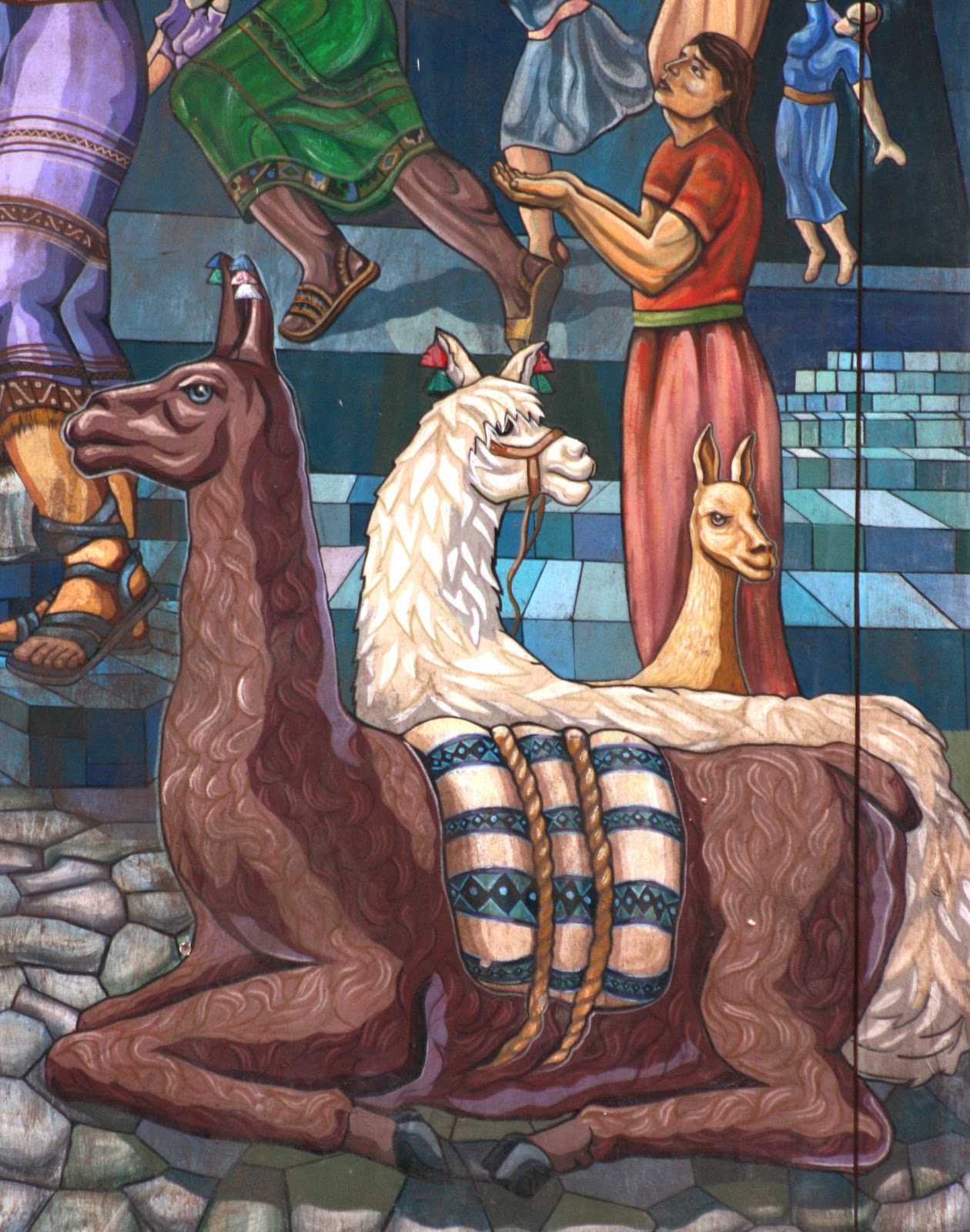
I love llamas!


Not only are llamas extremely cute animals, they are also useful and unusual.

Llamas have a fine undercoat, the wool from which can be used to make clothing and handicrafts, and their coarser outer hair is used for wall-hangings and rugs (I have one!). Just as llamas come in a variety of colours, so does their wool range in colour from white or grey to reddish-brown, light and dark brown, and black.

Llamas have been used as beasts of burden for centuries. They are sturdy and sure-footed, making them ideal beasts for bearing heavy burdens along the narrow mountain trails of the South American mountains.


And now for the unusual bits ... According to Wikipedia, llamas mate lying down – it’s called a kush position (sounds cushy to me!) – which is rather unusual for such a big animal and, also unusual for their size, their mating is no quick fling. Instead, they’re at it for between 20 and 45 minutes! Plus, the sexually aroused male makes a gargling sound – called an orgle – before and during the mating process.

But wait, there’s more ... As the tongues of female llamas (called dams – the llama, not their tongues!) cannot reach more than half an inch outside their mouths, they are not able to lick off their babies. I presume the foetal sac comes off when the baby llama (called a cria) rolls around on the ground. Instead of bonding with their offspring through the licking process, the mummy llamas nuzzle their babies and hum to them. I haven’t witnessed the humming but doesn’t it sound delightful? I wonder if they have favourite tunes.

This heavily pregnant female was rolling on the ground like a horse does. I can just imagine her humming
to her baby.

Llamas also have a reputation for spitting. A local once told me that llamas never spit at beautiful women, only at the less beautiful. I can verify there is some truth to that statement as I have had a llama spit at me. However, when I asked various other locals about this statement recently, they said they’d never heard of it, so maybe it’s just a good story to tell gullible tourists!

Wiki says that llamas which have been reared correctly rarely spit at humans, though they do spit at, kick, neck wrestle and ram into each other. These actions, by the males not the females, form part of the disputes they have to establish dominance in the herd – their way of moving up and down the social ladder of llama society. Apparently, the females do also spit, as a way of controlling other herd members – an interesting concept.

Is a nuzzle or a neck wrestle about to happen?

Though this spitting, kicking and neck wrestling all sounds rather aggressive, llamas are family animals and do look after each other. When threatened, a llama will emit a warning bray to alert the rest of the herd, and llamas often hum to each other as a way of communicating. As well as these sounds, they also make groaning noises or produce a 'mwa' noise when they’re afraid or angry. Strange then that humans use ‘mwa’ as an expression for sending someone a kiss.
A herd of llamas grazing in Bolivia
The llama is a symbol used in most of the Andean nations in South America. Here in Peru, you can buy soft toy llamas made of llama wool, they appear in paintings and on murals, and their image is frequently found on t-shirts.

As the word llama is pronounced yama in Spanish, puns are made on the name – for example, I have seen a t-shirt with a cartoon of a llama riding a motorbike, with the word Llamaha written beneath.
Peruvian women and children, dressed in traditional costume and leading llamas, are a common sight in central Cusco. Tourists can pay to have their photos taken with the women and/or children and/or llama.

Llamas are not to be confused with their close cousins the alpaca and the vicuña ... more on those creatures in a future blog.
The real thing ...
and the cuddly imitation

12 November 2011

Welcome to Bolivia!

The Litoral bus to La Paz left the bus station at Cusco soon after 10pm on Friday 28 October, with me sitting in seat 2, right up front behind the driver, next to a young male traveller – I have no idea of his nationality, though he spoke Spanish like a native, so maybe he was South American of some description. It was comfortable enough, and they gave us thick, cosy blankets, so I snoozed on and off till we reached Puno about 5am. We only stopped there, on the roadside, to let off passengers, then continued on to Despaguerdo for the border crossing from Peru to Bolivia.

Here, Litoral let us down, I later discovered, as they were meant to guide us through the process. Instead, one of the drivers simply told us, in Spanish, to get off the bus and line up. A local official went up and down handing out forms to the locals, but wouldn’t give any to the gringos, not just me. After an hour and a half, I made it to the head of the queue and had my passport stamped out of Peru. At the other side of the river bridge that forms the border, I was stopped by a Bolivian official and marched in to their office. They asked about drugs and checked how much money I had and searched my bag, but there was no paperwork to complete. Two other gringos were treated the same way so I didn’t think anything of it. And it wasn’t till I got back to the bus that I realised my passport hadn’t been stamped – it was too late to go back. And it wasn’t till I was checking in to the hotel in La Paz that I discovered what a problem the lack of a stamp and official piece of paper I was also supposed to have completed would be – I could be fined when I left the country so would have to spend Monday morning visiting the Immigration office in Uyuni to get it sorted. I later discovered this is a common scam to get tourists to pay the fine, which is then pocketed by the immigration officials. It wasn’t a good start to my holiday!

But the rest of the day was great. Tony, the travel agency’s guy, was at the bus station waiting for me, even though we were 1½ hours late arriving, and I was whizzed off in a van to my hotel – which was nice, with free internet in reception and friendly staff, and I had a large comfortable room. Tony gave me all the vouchers for my future travel and said he would meet me the next day.

I was feeling very tired, and the business of my immigration paperwork made me feel a bit down. But I hadn’t eaten since the previous evening so I knew I had to pick myself up and go out. And I was so glad I did.

The city was alive, full of people and buses and cars. It has motorways and overpasses and roundabouts, things Cusco does not. Its suburban houses and buildings seem mostly to be made of red brick, but in the city centre it has some interesting old architecture, buildings that look European but not necessarily Spanish colonial.

I had a late lunch in a delightful restaurant that looked like it hadn’t changed from the 1920s, with old family portraits and film star photos hung in elegant frames on the walls, and memorabilia stacked on every available surface – an old cash register, typewriter, camera, phonograph – and art deco light fittings that a collector in the West would die for! And the food was pretty good too.

When I stepped back out on to the street, with 3 empanadas in a little bag for my supper, there was a parade in progress on the other side of the street. It was some kind of traditional cultural display – and it was fun! Some of the characters were weird – heavily wrinkled old men dressed up in white lacy petticoats with angel wings on their backs, one performer with a green dragon head, guys with doll-like masks and bulging blue eyes. The performers were quite happy to be photographed and, when I showed them the photos, we shared a laugh and simple conversation. There was a carnival atmosphere and my smiles were quickly returned. I returned to the hotel, very tired but having had a lovely afternoon!

Angels?

Look at that face!

Conquistadors?


I shared a laugh with these two old gentlemen

A knitted mask

A doll-like mask


06 August 2011

Border run to Bolivia: day three

Saturday 30 July, and another early start. The lovely man from Allways Travel (highly recommended!) arrived at our hotel at 7.00am, took us to the bus station, showed us where to pay our departure tax and put us on the right bus … to Bolivia.

It was a double-decker bus so we had a good view as we travelled round Lake Titicaca, then inland towards the border. We passed a big cattle fair in one town, and then went through ‘blue toilet’ country – for some unknown reason every house had an outdoor toilet painted bright blue!


At the border we had to get stamped out of Peru by both the Police and Immigration, then we walked a few hundred metres across the border to get stamped in to Bolivia. The formalities went smoothly enough and we were soon back on the bus for the 10-minute ride to Copacabana. This is apparently the original Copacabana – the famous beach in Rio was named after it.


We had a room booked at Hotel Gloria, which turned out to be a very short walk up the road from the bus stop. And it was glorious – we had a twin room, with a large double bed each and a glorious view out over the lake. It was noon when we arrived, so once we got settled, we walked back to the main street and found a restaurant for some lunch.


Copacabana is a relaxed little town, like a resort but a little bit shabby and a little bit hippy – full of the backpacker type of traveller, not the rich tourists. It’s comfortable, and slow, and laid-back. After a leisurely lunch, we cruised slowly down the main street to the beach – you’ve gotta love a main street where the tarmac eventually turns into sand! – then back up again, checking out the shops. I got a Bolivian t-shirt and Kiri bought some bits of jewellery.


As we were walking around we noticed many of the cars had been decorated, with paper decorations and flowers and feathers amongst other things. The numbers of these cars increased as we approached the main square, and there we discovered what was happening – this was the Benedicion de Movildades, the blessing of automobiles. Apparently, this is a twice-daily occurrence, where priests bestow a ritual blessing on the vehicles and a ritual offering of alcohol is also poured over them, consecrating them for the journey home.


The blessing occurs in front of Copacabana’s Basilica de Virgen de la Candelaria, a gleaming white church, with Moorish-style domes and colourful ceramic tiles. The Virgen de la Candelaria is a short wooden statue of the Virgin Mary, which was sculpted by Inca craftsmen in 1576. It is believed to work miracles and is the most important pilgrimage destination in Bolivia. We had a quick look at the beautiful interior of the church and I couldn’t help but admire it’s striking architecture.

More cruising around the streets, a beer in the sun at a café in the main street, a stroll along the beachfront promenade licking a delicious ice-cream, and later a scrumptious dinner … all in all a wonderful way to chill out in charming Copacabana.