Showing posts with label llama. Show all posts

23 May 2012

On the road from Puno to Chivay


I had no idea how impressive the scenery would be as we drove out of Puno in the chilly early morning, heading for the little town of Chivay in the Colca Valley.

Our first stop was at Lagunillas Lake, where the blues of the lake and the sky competed for our attention – which was more blue? The sky was sprinkled with the whispiest of clouds and the lake surface peppered with flamingos – so pretty.


Soon after Lagunillas, we had our first sight of Misti, the active volcano that looms menacingly over Peru’s second largest city, Arequipa. Its shape echoes the cone-like perfection of Japan’s Mt Fuji, and Mt Egmont, in my native New Zealand.


At Pampa Cañahuas, in the Aguada Blanca National Park, we turned off the main Puno-Arequipa highway and made a short stop for a mid-morning snack. On the other side of the highway, there was a huge rocky outcrop, with ancient rock formations that reminded me of Cappadocia, in Turkey.


As we rode on, the skies were breathtakingly huge, the llamas and vicuña dwarfed by the grandeur of the big country that surrounded them. One herd of llamas played follow the leader down a steep hillside.


We stopped again at Patapampa, at 4800 metres, the highest point on our journey. As well as the ubiquitous roadside souvenir sellers, the ground was littered with artificial piles of small rocks. The bus company’s pamphlet said these were placed ‘by travellers and local residents, who place them as part of a ritual related to resting, strength to continue with the trip, protection, health and permission to enter somewhere new.’ I added a small rock to one pile.


At Chivay, we joined Luis the guide and a small group of travellers who would be our companions for the next day and a half. At our charming hotel in the nearby village of Choraque, we ate a delicious lunch and met the local guard 'dog', a llama/alpaca-cross, a critter with attitude. I got spat at quite early on, as did one of the men when he tried to persuade the beast to move away from the entrance gate. ‘My, what big teeth you have!’


In Chivay, after lunch, we explored the town, enjoying the beautiful paintings in its lovely old church, the bartering and banter of the sellers in the local market, the delicately embroidered and very colourful traditional dress of the local women. My friend Marianne and several of our group also enjoyed a warming soak in the local hot pools and, returning to the hotel, we ate a delicious meal and retired quite early to a heated room and comfy beds. What a superb day!


07 December 2011

I love llamas!


Not only are llamas extremely cute animals, they are also useful and unusual.

Llamas have a fine undercoat, the wool from which can be used to make clothing and handicrafts, and their coarser outer hair is used for wall-hangings and rugs (I have one!). Just as llamas come in a variety of colours, so does their wool range in colour from white or grey to reddish-brown, light and dark brown, and black.

Llamas have been used as beasts of burden for centuries. They are sturdy and sure-footed, making them ideal beasts for bearing heavy burdens along the narrow mountain trails of the South American mountains.


And now for the unusual bits ... According to Wikipedia, llamas mate lying down – it’s called a kush position (sounds cushy to me!) – which is rather unusual for such a big animal and, also unusual for their size, their mating is no quick fling. Instead, they’re at it for between 20 and 45 minutes! Plus, the sexually aroused male makes a gargling sound – called an orgle – before and during the mating process.

But wait, there’s more ... As the tongues of female llamas (called dams – the llama, not their tongues!) cannot reach more than half an inch outside their mouths, they are not able to lick off their babies. I presume the foetal sac comes off when the baby llama (called a cria) rolls around on the ground. Instead of bonding with their offspring through the licking process, the mummy llamas nuzzle their babies and hum to them. I haven’t witnessed the humming but doesn’t it sound delightful? I wonder if they have favourite tunes.

This heavily pregnant female was rolling on the ground like a horse does. I can just imagine her humming
to her baby.

Llamas also have a reputation for spitting. A local once told me that llamas never spit at beautiful women, only at the less beautiful. I can verify there is some truth to that statement as I have had a llama spit at me. However, when I asked various other locals about this statement recently, they said they’d never heard of it, so maybe it’s just a good story to tell gullible tourists!

Wiki says that llamas which have been reared correctly rarely spit at humans, though they do spit at, kick, neck wrestle and ram into each other. These actions, by the males not the females, form part of the disputes they have to establish dominance in the herd – their way of moving up and down the social ladder of llama society. Apparently, the females do also spit, as a way of controlling other herd members – an interesting concept.

Is a nuzzle or a neck wrestle about to happen?

Though this spitting, kicking and neck wrestling all sounds rather aggressive, llamas are family animals and do look after each other. When threatened, a llama will emit a warning bray to alert the rest of the herd, and llamas often hum to each other as a way of communicating. As well as these sounds, they also make groaning noises or produce a 'mwa' noise when they’re afraid or angry. Strange then that humans use ‘mwa’ as an expression for sending someone a kiss.
A herd of llamas grazing in Bolivia
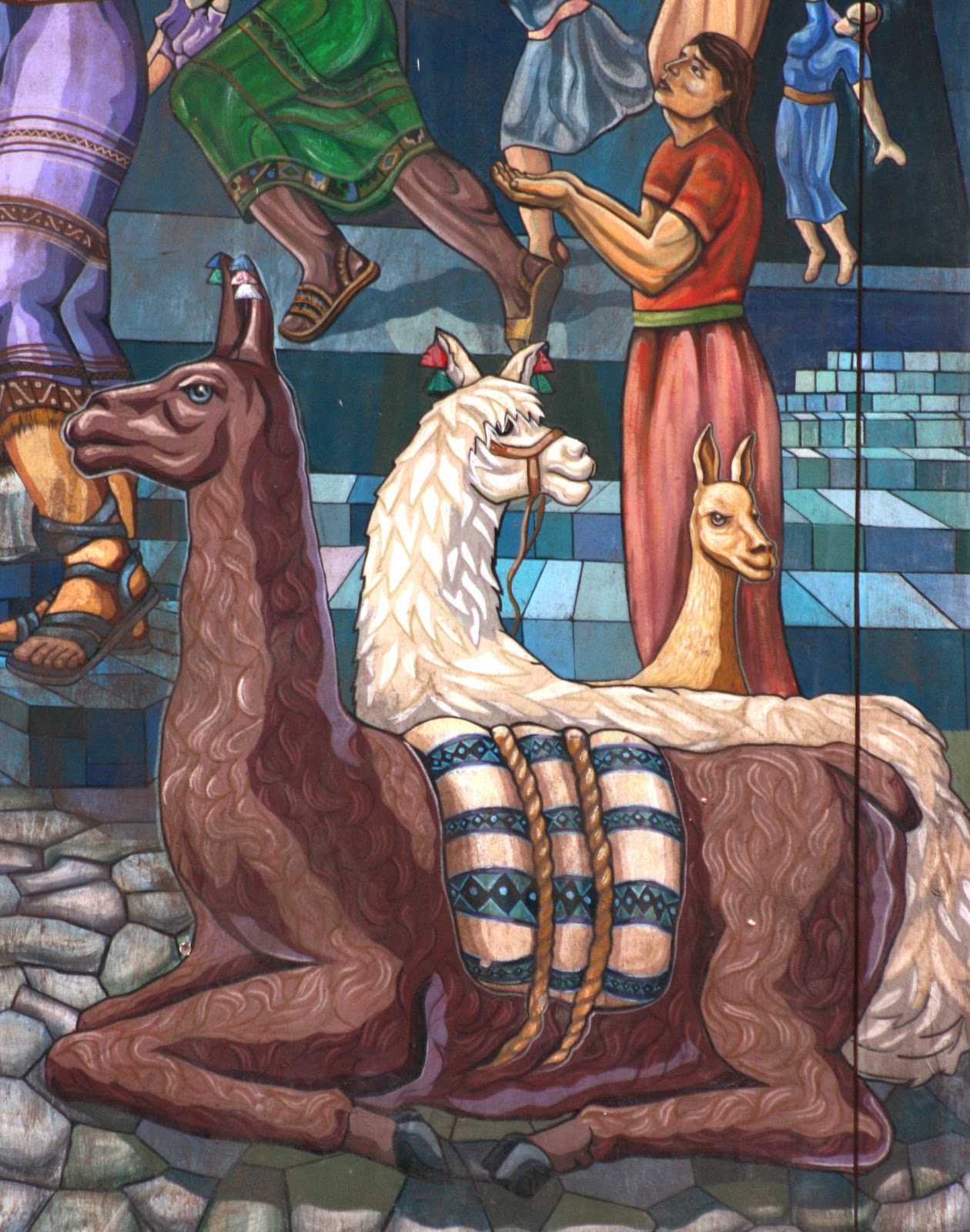
The llama is a symbol used in most of the Andean nations in South America. Here in Peru, you can buy soft toy llamas made of llama wool, they appear in paintings and on murals, and their image is frequently found on t-shirts.

As the word llama is pronounced yama in Spanish, puns are made on the name – for example, I have seen a t-shirt with a cartoon of a llama riding a motorbike, with the word Llamaha written beneath.
Peruvian women and children, dressed in traditional costume and leading llamas, are a common sight in central Cusco. Tourists can pay to have their photos taken with the women and/or children and/or llama.

Llamas are not to be confused with their close cousins the alpaca and the vicuña ... more on those creatures in a future blog.
The real thing ...
and the cuddly imitation

18 November 2011

Bolivia day 5: geysers, lagoons and llama


Compare the height of the steam to the size of the car!

On the last day of our Red Planet Expedition we were woken at 4.15 for a quick pee, brush of the teeth, pack and load. We were aiming to be inside the crater of an active volcano by sunrise – and we were! On the rim of the crater we were at the highest we’d been on this trip – and the highest I’ve ever been in my life – at 5200 metres.

The fumeroles in Sol de Mañana were impressive in the freezing cold morning air. There were a couple of very tall geysers and a lot of gas escaping the ground at high pressure, and some small mud pools – not as impressive as the thermal activity in New Zealand but there we would have been fenced off for safety’s sake. Here, we walked where we liked.

On to another lake, on the edge of which were thermal hot springs. The pool was tiny but several people took a dip, mostly to warm themselves up, I think. I wandered, taking photos of birds in the steam and the beautiful morning light. We had pancakes for breakfast in the restaurant at the lakeside, then headed on to the last amazing lake of our tour.


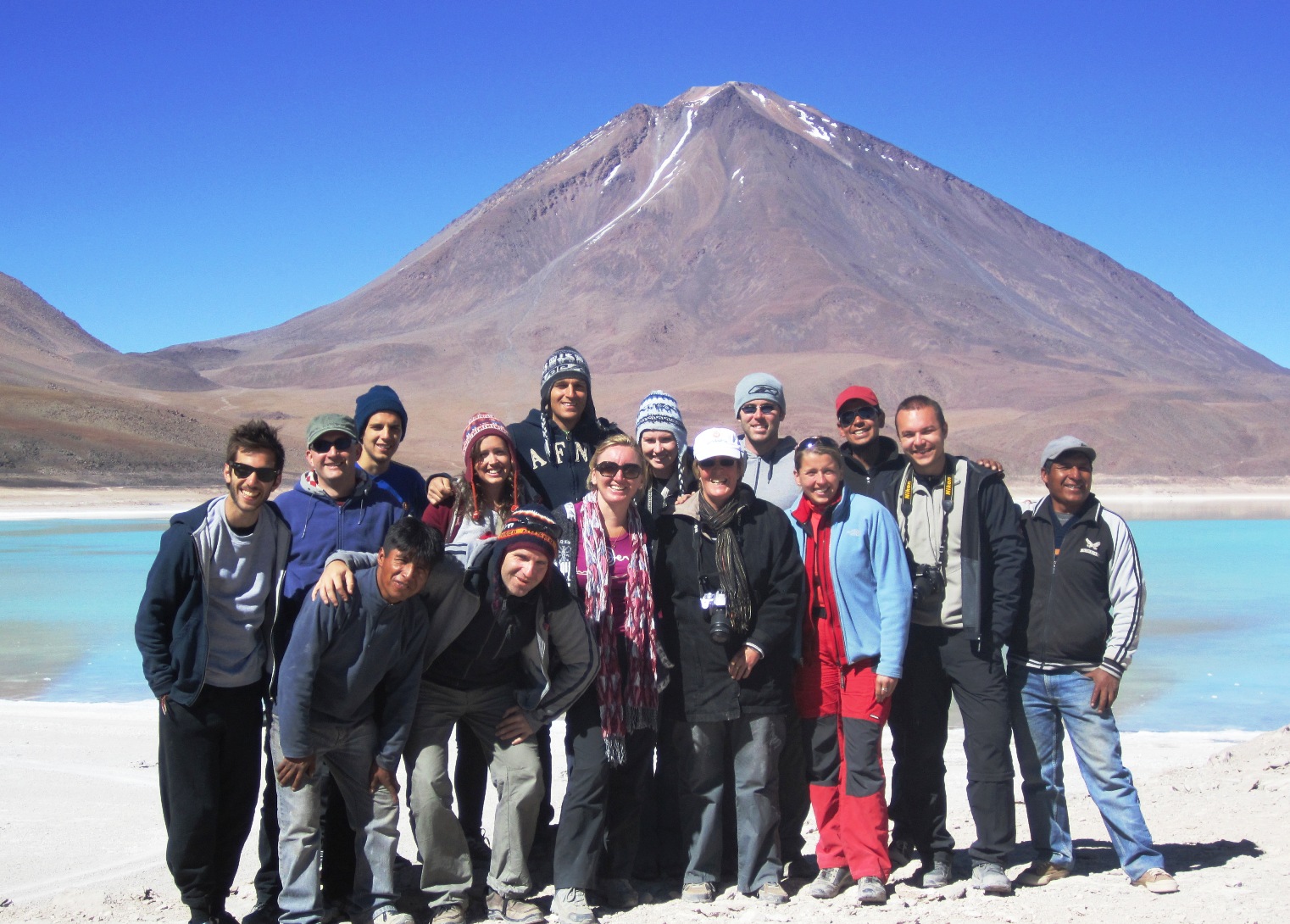
The colour of the Green Lagoon – Laguna Verde – is caused by the high concentration of arsenic and copper in the water. The lake is 17km2, is shallow and toxic. Its waters have been drying up since the massive Chilean volcanic eruption earlier this year, and it may eventually disappear. According to Al the tour guide, the whole volcanic area here in Bolivia has been more active since the volcano in Chile blew, proving they’re connected underground. Licancabur volcano sits behind the lake, in all its Fuji-like magnificence. More great photos! And, as this was our last stop as a group, we also took group photos.

A quick visit to Chile

Our expedition team


Next stop, Chile – or, at least, the border. Some of our group departed there, leaving only 5 of us to return to Uyuni. In such a remote area the border wasn’t fenced off, so I walked over to Chile for about 5 minutes – and I have the photos to prove it. You could, in fact, stand with one foot in each country if you wanted.

From the border, we retraced our route – though not the exact same route – back to Laguna Colorada. Blass, our driver, was happy to stop for photos, so we often did – for landscapes, for more flamingo pictures, for the strange rocks in the Dali desert, for llamas at the roadside, and later for rheas, the South American version of the ostrich. And the red colour of Laguna Colorada looked even more incredible in the morning light so, of course, we had to stop for photos there too.

We drove past more multi-coloured mountains, and climbed up and over more lava flows, where, at one stage, a bunch of small citroen cars on a rally were struggling to climb the slopes. We had lunch at the small settlement of Villa Mar, where there was a large herd of llamas grazing – more photos! – especially of a gorgeous pregnant female, who lay down on the grass and let me get really close.

From there we had a long long drive down straight straight roads back to Uyuni, where we arrived about 6.30pm. Back at the hotel, a hot shower never felt better, nor did a big comfortable double bed, with thick cosy quilts. I was asleep early, dreaming sweet dreams. It had been an incredible 3 days. I will never forget seeing some of the natural wonders of the world!