Showing posts with label yellow flowers. Show all posts

20 April 2015

Spring wildflowers: the yellowing of the countryside

Yellow is the colour of happiness, optimism, enlightenment, creativity, hope, cheerfulness, sunshine … and the quintessential colour of Spring.

Yellow is also the most luminous in the colour spectrum – the colour that most easily catches our eye and the eyes of bees so it’s no surprise that yellow is the most common flower colour. Here in Cheshire, after my first experience of a British winter in thirty years, I have been spellbound by the coming of Spring, and both charmed and uplifted by the yellow wildflowers everywhere. Here are some I’ve seen.


Cowslip (Primula veris)
How many common names can one small plant have? Well, the Cowslip boasts of this numerous and delightful collection: fairy cup, galligaskins, gaskins, herb Peter, key flower, keyword, lady's bunch of keys, lady's candlestick, lady's keys, lady's seal, luck flower, paggles, paigle, paiglewort, palseywort, paralysis, petty mullein, primerole, primet, and St Peter's wort.

As you can probably tell from its appearance, the Cowslip is related to the Primrose. It has close associations with English folklore and traditions, including being scattered on church paths for weddings and beautifying garlands for May Day celebrations. 

And, if you remember your high school English lessons on Shakespeare, Cowslip flowers were the bodyguards of Titania, the Fairy Queen, in A Midsummer Night’s Dream (Act 1, Scene 1).

Primrose (Primula vulgaris)
Primroses are one of the first Spring flowers, blooming as early as December when the weather is mild and continuing on until May. The Primrose was, supposedly, the favourite flower of former British Prime Minster Benjamin Disraeli (1804-81) and so was used as the emblem for the Primrose League, an organisation founded a couple of years after Disraeli’s death and active until the 1990s, whose purpose was to promote the ideals of the Conservative Party throughout Britain. I can’t quite imagine Britain’s current Prime Minster, David Cameron, wearing a Primrose flower in his buttonhole!

Coltsfoot (Tussilago farfara)
Though it looks a little like a dandelion, Coltsfoot is actually a member of the sunflower family. It is favoured by herbalists as its leaves and flowers apparently make an effective cough remedy. However, it has been found to cause problems with the liver so long-term use is definitely not wise.

This is another wildflower with a multitude of common names, including tash plant, ass’s foot, bull’s foot, butterbur, coughwort, farfara, foal’s foot, foalswort, horse foot and winter heliotrope. It seems that all those references to ‘foot’ result from the fact that the leaves are a similar shape to animal hooves.

Wild Daffodil (Narcissus pseudonarcissus)
Most of the Daffodils I’ve seen brightening the lane and roadside verges in Cheshire have been purposely planted there but occasionally I’ve come across small clumps of these golden blooms in more remote spots, in small woodlands or areas of rough scrub. These are the more precious Wild Daffodils – their pale yellow petals and darker yellow trumpets give them away.

The website for Kew, the Royal Botanic Gardens, reports that the Daffodil’s Latin name Narcissus refers to the figure of the same name in Greek mythology. Narcissus fell in love with his reflection in a pool of water and ‘The nodding head of the Daffodil is said to represent Narcissus bending down and gazing at his reflection’. 

Lesser Celandine (Ranunculus ficaria)
Everyone associates poet extraordinaire William Wordsworth with daffodils – ‘I wandered lonely as a cloud …’ – but Wordsworth’s favourite flower was, in fact, the Lesser Celandine, as witnessed by the bloom carved on his memorial plaque at the Church of St Oswald in Grasmere.

I’m not sure what ailments Wordsworth suffered from but perhaps he favoured the Lesser Celandine because it has long been considered a treatment for haemorrhoids, hence its old English name of Pilewort. According to the Ancient Greek physician Galen, sniffing a mixture of the juice of the roots with honey was also good for clearing the head of ‘foul and filthy humours’, though I wouldn’t recommend sniffing anything that also cured piles!

Yellow Archangel (Lamiastrum galeobdolon)
The Yellow Archangel I’ve seen is flowering early this year – it doesn’t usually flower till May and June. There is also a variety of Lamiastrum with variegated leaves, which has been labelled a noxious weed due to its over-zealous invasiveness and should be avoided at all costs – it will sprout from the smallest snippet and has been shown to spread easily from the garden to wilderness areas.


Marsh Marigold (Caltha palustris)
As its name implies, this wildflower likes the dampness of marshes, fens, ditches and the wetter areas of woodland. According to Wikipedia, it ‘is probably one of the most ancient native plants, surviving the glaciations and flourishing after the last retreat of the ice in a landscape inundated with glacial meltwaters.’ 

The Marsh Marigold is commonly known as Kingcup – its Latin name Caltha comes from the Greek word for goblet and its large golden cup-shaped flowers certainly look glorious enough to adorn the table of a king.  

Dandelion (Taraxacum officinale)
Perhaps my favourite yellow wildflower – some might call it a weed – is the humble Dandelion. In places, its flowers are so profuse that the ground appears to be carpeted in yellow.

Not only is it cheerful to behold, it is also a wonderfully useful plant. As it is a good source of beta-carotene, is rich in Vitamin C and the B-complex vitamins and also high in protein, the Dandelion has been used for thousands of years to improve the functioning of the liver, the gallbladder, and the urinary and digestive systems.

And, although I’ve never tried it, dandelion is also widely used to make wine. So, the next time you’re tempted to eradicate these ‘weeds’ from your lawn or garden, think again – and, instead, make use of Nature’s bounty.


There are a multitude of websites if you want more information on British wildflowers, including those of Plantlife, the Botannical Society of Britain and Ireland, Wildflower Finder, and many more.

01 January 2012

Happy 2012!


Twenty twelve is here, and I’m looking forward to an exciting new year! But before I start documenting the events of the new year, I want to share with you how the old year finished off here in Cusco.

As with most countries and cultures, Peru and its people have some traditions that they follow when celebrating the beginning of a new year. In the run up to New Year’s Eve, everyone in Peru likes to buy new clothes and burn their old ones – if they can afford it, that is. Though many of my clothes are becoming tatty (the washing machines here are hard on your clothes, as are the daily activities at school) this is not a tradition I can afford to follow.


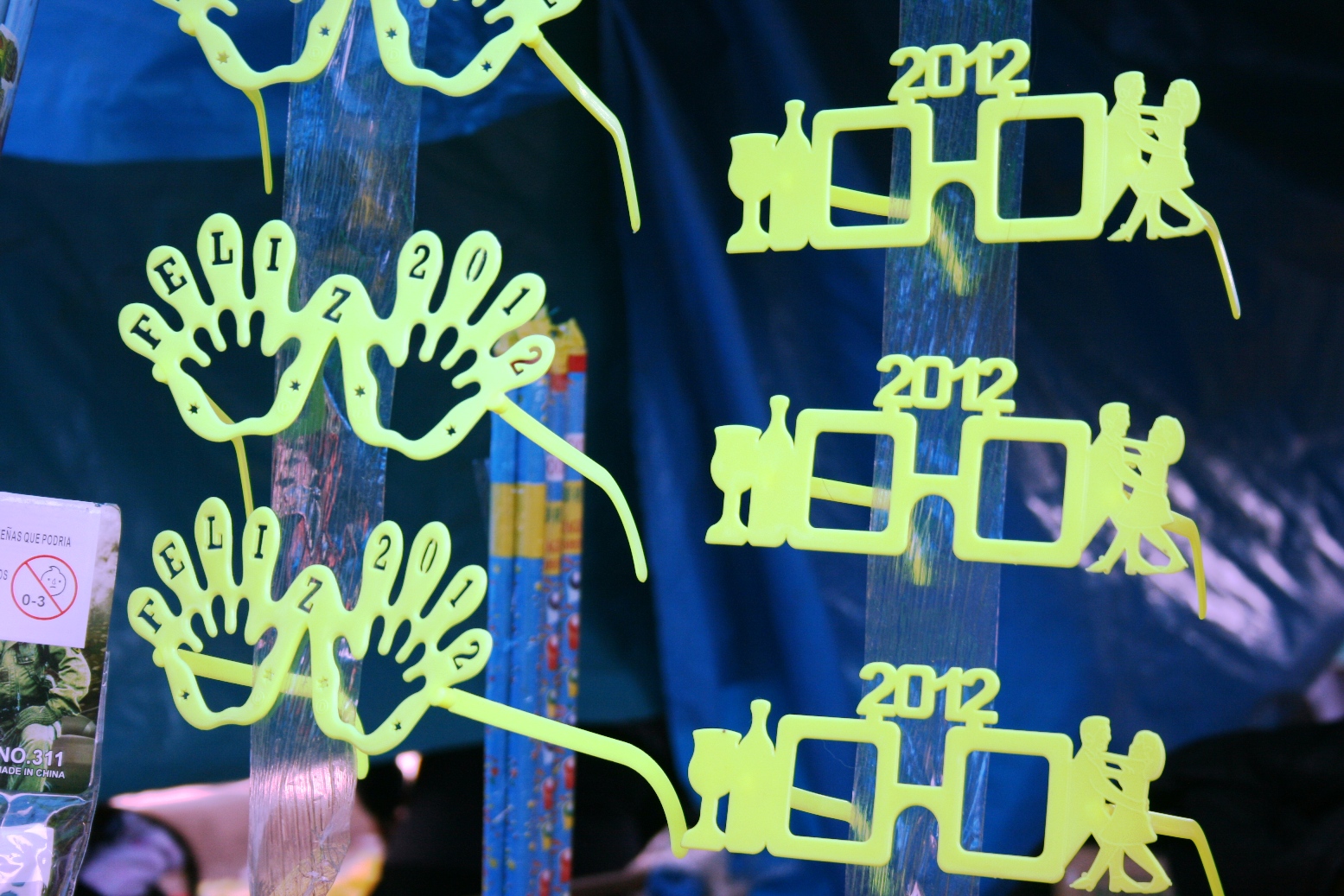
Everything yellow is lucky – there were silly hats and plastic spectacle frames, tinsel and garlands. On New Year’s Eve and the first day of the new year, you are supposed to wear yellow underwear for general good luck, though if you are hoping for love in the coming year, you should wear red underwear and, if more money’s what you desire, you should wear green underwear. I went on a photowalk around parts of the city yesterday and found stalls selling lots of underwear, mostly yellow. You can, of course, cover all your bases by wearing yellow underwear, with red and green flowers or writing on them! This is also not a tradition I am following – yellow is for flowers, not for bras and knickers!


So, one tradition I have followed is the buying of yellow flowers, mostly chrysanthemums. A bunch often comes with a couple of stems of barley – presumably for a bountiful harvest, plus a branch of rue – called ruda here, and a traditionally lucky plant (more on that in a forthcoming blog). You can also buy individual sticks of barley, pinned with fake paper money.


And, speaking of fake money, another tradition is to buy imitations of the items you would like to receive in the coming year. Money is one, but you can also buy small model houses and cars. Most houses have a sacred place, like a little shrine, where they have religious memorabilia, perhaps paying homage to baby Jesus or a favourite saint. The imitation houses and cars are placed near this shrine, in the hope that their patron will help them achieve their desires in the coming year.

Another local custom that I will follow is the sprinkling of yellow confetti around your house. I think my landlady would frown on my doing this around my apartment as she keeps a very clean property but I will be doing it around the entrance to Picaflor House.

Also for sale in the markets were the seeds of the various legumes people eat here. You could buy these in individual packets or as ornaments, in glass vessels or attached to little clay pots, varnished and sometimes adorned with glitter. Presumably the seeds represent the desire to have sufficient food in your house during the coming year.


As in many countries around the world, here in Cusco there were many parties to welcome in the new year, and people gather in the main squares to enjoy the music and dancing, and to count down the hours, minutes, seconds to midnight. The partying actually started well before midnight – when I was walking home at 8pm, after dinner with a friend, there were already many drunken people on the streets. The alcohol of choice seems to be a particularly sweet and syrupy red wine, which I sampled in the market yesterday. It was more like port than wine so I imagine the drinkers will have huge hangovers today.

A young guy selling alcohol at the market, who was happy to give us a free sample and to pose for a photo


The fireworks also started well before midnight – even though they are illegal here, everyone still lets them off. Their illegal status is due to previous accidents that caused large numbers of fatalities. In December 2001, a fireworks explosion set off a huge blaze in central Lima that killed more than 200 people and, in recent months, two unrelated incidents involving vehicles carrying fireworks resulted in the deaths of 16 people, with many more injured.

A small selection of the fireworks available


To celebrate the first day of the new year, you should eat pork as it attracts money – think, for example, of the piggy bank – and piggy banks were also for sale in the markets yesterday. You should not eat chicken or, indeed, any poultry: just as birds can fly away, so can your luck and your money!
Before ... for sale in the market


After ... ready for eating


For some reason that I haven’t figured out, you are also supposed to eat grapes, and there were barrow-loads for sale around town this week. Maybe it’s just the right season for them.


The locals here don’t seem to bother with New Year’s resolutions ... but I always like to have a few things to aim for when I’m thinking about the year ahead. For 2012, these include some new ideas for the wonderful children of Picaflor House, some extra challenges I’ve set myself for my photography, as much travel as I can possibly afford and, later in the year, a move to fresh pastures. Oh, and with the help of a new friend, I am planning finally to climb a mountain (or three), something that’s been on my bucket list for a while now.

Feliz año nuevo para todos mis amigos. Espero que el 2012 sea lleno de amor, dicha y prosperidad.