Showing posts with label wind turbine. Show all posts

13 September 2014

England: A big day out on the Wirral


You name it, we did it: from a historical industrial township and local art gallery jam-packed with treasures to bird-filled parks and a beautiful beach, a day on the Wirral peninsula can provide a wonderful combination of culture and nature. And if you’re not sure what/where the Wirral is, well, it’s that rectangular peninsula of land that sits on England’s north-west coast between Wales and the River Dee on the southern side and the River Mersey and the city of Liverpool to the north.


First stop today was Port Sunlight, one of the finest surviving industrial villages in the UK. It was founded in 1888 by William Hesketh Lever, a multimillionaire businessman, entrepreneur and philanthropist. In 1884 he focussed on selling one product – household soap, the world-famous Sunlight Soap. Within four years the product proved so successful that Lever built a large factory at Port Sunlight. But he didn’t stop there. Lever also campaigned for better welfare and a shorter working day, and supported building, education and medical projects. And he built the village of Port Sunlight to provide his workforce with good housing.

What makes Port Sunlight unique is the way in which the social goals and romantic ideals on which the village was founded and developed have been so successfully integrated into the architecture, landscape and layout of the village. Lever collaborated with over 30 architects in the creation of the village.


The main influence was the regional vernacular of Cheshire and Lancashire, which provided a wide range of styles and features to draw on, from virtually every period of architectural history – meaning there are black-and-white half-timbered houses, some amazing brickwork, tall spiralling chimneys, pretty stucco decoration, interesting window designs and glasswork with Art Deco patterns, sculptural details like gargoyles and carved heads, and black-painted ornately carved gable-ends. The inhabitants are obviously still proud to live in the village as many houses have pretty gardens and colourful hanging flower baskets.

As well as the houses, there are a hotel that used to be a cottage hospital, a school, and a church; the Bridge Inn and the Gladstone Theatre; a small museum; a couple of tearooms; a dell – a park where a stream once ran; and the Port Sunlight war memorial, one of the largest in the UK, unveiled in 1921 and now listing the names of Lever employees killed in both world wars.

Art was another of Lever’s passions. He used his enormous wealth to bring together an outstanding collection of artworks and built the Lady Lever Gallery to give everyone the chance to see and be inspired by it. The Gallery has one of the finest collections of sculpture in Britain and the works are perfectly housed in the two circular rooms Lever built at each end of the building. Two other rooms hold the world’s finest collection of Josiah Wedgwood’s most famous product, jasperware. Outstanding pieces of 18th-century Wedgwood jasperware here include three of only four complete fireplace pieces in the world and the largest vase.


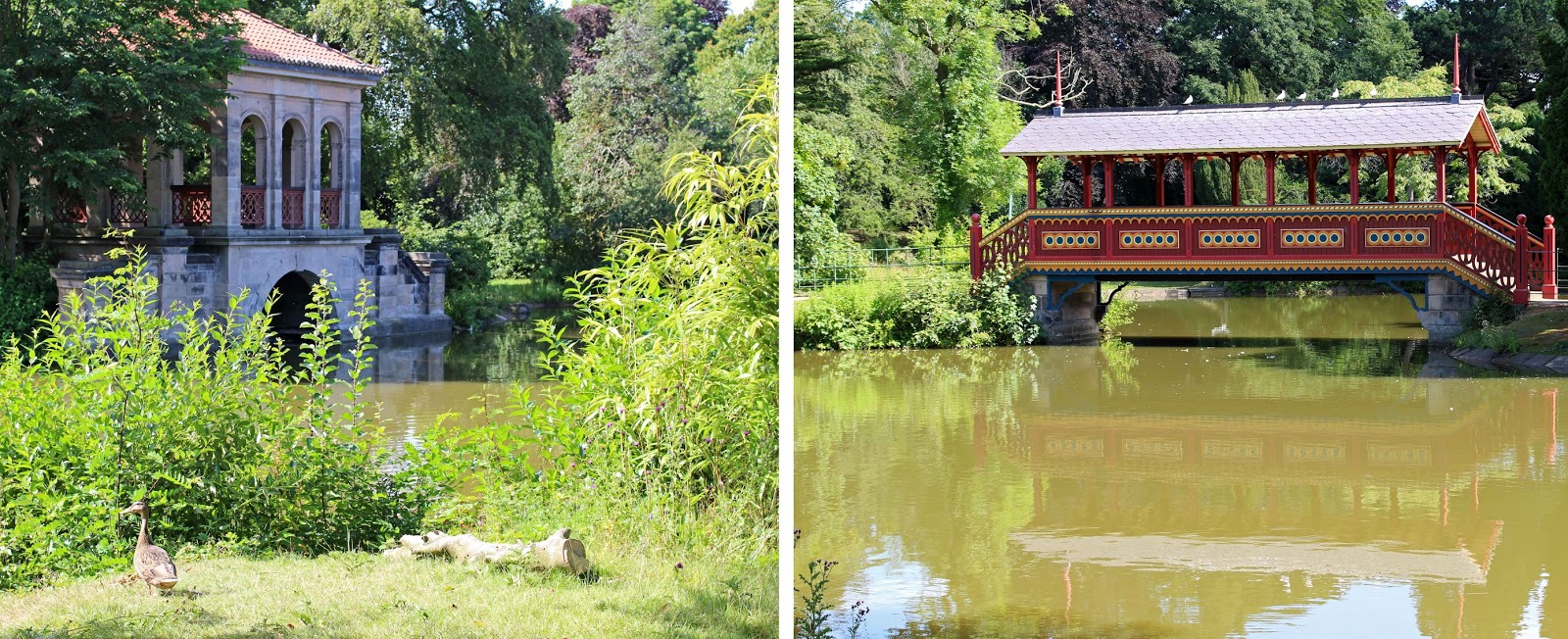
We lunched in the gallery’s café before heading further along the Wirral, to Birkenhead Park, originally designed by Joseph Paxton and an early model for public parks in other cities, including New York’s Central Park. To be honest, I thought it a fairly ordinary park when compared, for example, to Auckland’s Domain but we took a turn around the lake to see a couple of bridges and the pavilion. Of course, what Auckland doesn’t have is squirrels – and I just love squirrels. These ones were plentiful and quite tame, used to begging peanuts off humans, so I managed to get lots of photos of them. There were also plenty of Canada geese, ducks, seagulls, a few coots and a moorhen sitting on a couple of chicks.


Onwards once more, and next was a short stop for a walk around the red sandstone rocks and flowering heather at Thurstaston Nature Reserve, before continuing at a slow crawl through the township of Hoylake – slow, because the town is home to the Royal Liverpool Golf Club where the British Open Championship was to be held later that week, and this was a practice day, meaning hordes of people had flocked to the town to watch some of the world’s best golfers do their swing thing.

The fort at New Brighton, with Liverpool in the background
Our last stop of the day was at New Brighton, right at the end of the Wirral peninsula, with the Irish Sea on one side and the mouth of the River Mersey on the other. We parked and walked along the rather bland and featureless prom to Fort Perch Rock and the lighthouse. There are large numbers of wind turbines off the coast here – still an unusual sight for me – and there are two much closer, on the opposite side of the river, on the outskirts of Liverpool.


After a walk on the sands, dipping my toes into the river waters and taking a ton of photos, we settled in one of the cafés overlooking the town's marine lake and enjoyed a delicious icecream in the gorgeous twilight – the perfect way to enjoy the long, summer evening and to round off another great day out.


11 September 2014

England: Formby Sands and Southport


This was a truly wonderful day that included a visit to an artisans’ market at a lavender farm, rare red squirrel spotting in the forests behind Formby Sands followed by a long walk along that glorious long sandy beach, topped off by a walk along lovely Lord Street, the esplanade and England’s second longest pier at Southport.

Sarah drove, I navigated – most of the time successfully! Up the M6, along the A580, for a visit to Inglenook Lavender Farm. By chance there was an artisan’s market on so we checked out the stalls – there was nothing of great interest, though I was very impressed with the chainsaw sculptures and and we did get ourselves some yummy lunch for a picnic later.

There was only one small field of lavender, which was a little disappointing – I was expecting fields and fields, great expanses of the stuff. Sarah thought it was because they’d already harvested the lavender but there didn’t seem to be anything in the surrounding fields. Still, there were some guinea fowl and some very cute black-faced sheep mooching around in that one lavender field, which made for a few good photos. I actually took lots of photos but failed to get a single one in really sharp focus, so I was annoyed at myself for that. I think my eyes are the problem – wearing distance lenses and trying to focus on a close subject. That’s my excuse anyway!

Onwards, along more country lanes lined with fertile fields planted with various crops and edged and dotted with interesting-looking old farmhouses and barns. We picked up drinks and chocolate muffins at a Tesco supermarket, then eventually found ourselves at Formby, home to the wealthy footballers who play for Manchester United and Liverpool. I’m sure a few of them sped impatiently past us in their flash cars as we drove more sedately through the streets full of their large, expensive houses.

Head past those streets and you’ll come to an area of extensive pine woodlands, towering sand dunes and the Formby Sands, a long and exceedingly beautiful stretch of coastline that borders the Irish Sea. We ate our picnic lunch, then strolled through the woodlands, hoping to spot one of the small population of red squirrels that lives amongst the trees. The reds used to be the only squirrel species in the UK, until the brash American greys were introduced in the late 1800s – not only do they digest acorns better, they also brought the pox virus with them, which decimated the local red population. Luckily, the reds are making a comeback in this haven at Formby and, even more luckily, we managed to spot a couple. They move fast though, so my photos aren’t very sharp.

We then headed across the dunes and down to the beach for a bracing walk in the stiff breeze. It is a popular place for family picnics, long beach strolls, walking the dog or riding a horse, flying kites and wakeboarding, or trying to locate the prehistoric animal and human footprints that can sometimes be found in the silt beds along the shoreline. We didn’t find any of those, but did spot plenty of black-headed gulls and washed-up jellyfish, marvelled at the large array of wind turbines sited out to sea, and could just make out the tower and the huge rollercoaster across the shimmering water at Blackpool.

Our last stop of the day was Southport, a seaside town that was particularly popular around the turn of the 19th century. Its architecture reflects those halcyon days, with several interesting buildings dotting the Esplanade and even more along the main road, Lord Street. There are some grand sculptural features, including carved heads and classical columns, wrought iron verandahs cover the footpaths, and, in the summer months, gorgeous flowering baskets beautify the streets. Lord Street has a wide central strip with an impressive war memorial, bandstand, cafés and gardens – it’s all very grandiose for a relatively small city.


As well as being by the seaside, Stockport has a large seawater lake / lagoon that we walked around – seagulls and Canada geese competed for my camera’s attention, as did the big suspension bridge over the water. Southport also has the second-longest pier in England but we only got halfway along its 1112 metres as it closes at night – we had left that part of our wander till last, thinking to watch the sun set over the water.


Dinner that evening was fish and chips – so appropriate after a day at the seaside, and rather delicious it was too! And then we had a 45-minute drive home, an extremely quiet trip along the M6 as most people were glued to their televisions, watching the World Cup final.