Showing posts with label lighthouse. Show all posts

10 October 2019

Portland : lighthouses


I’d always wanted to stay in a lighthouse so, three years ago, when I got the chance to join a Glamorgan Bird Club weekend in Portland, I jumped at the chance – and I’ve just been back for my third such weekend. Of course, the purpose of the weekend is birding but Portland Bird Observatory and Field Centre is a former lighthouse, now filled with bunk rooms to accommodate the visiting birders who come to check out the rarities this extreme location always seems to attract.


There are, in fact, three lighthouses at Portland Bill, the narrow promontory at the southern end of the Isle of Portland: the Old Lower Light (now Portland Birds Obs), the Old Higher Light (now converted to holiday accommodation; not covered in this blog), and the current operational light.


When you’re at the Bill, especially in stormy weather, it’s easy to see why the lights are necessary – as the Trinity House website explains

The Portland Race is caused by the meeting of the tides between the Bill and the Shambles sandbank about 3 miles SE. Strong currents break the sea so fiercely that from the shore a continuous disturbance can be seen.


The Old Lower Lighthouse, the attached cottage and its boundary wall are all Grade-II listed structures. The current building, built in 1869, is, in fact, the third lighthouse to be built on this site: the first began operating in conjunction with the Old Higher Light in 1716 but was replaced in 1789. The 1869 structure, the existing Old Lower Light, was built, appropriately enough, of Portland stone and is 63 feet high.


Both the Old Lower and Old Higher Lights were decommissioned in 1906 when Trinity House had the current lighthouse built. The Old Lower Lighthouse has had many incarnations since then: for a time in the early 1900s it was a tea garden, and it has also been a family home. By the 1950s it had been abandoned and was derelict but, thanks to the beneficence of Miss Mary Brotherton, the building was saved, restored and converted for use by visiting ornithologists. And so the Portland Bird Observatory and Field Centre was born, in March 1961, and I’m delighted to report it is still going strong, as a registered charity supported by the passion, hard work and generosity of its warden, staff, volunteers and supporters.


The present lighthouse, the red-and-white-striped tower that stands close to the end of Portland Bill, is 135 feet high. According to Wikipedia, Trinity House   

acquired the required land in 1903. The builders, Wakeham Bros. of Plymouth, began work on the foundations in October 1903. Chance & Co of Birmingham supplied and fitted the lantern ... The lighthouse was completed in 1905 at a cost of £13,000, and the lamp first lit on 11 January 1906 ...
On 18 March 1996, Portland Bill Lighthouse was demanned, and all monitoring and control transferred to the Trinity House Operations & Planning Centre in Harwich [in Essex].


Though I haven’t been in, there is a visitor centre in the former keepers’ cottages at the present lighthouse. As well as perusing the various informative displays about the lighthouse, visitors can also climb the tower to enjoy the views from the top. It’s on my list for my next visit to Portland!

13 September 2014

England: A big day out on the Wirral


You name it, we did it: from a historical industrial township and local art gallery jam-packed with treasures to bird-filled parks and a beautiful beach, a day on the Wirral peninsula can provide a wonderful combination of culture and nature. And if you’re not sure what/where the Wirral is, well, it’s that rectangular peninsula of land that sits on England’s north-west coast between Wales and the River Dee on the southern side and the River Mersey and the city of Liverpool to the north.


First stop today was Port Sunlight, one of the finest surviving industrial villages in the UK. It was founded in 1888 by William Hesketh Lever, a multimillionaire businessman, entrepreneur and philanthropist. In 1884 he focussed on selling one product – household soap, the world-famous Sunlight Soap. Within four years the product proved so successful that Lever built a large factory at Port Sunlight. But he didn’t stop there. Lever also campaigned for better welfare and a shorter working day, and supported building, education and medical projects. And he built the village of Port Sunlight to provide his workforce with good housing.

What makes Port Sunlight unique is the way in which the social goals and romantic ideals on which the village was founded and developed have been so successfully integrated into the architecture, landscape and layout of the village. Lever collaborated with over 30 architects in the creation of the village.


The main influence was the regional vernacular of Cheshire and Lancashire, which provided a wide range of styles and features to draw on, from virtually every period of architectural history – meaning there are black-and-white half-timbered houses, some amazing brickwork, tall spiralling chimneys, pretty stucco decoration, interesting window designs and glasswork with Art Deco patterns, sculptural details like gargoyles and carved heads, and black-painted ornately carved gable-ends. The inhabitants are obviously still proud to live in the village as many houses have pretty gardens and colourful hanging flower baskets.

As well as the houses, there are a hotel that used to be a cottage hospital, a school, and a church; the Bridge Inn and the Gladstone Theatre; a small museum; a couple of tearooms; a dell – a park where a stream once ran; and the Port Sunlight war memorial, one of the largest in the UK, unveiled in 1921 and now listing the names of Lever employees killed in both world wars.

Art was another of Lever’s passions. He used his enormous wealth to bring together an outstanding collection of artworks and built the Lady Lever Gallery to give everyone the chance to see and be inspired by it. The Gallery has one of the finest collections of sculpture in Britain and the works are perfectly housed in the two circular rooms Lever built at each end of the building. Two other rooms hold the world’s finest collection of Josiah Wedgwood’s most famous product, jasperware. Outstanding pieces of 18th-century Wedgwood jasperware here include three of only four complete fireplace pieces in the world and the largest vase.


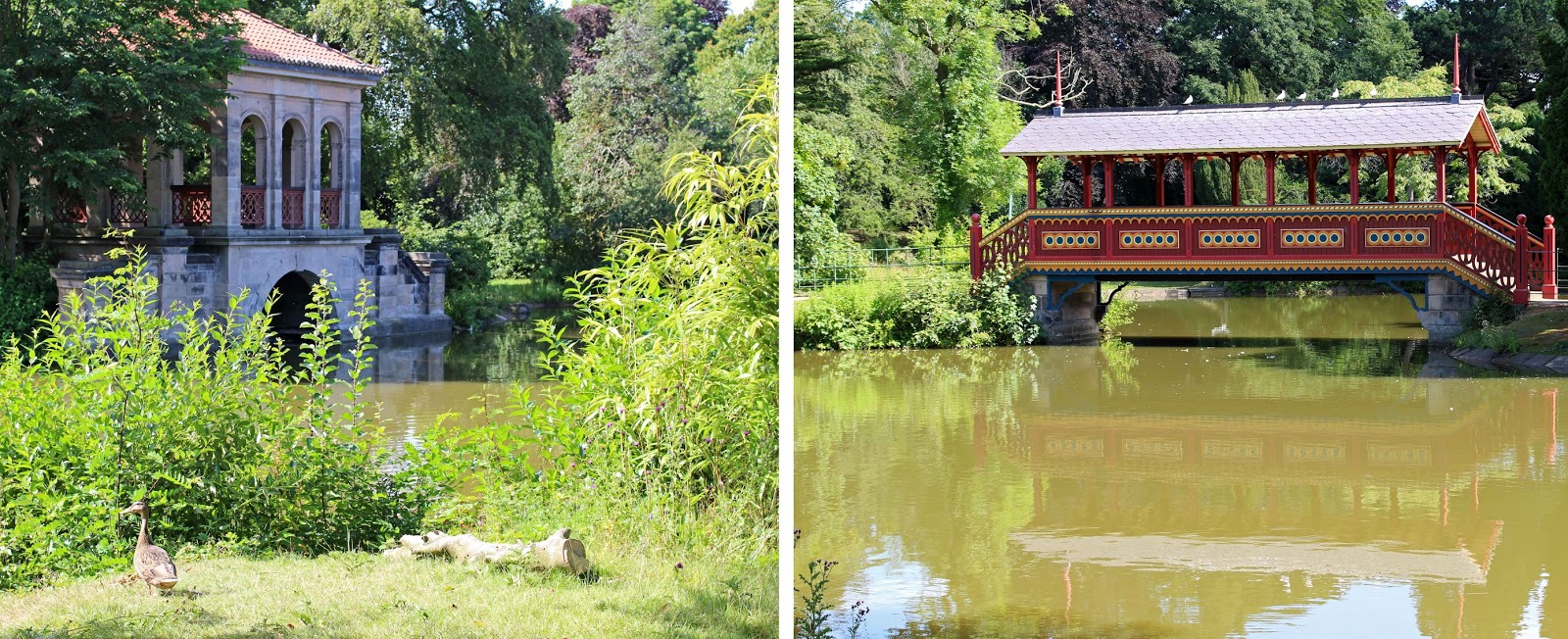
We lunched in the gallery’s café before heading further along the Wirral, to Birkenhead Park, originally designed by Joseph Paxton and an early model for public parks in other cities, including New York’s Central Park. To be honest, I thought it a fairly ordinary park when compared, for example, to Auckland’s Domain but we took a turn around the lake to see a couple of bridges and the pavilion. Of course, what Auckland doesn’t have is squirrels – and I just love squirrels. These ones were plentiful and quite tame, used to begging peanuts off humans, so I managed to get lots of photos of them. There were also plenty of Canada geese, ducks, seagulls, a few coots and a moorhen sitting on a couple of chicks.


Onwards once more, and next was a short stop for a walk around the red sandstone rocks and flowering heather at Thurstaston Nature Reserve, before continuing at a slow crawl through the township of Hoylake – slow, because the town is home to the Royal Liverpool Golf Club where the British Open Championship was to be held later that week, and this was a practice day, meaning hordes of people had flocked to the town to watch some of the world’s best golfers do their swing thing.

The fort at New Brighton, with Liverpool in the background
Our last stop of the day was at New Brighton, right at the end of the Wirral peninsula, with the Irish Sea on one side and the mouth of the River Mersey on the other. We parked and walked along the rather bland and featureless prom to Fort Perch Rock and the lighthouse. There are large numbers of wind turbines off the coast here – still an unusual sight for me – and there are two much closer, on the opposite side of the river, on the outskirts of Liverpool.


After a walk on the sands, dipping my toes into the river waters and taking a ton of photos, we settled in one of the cafés overlooking the town's marine lake and enjoyed a delicious icecream in the gorgeous twilight – the perfect way to enjoy the long, summer evening and to round off another great day out.