Showing posts with label inn signs. Show all posts

26 April 2019

Lewes : pubs and their signs


It’s been a while since I blogged any pub signs and, as I photograph them wherever I go, I figured it was time I dipped in to my ‘waiting to be blogged’ album. So, without further ado, let me take you on a tour of some of the many public houses to be found in the charming historic East Sussex town of Lewes, a town which once had as many as 9 breweries and 63 pubs.


Harvey’s Brewery
Actually, this isn’t a public house as such but rather one of the sources of the amber liquid sold in those public houses and the source of that peculiar smell you notice as soon as you arrive in Lewes – the smell of brewing! Though extensively remodelled around 1881, much of this Grade II listed building was originally built in the early 19th century. Harvey’s website provides some excellent information on the brewery’s history, including a selection of wonderful old photographs.


The Brewers Arms
This is another pub with a nice piece about its history on its website. As you can see, the present building is not terribly old – it dates from the early 20th century, but the pub believes there has been an inn on this site since the end of the 17th century, though it has only been named the Brwers Arms since 1769. Its previous incarnations include the Red Lion from 1727 10 1744 and the Ship from 1744 to 1769.

The Gardener’s Arms
I love this sign! It’s not the sign at the front of the pub but is instead attached to the outside wall in the lane at one side of the building. It took me a while to realise that the grubby mark on the gardener’s apron is not actually part of the sign but an addition by a passing bird – I think it adds a note of authenticity!

The Gardener’s Arms is located in Cliffe High Street and housed in a Grade II listed building that dates from the early to mid-19th century. This would originally have been a shop though, according to the local Kelly’s Directories, the location has housed ‘beer retailers’ and ‘beerhouse keepers’, both men and women, since at least 1870.

White Hart Hotel
The white hart (or deer) is a very popular pub name in England, as an article on the History Press website explains:   

In 1393, during the reign of King Richard II, an Act was passed which made it compulsory for pubs and inns to have a sign in order to identify them as official watering holes. Many adopted The White Hart as their sign as it was the personal badge of the King – today it is the fourth most popular pub name in the UK.


As you can tell from the photos, Lewes’s White Hart is not that old, though behind that mid-19th century frontage lurk the remains of a building from the 16th century, if not earlier. Once the town house of the Pelham family, the building became a hotel in the early 1700s, according to the hotel website.     

The pub’s sign is fairly plain but I do really like the statue of the deer that adorns the hotel’s roof, though lichen has changed its colouring from white to some lovely shades of orange.


Rights of Man
Here’s another pub sign that I really like, all the more so because this pub was only established as the Rights of Man in 2012 – it’s great to see new owners maintaining the old signage traditions. Before the change to its present name, this inn had been called Lincolns and before that The Rainbow Tavern but that’s as much as I’ve been able to find out about its heritage.   


The Lansdown Arms
Built in 1827, the Lansdown’s owners proudly announce on its grey brick exterior that it’s ‘an atmospheric drinking den’ – not a claim that would attract me inside but I guess it works for some people. The pub is part of a terrace of buildings that extends along Lansdown Place, with two shops adjoining the pub and then houses next to those. From the layout of the windows on both the pub and the shops, it looks like it was a purpose-built public house but I’m not certain of that.

The coat of arms on the pub’s sign is that of the Marquess of Lansdowne, a peer of Ireland, and doesn’t appear to have any connection to Lewes. I assume, though the spelling is different, that it was chosen because of the name of the adjacent street.


The Red, White and Blue (now a house)
This last building is no longer a pub, nor does it have a pub sign, but it once was and it still retains some wonderful tile decoration along its frontage. The local Kelly’s trade directories show it was a beer retailer / beer house / inn from at least 1867, if not earlier, until it closed its doors for the final time around 1960. I understand those wonderful tiles were once painted over so well done to the house owners who restored them to their former glory.

15 April 2018

Inns and their signs: Dorset, 1


A few months have passed since my excellent Christmas holiday in the Dorset – Hampshire – Somerset area, yet I haven’t written up these pub signs I photographed. Time to remedy that!


The Tippling Philosopher, Milborne Port
Now admittedly this 16th-century pub doesn’t have a very inspiring sign, especially considering its wonderful name, but it’s because of that name and the fact that the pub’s website actually has some good detail about its history that I’m including this one. Oh, and my friend Sarah and I also enjoyed a very nice lunch here.


To summarise the website: A tippler was an ale maker, and a local tippler was plying his trade on this very site from at least the mid 17th century. It is likely that the actual ‘Tippling Philosopher’ was one Robert Boyle, an eminent physicist, chemist and philosopher (who developed Boyle’s Law  and whose father Richard Boyle, 1st Earl of Cork, owned much of the land around Milborne Port. It seems Robert may have spent his evenings in this very alehouse, pontificating on his theories of life, the universe and everything. (The website has even more fascinating snippets of history if you’ve a mind to know more.) 


The Grosvenor Arms, Shaftesbury
Though there has been an inn (previously named The Red Lion) at this location since the medieval era, the current building is elegant Georgian, rebuilt and renamed The Grosvenor Arms when purchased by the Grosvenor family in 1820. 

The pub sign shows the family’s coat of arms, whose motto Virtus non stemma means Virtue, not pedigree. 

The hounds supporting the shield are Talbot dogs, which were introduced to Britain as hunting dogs by the Normans.


The George, Sherborne
The sign claims that The George is the oldest pub in Sherborne and that may well be true, as the British Listed Buildings website states that the building may date from the early 16th century, when it formed part of Becket’s Chapel or Hospital. The building has since been much altered, though it retains enough of its original features to maintain its Grade II listing. The sign shows a very well drawn version of the traditional story of St George slaying the dragon


The Half Moon, Sherborne
Unfortunately I’ve found no information about The Half Moon. The building looks old, though not as old as many in Sherborne town centre, and I assume the inn is named after its location in Half Moon Street. The pub’s sign also appears modern but I like its stylistic simplicity.


The Plume of Feathers, Sherborne
Dating from around 1590, The Plume of Feathers enjoys a prime location immediately opposite stunning Sherborne Abbey. 

It is a building of two parts: the left side of three storeys retains its 16th- or early 17th-century stone mullioned windows, while the right side, of two storeys, dates from some time in the 19th century. 

The plume of feathers symbol, and its accompanying motto Ich dien (I serve), can be seen adorning many British pubs, and is in common use in many other contexts: it can be seen on the reverse of the old 2 pence coins, it’s the logo of the Welsh Rugby team, and, of course, it’s the official badge of The Prince of Wales. You can read more about the origins of the badge here.


The White Hart, Sherborne
Like the plume of feathers above, the white hart is another very common inn name – the fifth most popular, in fact, and another that’s associated with royalty. The white hart was the personal badge of Richard II, and the creature itself (a leucistic adult male red deer) has a long and interesting place in Celtic and later Christian myth and history. Sherborne’s White Hart is set amongst a row of Grade-II listed buildings in the very heart of that historic town, and looks a very nice place to enjoy a glass or two.

17 March 2017

Salisbury: pubs and their signs, 1

The lovely historic city of Salisbury seems as awash with public houses as it is with rivers – it sits at the confluence of no less than five – no wonder it was so foggy when I visited on a grey December day in 2016! Its public houses must number far more than five but I hadn’t time to explore more than a few streets in any direction from my hotel and the cathedral, and there were more than five in that small area alone. Here are just four that took my fancy.


The Cloisters
As I had just enjoyed a peaceful stroll around the large cloisters (the largest of any cathedral in Britain) at Salisbury’s magnificent cathedral, it was this pub’s lovely sign that initially caught my eye. The pub itself is in a Grade II-listed building, which the pub’s website says dates from around 1350AD but the British Listed buildings website, probably more accurately, dates to the 15th or 16th century, though it has had more recent modifications, with an early 1800s shop window on one side of the ground floor and a more modern shop front on the other. Given its cosy dimensions and advertised open fires, it sounds the perfect place for a winter warm up.

Queen’s Arms
This, too, is a Grade II-listed building, though the British Listed Buildings website reports it is a more recent 17th or 18th century construction, with 19th century alterations and a modern glazed shop window and door. The pub’s own website, however, says that, prior to becoming an inn, the building was ‘bequeathed to the Dean and Chapter of the Cathedral in 1440’ and also that it was first licensed as an inn in 1558, the year Queen Elizabeth I took the throne, so it claims to ‘have the longest held continuous licence in the city of Salisbury’. Whatever the truth of the matter, I was particularly struck by the very literal interpretation of the ‘Queen’s Arms’ name on their sign and the thoroughly modern take on the queen, with a tat of a coat of arms on her arm.


The Wig and Quill
I was not able to discover anything about the history of The Wig and Quill, though it does appear to have a good reputation for a ‘Fantastic Sunday roast, warm fires, great seating and a good beer selection’. The bar features beamed ceilings and has open fires for winter warmth, plus there’s a sheltered courtyard garden in which to enjoy a cold drink in the warmer summer months.

I assume the name is a reference to the legal profession – perhaps solicitors and judges are frequent visitors, or it may be that the building previously housed offices of legal professionals, or perhaps there is a courthouse nearby.


The New Inn
Not one but two signs adorn the frontage of the New Inn – unfortunately, I didn’t get a good shot of the better, pictorial sign – but don’t you just love the badger symbol of Hall & Woodhouse, the brewery with which this pub is affiliated. 

And if this is the new inn, I wonder what the old one looked like, as this was a superb example of an old black-and-white building, all wonky angles and not a straight line in sight.

According to British Listed Buildings, this really is a historic building, with construction dating from around the 15th or 16th century, though it has seen a few changes since those early days. You can get a better look at the outside and some of the interiors on the pub’s website here

And what’s not to love about a pub that includes a photo of their cat in their photo gallery. Top marks, New Inn!

20 January 2017

Cornwall: pubs and their signs

I’ve already included some of the many wonderful pub signs I discovered in Cornwall in my blogs about the places we visited but wait, there’s more!

Plume of Feathers, Porthscatho
In the 18th and 19th centuries, Porthscatho’s 17th-century Plume of Feathers pub would have been packed with local fishermen, celebrating (or commiserating about) the size of the day’s pilchard catch. The town is still a fishing port but these days the pub is more likely to be full of tourists and holidaymakers.

Interestingly, the plume of ostrich feathers on the pub’s sign is the heraldic badge of the Prince of Wales, and there are many pubs with this, or similar names, in areas of Britain that are associated with royal estates.

The Red Lion, Newquay
The Red Lion was once the most popular name for a pub in Britain, with over 600 back in 1986. This particular Red Lion sits on a hill high above Newquay and enjoys lovely views over the old harbour, town and beaches. With its front verandah, it looks like it could be located somewhere in the colonies rather than a town in Cornwall: there’s a wonderful old photo of it, dated 1888, in the Francis Frith collection.


The Old Custom House, Padstow
As the name indicates, this building once contained Padstow’s Custom House, with a bonded warehouse and neighbouring house for the Customs officials. Sitting right on the edge of the picturesque harbour, the oldest part of the building probaby dates from the 18th century, though there have been later additions and alterations. The sign presumably shows a Customs official at work recording goods in his ledger.


The Shipwrights, Padstow
This pub’s website says the Shipwrights is a ‘traditional brick pub built originally to serve the fishermen and tradespeople of the bustling historic port of Padstow’ but, according to a photograph and text in the book Padstow History Tour by Malcolm McCarthy, the building was not always a public house. In the 1920s, ‘H. Brown, painter and decorator, was using it. In earlier times, this building was the site of the saw pit, where great baulks of timber were cut by hand for the flourishing shipbuilding industry in the port.’ Regardless of the truth of the matter, it’s a wonderful old pub that was being very well patronised on the day we were in Padstow.


The Golden Lion, Padstow
Finally, a website that includes details of the pub’s history. You’d think it would be something to celebrate for all old historic buildings. The site says: ‘The Golden Lion dates back to the 14th century and is the oldest in in Padstow.’ And ‘The Golden Lion is the stable of the Old ‘Oss which, on the 1st May each year, dances through the streets of Padstow to the sound of drums and accordions’. You can read more about that May Day event here


The London Inn, Padstow
The London Inn’s website also tells the interesting, if slightly garbled story of its history. I interpret their text to mean that the buildings that originally housed three fishermen’s cottages were converted to a public house in 1803, and, rather than referring to the city of London (which is what the sign seems to infer), the name London came from a local sloop that operated out of Padstow between 1877 and 1878.


Tywarnhayle Inn, Perranporth
The Tywarnhayle Inn sign, an interesting shape that has an image showing the local beach landscape, says this pub was established around 1830 but I’m afraid I’ve uncovered no further information about its early history. More recently, though, it has suffered a series of rather smelly problems – according to an article dated 13 October 2014 on the Cornwall Live website, the pub had several times suffered ‘from internal flooding, which means that raw sewage waste travels up through the floorboards, sinks and toilets when nearby storm drains overflow.’ The floods were so bad they had forced the landlords to go out of business. Presumably, the local council has since rectified these problems.


The Green Parrot, Perranporth
Congratulations to Wetherspoons for exploring and celebrating the histories of their pubs:
‘Wetherspoon’s chairman and founder, Tim Martin, said: “We take immense pride in the restoration and refurbishment of wonderful buildings into Wetherspoon pubs. We feel that it is right to celebrate the history of the buildings.”’ 

The website gives the following information on the Green Parrot:

'Built as a private residence, this building was converted into The Green Parrot in c1977. The old house stood in wooded grounds and was originally named Pentrig House, from the Cornish meaning ‘end of the sea’ or ‘low tide’. In the late 1890s and early 1900s, it was the home of Joseph Teague, ‘Capt. & Hon. Major’ in the 1st Volunteer Battalion, Duke of Cornwall’s Light Infantry, Perranporth.'

That doesn't explain where the pub got its current name but it's certainly a handsome pub sign.

18 October 2016

Cardiff: pubs and their signs 2

Fancy a drink? How about a pub crawl? Just to check out the signs and their buildings, of course. No imbibing!

Poet’s Corner, Roath
It was brought home to me recently how behind I am with my posts on this blog when I discovered that this pub, the Poet’s Corner in City Road, Roath, has closed down since I took these photographs back in September last year. Built in the late 1800s and known by a series of names, including The Ruperra Arms, PC’s Food and Drink Factory and Tut’n’Shive – who thinks up these names? – last orders were called for the final time in December 2015. Word at the bar is that old pubs like this are being targeted by property developers keen to grab a prime piece of inner city real estate, knock down the heritage buildings, and build cheap and soul-less concrete blocks in their places, though it also seems there are just too many pubs and not enough punters these days – or maybe that should be too many pubs and not enough poets!


Pen and Wig, Cathays
In contrast to the Poet’s Corner, the Pen and Wig, no more than a mile away, seems to be thriving. I’m sure it benefits from being closer to the city centre, very close to City Hall, the National Museum, Cardiff University and the Crown Court, and, as you might guess from its name, the area is awash with legal professionals. This pub also boasts a large rear garden area and a reputation for good food, including Sunday roasts, a combination sure to bring in the customers. 

The building was previously occupied by an ophthalmologist and only converted to a public house in 1994. The pub sign may be modern but is stylish and has a traditional feel.

Robin Hood, Canton
As far as I’m aware there is no actual association between this pub and the legendary Nottinghamshire outlaw and, in fact, there are pubs throughout Britain called ‘Robin Hood’ for no other reason than the fact that the owner liked the name. Apparently, this particular Robin Hood was built as recently as 1901 and its main claim to fame is that it used to be owned by Charlotte Church’s parents – this is where the Welsh singer-songwriter-actress-television presenter began her career in singing. With such a handsome Robin hanging outside to inspire her, I'm a little surprised she didn't adopt the stage name Maid Marian!

The pub sits in a nice tree-lined suburban street and I imagine it’s rather pleasant sitting outside sipping on a cold one on a hot summer’s day. (For the dubious, yes, we do actually have hot summer’s days in Cardiff!) 


The Heath, Cathays
I pass the Heath often, as it occupies a corner adjacent to Cathays Cemetery and is on one of my regular walking routes to Bute Park and the River Taff, yet I’ve never crossed its doorstep. It’s known as a working man’s pub, though I imagine it also attracts its fair share of the medical students and staff from Heath Hospital, just down the road. 

The Heath was built in 1899 but has been altered and extended since its original construction, though I understand it still retains some traces of its original interior decoration, with plaster reliefs of national symbols and a coat of arms high up on the walls. 

I particularly like the Heath’s pub sign, which has a rather eerie look with its solitary caped woman and sinister black bird.


03 September 2016

It’s a sign: East Sussex

You know I just can’t resist a well-designed / interesting / lovely / intriguing / memorable / fascinating sign when I see one so, of course, I photographed a few during my recent short break in East Sussex. Here they are:

The Kings Head, Battle
The Kings Head is reputed to be the oldest pub in Battle but I don’t know if that’s actually true. The English Heritage website says it’s a Grade II-listed timber-framed building, dating from the 17th century or earlier, though it has at some point been modernised and had a new front attached. When researching this piece, I found a fascinating reference to documents, pertaining to the building, that are held at the East Sussex Record Office

The will of William Easton of Battle gent., dated 1783, proved PCC 1789, among other property devises a freehold messuage in Battle to John Longley the elder of Battle bricklayer and then to his son John ... In a mortgage of Nov 1810, the property is called Delveday ...

In Nov 1833, Ann Longley conveyed this property to her mother Mary ... who in Oct 1837 sold it to Thomas Wickham of Battle, miller for £650 ... The property passed to his daughter Elizabeth, wife of William Austin of Battle, victualler ... In June 1845, they sold the property, now known as the Kings Head Inn, for £735 to William Miskin of Broad Street, Horselydown, Surrey and others ... [and there is more]

The pub obviously has a long and interesting history. It also does reasonable food, as we discovered when we stopped off here for an early dinner on our way home from Rye Harbour.

The Cuckmere Inn, Cuckmere Haven
This was our lunch stop on the day we spent at the Seven Sisters Country Park, and a very pleasant one it was too. Conveniently situated at Exceat, on the road between Seaford and Eastbourne, and overlooking the Cuckmere River, the outdoor terraces proved a very pleasant place to eat and sparrow watch – a rather large flock has discovered the joys of human leftovers.

Though I haven’t been able to date the Inn, I imagine it is quite old. It is perfectly sited as a transfer point when the nearby beach at Cuckmere Haven was used by smugglers in the Middle Ages. The top part of the sign includes part of the coat of Arms of the nearby port of Seaford: the ‘lion-hulks’ (half lion half ship) appear in the heraldry of many of the Cinque Ports towns, and the eagle comes from the coat of arms of the d'Aquila family, former landowners in medieval times. The lower part of the sign shows the meandering Cuckmere River, and the motto ‘E ventis vires’ means ‘From the wind, strength’, a reference to the days of sailing ships.

The Cuckmere Inn used to be called the Golden Galleon, an allusion to Drake’s galleon the Golden Hind perhaps or to the Famous Five book? Who knows. I do know lunch was delicious!

Unstable ground
This sign appears at the start of the Seven Sisters cliff-top walk and other similar warning signs have been hammered into the ground all along the cliff tops. Unfortunately, the warnings are frequently ignored by walkers, who range perilously close to the cliff edges, as you can see from my photo. They’re mad! The chalk is crumbly and, with constant encouragement from wind and rain, large slices of cliff fall off on a regular basis.

The Ram, Firle
Another day, another scrumptious pub lunch. The Ram is in the tiny historic village of Firle and is part of the 500-year-old Firle Estate, owned by the Gage family. The inn is a Grade II-listed, brick and flint building that used to be a regular rest stop for the Lewes to Alfriston coach – that’s horse and coach, not motorised bus! The building was also once used as the village court room where the rents for tenant farmers were set and collected. Nowadays, it’s a popular lunch stop and also has boutique accommodation if you fancy a weekend away in a delightful setting.

Metal detecting prohibited
After our lunch at the Ram in Firle, we drove to the top of the hills above and walked a few miles of the South Downs Way. This sign hung on a gate into farmland at the beginning of our walk. In case you can’t quite make it out the sign reads: ‘Firle Estate. METAL DETECTING ON THIS LAND IS A CRIMINAL OFFENCE. To Report an incident Please Call the Estate Office on xxx or Sussex Police on xxx.’ It’s the first time I’ve seen anything like this but, as the hilltops are dotted with ancient Bronze Age barrows and Neolithic earthworks, I can certainly understand the prohibition on amateur metal detecting.

17 July 2016

Cardiff: pubs and their signs 1

It’s almost a year since I moved to Cardiff and I haven’t yet written a local pub signs blog – how can that be? There is certainly no shortage of old pubs or wonderful old pub signs, so without further ado, let’s have a cold one!


The Romilly, Canton
The pub sign shows the coat of arms of the Romilly family, their motto ‘Persevere’, and the note at the bottom reads: ‘Arms of Baron Romilly 1866-1905’. 

The Baron was the son of Sir Samuel Romilly, who bought most of the land where the south Wales coastal town of Barry now sits in 1812 and, in 1818, was granted the Manor of Llandaff by the contemporary Earl of Llandaff, Francis James Mathew. That Manor encompassed a large chunk of central Cardiff, including the area where the pub now sits, on Romilly Road.

Samuel’s son Sir John, who had served as Solicitor General and Attorney General of Britain, was created a baron in 1866, hence the date on the sign.

The pub, built in 1898, was initially a coach house. I haven’t been able to find out when it was transformed into a public house.


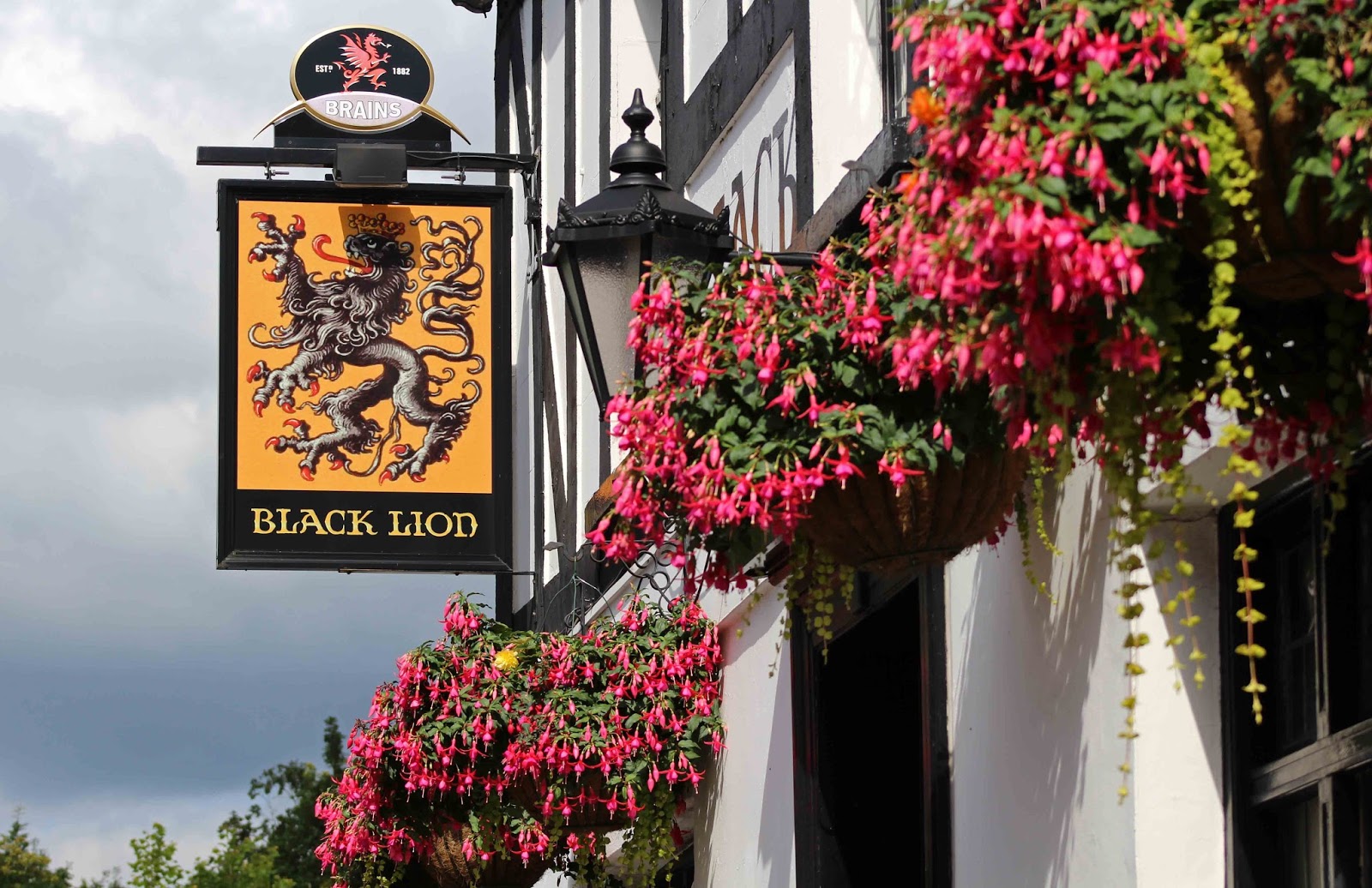
Black Lion, Llandaff
From Wikimedia Commons
Appropriately enough for a building that sits slap bang in the middle of the Cardiff suburb of Llandaff, this pub also has a connection to Francis James Mathew, who was Earl of Llandaff in the early 19th century. The pub’s name and the black lion shown on the pub’s sign – in heraldry-speak ‘Or, a lion rampant sable’ – are both taken from the Earl’s coat of arms. The image of the coat of arms shown at right is a memorial tablet in Llandaff Cathedral where there are effigies, dating from the 15th and 16th centuries, of three earlier members of the Mathews family. 

Though it looks old, the pub itself is not a listed building and probably only dates from around 1910. It originally had a shop operating next door, which later became an off-licence, before being incorporated into the public house itself. The Black Lion has had several name changes over the years, having been known as the Glamorgan Arms for a short period, and also, in the nineteenth century, when Sir Samuel Romilly was granted the Manor Llandaff (as mentioned above), it was called The Romilly in his honour. When Sir Sam sold the manor in 1852, the pub’s name was changed back to the Black Lion.


Butcher’s Arms, Llandaff
Just up the road from the Black Lion is the Butcher’s Arms. The building only became a pub in 1880. Before that, as you might suspect from the name, it was a butcher shop, with a slaughterhouse out the back. The sign shows the arms of The Worshipful Company of Butchers, one of the ancient trade guilds that was first granted its licence by James I back in 1605. The motto, ‘Omnia subjecisti sub pedibus oves et boves’ is theirs too, and translates as ‘Thou hast put all things under his feet, all sheep and oxen’. Many of the mottos of the early guilds were taken from the Bible and this is no exception; it comes from Psalm 8 ‘A Psalm of David’, verses 6 and 7. The Arms of the Company were first granted by the College of Heralds in 1540 and show items representative of the butchery trade.

13 December 2015

Cheshire: pubs and their signs 8

‘Keep your libraries, your penal institutions, your insane-asylums ... give me beer. You think man needs rule, he needs beer. The world does not need morals, it needs beer ... The souls of men have been fed with indigestibles, but the soul could make use of beer.’ ~ Henry Miller

Here are some more of the pubs in Cheshire that would make Henry Miller a happy man!


The Bricklayers Arms, Altrincham
Now sitting on the outskirts of Manchester city, Altrincham has long been a thriving market town, though it really took off in the 18th century when canal and railway links greatly improved transportation. The Butchers Arms isn’t quite that old but does date to the beginning of the 19th century, so perhaps was built to take advantage of Altrincham’s growth.

The sign is interesting. It shows a variation of the coat of arms of the Worshipful Company of Tylers and Bricklayersone of the ancient Livery Companies of the City of London. Members of the Company would once have held a monopoly over all roof and floor tile- and brick-laying in London but, like all the Livery Companies, now exists only as a charitable body to promote excellence in its associated industries. The mottos read: ‘In God is all our trust’ and, the one I particularly like, ‘Let us never be confounded’.


The Axe and Cleaver, Dunham Massey
This is one of the few pubs I’ve blogged about that I’ve actually had a drink at. 

Sitting in the garden on a hot summer’s day, sipping on a rather delicious thirst-quenching pint of cider, was perfect after a long walk along the Bridgewater Canal.

The Axe and Cleaver dates from around 1880 and was originally a private house whose owners held a beer licence. It has since been modified and added to, though the coaching-inn-style outbuildings are original and are listed buildings. 

The setting is delightful and I’m told the food is hearty so it’s a great way to end a day out at the National Trust property at Dunham Massey, which is close by.  


This public house is around 300 years old and is one of the meeting places for the Cheshire Hunt, so is aptly named. And, though I don’t approve of hunting hares with hounds, I have included it here for its interesting signs. The one showing the frantic hare being pursued by eager hounds is the usual image associated with this type of hunting but I much prefer the image on the other sign, where the hare sits calmly in a clump of grass on one side of a stream while the two hounds stand thwarted from their blood-thirsty work on the other side. One up for the hare!


The Tunnel Top, Dutton
According to its own website, the Tunnel Top

has stood above the Preston Brook Tunnel on the Trent & Mersey Canal since 1903. The pub has seen many changes over time yet has remained at the heart of a local community for many years and is still inviting for passing travellers and canal users throughout the year. Many local walks can be commenced from the pub, for those interested in rural history.

This public house was formerly named the Talbot Arms, after its landlord Mr Talbot, who retired not too many years ago at the grand old age of 93. And, as the website says, it is perfectly situated for a beer at the end of a countryside stroll.

This is another public house where I’ve enjoyed a drop of the local cider, as it is alos perfectly situated, on a quiet side road off the A9 and just along from a charming old country church that is also worth a look. 

The Arms is said to be 400 years old and is a charming maze of tiny rooms and alleyways. 

The coat of arms on the sign comes from the Chetwode family, the most famous of whom was Sir John Chetwode (1764-1845), who was born in Cheshire, in Stockport, and served as Cheshire’s High Sheriff in the late 1780s before commencing a parliamentary career. 

I’m not sure of the family’s connection with this particular pub – perhaps they owned the land hereabouts at some point.


I grabbed photos of these last two pubs during a very brief visit to Sandbach to see the town’s famous 9th-century Anglo-Saxon crosses, and I was so charmed by the bear on the roof of the Old Black Bear that I forgot to take a close up photo of the pub’s sign.

As you can see from the photo, this is a very old building, dating from 1634, and a wonderful example of the half-timbered properties to be found in many of Cheshire’s market towns. Not surprisingly, this is a Grade II listed building, with plenty of heritage features: the moulded wood mullions, the gables and (restored) bargeboards, exposed ceiling beams and framing timbers. And what a superb job the thatcher has done of the new roof!


This public house is much more recent than the Old Black Bear, built in 1890 at the request of Lord Crewe to provide a shuttle service for travellers to Sandbach Station, according to Joan Alcock in her book Cheshire Inn Signs (The History Press, Stroud, 2008). Apparently, it also served as the headquarters for the American GIs who were billeted in this area during World War Two.

I haven’t discovered the origin of the pub’s name but a wheatsheaf would’ve been a common sight in the fields surrounding the town in the days before modern harvesting equipment, and the sign is a lovely example of the art of signwriting.