Showing posts with label Black Lion. Show all posts

17 July 2016

Cardiff: pubs and their signs 1

It’s almost a year since I moved to Cardiff and I haven’t yet written a local pub signs blog – how can that be? There is certainly no shortage of old pubs or wonderful old pub signs, so without further ado, let’s have a cold one!


The Romilly, Canton
The pub sign shows the coat of arms of the Romilly family, their motto ‘Persevere’, and the note at the bottom reads: ‘Arms of Baron Romilly 1866-1905’. 

The Baron was the son of Sir Samuel Romilly, who bought most of the land where the south Wales coastal town of Barry now sits in 1812 and, in 1818, was granted the Manor of Llandaff by the contemporary Earl of Llandaff, Francis James Mathew. That Manor encompassed a large chunk of central Cardiff, including the area where the pub now sits, on Romilly Road.

Samuel’s son Sir John, who had served as Solicitor General and Attorney General of Britain, was created a baron in 1866, hence the date on the sign.

The pub, built in 1898, was initially a coach house. I haven’t been able to find out when it was transformed into a public house.


Black Lion, Llandaff
From Wikimedia Commons
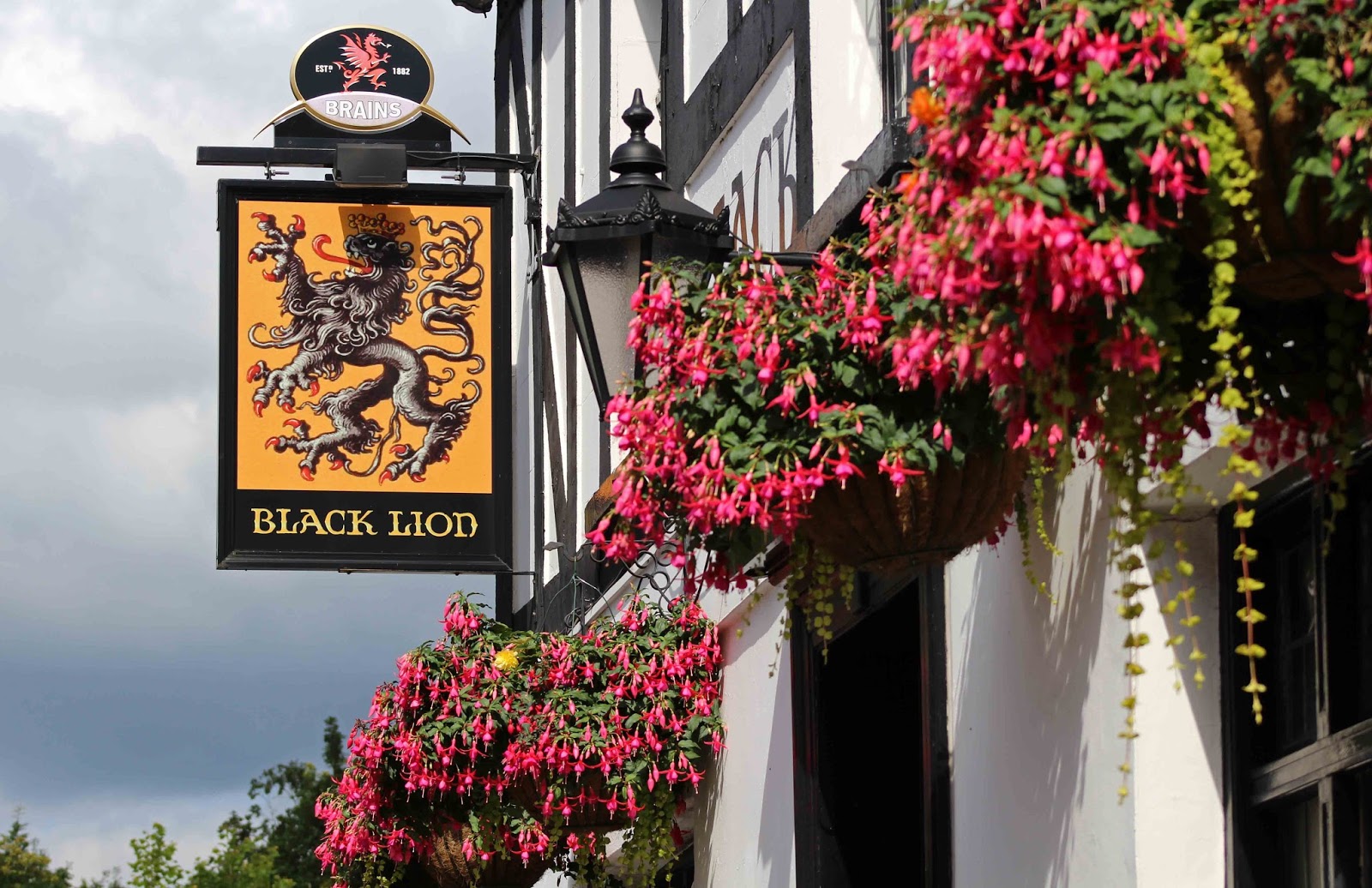
Appropriately enough for a building that sits slap bang in the middle of the Cardiff suburb of Llandaff, this pub also has a connection to Francis James Mathew, who was Earl of Llandaff in the early 19th century. The pub’s name and the black lion shown on the pub’s sign – in heraldry-speak ‘Or, a lion rampant sable’ – are both taken from the Earl’s coat of arms. The image of the coat of arms shown at right is a memorial tablet in Llandaff Cathedral where there are effigies, dating from the 15th and 16th centuries, of three earlier members of the Mathews family. 

Though it looks old, the pub itself is not a listed building and probably only dates from around 1910. It originally had a shop operating next door, which later became an off-licence, before being incorporated into the public house itself. The Black Lion has had several name changes over the years, having been known as the Glamorgan Arms for a short period, and also, in the nineteenth century, when Sir Samuel Romilly was granted the Manor Llandaff (as mentioned above), it was called The Romilly in his honour. When Sir Sam sold the manor in 1852, the pub’s name was changed back to the Black Lion.


Butcher’s Arms, Llandaff
Just up the road from the Black Lion is the Butcher’s Arms. The building only became a pub in 1880. Before that, as you might suspect from the name, it was a butcher shop, with a slaughterhouse out the back. The sign shows the arms of The Worshipful Company of Butchers, one of the ancient trade guilds that was first granted its licence by James I back in 1605. The motto, ‘Omnia subjecisti sub pedibus oves et boves’ is theirs too, and translates as ‘Thou hast put all things under his feet, all sheep and oxen’. Many of the mottos of the early guilds were taken from the Bible and this is no exception; it comes from Psalm 8 ‘A Psalm of David’, verses 6 and 7. The Arms of the Company were first granted by the College of Heralds in 1540 and show items representative of the butchery trade.

24 April 2015

Cheshire: pubs and their signs 6

I spent a couple of hours recently exploring Nantwich: so many beautiful old black-and-white buildings, so many pubs which, of course, means pub signs! So, here’s a little history of Nantwich told through its public houses.

The biggest thing that ever happened to this Cheshire market town was the Great Fire on 10 December 1583 and, wouldn’t you know it, it was caused by a brewer who accidentally set fire to his kitchen. Chaos reigned as a bucket-passing human chain tried to quell the flames with water from the River Weaver, all the while dodging the bears that were running through the streets – a landlord who provided the horrendous entertainment of bear baiting had let his animals loose when the fire got near his premises.

The townsfolk’s efforts were in vain and much of the town was destroyed but their misery has become our delight. As Nantwich played an important role in the Cheshire salt industry, good Queen Bess organised some national fundraising and herself contributed wood from nearby Delamere Forest so many of the beautiful old taverns we can see today date from the time of town’s rebuilding.

The Cheshire Cat, Nantwich
Let’s start with the pub with the cutest name, The Cheshire Cat. The black-and-white part of the pub was originally built in 1637 as three cottages. In 1676-77, in memory of his beloved wife, local man Roger Wilbrahamhad the cottages converted to almshouses, to house six impoverished local widows and so they remained until the 1930s.

In 2002, the buildings were redeveloped for their current use as a pub, restaurant and small hotel, hence the rather modern cat sign – the Cheshire Cat artwork is by local artist Tori Chantler. I’m not sure I’d want to stay there though – apparently, the building has its share of ghostly inhabitants!

The Malbank, Nantwich
Malbank was the name of the family that owned Nantwich and much of the surrounding area in Norman times. Although the Romans had settled here earlier, in order to mine the extensive local salt deposits, William Malbank, third Baron of Wich Malbank (an earlier name for Nantwich) is credited with putting the town on the map.  

This building wasn’t always a pub – I found a photograph dating from around 1910 which gives its name as Acton’s Stables, and the pub sign appears to be a modern artist’s rather fanciful interpretation of how William Malbank may have looked in full battle armour – not exactly historically accurate, if the Bayeaux tapestry is anything to go by.

The Oddfellows Arms, Nantwich
As you may know, the Oddfellows is a Friendly Society, formed in 1810 but derived from the trade guilds of medieval times, which has the aim of ensuring that their large, 280,000-strong membership ‘join[s] together to enjoy the social side of life, as well as providing care advice and support in times of need’. Though the building occupied by the pub dated from the early 19th century and the arms displayed in the pub’s sign are those of the Oddfellows Society, I’m not sure if there is any connection. Perhaps the building was originally constructed for the society.

I particularly like the additional sign for Oscar’s Bar on the wall adjacent to the pub itself. Oscar was obviously a much-loved patron!

The Black Lion, Nantwich
Not far from The Oddfellows Arms is The Black Lion. Built in 1664, it still retains many of its original architectural features (stone floors, beams, and wattle and daub construction) and is the longest-running public house in Nantwich. No surprise then that this is another pub that’s said to be haunted.  

Though I’ve not found anything on the history of The Black Lion’s name, animal names coupled with colours are often heraldic references – The Red Lion, for example, is the most common pub name in England.

The Red Cow, Nantwich
According to their own website ‘The Red Cow is a charming 15th Century traditional pub close to the centre of Nantwich Town’, which underwent ‘a full and stunning refurbishment in March 2013’.

I found a wonderful snippet about The Red Cow’s history on a website quoting local historian Andrew Lamberton:

There is information regarding the public house in the booklet by Dr A.J. MacGregor called the ‘Inns and Innkeepers of Nantwich’. The address was 9 Beam Street, and it was originally an alehouse in 1792 called the Red Cow. In 1830 it was known as the Old Red Cow to distinguish it from the new one which was further down the street, the proprietor having taken the name with him when he moved to the new premises. The "new" Red Cow is still a public house in Beam Street.

The Crown, Nantwich
This wonderful old building was built in 1584, soon after that disastrous fire had decimated the town, and still has many original features as you can probably tell from its rather wonky shape. No wonder it’s Grade I listed. An inn named The Crown and Sceptre was referred to in the Domesday Book of 1086, and there is speculation that this was the original site of Nantwich Castle, which was built prior to 1180, so this location has seen a lot of history. You can read more on Wikipedia.  

Pub names like The Crown, which refer to royalty, have long been popular and are thought to have indicated the landlord’s loyalty to authority (at least publicly). The Inn Sign Society’s website also notes that ‘The sign of the crown has been used as an inn sign for hundreds of years as it was easily identifiable for the majority of the population, most of whom were illiterate.’

The Talbot, Nantwich
I was fascinated to learn that The Talbot’s name ‘comes from a breed of dog first put on their coat of arms by a family called Talbot’. Apparently, ‘the dogs were used for hunting (like a fox hound) or for running alongside stage coaches’.

Though it was originally named The Talbot, former owners changed the pub’s name to The Frog and Ferret – a rather bizarre combination of creatures. Locals celebrated when the name was changed back to the original in 2007. Photos of some of this pub’s previous signs can be seen on A Dabber’s Nantwich’s website – I think I like the current sign best.