Showing posts with label Uyuni. Show all posts

19 November 2011

Bolivia days 6 and 7: a mountain of silver


The bus left Uyuni at 9.30 for the 5½ hour journey to Potosí. At first, it was a narrow gravel road up ad over the hills behind Uyuni, close to which the roadside was absolutely littered with rubbish. Our first stop was at a small mining settlement to drop off and pick up locals, who stood in the aisle. From the green colour of the hillside, I presume they were mining copper. Just down the hill from that settlement we drove on to a new tarsealed road – though we kept having to detour round places where they were inserting hug drains under the road – so, no one had thought of that before they built the road?

There were occasional grazing vicuna and herds of llamas; there are road signs here that warn of llamas crossing. The bus was hot, as the windows wouldn’t open and there was no other form of ventilation – it gradually got more stuffy and smelly! But, on the plus side, there were trees outside! They were shrubby specimens for the most part, but some quite large willows and poplars were sucking life-giving water from alongside small streams.

The courtyard at my hotel
There was a short stop about half way, for much biscuit eating by tourists and locals alike, and some squatting by locals. Then, onwards again. I snoozed on and off, woke up to take photos of a big mining town, and then we arrived at our destination, another big mining town, Potosí, where 60% of the 160,000 population still earn a living from mining. The earth has been good to these people.

The guide, Juan Carlos, looked like a smaller version of Javier Bardem – he’s probably married with 6 kids! He delivered me, and a Swiss couple, to our hotel, where I had a small room – but it was comfortable enough. I went out for a 2-hour walk around, and got some food, then chilled for the rest of the evening.

We – me, the guide and the Swiss couple – spent the next morning seeing the highlights of Potosí. As the couple spoke Spanish, Juan Carlos gave his spiel in Spanish, slowly, and I’m proud to say I understood about 90% of it! I may not yet be able to speak the language well, but my comprehension is definitely improving. We began by driving around the inner city, the Spanish colonial part – the indigenous population were forced to live elsewhere, even had their own churches to worship at – Catholicism was obligatory. There are 38 churches in the city, only 5 of which are still used – the others are museums, a theatre, or simply closed.

One of the 38 churches
Another beautiful church


We then headed through the mining neighbourhoods, where tiny shops sell everything the miners need, from safety helmets and gumboots, to coca and dynamite. The Cerro Rico mountain, from which silver has been mined for over a thousand years, dominates Potosí and, although the quality of the silver that remains is poor, it is still mined, by hand.


Guide Juan Carlos with coca leaves and dynamite, mining essentials!
First, we bought small bags of coca leaves to give to the miners in exchange for their permission to take photographs. The same little shop also sold dynamite! We then went further up the mountain to see the action. It was quiet that day as many people were still enjoying time off for the Todos Santos (Day of the Dead) festival, but we visited two small mines and went a short way inside one – we weren’t suited up for a long walk inside like some tourist groups were, but even a short way was enough to get an idea of how dark, claustrophobic and airless it was. The miners work all day without a break for eating or drinking, so chewing coca leaves keeps them going. The first miner we saw had his left cheek totally stuffed with coca and his eyes looked red and a bit dazed. The second was coca-less, so full of smiles at receiving his gift.

Left cheek stuffed with coca leaves
Happy to get a bag of coca


The average life span of these miners is just 55 – then they die of lung disease, if they haven’t already been killed or incapacitated in accidents. Apparently, many lose the little fingers of both hands as the tunnels are so narrow that they scrape their hands against the sides when wheeling our barrow-loads of rock weighing between 80 and 100 kgs. There is no health system in Bolivia, unless you have a government job, so people have to pay for hospital visits, and there is no unemployment benefit or old-age pension. The mines are worked by co-operatives or private companies – mostly co-operatives, so perhaps the miners help each other through tough times, if they can. Understandably, young men no longer want to follow their fathers into the mines, but there is no other industry in Potosí.

Some of the mines on the mountain

Women are not allowed to work in the mines, as it’s considered bad luck, but they do work outside. There was an old woman outside the first mine we visited; it was her job to keep count of the output of each member of the co-operative, so she had to live in a small adobe hut outside the entrance. There was water but no electricity or toilet – in fact, faeces and various other rubbish littered the ground all around. Two pigs wandered the site, I saw a sheep further down the mountain and, of course, there were dogs everywhere. A grim existence by anyone’s standards!

We went further up the mountain to a church, which has nothing to do with the miners and is, in fact, now the home of a family who help maintain the various telecommunications antennae that surround it. Our guide said the miners don’t worship Christ but, rather, the devil – understandable given the hellish conditions they work in.

From the mountain we went back down to the city, to a church and the university and a small market, before being dropped back at the hotel. I bought a t-shirt on the walk back – I had thought I might get something in silver from Potosí but the guide said all the silver is exported.
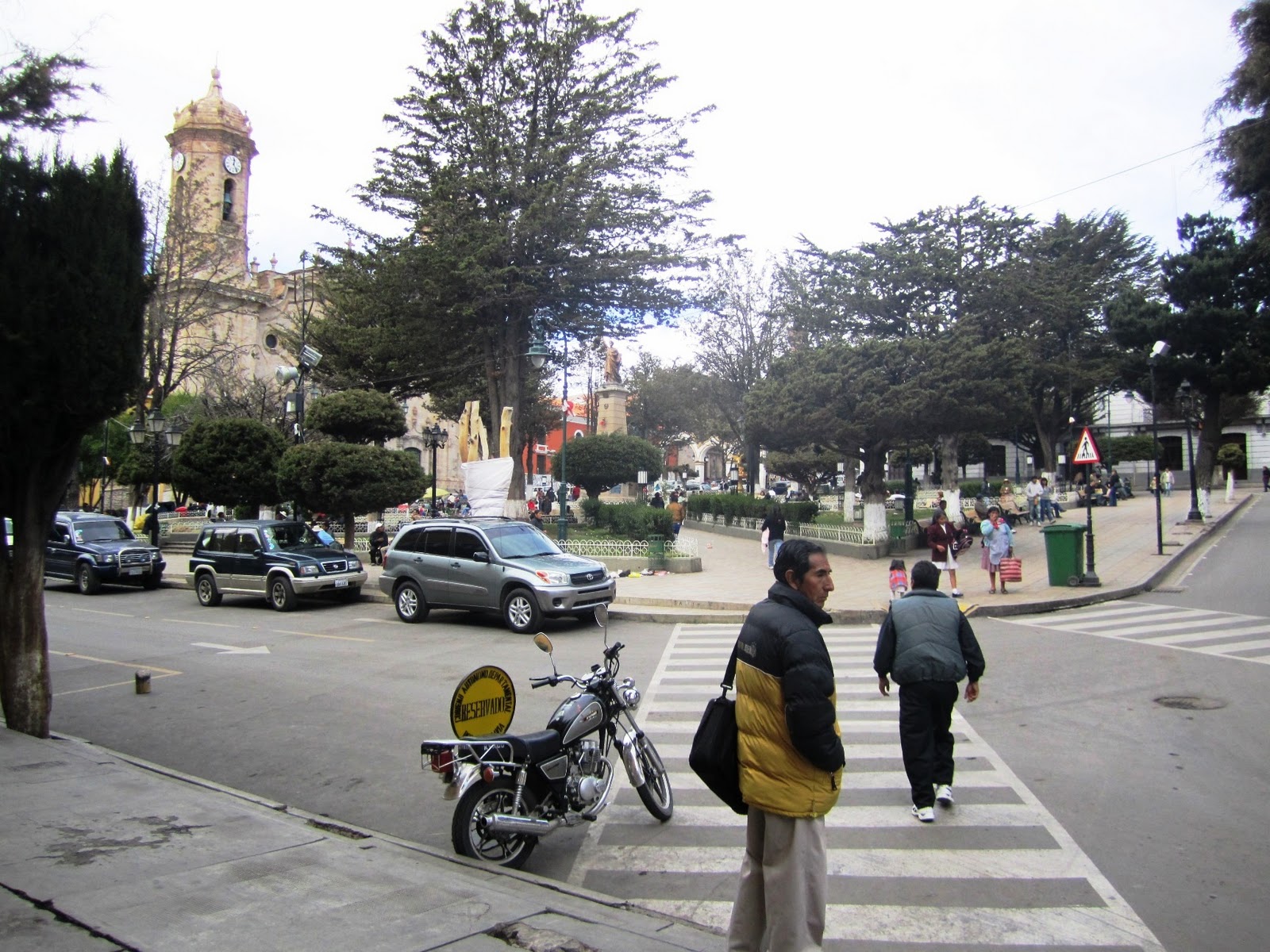
Potosi's main plaza


I had a few biscuits for lunch and put my feet up for an hour, then wandered down through the city streets to meet the Swiss couple at the former Mint House, now a museum. The tour there took 1½ hours and was fascinating. There were former mint machines and coins, an art gallery housing religious artworks from the now-closed churches, minerals from around the world, and a couple of rooms of archaeological remains, as well as lots of silver – and police. Their main job was telling tourists who hadn’t paid the extra fee to stop taking photos! Another interesting day!
At the Mint House
Spanish colonial house in the inner city

18 November 2011

Bolivia day 5: geysers, lagoons and llama


Compare the height of the steam to the size of the car!

On the last day of our Red Planet Expedition we were woken at 4.15 for a quick pee, brush of the teeth, pack and load. We were aiming to be inside the crater of an active volcano by sunrise – and we were! On the rim of the crater we were at the highest we’d been on this trip – and the highest I’ve ever been in my life – at 5200 metres.

The fumeroles in Sol de Mañana were impressive in the freezing cold morning air. There were a couple of very tall geysers and a lot of gas escaping the ground at high pressure, and some small mud pools – not as impressive as the thermal activity in New Zealand but there we would have been fenced off for safety’s sake. Here, we walked where we liked.

On to another lake, on the edge of which were thermal hot springs. The pool was tiny but several people took a dip, mostly to warm themselves up, I think. I wandered, taking photos of birds in the steam and the beautiful morning light. We had pancakes for breakfast in the restaurant at the lakeside, then headed on to the last amazing lake of our tour.


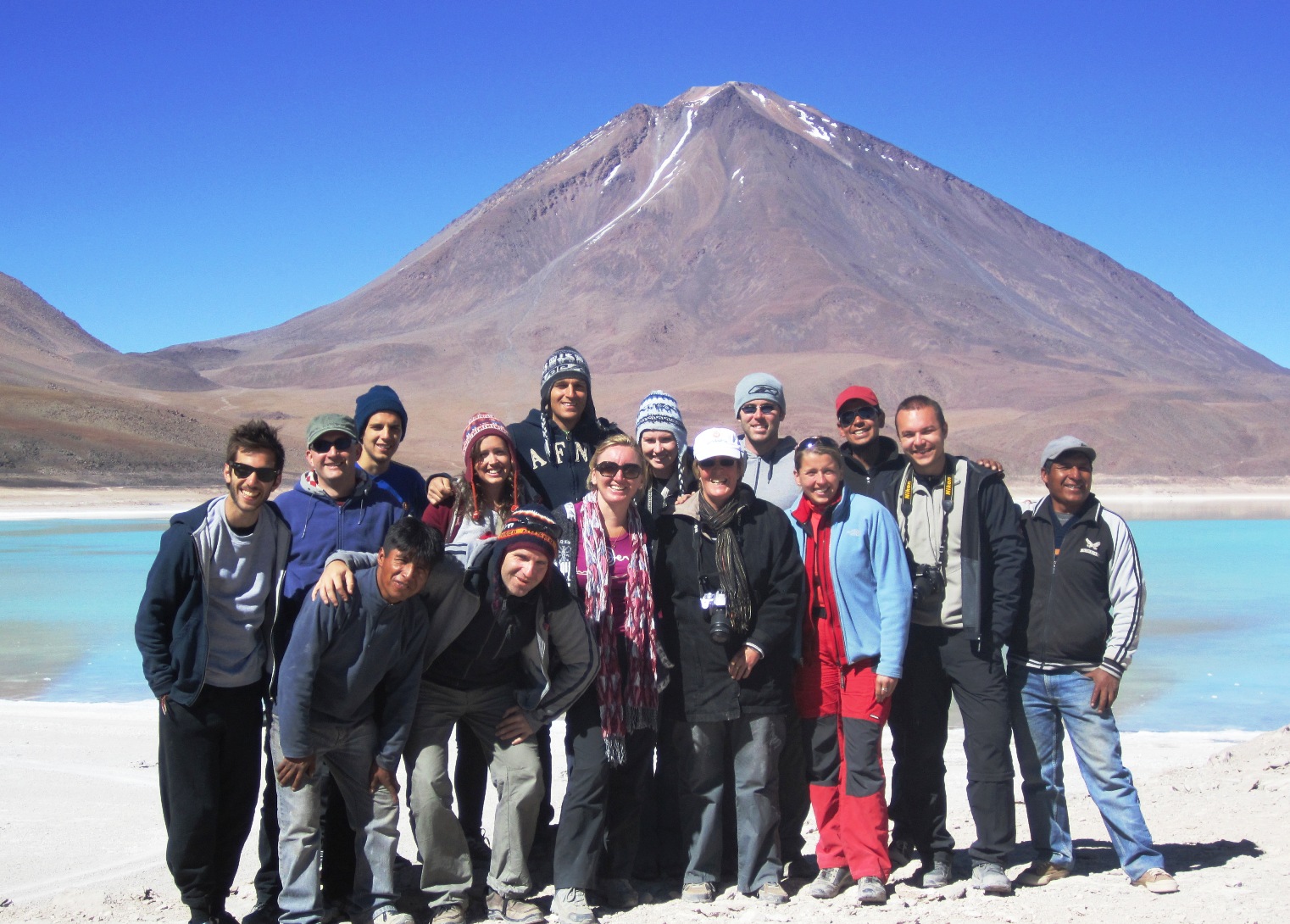
The colour of the Green Lagoon – Laguna Verde – is caused by the high concentration of arsenic and copper in the water. The lake is 17km2, is shallow and toxic. Its waters have been drying up since the massive Chilean volcanic eruption earlier this year, and it may eventually disappear. According to Al the tour guide, the whole volcanic area here in Bolivia has been more active since the volcano in Chile blew, proving they’re connected underground. Licancabur volcano sits behind the lake, in all its Fuji-like magnificence. More great photos! And, as this was our last stop as a group, we also took group photos.

A quick visit to Chile

Our expedition team


Next stop, Chile – or, at least, the border. Some of our group departed there, leaving only 5 of us to return to Uyuni. In such a remote area the border wasn’t fenced off, so I walked over to Chile for about 5 minutes – and I have the photos to prove it. You could, in fact, stand with one foot in each country if you wanted.

From the border, we retraced our route – though not the exact same route – back to Laguna Colorada. Blass, our driver, was happy to stop for photos, so we often did – for landscapes, for more flamingo pictures, for the strange rocks in the Dali desert, for llamas at the roadside, and later for rheas, the South American version of the ostrich. And the red colour of Laguna Colorada looked even more incredible in the morning light so, of course, we had to stop for photos there too.

We drove past more multi-coloured mountains, and climbed up and over more lava flows, where, at one stage, a bunch of small citroen cars on a rally were struggling to climb the slopes. We had lunch at the small settlement of Villa Mar, where there was a large herd of llamas grazing – more photos! – especially of a gorgeous pregnant female, who lay down on the grass and let me get really close.

From there we had a long long drive down straight straight roads back to Uyuni, where we arrived about 6.30pm. Back at the hotel, a hot shower never felt better, nor did a big comfortable double bed, with thick cosy quilts. I was asleep early, dreaming sweet dreams. It had been an incredible 3 days. I will never forget seeing some of the natural wonders of the world!

15 November 2011

Bolivia day 3: salt salt everywhere!

Our expedition is marked with a red line
Our departure to the Uyuni salt flats was supposed to be at 10.30am and my guide was supposed to pick me up at 10am to take me to Immigration ... but this was Bolivia ... it’s like a different time zone! The guide finally collected me at 10.45 and took me to the Immigration office but, as neither she nor the officials spoke English, nothing productive happened. So, we went to the Red Planet Expeditions office, where I finally got some help. Al, their tour guide, walked back to Immigration with me and interpreted. There was no getting round it – the regulations said it was my responsibility to ensure I got my passport stamped and completed the correct paperwork – difficult when you don’t know what to expect! – so I had to pay the 300 Bolivianos’ fine, or I would have had to pay 150 Bolivianos for each day I was in the country when I finally left it. No contest there!

Back to the Red Planet office, where Al helped again. He asked whether I had enough money to pay the entry fees to an island and the national park that were part of our tour. On checking my itinerary I discovered the entry fees were supposed to be included so he phoned my tour company. The local guide turned up 10 minutes later with the money – presumably she would have kept the cash if Al hadn’t checked.

By this time it was 11.30 and we obviously hadn’t left Uyuni. Turns out there was a petrol tankers’ strike on, so petrol was in short supply. The queues at the local gas station were long so, eventually, the woman managing the Red Planet office gave up and bought black market petrol – and we finally got underway at 12.30.

My fellow expedition team members
There were 12 of us tourists: 2 young guys from Melbourne; an Irish couple and Michelle, a 35-year-old Irish woman from Sligo on a 4-month holiday from her job as an A&E nurse; an English couple on a 9-month honeymoon that later includes 4 weeks campervanning around New Zealand; 2 Polish guys; and Gabriela and Richard, a Slovakian couple from Bratislava.

We were in two Toyota Landcruisers, one with rally driver Luis and the other, with more safe and reliable Blass. I was particularly glad to be with Blass when Luis’s vehicle later lost a wheel on the salt flats! Luckily, he stopped the car quickly, without injury, though it was the stuff of Trip-advisor horror stories to see the hubcap heading off in one direction and the tyre in another!

First stop was the train graveyard, final rusting place of the trains that either used to run from La Paz or carried minerals to ports on Chile’s Pacific coastline. In the 1940s, the mining industry collapsed, partly due to mineral depletion, so many of the trains were abandoned. Apparently, there is talk of a passenger service from La Paz being restarted, but no one knows when it will happen. One interesting piece of graffiti among the many declarations of undying love that covered the dead machinery was Ghandi’s ‘An eye for an eye will leave everyone blind’.


Next stop was the little settlement of Colchani, where we observed the process of manual salt production by a local man. We had lunch in part of his house made of salt bricks. There was even a salt-brick llama statue in the little gift shop attached. And I spent a few minutes there tickling the tummy of the man’s baby to stop it crying while the mother was pouring water down the toilets to flush them.

Soon after we left there, we stopped for photos of piles of salt drying on the flats, prior to it being trucked off to Colchani for processing.


Then we drove further on to the salt flats, to a salt-brick hotel. It’s no longer used for accommodation but has not been demolished as it provides an essential landmark for the drivers on the visually challenging flats. We stopped nearby to take lots of crazy photos. There’s something about the refractive or reflective properties of the salt that allow you to take photos with unusual visual effects. For example, objects that are relatively close together appear quite far apart, so a person might appear to stand on a bottle, or one person appears to pull another out of a hat. It was great fun working out new and strange compositions!


The salt flats -- the Salar de Uyuni or Salar de Tunupa -- are the world’s largest at 10,582 km2  and were formed from the transformation of several prehistoric lakes. The centre of the flats contains a few ‘islands’, the remains of the tops of ancient volcanoes. The black basalt rocks are covered with fragile petrified coral, conclusive evidence that the islands were long ago under water. Our last stop for the day was at Inca Huasi Island (also called Fish Island, due to its shape), on which grow about 4000 giant cactus plants. Those cacti with a single trunk are male, those with ‘arms’ are female, and there are two varieties, one with white flowers, the other with pink. They are slow-growing plants and some are apparently over 1000 years old. It was a very beautiful, if very unusual place, and cold, as the wind was blowing a gale across the flats.


The sun was setting as left the island for the hour or so drive to the little village where we spent the night in a hostel made of salt bricks. Dinner was at 9pm, and the electricity generator was shut off at 10pm, so that was also time for lights out. I slept like a log on my salt-brick bed.

13 November 2011

Bolivia day 2: getting to Uyuni


Part of La Paz

After a lazy morning, resting up for the long journey ahead, Tony the tour guide picked me up from the hotel at 1pm and took me to the bus station. The Naser double-decker to Oruro departed at 2pm and arrived just after 5pm.

We climbed up out of La Paz, before heading south. La Paz is a city of about 1.3 million people, according to my tour guide, so about the same population as my home town of Auckland, but La Paz’s setting is unique. It sits in a huge steep-sided canyon, with another large separate city, El Alto, built on the plains above it, and the high snow-capped mountains of the Altiplano bordering one side. Due to its unique topography, the elevation of La Paz ranges from 3200 to 4000 metres, so many visitors suffer from altitude sickness when visiting the city. Luckily, coming from Cusco, that didn’t affect me.

One of the huge peaks of the Royal Andean range that runs alongside La Paz
There was snow and ice in places along the roadside, something I hadn’t expected, and sprinklings too on the surrounding hills. It was very windy and obviously cold out, as people were well wrapped up, huddled in doorways or crouched behind walls out of the wind. It was brown, brown countryside and looked barren, but the fields had been ploughed – though there no signs of the green of growing crops. And there were no trees, and only the tufty grass that grows in the high country the world over. Occasionally, I could see small herds of cows and flocks of sheep, with their ever-mindful shepherds in attendance – no fences here to contain wandering animals. In places, there were also llamas – once I saw one rolling on its back in the sand like horses do.
The Tigo logo is everywhere

The green and white of Vivo


We passed through several small settlements, with buildings constructed of adobe or red bricks. There were few painted walls, except those sponsored by advertisers: popular ones are the green and white of Vivo; the red, black and white of Viacha, a cement company; and the blue and white Tigo label is everywhere, a telecommunications company, I think. The ubiquitous plastic bag littered the fields bordering the road and, near the towns, the dry stream beds were full of rubbish.

At Oruro, tour guide Martin met me off the bus and took me to the train station. It was interesting to chat to him. He is half Bolivian, on his father’s side, and half German, through his mother – his parents met at university in the US. They have since divorced but Martin enjoys duel citizenship, so he has lived in Europe as well as Bolivia. However, he’s now married to a Bolivian woman and has a young daughter, so prefers to live in Bolivia. He said that because his wife and child are darker skinned than him they suffer much prejudice when visiting Germany. Martin teaches German at a college in Oruro, and does tour-guiding part-time because he enjoys meeting people from other countries and cultures. I enjoyed meeting him too!

The train to Uyuni departed at 7pm. I was in first class, which was very comfortable, with reclining seats, though my seat was broken and wouldn’t recline as far as the others – actually a good thing, as I didn’t want to sleep past my stop – the train goes on to Chile! It was very hot. There were two movies: the latest Johnny Depp Pirates of the Caribbean movie, which seemed good but was in Spanish so I’m not entirely sure what was happening in the story; and then the X-men origins movie, which had English sub-titles. There actually weren’t many English-speaking travellers on the train – lots of Belgians, a big group of French, and various other Europeans.

After 7½ hours of chugging slowly along, we finally reached Uyuni at 2.30am. Luckily, my pick-up person was waiting and I was snuggled up in my lovely big comfy bed at the Tambo Aymara Hotel by 3am.