Showing posts with label Bear's Paw. Show all posts

21 February 2015

Cheshire: Pubs and their signs, 4

Time to pull a pint or two of real ale, find a cosy nook in a centuries-old public house, and let the walls – and the pub signs – tell us their wonderful stories. Are you sitting comfortably? Then I’ll begin …

The Antrobus Arms, Antrobus 
Antrobus is an unusual name for a pub, a village, a person, and the jury is out on whether its origin is to be found in the time of the Vikings (a tongue-twisting combination of the Old Norse personal name ‘Andrithi’ or ‘Eindrithi’ and ‘buski’, their word for bush or thicket, resulting in ‘Andrithi's thicket’) or whether this ‘area between two forests’ was named by the French-speaking Normans ‘Entre bois’, meaning ‘between the woods’. Either way, it was first listed as Entrebus at the time of the Domesday Book survey in 1086 AD and the first person recorded using the surname was apparently one Thomas Antrobus (on the Register of the University of Oxford in 1600). 

The pub itself is not that old – according to their website, it was first licensed in the 1700s. And The Antrobus Arms is not its original name – I found a record of its being called The Wheatsheaf in the 1930s – and I have no idea who the coat of arms belonged to (contrary to popular belief, coats of arms are personal, not attached to a surname).

One particularly interesting fact I did find though relates to the tradition of soulcaking or souling. Around All Souls Eve (1 November) each year, a group of mummers performs a traditional hero-vs-the bad-guy play at The Antrobus Arms and other pubs in the area (check out the video here), and the local children dress up and knock on doors, reciting a special rhyme in return for spiced cakes. The origins of trick-or-treating, perhaps?


The Bear’s Paw, High Legh
I was homeward bound after a walk when I found The Bear’s Paw and popped in, thinking to enjoy a late Sunday lunch. No such luck! It was fully booked, overflowing with the Sunday-best-dressed and quite obviously no place for an outdoorsy type who still had her jeans tucked into her socks. I should have guessed from the ‘Country Inn and Restaurant’ label, which undoubtedly adds at least £5 to the price of every meal.

According to the pub’s website, the building was originally a 17th-century farm house and, from the little I saw, it certainly oozed authentic character, with a roaring open fire and low-slung beamed ceilings. It was worth the stop to get a photo of the 3D sign. The bear’s paw is a common enough name for a public house – there’s another just 15 miles away in Frodsham  – but, as this place doesn’t have a long history as a pub, I assume it has no particular meaning here.

The Angel, Knutsford
According to the Inn Society’s website, Angel is the 11th most popular inn name in the UK and is a

reminder of the religious connection between pint and pulpit. The name is thought to have represented the Archangel or St Michael …, who was the patron saint of the Knights Templar. They would adorn a tavern with such a painting, not to name it, but to show that it was under God’s protection.

The hotel’s own website proudly announces that The Angel Hotel, previously the Angel Inn, ‘was a noted posting house and inn’ in the time of Knutsford’s favourite daughter, the author Elizabeth Gaskell, and, if you’ve read her book Cranford (published in 1851), you might recall the character Lord Maulevere stayed at the Angel while visiting Captain Brown.


The Cross Keys, Knutsford
The Cross Keys is another popular pub name – I even remember drinking in one of that name in Cusco, Peru – and is another with a Christian connection. The crossed keys of heaven are a symbol of Saint Peter: ‘I will give you the keys of the kingdom of heaven, and whatever you bind on earth shall be bound in heaven, and whatever you loose on earth shall be lost in heaven’, Matthew 16:19.

Though obviously not of biblical age, the Cross Keys is certainly one of Knutsford’s oldest pubs, dating from around 1642 when, it seems, there were 42 (!) taverns in the town. The pub’s website reports that, ‘A map dating back to 1786 shows the Cross Keys as being part of the Lord Egerton estate. For many years the Barrow family ran the inn – the 1841 census shows 30-year-old Hanna Barrow as Innkeeper, assisted by her sisters Jane, 23 and Anne aged 20.’ It was a common enough profession for a woman if the novels of authors like Charles Dickens are to be credited with more than an ounce of historical truth.


The Salt Barge, Marston 
This is one of my locals, a welcome refreshment stop during my walks along the nearby Trent and Mersey Canal. For tourists and visitors to the area, the Salt Barge is also not far from local attractions, the Anderton Boat Lift, Marbury Country Park and the Northwich Woodlands, and the soon-to-open Lion Salt Works Museum is just across the road.

Built in 1861 to replace the earlier Red Lion Inn and previously named The New Inn, The Salt Barge is steeped in canal history, as portrayed by the memorabilia and historical photographs of local salt mining that are sprinkled throughout the bar.

The Kilton, Mere
If you read my previous pub signs blog, you’ll recall that owning and training racehorses used to be a popular vocation in this neck of the woods and several of the local pubs are named after them. The Kilton is another. The horse it is named after was owned by Mr Thomas Langford-Brooke of Mere Hall. Kilton apparently excelled at the Knutsford Races and, in 1796, won the prestigious Knutsford Gold Cup, beating the horse Delamere, owned by another well known Cheshire habitant, Mr Tatton.

An article in the Warrington Guardian of 14 May 2012 states that The Kilton Inn was built in the 16th century and ‘is rumoured to once have served as some kind of prison’. I also found a report, in T. A. Coward’s 1903 book Picturesque Cheshire [Sherratt and Hughes, London and Manchester, 1903, pp.68-9] that the infamous highwayman Dick Turpin had an association with The Kilton. It is such a good story that it is worth including in full here:

There is a good bowling green at the "Kilton" at Hoo Green, well known to picnic parties from Manchester and elsewhere. It was on this self-same green that a game was in progress, when that smart gentleman of the road, Dick Turpin, pulled up his sweating black charger, and smiting the ostler across the shoulders, asked him emphatically what time it was. Then the redoubtable Richard joined in the game, swaggering about the green so as to be noticed by all the sporting gentry. When, later, it transpired that a dastardly assault and robbery had taken place within a few minutes of the time stated by the ostler, it was considered impossible that this gay but suspicious Turpin could have ridden from Newbridge Hollow to the inn in so short a time, and his alibi was accepted. This story is familiar; Dick Turpin's ride from London to York, and other tales of the same notorious character are so similar that we must accept this legend cum grano salts. Dick Turpin may have been here; but the true history of the man shows him to have been no dashing, chivalrous highwayman, but a cruel, mean swindler and burglar, a man who liked to rob lonely houses where there were defenceless women, especially when he had a gang of similar lawless desperadoes at his back.


The truth of this rollicking tale may never be known but it is certainly a good story to recount over a pint or two.

14 January 2015

Cheshire: pubs and their signs 3

I’ve done it before, I’ll do it again. Here I go on another dry pub crawl around the towns of Cheshire, this time in and around the township of Frodsham

The Bear’s Paw, Frodsham   
Originally built as a coaching inn in 1632 – the door lintel is inscribed ‘W:L:ANNO:DOMINI:1632’, this red coursed sandstone building has had a number of different names during its 380-year lifetime. It was built on land owned by the Savages of Rocksavage, the lords of the manor of Frodsham in the 1600s, and initially named the ‘Lyon’s Paw’, perhaps because their coat of arms includes six lions rampant. The reason the name changed to the ‘Bear’s Paw’ is disputed – one source I found said that ‘In 1697 Earl Rivers of the Savage family reverted to Roman Catholicism and, following the outcry that resulted from this, the name was changed to ‘Bear’s Paw’’ [Arthur R. Smith, ‘The Bears Paw - a brief history’, Journal of the Frodsham & District History Society, no.39, 2009, pp.20–22). Another source noted that the crest of the Savage family is, in fact, a bear’s paw, so perhaps this accounts for the change of animal in the inn’s name. To my eye, the erect animal paw depicted at the top of the coat of arms could easily be interpreted as either a lion’s or a bear’s paw.

In the 18th century the addition of a post office room led to the name being extended to ‘Bear’s Paw Hotel and Posting House’. Then, with the coming of the railway in 1850, the pub’s name changed once more, this time to the ‘Bear’s Paw and Railway Hotel’. Around 1905 the name was shortened to the name it still bears (pun intended!). As you can see from the two images displayed above, the pub’s sign has changed in recent months, some time between my visit last summer and my visit in November 2014.


The Cholmondeley Arms, Frodsham
According to a sign in Frodsham, this public house was previously owned by the Atlas Brewery and operated as a beer house called ‘The Albert Inn’. The building isn’t as old as it might seem – the front gable bears the date 1891 and the external façade has changed little since the photograph (above right) was taken c.1900. One interesting fact: the pub’s cellar was apparently used as an air raid shelter in the Second World War.

Lord Cholmondeley (pronounced Chumley), later the Marquis of Cholmondeley, became Lord of the Manor of Frodsham and owner of most of the land thereabouts on his marriage to the daughter of the 4th Earl Rivers in the early 1700s – hence the name of the pub.

The Golden Lion, Frodsham
This inn, formerly a hotel, is built on an original burgage plot (i.e. the land was owned by the local Lord of the Manor who received a yearly rent or some form of service for its use) which means records exist for the site from as early as 1361 when it was granted to Henry Torfote, an up-and-coming local man at the time. The present building dates from the early 19th century although the cellars are believed to be much older. According to the Frodsham Pictures website ‘The Golden Lion’ was known as ‘The White Hart’ from 1822 to 1845, during which time it was owned by Mather’s Brewery in Penketh. Ownership passed to Gasgarth’s of Altringham in 1879 and then to Samuel Smith in 1967. Not surprisingly, it is a grade II listed building.

The Queens Head, Frodsham
According to their own website, ‘The Queen’s Head’ was:

built in the early 16th century, this grade two listed pub is the oldest coaching inn in Frodsham, originally having stabling for 23 horses, of which [some] are still visible today. Known at the time as The King's Head the name was changed when Queen Victoria came to the throne in 1837. The pub is part of the Sandstone trail, which is one of the most popular walks in Cheshire. The trail runs straight through the property making the Queen’s Head a popular gathering point for walkers and tourists during the warmer months.

The detail about the Sandstone Trail running straight through the property appears to be an exaggeration according to the trail website but you get the general idea that the pub is a good starting point for the walk. I admit I don’t particularly like the new-fangled sign (below, left) – I’m sure a portrait of Queen Victoria would look much better.


The Hanging Gate, Weaverham
What an intriguing name this is! Sadly, the pub’s website offers no information about the pub’s history or the origin of the name. This gastro-pub is owned by the New Moon Company which operates 6 similar ‘fine wine and dining’ establishments in England’s North West.

Fortunately, the local historical society has the story on its website

An early 18th century farm pub, originally called Gate Inn (gate meaning highway). It was the last farm pub in the village. Formerly two small rooms, which became two bars. The pub was part of the Marbury Estate, which accounts for its other name, The Barrymore Arms. Indeed, Lord Barrymore's agent used to collect his rents here. In 1932 it was sold to Greenall Whitley and became the Hanging Gate....


The Farmers Arms, Kelsall 
Once again the pub’s website gives no clues as to this pub’s history, though some research produced the fact that it used to be called ‘T’ House at Top’, a reference to its situation at the top of the hill on the former Kelsall to Winsford Road. 

Kelsall is a medium-sized Cheshire town, equidistant between Chester and Northwich, and about 7 miles from Frodsham. In Victorian times, the town was an agricultural centre with a population that never topped 700, and presumably included a lot of farmers. I love the rural view on the sign. These days its relative proximity to Chester and Northwich means it’s also a commuter town and its population has risen to around 2500.


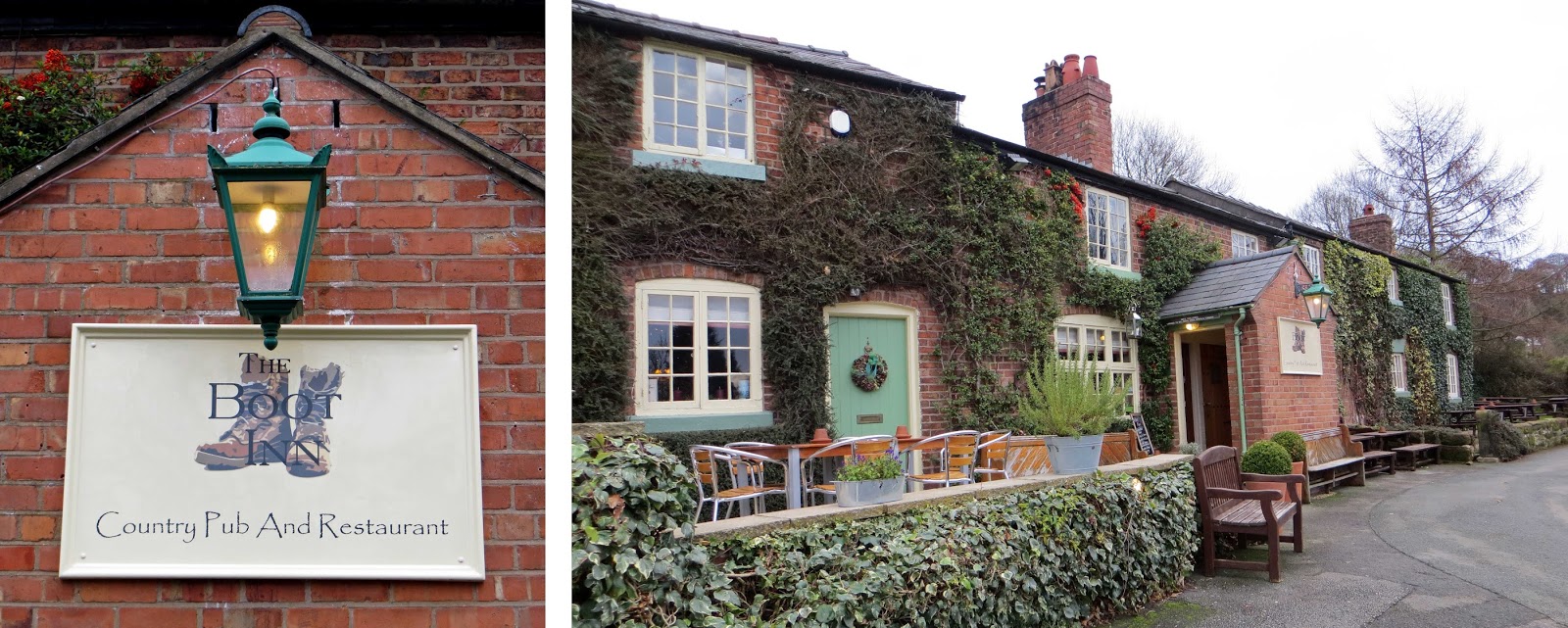
The Boot Inn, Willington
‘The Boot Inn’ is made up of a picturesque row of sandstone and red brick cottages that were built in 1815 and is tucked away up a country lane, hugging the side of a hill, in an area known locally as ‘Little Switzerland’. The setting is quite charming, with orchards of fruit trees and single large oaks dotting the landscape.

‘The Boot’ was originally called ‘The Cat’ and I found a charming story about how it got that previous name. According to Thecatwillington’s one and only blog post, ‘From around 1912 for about 20 years this tiny tap house (part of a row of 3 houses), was owned by an old widow who had a large cat that used to lie on the bar. The local men would say to their wives, "I’m just going up to see the cat, love." According to Old Harry who was 86 and still drinking there in 1980 he said they would inevitably return home pissed.'

The Boot Inn’s current name may well be a derivation of Boothdale, the name of the nearby steep-sided valley. It seems the three cottages were knocked together in the mid 1850s and, though I haven’t sampled any of the local ales, I have it on good authority that the Weetwood ales – Cheshire Cat, Eastgate and the Weetwood Best bitter – are particularly good local specialities.

The Horseshoe Inn, Kingsley 
The little village of Kingsley is about 3 miles from Frodsham – its name comes from the phrase ‘meadow of the king’, hence ‘king’s lea’, hence Kingsley.

The Horseshoe Inn used to be the Horseshoe Hotel and, according to its website, it was owned by the Smith-Barrys until 1872 when it became a Greenall’s house. The website also includes a list of the licensees going back as far as 1797 and a photo from 1921, showing a horse-drawn landau outside the hotel. Judging by the sign, I’m guessing there used to be a smithy on this site.