Showing posts with label guinea pig. Show all posts

09 March 2012

What’s behind the blue door?


Actually, you will be surprised to find out what’s behind such a plain-looking door in a side lane in Oropesa, Peru.


We’ve been thinking about getting some guinea pigs to raise at school, partly to breed them to make some money and partly to teach the children how to care for other living creatures. Each day at Eufemia’s, the little cafe where we have lunch, we always exchange pleasantries with an old gentleman who lunches at the same time as us.

Today, when we were asking Eufemia questions about raising guinea pigs – she has recently acquired about 40 herself, the old gentleman was also providing us with answers and extra information, and we found out he also raises guinea pigs. He invited us to visit his house so, after we’d finished eating, we went to see him.

Lovely, heavily pregnant lady
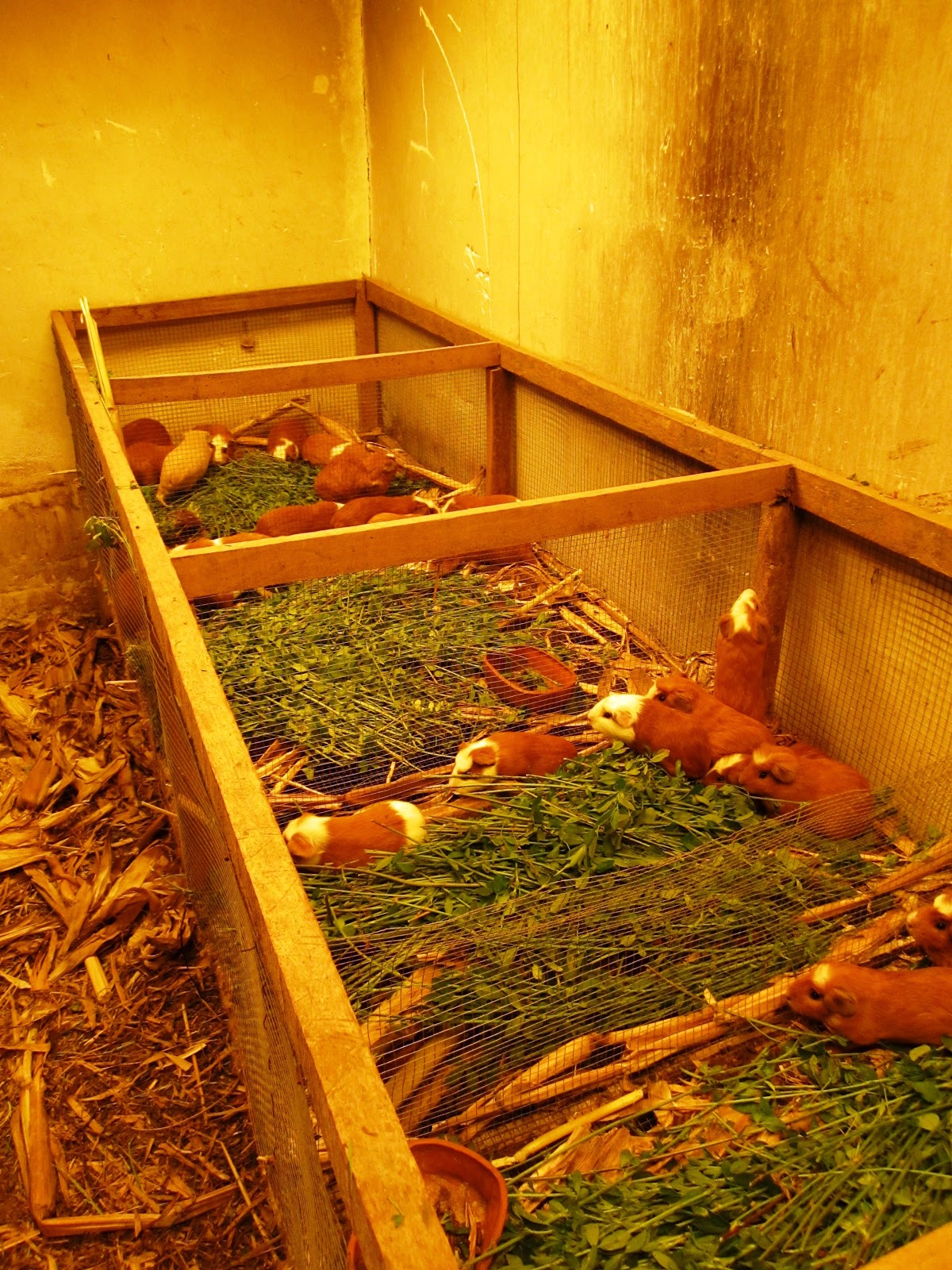
Pens of little piglets


His is the blue door. And behind that door, as well as his house, he has a room full of around 200 guinea pigs of all shapes and sizes – a couple of bigger male studs in with the females they are busy servicing, separate small cages for heavily pregnant females who are about to give birth, pens for litters of around the same age, and a whole of heap of babies (they call them cria) scurrying around on the floor.


I love the rich chestnut brown colour of domesticated guinea pigs, and their fur is very soft, but it’s actually quite difficult to get near any of them. Unlike the guinea pigs kept as pets in the West, these little critters are extremely skittish and run around excitedly at the slightest movement near their pens. One thing that struck me was the noise – they squeak constantly, or wheek as some people call it. If you’ve never heard a guinea pig wheek, I found this short YouTube clip that will give you a good idea.

After visiting the guinea pigs, we were all set to leave when our elderly friend asked if we’d like to see his flowers. A few plants behind the house, I thought – how wrong I was! There were huge hot houses full of plants of all descriptions – and, interestingly, many of the plant names are exactly the same in Spanish, just pronounced differently.

We were amazed and a little stunned and totally delighted as the man proudly showed us around. And he looks 
after all these plants himself, propagating from seed and stem and leaf cutting, and eventually selling them to retailers as far away as Puno and Lima. He is a retired teacher, but now spends his days happily pottering in his wonderful garden. Who would have thought this little bit of paradise was lurking behind that bland looking front door!


05 March 2012

Guinea pig for lunch anyone?


Eating guinea pig is not for me, but it’s certainly very popular here in Peru. In fact, it’s a delicacy and very much savoured on special occasions, like birthdays, weddings, feast days … and, for the staff at our Picaflor House Community Project, it was the perfect food to celebrate the contribution made by our manager Nelida on her final day of work.

Our celebration lunch
Partly roasted


We lunched at a restaurant in Tipon, a small town southeast of Cusco famous for guinea pig, or cuy as it’s called here. The menu has a choice of roasted or fried guinea pig – I’m told roasted is best, as fried can be a little greasy. Whichever cooking method you choose, you don’t actually get much meat to eat, even though guinea pigs are fattened for the pot with a daily serving of tasty barley and look quite chubby with their fur on. These little pigs are actually quite lean inside and you have to work hard to get a decent meal off them, crunching and sucking on the bones for every last tasty morsel. The roasted version is usually served whole – head and feet still attached – the brain is, in fact, meant to be one of the tastiest portions!


I think it’s partly the sight of the whole roasted guinea pig that puts many people off – that, and the fact that, in the Western world, we usually think of guinea pigs as soft cuddly pets. In fact, according to a news article I read today on the National Geographic website, it’s now believed that guinea pigs were widespread as pets in Europe as early as the 16th and 17th centuries, having been brought back from their native South America by Spanish conquistadors. There is even a 1615 painting by Jan Brueghel the Elder that depicts multi-coloured guinea pigs – the multi-coloured hair is, apparently, an indicator of their domestication. The poor creatures were also widely used for biological experimentation in the 19th and 20th centuries, which resulted in the epithet ‘guinea pig’ being used for any test subject.


The guinea pig is, of course, not related to the pig, nor does it come from Guinea. It is a rodent and is native to the Andes. Here in Cusco, as well as the live – and roasted – animals, you can also get cuddly toy guinea pigs and stone guinea pigs – all designed with the tourist dollar in mind.


26 November 2011

Bolivia day 11: the ruins at Tiwanaku


An archaeological day! Along with about 20 other tourists in a small bus – including the Swiss couple I had spent the day with in Potosi, and bumped into again when back home in Cuzco – we headed out of La Paz towards Lake Titicaca, to the site of Tiwanaku, 20kms from the lake.

The countryside on the way to Tiwanaku


How the site might have been


The Incas are the best known of the ancient South American civilisations but the reality is that, though large, they were only dominant for 170-180 years, whereas the people who created Tiwanaku were active from 1580BC to 1200AD, almost 2700 years. The ruins at Tiwanaku are in the middle of the Altiplano, at 3870 metres above sea level, and consist of one large pyramid and three other temple structures on one side of the small township and another large pyramid on the other side (named Kalasasaya and Pumapunku, respectively). Nothing has been fully excavated and, in the 1970s, some attempts at reconstruction were made, badly, without piecing the stone together correctly and using concrete – so it is difficult to know what is authentic and what isn’t.

We visited the museums at the site first, one that contained ceramic and metal remains, some skulls and textiles – strangely some items looked slightly Asian. The second museum housed the monolithic sculpture for which Tiwanaku is famous, almost 70 metres tall and covered in carvings, some of which have astronomical meanings (e.g. there are 365 circular patterns on the skirt, one for each day of the year). The sculptured figure also has strangely placed hands – the right is depicted in a physically impossible position – and this arrangement is repeated on other sculptures. No one knows why.


The sun gate

Much-weathered carved heads
Interesting carved figures
Another stunning gateway
We walked the site, climbed the tiers of the pyramid (where there’s a constant repetition of seven steps), admired the sun gate (through which the first rays of the sun shine on the morning of the mid-winter solstice on to an obelisk placed directly behind), and puzzled at more astronomical symbols and strange figures carved on another gate.

Next came lunch – and a respite from the blazing sun. The meal was delicious, with quinoa soup, then trout that looked and tasted like salmon, followed by banana and the artificially coloured pink yoghurt that seems to be everyone’s favourite in Bolivia.

Pre-Inca crosses?

More precisely carved stones


After lunch we visited the second part of the site, the pyramid at Pumapunku, where very little has been excavated. However, the large stones visible on the ground have Inca cross (so it’s actually a pre-Inca design?) and other precisely cut carvings, as well as indentations where metal butterfly clips had been used to join the stones together. It was a fascinating glimpse into an ancient culture, about which so little is known, and it will be interesting to see what is revealed in the future.

One small highlight – literally – was the sudden appearance of a wild guinea pig as we walked around. It just scooted across our path and, obligingly, paused long enough for some photos. So cute! I really can’t understand anyone who wants to eat this little creature, though it is as much a favourite in Bolivia as it is in Peru.


We arrived back in La Paz late afternoon and, after dumping some of my gear, I headed out again to explore. I didn’t get to the street with the museums as I’d resolved to, but I walked streets lined with small stalls selling everything from sexy lingerie, a million and one pirated DVDs, food and toiletries, to the fancy petticoats and brightly coloured skirts the women favour in Bolivia. Eventually, my feet would carry me no further and I returned reluctantly to the hotel, weary but entranced after another day of fascinating sights, sounds, smells and tastes.

An alleyway of shops

Tourist tempters!

24 June 2011

Waterworks everywhere

This is at Tipon, a small village on the main road southeast from Cusco. It’s about 25km outside of the city, and on the way to work – Oropesa is just a few kilometres further on.

Today Tipon is famous for its cuy – that’s guinea pig, to you and me. Peruvians eat guinea pig on special occasions – Mother’s Day, birthdays, Saints’ Days, etc – and they come out from Cusco especially to eat Tipon’s cuy as it has a succulent reputation. No, I haven’t eaten it … yet. I’m not much of a meat-eater anyway, and the problem with cuy is the way they serve it – intact, with the poor little critter lying on its back, feet in the air, grimace on what’s left of its face.

In the past, Tipon was yet another of the many extraordinary Incan sites – and it’s still impressive. According to the brochure that came with the entrance ticket, ‘this wonderful complex of hillside farming terraces, long staircases, and water channels carved in bare stone is one of the royal gardens built under Inca Wiracocha’.


The site is at an altitude of 3500m (11.480ft), and offers stunning views over the village of Tipon and the surrounding area. The narrow dirt road up to the site is a little hair-raising for the acrophobic, especially if you’re travelling in a rattly local taxi with questionable brakes!

Its twelve terraces are bordered by highly polished stonewalls and it has vast agricultural terraces that diminish in size as you ascend the site. Most remarkable is the irrigation system, which is still used by the local farmers. Stone-lined conduits feed both the spring water and the rainy-season run-off throughout the site, along open channels, over vertical drops and through decorative waterfalls. It is a striking example of the Incans’ mastery of irrigation and hydraulic engineering.