I have spent many a happy hour, smiling at the
acrobatics of nuthatches, as they bicker with blue tits over seeds, and
admiring the tenacity of woodpeckers, as they battle to extract a fat,
nourishing peanut from behind the wire netting of a feeder. These are some of
my avian friends from Marbury.

Dunnock (Prunella modularis)
I am a huge fan of this little sparrow-like bird. It
may look rather drab but its sex life is anything but. It may have an
incredibly short copulation time, of a fraction of a second, but it more than
makes up for that by being the most frequent fornicator of Britain
.JPG)
Eurasian Jay
(Garrulus glandarius)
Though a shy bird by nature, the jay’s colouring is
anything but. With a vivid blue patch on its wings, a body of dusky pink,
pretty little black-and-white stripes atop its head and what looks remarkably
like a black moustache, this bird is chic. No surprise then that ‘Jay’ was once
used, somewhat sneeringly, to describe a flashy dresser.
Like most members of the crow family, the jay can be
loud and noisy, and an excellent mimic. As well as copying other birds, they’ve
been known to imitate the sounds of cats, dogs and even telephones. Some of
their actions even mimic squirrels – they bury large quantities of acorns and
show incredible skill at remembering where they’ve buried their hordes.
 |
| Jay, at left, and nuthatch, on the right |

Nuthatch (Sittidae)
Nuthatches are frequently to be seen upside down,
scrambling down a tree trunk or hanging from a bird feeder while pecking
urgently to extract their favourite nuts and seeds. And they seem never to keep
still, so I’ve yet to get a really sharp photo of one.
As their name implies, they love nuts and, like
squirrels and jays, they frequently stash nuts in chinks and crevices. This can
cause problems for homeowners – I read one story of a nuthatch burying seeds in
the cracks between patio pavers and in potted plants. If the bird didn’t return
for all its buried food, the homeowners got its (unwanted) treasure of
sprouting trees, shrubs and sunflowers.
Reed
Bunting (Emberiza schoeniclus)
As its name implies, the Reed Bunting is most at home
in the reed beds and rush-filled pastures that surround many of Britain’s
freshwater lakes and ponds, though it has been encroaching on farmlands and
into woodlands during the last 80-odd years, perhaps in response to a reduction
in its preferred wetland habitats. Luckily, at Marbury, it is flourishing in
the expanses of reed beds that fringe Budworth Mere.
.JPG) |
| Mrs Reed Bunting on the left and Mr Reed Bunting on the right |
 |
| Another male Reed Bunting |
.jpg)
.JPG)
Eurasian Treecreeper
(Certhia familiaris)
The Treecreeper (above and left) is one of the most inconspicuous of Britain
Great
Spotted Woodpecker (Dendrocopos major)
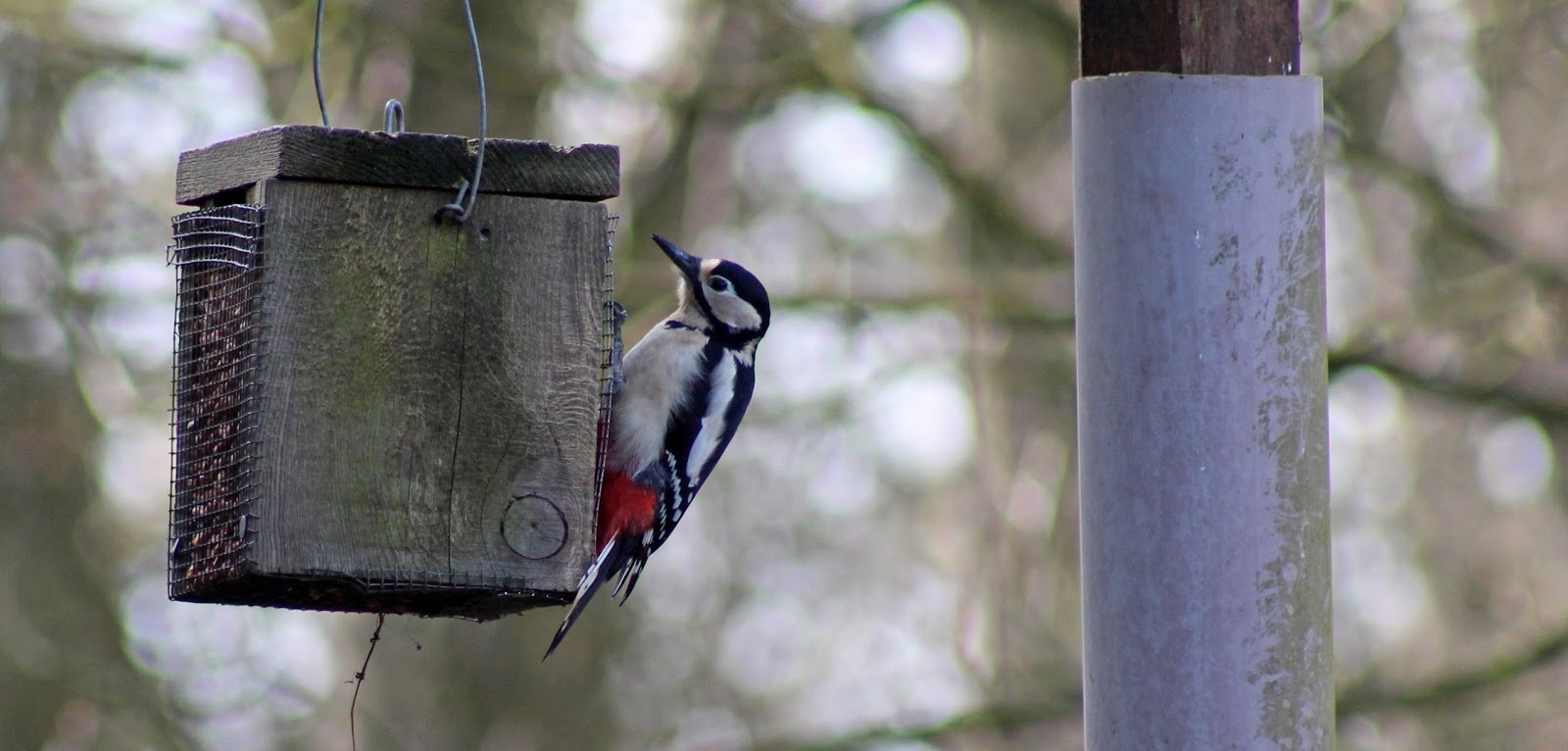
As well as nuts and a broad range of other dietary preferences,
ranging from peas and grains to suet, these woodpeckers also have some less
pleasant eating habits. They are known to raid the nests of other birds, taking
both eggs and chicks to feed their own young. It’s a bird-eat-bird world!

Chaffinch (Fringilla coelebs)
Though I found these chaffinches in a
woodland setting, they are equally at home in urban gardens, as long as
there are trees around. Mr Chaffinch’s multi-hued plumage is particularly
dapper, and is the reason why the expression ‘as gay as a chaffinch’ was used
for a well-dressed and vivacious person, in the days before ‘gay’ acquired a
rather different meaning. I think Mrs Chaffinch looks every inch the stylish
tweed-wearing countrywoman as well.
Chaffinches are prolific singers, so much
so that Brits used to hold contests to determine which bird could sing best and
longest. The Avicultural Magazine of
1896 (vol.2, pp.115-17) has a wonderful story about the contest between
‘Shoreditch Bobby’ of Bricklane and the ‘Kingsland Roarer’, organised by the
landlord of the ‘Cock and Bottle’ pub in London and, as the Chaffinch is the
last but by no means the least bird in this blog post, I have reproduced most
of the article here for those who, as I do, love a good story
In the parlour all the
gas-jets are lighted, but have some trouble to penetrate the fumes of tobacco,
beer, etc. At last the contesting parties enter, each dressed in his Sunday
best. …The two markers take their places, and as the clock strikes the two
cages are uncovered and hung up. The battlers look around for a moment, shake
their plumage, whet their beaks and one may take a grain of seed, but before it
is cracked he hears a familiar sound uttered by his opponent. Immediately he
replies by a full strophe of his song, to which the other answers with fuller
power. Before each marker is already a stroke of his chalk, and now the combat
is fairly ‘started’. The chalks are busily employed to mark each properly
delivered strophe, and keep pace with each other for a time, until ‘Bobby’
takes it into his head to betake himself to the food trough.
Meanwhile, the ‘Roarer’
continues steadily to pour out his heart, and gains considerably in chalk marks.
‘Costermonger Joe’ is getting very uneasy and cannot understand this ‘trick’ of
his much-renowned bird. Never before did he think of food while in the presence
of an opponent. In order to draw his bird’s attention upon himself and from the
food trough, he moves uneasily in his seat and ventures at last to cough aloud.
It must be understood,
that while a match is proceeding no words of encouragement are allowed; no
whistling or other means may be resorted to, to recall a truant to his duty.
Fair play is rigorously enforced. Coughing cannot be stopped.
At last, Joe can stand
it no longer: accidentally his beer glass gets knocked over and falls on the
floor with much clatter. Bobby peers across the room to ascertain the cause of
the unusual disturbance and catches sight of his master, and immediately he
resumes his battle-cry. The ruse has succeeded, although there is a tumbler to
pay for.
The chalk marks on the
tables are getting very numerous. The Roarer has challenged without a fault for
thirteen minutes and is forty points ahead of Bobby, but now he feels rather
‘dry’. He stops working, takes a drink of water and hops to the food box. But
‘Kingsland Bill’ does not give his bird time to lose ground by feeding like the
other. In a moment he whips out the brightly-coloured handkerchief the Roarer
knows so well, and pretends to wipe the perspiration from his anxious brow. His
finch takes the hint, and gallops through the remaining two minutes of the
appointed fifteen in grand style. Bobby also had tried hard to make up for the
precious time he had lost so wantonly, but could not recover all of it.
Although credited with 212 marks, the Roarer beat him by 28 strokes.
Immediately protest is entered by Costermonger Joe, fair play having been violated by the use of the coloured cloth. Bill retorts by calling into question the fairness of the beer glass episode. One word leads to another, the spectators mingle in the strife, expressions of opinion and sympathy with either party are getting more and more select, and battle of another kind seems imminent. Joseph declares he has won, but William insists on ‘fighting’ him for the stakes. This mode of settling the question being declined by Joe, the landlord is called upon to exercise his functions of umpire. With characteristic disinterestedness he declares the whole match null and void, and orders a fresh match to be sung for the same stakes that day week and on the same spot.
Many of the fact-lets for
this blog post came from that most excellent publication, Birds Britannica, Mark Cocker and Richard Mabey, Chatto
& Windus, London

.JPG)


.JPG)

%2Btw.jpg)

