Showing posts with label wat. Show all posts

19 June 2013

A wat or six

I think I am rapidly gaining a reputation as the Mad Wat Woman of Siem Reap, at least in the opinion of my friendly neighbourhood tuktuk drivers and their associates. I doubt if any white person ever in the history of tourism in this city has visited as many of the wats as I have. It’s a very good thing I’m leaving Cambodia soon as this could turn into an addiction.

I can’t help myself. These places have the most incredible architecture, and are often extremely colourful. They are almost invariably empty of tourists. They’re inhabited by friendly monks who are only too happy to practise their English by answering my questions and who seem to appreciate my interest in their sacred places. And, although these are all living monasteries where poorer members of the public can seek shelter in times of crisis and so are never entirely deserted, they are invariably tranquil places to wander around. They offer a fascinating insight into many aspects of the local culture, not just religion. And I love the tuktuk rides I have to take to get to most of them.

So, here are some photos of my recent explorations. All six wats are within 15 kilometres of the city centre, and situated close to the main road than runs from Siem Reap city to Tonle Sap, the largest lake in southeast Asia. I’ve drawn a rough map for anyone visiting the area who also wants to check these out.

Wat Svay
I walked to this wat, a hot sweaty walk there and back alongside the river with no shade. But it was worth every bead of perspiration. There are two temples here, an old one that is in a very sorry state of repair and, judging by the amount of bird poop all around it, is now more of an aviary than a place of worship.

In comparison, the new temple is a shining light of Buddhism, all golds and oranges, with the bright blue highlights of the garudas, the ornamental roof supporters. There are many other buildings, including an old meeting hall built on high stilts, perhaps an indication of how high the river waters can rise and threaten this place.


Wat Kong Mouch
Not much further down the river, this place is quite a contrast to Wat Svay. It looks much older and the grounds are quite unkempt, but the temple itself is no less elaborately decorated, with particularly beautiful windows and doors, and a ton of burial stupas lined up around it in neat, repetitive rows.


Wat Atwea
The next wat down the road is Wat Atwea but I’ll say little about that here so I’ve already blogged about my visit to this place. It has the added attraction of ancient Angkorian temples in its backyard so is worth a visit for those alone.

Wat Po Banteaychey
This wat was a wonderful surprise. The main temple is a colourful many-splendoured construction but there is so much more: an equally splendid meeting hall and lovely office buildings, many vibrantly coloured statues, a large pond with its own small temple sitting in it, and behind the main complex, an extra revelation – a square structure with peaked towers at each of the four corners and a huge tower in the centre.


Wat Aragn Sakor
The architecture of this temple is remarkably different from any other I’ve seen in Cambodia. Although its wooden window shutters are painted in bright reds, blues and golds, the rest of the temple is quite plain and painted a simple dirty white. And its columns are most unusual, with spiral fluting more reminiscent of an ancient Greek temple than something found in southeast Asia.

The rear of the wat backs on to farm land, and that was also like stepping back in time, as I watched a farmer ploughing his rice paddies with an old wooden plough and two large white cows.


Wat in Phnom Krom village
Last but by no means least in this little jaunt along Tonle Sap Road is the wat in the village at the bottom of Phnom Krom (phnom means hill in Khmer), where I had my very own little group of local girls as tour guides. This temple is a very tall structure, with wonderful multi-coloured bands around its base, garuda statues and mint-green-painted nagas guarding its entrance stairways, and an abundance of burial stupas filling its grounds. From the cremation chamber at the rear of the enclosure, you can look out across the fields or back towards the hilltop, where yet another pagoda sits, beckoning the explorer. But that, as they say, is another story.


20 April 2013

Wat Preah Enkosei and its Angkor temples


On the first day of the Khmer New Year – year 2557 by their calendar – I set out to explore yet another of Siem Reap’s wats. This was the one I had intended to visit the previous day before I got sidetracked.

Although it is an easy two-kilometre walk from the central city, on the east bank of the Siem Reap River along River Road, I grabbed one of my local tuktuks, knowing I could enjoy the pleasant walk back a little later. This time we went further than Wat Preah Enkosa to the wat with the oh-so-similar name, Preah Enkosei.

This is a living wat, currently home to 35 Buddhist monks, but this is also the only place I know in Siem Reap where you can see Angkor temples, albeit small ones, for free. (I later found another freebie - see here.) Behind the modern temple sit two brick towers, the bases of two other structures, and the remains of the east gate of a complex dating from the mid- to late-10th century. It is possible that there were originally three towers but the third has now disappeared. As the platform base of the modern temple is made of laterite blocks, it seems likely that the building blocks of the ancient structure were used to help construct the more modern one.


The site was originally contained within a moat, though much of this has now been filled in and what remains has become something of a tipping place for garden and other rubbish. The towers, too, are now mostly ruins, though the larger of the two has a lintel with surprisingly well preserved sculptural reliefs. The broader lower panel shows a central elephant head flanked by dragons and other characters, while the narrow top panel features an interesting depiction of the Churning of the Sea of Milk. (This refers to a story from Hindu cosmology where the gods and demons toiled together for a thousand years to release from the sea of milk the nectar of immortal life.)


Gnarled old frangipani trees grew around the temples, filling the air with their sweet perfume and providing welcome shade on another of April’s over-40-degree days, and there was a pleasant breeze, so I sat a while in the shade of one tower, soaking up the peaceful atmosphere. I had expected the wat to be humming with New Year’s celebrations – and there were some (see my New Year’s blog) – but they were contained in two particular areas so didn’t encroach on the overall feeling of tranquillity.

The decoration on the modern building was relatively subdued for a Buddhist temple, but no less impressive. The reliefs above the doors and windows, the roof-edge ornamentation and the roof pediment decoration all gleamed with their gold and yellow paint.

Elsewhere in the wat, an ancient banyon tree was surrounded by more than the usual number of small shrines, and two stone Buddhas soaked up the sunshine, despite their golden umbrellas. All in all, it was rather a splendid start to 2557!


The burial stupas and a little monk washing


15 April 2013

Wat Preah Enkosa


I spent another couple of hours exploring a new wat last Saturday morning and I have to admit I came away slightly disappointed as I had read that it had some old Angkor remains, as well as the modern temple … but, no! And it wasn’t just that I didn’t find them, as I asked the two different monks I talked to and they both said there were no old temples to be found there.


I tuktuked along to the wat as it looked from the map to be quite a long way along River Road, though, in the end, it wasn’t as far as I thought, and it was a pleasant stroll back afterwards.

When I arrived, monks and men were preparing the pagoda for the following day’s Khmer New Year celebrations, placing flags in the pole stands on either side of the long tree-shaded driveway. One of the monks said hello and ‘where are you from?’, the universal greeting here, and our conversation continued as he gave me a tour of the temple building, unlocking it for me to see the two huge Buddhas inside, one seated and one reclining – as well as assorted smaller ones.

The monk’s name was Somurt and he is almost 23. He has been a monk for 8 years. He told me the temple is 99 years old and the interior paintings (of the ubiquitous scenes from Buddha’s life) are between 30 and 35 years old. This information may or may not be true but, certainly, the temple ceiling was showing much water damage, whereas the paintings still looked quite fresh and vibrant.


Somurt’s English was quite good but he wanted to practise so we sat a while and chatted. Eventually, he went back to his flags and I wandered a little further, though didn’t get far before I was waylaid by another young monk, Sopheap, who invited me to sit with him on a bench amongst the burial stupas. Our conversation was almost an exact repeat of the previous one but I was happy to sit and help a little with his pronunciation. Bizarrely, he had been listening to an Australian sports commentary on his phone radio. I’m not sure how helpful that was to his English learning and he admitted he couldn’t understand most of it – ‘too fast and a funny accent’ – his words, not mine.


I wandered some more, taking photos of stupas and temple buildings, a beautiful open-sided building full of golden seated Buddhas and, finally, what looked like an office building – or, perhaps, with offices downstairs and monk accommodation upstairs, as the building was mostly unfinished.

In front of its main entrance was an elaborately carved archway, under which sat another group of Buddhas and a set of glass boxes for donations for building restoration or monk education or feeding the monks or just general blessings. An elderly nun sat to one side, giving out blessings, so I tossed a buck in her basket and knelt to receive her good wishes for the New Year. She then agreed to be photographed, moving over to sit elegantly in front of the Buddhas, arranging her clothing to look her best. I showed her the photos I took and I gather from what she said next (in Khmer) that she wanted a copy of the pictures, so I’ll get some done and take back to her next week.


Postscript: I discovered, when I got back to my room, that I had gone to the wrong wat. My tuktuk driver had been going to drive past the entrance and I stopped him, thinking he hadn’t understood where I wanted to go. My mistake! There are, in fact, two wats quite close together and, turns out, their names are also quite similar: Enkosa and Enkosei. When I checked Google maps again, I discovered the first was hidden under cloudy skies – at least, that’s my excuse!

11 April 2013

Kesararam: the wat and the killing field


Earlier this week, in preparation for writing this blog, I googled Wat Kesararam, a wat in central Siem Reap, immediately adjacent to the five-star Angkor Sokha Hotel on Route 6. Little do the guests enjoying that hotel’s luxurious surrounds realise what sits next to their sumptuous accommodation. Much to my surprise and with not a little horror, I discovered that the wat had been the site of a security office, a prison and a killing field during the disastrous days of Pol Pot and the Khmer Rouge, a fact not much advertised in this town.

A news story from the Phnom Penh Post, dated as recently as 12 September 2012, described the finding of a mass grave during excavations for a new building within the wat grounds. The disarticulated remains of at least 18 bodies were unearthed and now rest in a small wooden hut, amidst the burial stupas of deceased monks. It is rather a gruesome sight but, sadly, a very real part of the all too recent history of this country.


The news article related a conversation with the wat’s head monk, Sambath Ly Yeut, during which he described previous macabre finds in the wat grounds: ‘In the last five or six years we have been discovering human bones. In 2001, when we built our temple, we saw many bones of bodies, buried with handcuffs.’ The most recent bones also showed signs of having suffered violent deaths, with arm bones trussed with ropes and leg bones fastened together by iron manacles. Indeed, the skull I looked at had a large hole above the left eye socket and a smaller one in the right temple area, which may have occurred during the excavation process but may also have been bullet holes, or worse. There were, apparently, 24 known killing sites in the Siem Reap area alone, with the number of victims at these sites estimated at 44,528!

I find such violence difficult to contemplate and it seems appropriate to me that Wat Kesararam is now a place for meditation and prayer. Many sources date the wat’s construction to the early 1970s but this seems unlikely given the site’s violent history: in the early 70s, the Khmer Rouge were slowly gaining control of Cambodia and their genocidal regime was in full swing. Ly Yeut named 2001 as the year of the temple’s construction, though the wat may have been founded prior to that.

The temple’s excellent state of preservation supports this more recent construction date, and both its exterior and its interior walls are decorated with immense and very colourful depictions of the events from the life of Buddha. Lions and nagas (representations of seven-headed serpents) guard the stairways at the four entrances to the building, with the nagas’ bodies forming the balustrades that border the temple platform and fantastical bird-headed creatures (garudas?) supporting these balustrades.


Wat Keseraram is also known as the “Pagoda of the Cornflower Petals”, perhaps from the shapes of the gold-painted moulding that adorns the roof edges of the temple. The anthropomorphic ornamental roof supports, the windows, doors and their frames also glisten with gold paint, as do many of the burial stupas near the boundaries of the wat.

Most impressive is the tall shrine that sits in the large courtyard in front of the temple. It’s the largest I’ve seen here in Siem Reap and is wonderfully embellished with intricate sculptural reliefs. And encircling the whole of this wat, and the dark secrets sheltered within, is a garishly painted boundary wall, making its location very easy to find. Perhaps all this wat’s bright colour serves as the monks’ way of banishing the grim truth of its not so distant past.


08 April 2013

Wat Bo


Wat is the Khmer word for pagoda and, in Cambodia, pagoda is a generic term for a place of worship, and, in Siem Reap, Wat Bo is one of the oldest places of worship for the local Buddhist people in the city. It is also the pagoda closest to where I live, and I have visited it often. Click on this link to see an aerial view of the wat on google maps. 


Its large grounds, which are filled with the tombs of deceased monks and the houses of the living, provide a haven of peace amidst the hustle and bustle of this crazy city.

Nowadays, the main temple is usually locked so I haven’t been able to venture inside for a couple of years … until today. I was wandering around, taking photos of the temple, then walked over to the meeting hall. I didn’t venture inside as two monks were sitting there, talking quietly, and I didn’t want to disturb them. But, as I strolled from there towards the stupas, an old man – I don’t think he was a monk – came shuffling over to the window of the meeting hall, yelling something and waving his arm at me. I thought I was in trouble for some reason, though I couldn’t think why, having done nothing offensive and being appropriately attired for a temple (shoulders covered and shorts below the knee). I kept walking but he spotted me between the stupas and yelled out again, this time gesturing from me to the temple with one hand and jangling an impressive set of keys with the other. I got it! He was offering to let me in. In my best Khmer, I said “Jahs som. Orgun tom tom.” (That’s “Yes, please. Thanks very much.”)


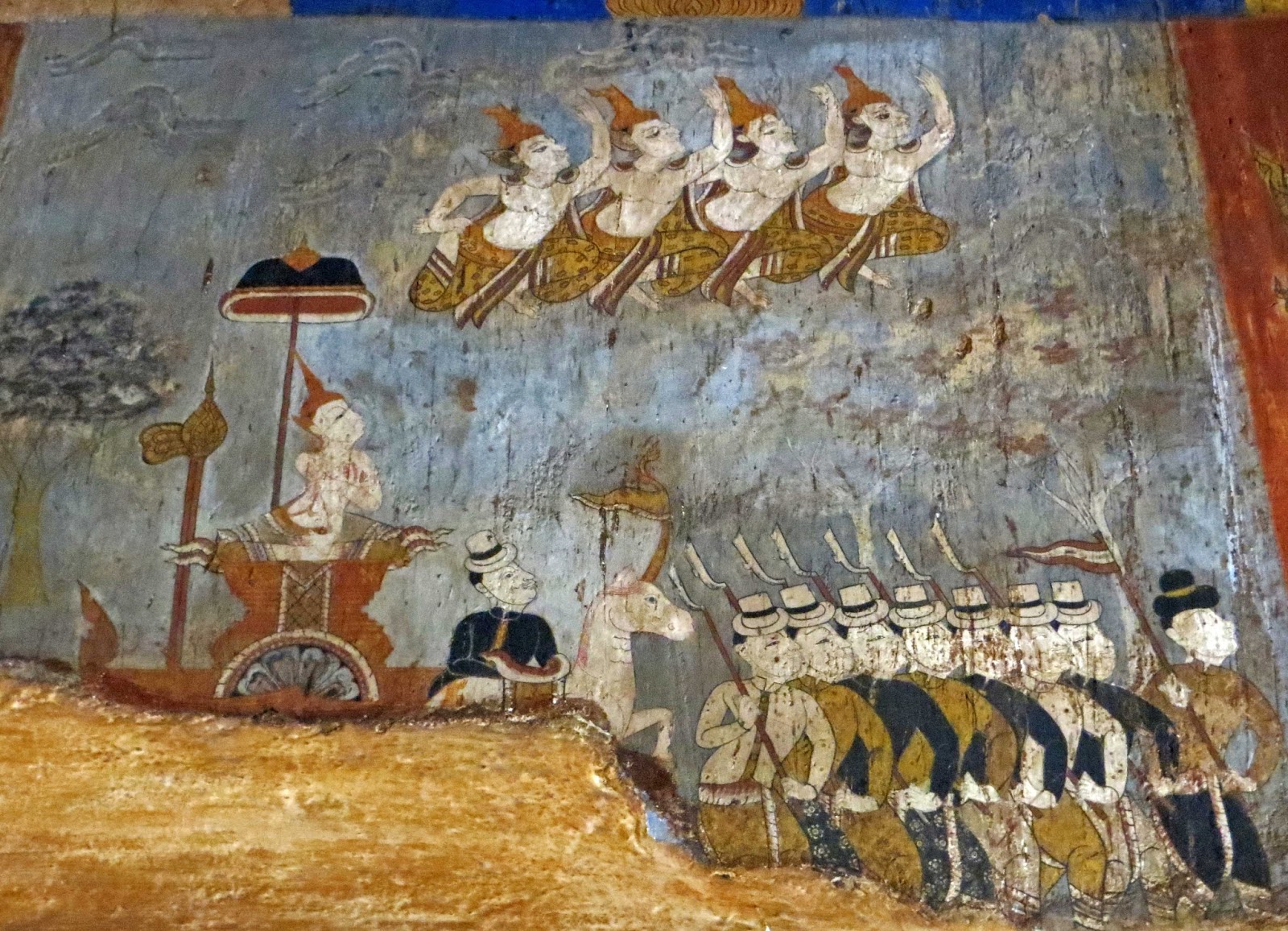
Leaving my sandals at the door, I entered the gloomy interior as the old man scurried around opening up a few windows to let in the light. This was a rare treat because, although Wat Bo is a Buddhist temple, its interior walls are covered in scenes from the Reamker, Cambodia’s interpretation of the Ramayana, an ancient Hindu love story. According to Andy Brouwer, there are only two depictions of this narrative in Khmer art – the other is on the walls that enclose the Silver Pagoda in Phnom Penh. Brouwer says the paintings date from the early 1920s, but others give their date as late 19th century. Whichever is correct, the paintings are in reasonably good condition considering their age.


My photographs are not sharp as I thought it best not to use the flash on my camera and, as I’m not familiar with the love story of Rama and Sita, I can’t explain what is happening in these scenes. It is interesting, though, to see Western-like characters appearing in some scenes – presumably an influence from the days of French colonialism. The temple also has an impressive collection of Buddha statues lined up both in front of and behind the main Buddha.


The exterior of the temple is also beautiful, with ornate sculptural reliefs above the windows and doors, fantastical creatures guarding the entrances and adorning the rooftop, and thin carved panels painted in multiple colours decorating the lower level of the building.

Having made a donation to help with the upkeep of this exquisite building, I wandered a little longer in the grounds, where there is an interesting collection of old and new buildings and, of course, the ubiquitous burial stupas. If you manage to visit and happen to get yelled at by a toothless old man, don’t despair. You, too, might get to take a peak inside the temple.