Showing posts with label Siem Reap. Show all posts

01 January 2014

Inspiration for 2014

I’ve spent some time over the past week adding inspirational quotes to some of my favourite photographs to make myself a new set of desktop wallpapers for 2014 and I thought I’d share them with you all.

If anyone wants hi-res versions of these, just get in touch.

Ancient volcanoes, Reserva Nacional de Fauna Andina Eduardo Avaroa, Bolivia
 
Red deer on bank of Madre de Dios River, Manu National Park, Peru
Confluence of the Waipa and Waikato Rivers, Ngaruawahia, New Zealand (the town where I was born)
 
Waterlily, Wat Damnak pagoda, Siem Reap, Cambodia
Convent of Santa Catalina, Arequipa, Peru

Street art, Santiago, Chile

Hoatzin, Manu National Park, Peru
Banteay Kdei, Angkor World Heritage Site, Cambodia


Laguna and flamingos, Reserva Nacional de Fauna Andina Eduardo Avaroa, Bolivia

Wintergardens, Auckland Domain, New Zealand
 
Zhouzhuang water town, near Shanghai, China

Mt Eden, Auckland, New Zealand


25 August 2013

Homage to home

I’ve had lots of homes in my life – in fact, a quick count reveals that my latest move brings the total to 27.

My first 17 years were spent in the bosom of my family, in the little town of Ngaruawahia, where I was born. The first few years were in a two-bedroom state house, then we moved to a larger state house in the next street soon after my brother was born. That was home for about 14 years and is where my many wonderful childhood memories are based.


Our family home in Ngaruawahia


Dorset St (the red cast is a result of
 using Kodak film in the 70s)
At 17, I went to Auckland for university, and lived a riotous life in a student hostel, before dropping out and heading off to Sydney with a friend for my first, rather short overseas adventure. There were two small, rather grotty flats in Sydney.

After that hot summer, I returned to New Zealand and a flat with 3 others in Kohimarama, followed by my first experience of living alone in half of an old house in Herne Bay. Next came a move with my job at TVNZ to Christchurch, where I lived in 4 different places in the 18 months I spent there. My first home there was in the heritage-listed Dorset Street Flats, which I see from googling suffered some damage in the 2011 earthquake; the others, in old wooden houses, appear to have survived intact.

The Ponsonby house in 2011 (image
from Ray White Realty)
Back in Auckland, I lived first on the waterfront in Kohimarama, in a flat owned by Sir Michael Fay, who lived next door and wasn’t then a ‘sir’. From there I had a few months in a little place in Mission Bay but on the wrong side of the hill, before purchasing my very first home of my own, a wonderful two-storey colonial house in Ponsonby, in the days before the developers moved in. I bought that house for about $27,000 and it’s probably now worth over a million! It was a very social house, the setting for many parties and Sundays ‘at home’. Next was a short interlude of just a couple of months in a concrete-block flat in Parnell, which was very cold but my bedroom had the most wonderful view of the museum and the greenery of The Domain.

And then my next journey to foreign shores got underway, with my first home a bedsit in the Edinburgh suburb of Stockbridge, in a Georgian terrace house that was built before New Zealand was settled – I loved that sense of history, and that marvellous city, particularly as I was footloose and fancy free during the time of the annual festival so roamed the streets enjoying daily doses of culture. But I craved the snow so headed north to the mountains, a job in a hotel and 6 months in their staff hostel. I loved that place too, the daily wilderness walks and the grandeur of those mountains … and the wild whisky-filled winter nights.

Stockbridge, Edinburgh (mine was one of those first floor windows) (image from an Edinburgh realtor)

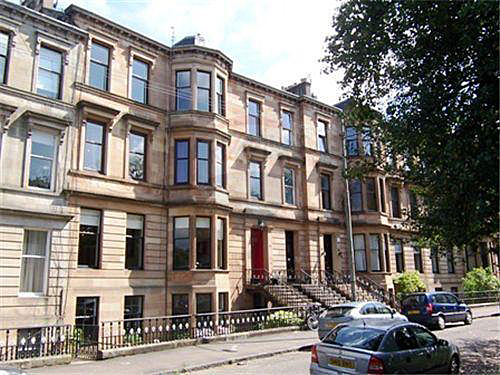
It was in Aviemore that I met my future husband and my next move was in with him, much to his parents’ initial horror, in a bedsit in Glasgow’s Queens Park in a ‘blonde sandstone building of striking architecture c.1900'. That was mostly a cosy little place, though the bizzie-lizzies on the window seat froze solid one particularly freezing mid-winter night when the temperature descended to minus 17!

Queen's Park, Glasgow (ours were the two windows below ground level at the left) (image from a Glasgow realtor)

After a couple of years, by which time we were married, we set off on the longest possible honeymoon … nine months spent travelling back to New Zealand. I haven’t counted any of those places we stayed as homes, though we did get rather attached to a very cheap bedroom in an unfinished hotel run by a Greek named Giorgos on the island of Ios and lingered there a couple of months

In Papakura, I became something of a gardener

Arriving back in New Zealand rather broke, we dossed down with Mum and Dad in Ngaruawahia for a short time (I haven’t counted that either) before moving to Papakura, not by choice but because the ex had a specialised profession and that’s where the work was. We rented for perhaps 18 months, saving every possible penny, before buying our first home together.


The Titirangi house


After 13 years in Papakura, my second-longest abode, we bought our second home, in Auckland’s bush-filled suburb of Titirangi, where I lived for 5½ years, before leaving the marital home and moving into my bachelorette pad in the rather stylish Connaught apartment block in central Auckland city.

The bachelorette pad (images from my latest realtor)
After 5½ years my itchy feet got the better of me once again and my third overseas adventure led me to Peru, where I spent 18 months in a nice little place in Cusco, another physically cold abode but with the spiritual warmth of the friendly locals as compensation. From Peru, I travelled half way around the world to Siem Reap in Cambodia, where I hopped from one guesthouse to another and then one more in the 6 months I was there.

My last abode in Siem Reap


From there back to Auckland, to that dinky little bachelorette pad with its fabulous views over the inner city and down the sparkling Waitemata harbour. And though I returned to sell that place and become a vagabond, I found the opportunity instead to remain in the same building but downsize was too good to pass over, so my latest and current home is in the same building, with almost the same view but much less space. I’m still unpacking my books, settling in, getting cosy, putting my pictures up … but this new home has a really good feeling to it. It may be small but it’s perfectly formed!


My new home


* Please note that many of the photos shown here are not my own but were found seemingly freely available on the internet. I have added acknowledgements where known. If I have unknowingly used one of your photos and you'd like it removed or acknowledged, I apologise and ask that you contact me.

07 July 2013

The joys of Cambodia

I’ve picked out ten photos to showcase what were, for me, the never-forget and laugh-out-loud moments, the heart-stopping places and heart-warming days, and my all-time favourite things from my six months living and working in Cambodia. These images are in chronological order – I couldn’t possibly decide which is the most special.

The many and varied temples within the 400 square kilometres of the Angkor Archaeological Park never cease to fascinate and amaze me, with their skilful engineering and their stunning architecture, and though extremely destructive if left unchecked, the kapok trees and strangler figs are an integral part of the Angkor experience. This magnificent kapok tree has buttresses that prove just how skilled an architect Mother Nature can be.

The Silver Pagoda was definitely the highlight of the few short hours I spent exploring Cambodia’s capital Phnom Penh and, once I spotted the reflections in the waterlily-filled urns, I couldn’t resist taking hundreds of photos. The combination of the superbly sculpted temples and shrines with the beautiful waterlily flowers, all reflected in the still dark water, was irresistible.

Sihanoukville turned on sunsets like this every night we were there and, as long as you walked past the boozy-bar, sleazy-tourist end of Ochheuteal Beach, you could enjoy the tepid waters and desert-island feel of this gorgeous white sand beach.

The two weeks I spent in workshops with creative artists from around the world and excited children from local NGOs, making the enormous puppets for the annual Giant Puppet Parade, were the most fun of my six months in Siem Reap. The children’s energy and enthusiasm were as charming as they were infectious, and performing as number two puppeteer on the Hanuman puppet on the night of the parade left me exhausted but wonderfully exhilarated – a once-in-a-lifetime experience!

Another day, another temple. The combination of an hour-long tuktuk ride, relatively few tourists, a magnificent temple to explore IndiAnnie-Jones-style, and like-minded company to share the pleasure with – a perfect combination! I had been to Beng Mealea before, I went again in March, I would repeat the day at the drop of a hat!

In Cambodia I discovered the delights of waterlilies, their infinite variety of patterns, the delicate subtlety of their colours. Feast your eyes on these beauties and smile!

Cambodian children are wide-eyed, cheeky, desperately poor, smart, smaller and thinner than they deserve to be, cute, capable, hard-working, affectionate, creative, playful, sensitive.… And one of the joys of my last few months in Siem Reap was managing the transition of Helping Hands, the project these three girls attend, into the Globalteer family. I hope their future is a bright one as they each deserve to be stars!

Even now I laugh when I look at this photo. Whenever my spirits were low – which, luckily, was seldom – I would visit the pond at Wat Damnak where there is a healthy population of these little frogs, and their comic antics would always make me laugh out loud.

If you’re a regular reader of my blog, you’ll be aware of my obsession with the pagodas of Siem Reap. This one, Wat Po Banteaychey, is probably my favourite, though each is special in its own way. I think it’s the combination of splendid architecture, the vibrant technicolour decoration, and the tranquillity of the pagodas that made them my favourite places for exploration and lingering.

Here’s another creature that made me smile, with its hilarious dance-like actions, its ability to change colour when aroused, and its truly impressive tail. Both these Oriental Garden Lizards and the tiny geckos that inhabit every nook and cranny of every building in Cambodia, as well as the Tokay geckos that cry out “okay, okay, okay”, charmed and entertained me, and helped provide me with the memories of Cambodia that I’m sure will never leave me.

19 June 2013

A wat or six

I think I am rapidly gaining a reputation as the Mad Wat Woman of Siem Reap, at least in the opinion of my friendly neighbourhood tuktuk drivers and their associates. I doubt if any white person ever in the history of tourism in this city has visited as many of the wats as I have. It’s a very good thing I’m leaving Cambodia soon as this could turn into an addiction.

I can’t help myself. These places have the most incredible architecture, and are often extremely colourful. They are almost invariably empty of tourists. They’re inhabited by friendly monks who are only too happy to practise their English by answering my questions and who seem to appreciate my interest in their sacred places. And, although these are all living monasteries where poorer members of the public can seek shelter in times of crisis and so are never entirely deserted, they are invariably tranquil places to wander around. They offer a fascinating insight into many aspects of the local culture, not just religion. And I love the tuktuk rides I have to take to get to most of them.

So, here are some photos of my recent explorations. All six wats are within 15 kilometres of the city centre, and situated close to the main road than runs from Siem Reap city to Tonle Sap, the largest lake in southeast Asia. I’ve drawn a rough map for anyone visiting the area who also wants to check these out.

Wat Svay
I walked to this wat, a hot sweaty walk there and back alongside the river with no shade. But it was worth every bead of perspiration. There are two temples here, an old one that is in a very sorry state of repair and, judging by the amount of bird poop all around it, is now more of an aviary than a place of worship.

In comparison, the new temple is a shining light of Buddhism, all golds and oranges, with the bright blue highlights of the garudas, the ornamental roof supporters. There are many other buildings, including an old meeting hall built on high stilts, perhaps an indication of how high the river waters can rise and threaten this place.


Wat Kong Mouch
Not much further down the river, this place is quite a contrast to Wat Svay. It looks much older and the grounds are quite unkempt, but the temple itself is no less elaborately decorated, with particularly beautiful windows and doors, and a ton of burial stupas lined up around it in neat, repetitive rows.


Wat Atwea
The next wat down the road is Wat Atwea but I’ll say little about that here so I’ve already blogged about my visit to this place. It has the added attraction of ancient Angkorian temples in its backyard so is worth a visit for those alone.

Wat Po Banteaychey
This wat was a wonderful surprise. The main temple is a colourful many-splendoured construction but there is so much more: an equally splendid meeting hall and lovely office buildings, many vibrantly coloured statues, a large pond with its own small temple sitting in it, and behind the main complex, an extra revelation – a square structure with peaked towers at each of the four corners and a huge tower in the centre.


Wat Aragn Sakor
The architecture of this temple is remarkably different from any other I’ve seen in Cambodia. Although its wooden window shutters are painted in bright reds, blues and golds, the rest of the temple is quite plain and painted a simple dirty white. And its columns are most unusual, with spiral fluting more reminiscent of an ancient Greek temple than something found in southeast Asia.

The rear of the wat backs on to farm land, and that was also like stepping back in time, as I watched a farmer ploughing his rice paddies with an old wooden plough and two large white cows.


Wat in Phnom Krom village
Last but by no means least in this little jaunt along Tonle Sap Road is the wat in the village at the bottom of Phnom Krom (phnom means hill in Khmer), where I had my very own little group of local girls as tour guides. This temple is a very tall structure, with wonderful multi-coloured bands around its base, garuda statues and mint-green-painted nagas guarding its entrance stairways, and an abundance of burial stupas filling its grounds. From the cremation chamber at the rear of the enclosure, you can look out across the fields or back towards the hilltop, where yet another pagoda sits, beckoning the explorer. But that, as they say, is another story.


02 June 2013

Wat Damnak

I first started exploring Wat Damnak, just across the river from downtown Siem Reap, back in February, when I was taking part in the Giant Puppet Parade workshops and I have visited at least once a week ever since.

Not only is it on a slightly circuitous route to town from where I live, but its Buddhist pagoda, shrines and stupas, its gnarled frangipani trees and beautiful waterlilies, its delightful frogs and darting lizards all make good subjects for my photo-a-day project. 

I also find it a tranquil place to wander and sit – this despite the primary school incorporated inside its extensive grounds, the occasional young man asking for a donation to support some good cause or other, and the constant comings and goings of monks and laypeople.

The central pagoda is currently undergoing internal renovation


This is a living Buddhist monastery with an interesting past. It was a royal palace in the days of King Sisowatch, ruler of Cambodia from 1904 to 1927, hence its name: dam nak is Khmer for palace, and it also served as a Khmer Rouge military depot in the dark days of Cambodia’s recent civil conflict.

Now its biggest claim to fame is its Centre of Khmer Studies, an international NGO whose primary aim is to facilitate global understanding of Cambodia, its history and its culture. The adjacent CKS library is the second biggest public library in the country and its 11,000 publications draw scholars from around the world seeking to research Cambodia’s intriguing past.

The Centre of Khmer Studies

Though I am a book lover through and through, for me the library holds a very different fascination. Running along the front of the building is a long narrow water feature, filled with the most gorgeous varieties of waterlilies and the biggest population of green paddy frogs I have ever seen. The markings on the waterlily blooms, which come in subtle shades of white and cream, pink, blue and lilac, seem infinitely varied, and I return often to photograph them. I am also drawn to the cute little frogs – they actually make be laugh out loud at their frantic panicked leaps, and the comical way they sit and stare goggle-eyed at me. So funny!


The monastery grounds are also home to the Kossamak Nearyroath Institute of Buddhist Studies, a facility to educate monks and the general public in the ways of Buddha, and to a second NGO, the Life and Hope Association Sewing School, which has the wonderfully practical aim of providing young Khmer women with a vocation and a future.


Wat Damnak sits in large park-like grounds, which are well filled with buildings and meeting halls, temples and stupas, as well as a large deep pond, in which sits a bright yellow shrine. The air is sweetly scented with frangipani, the large trees provide welcome shade, and the Khmer architecture mesmerises with its intricate detail. I think you can see why I return again and again to this charming location.