07 October 2015

A feast for Fungus Day

It’s prime fungi time here in the Northern Hemisphere and this coming Sunday, 11 October, is UK Fungus Day. So, what better time to share with you some of the incredibly diverse range of fungi I’ve managed to photograph just this week.

And what better location to go fungi spotting than in a place that’s been designated a Site of Importance for Nature Conservation (SINC), a place that’s fast becoming one of my favourite places in Cardiff for so many reasons, Cathays Cemetery.    

The main reason the cemetery was designated a SINC by Cardiff Council was because of its fungi. At least fourteen species of waxcaps have been found within the grounds of the cemetery – for those with a mycological bent, they are Hygrocybe aurantio-splendens, H. calyptriformis, H. ceracea, H. chlorophana, H. citrinovirens, H. coccinea, H. conica, H. glutinipes, H. intermedia, H. pratensis, H. psittacina, H. punicea, H. quieta and H. virginea. Many of these waxcaps are common but, apparently, Hygrocybe punicea, H. aurantio-splendens, H. calyptrifomis, H. intermedia and H. citrinovirens are all significant finds within the county of Glamorgan in which Cardiff is located.

Fairy rings of waxcaps

Of course, the cemetery doesn’t just have waxcaps. You can also find a selection of the more common fungi found in grassland sites, including ‘fairy’ rings of Blewits (Lepista cf sordida) and Clouded agaric (Clitocybe nebularis). And, just this week, I found some Coral fungi (below), which may or may not be Ramarai pallida – it seems positive identification involves the use of a microscope!


I’m a keen fungi-finder but their identification is always a bit of a mystery to me as I find the photographs and descriptions in most books difficult to relate to what I’m seeing in the flesh, and googling doesn’t often help either. That – and the fact that I am new to Cardiff – are my excuses for not having identified most of the fungi in my photographs. If you can help with their identification, I would be very pleased to hear from you.

In the meantime, I hope you can get out and enjoy some fungi spotting this Fungi Day, and in the weeks to come. And, remember, only eat them if you can positively identify them – many are poisonous, some can kill!


On the left, perhaps Sulphur tuft (Hypholoma fasciculare), and the one on the right looks like one of my omelettes!


A favourite feast for the slugs

I love how these clumps burst from the ground, almost growing before your eyes


A lesson in persistence, as these Common puffball (Lycoperdon perlatum) force their way through cracks in a gravel path. 


Possibly Tricholomopsis rutilans, also known as 'Plums and Custard' fungus 


02 October 2015

Quaker’s Yard walk: Tramroads, viaducts and bridges

‘Anyone with a feel for our industrial heritage will experience a tingle in the soles of his feet throughout this walk’ writes author Gordon Hindess in his informative little book Family Walks around Cardiff and the Valleys (Scarthin Books, Cromford, 1992, p.57). As I am lucky enough to be out walking with the man himself, and his lovely wife Liz, I don’t have to settle for a feet-tingling experience – I am treated to a running commentary of interesting facts and figures about the route we are walking, much of which I would otherwise have missed.

We start and end our 4-mile walk in the tiny village of Quaker’s Yard, which takes its name from the 17th century Friends' burial ground by the main crossroads in the village. It’s a simple stone-walled enclosure, easily missed if you don’t know what to look for, particularly because, traditionally, Quakers don’t mark their graves with headstones.

Our route along the former Penydarren tramroad is green and leafy, with the River Taff babbling pleasantly below us. As Gordon tells me, this tramroad is where the very first steam locomotive to run on rails first hauled its load of iron ore and passengers from Merthyr to Abercynon way back in 1804. Though the tramroad has been closed for over a century, you can still see the rail support stones in some places. Regular holes in the stones and their positioning in a straight line along our trail are the tell-tale signs of the tramway.


We cross the Taff over a high bridge and then almost immediately pass under the dizzying 90-foot-high spans of the Goitre Coed viaduct, an impressive feat of engineering that has been carrying Taff Vale Railway traffic across the river here since April 1841. It comes as no surprise that this towering construction was designed by that master of railway engineering Isambard Kingdom Brunel.

Further along the trail we pass what’s left of two more lofty viaducts, their enormous stone supports now almost disappeared beneath smothering vegetation. At home, later, I find on the internet some old photos of these soaring structures, including one of demolition day on Alan George’s website – what a sight that would have been!  


Before re-crossing the Taff, we stop at a perfectly sited farmhouse, offering tea and cake – help yourself and leave a donation! – where I also make friends with a cute kitten sunning itself on a chair and, not to be left out, a handsome horse poking his head over the stable door.


Refreshed and recharged, we cross the Taff by the charming Pont-Y-Gwaith, a steeply arched stone bridge, built in 1811 to the design of architect William Edwards, to replace a wooden bridge which was associated with the nearby 16th-century ironworks (Gwaith is Welsh for works). Gordon spoiled my romantic illusion of this delightful place just a little by telling me that, when the bridge was repaired by the Mid Glamorgan County Council in 1993, it was rebuilt in reinforced concrete, then re-clad with the old stones from the original bridge. Still, it looks authentic, and at least it should be around for many generations of walkers to enjoy.

A modern subway takes us under the busy A470, then we turn left, passing over what remains of the Glamorgan Canal. For a hundred years after its opening in 1794, this canal served the Cyfartha ironworks in Merthyr. Now, it’s merely a weed-filled hollow, barely discernible as a former waterway.


Rather than follow the track by the canal or the single-lane road back to the car, we veer off to the right and climb steadily upwards on to the mountain ridge of Daren y Celyn. The ascent is well worth it as we are rewarded with breath-taking panoramic views in every direction. The coal-bearing hills roll away on all sides, rows of terrace houses hug the hillsides in the valley villages below, the blades of a wind turbine can just be seen revolving steadily beyond a neighbouring ridge top, and one distant hillside is almost completely covered in solar panels. The landscape tells a tale of industrial history, from the long-gone days of the underground coal mining pits to the modern methods of energy-production.


Continuing along the ridgeway, we scramble up the boulders and around a large gap on the summit of Daren y Celyn, the former quarry that once supplied the stone for the railway viaducts, now known to the locals as the ‘Giant’s Bite’. If you know what to look for – and Gordon does  you can see the remains of fossilised trees in the stones here.

Having soaked in the views and enjoyed the cooling breeze, we head down the side of the mountain, forcing our way through the thick bracken that almost blocks the track, before joining the country lane that leads us back to Quaker’s Yard. 

We have had a fascinating journey through the industrial heritage of this area, a heritage representative of many of the coal-mining valleys of South Wales, and a thoroughly enjoyable walk to boot. My sincere thanks to Gordon and Liz, for sharing their knowledge and for their good company.

01 October 2015

A celebration of trees: September: Once were trees

This month’s celebration of trees is a little different – it’s about death.

This dead tree in Roath Park became an art installation
 for a few weeks
Okay, that’s a little dramatic. It’s about trees that are now physically dead but live on in the ways we still use them. There are hundreds of uses for dead trees, of course – they're all around us in our daily lives. As I sit writing this, I can cast an eye around my little flat and see wood in furniture and shelving, doors and window sills, kitchen utensils and books.

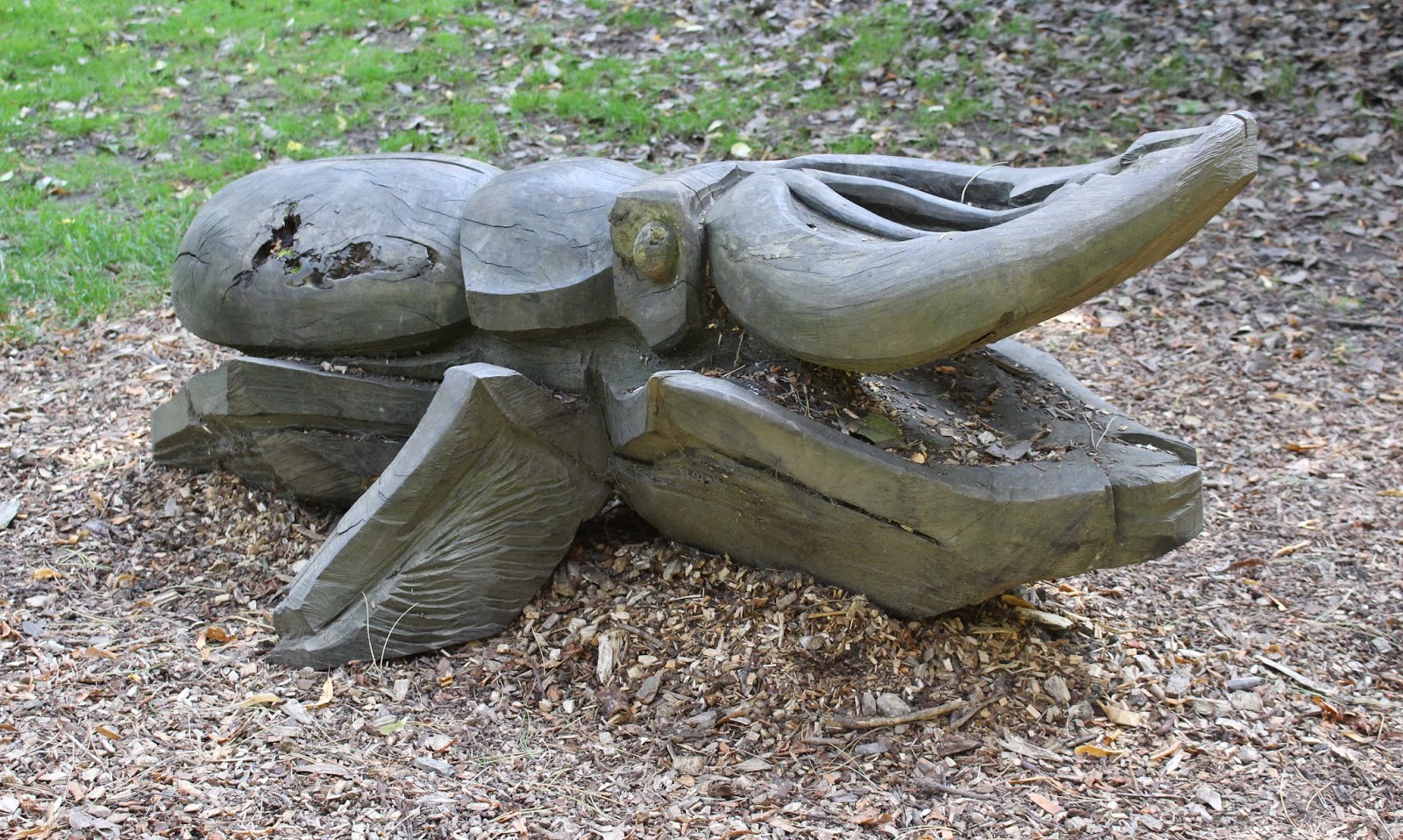
However, prompted by the various artworks I’ve discovered in the parks of Cardiff, I want to show you some trees that have been put to more creative uses, as statues and sculptures, as benches and as play features.

Expect for the tree on the right, the objects in my photographs can all be found in Cardiff's Bute Park, which has both a sculpture trail, where artists have frequently used dead trees from within the park to create beautiful artworks, and a discovery play trail, to introduce children to local historical and ecological themes.

Unfortunately, the information on the Bute Park website is incomplete – the interactive map doesn’t actually show all the sculptures and there are no specific details of the artworks or their creators. Hopefully, these omissions will be rectified in the near future. In the meantime, it’s a beautiful park to wander around and discover these resurrected trees for yourself.

The frog on a log was originally the frog and the fly but the fly has flown ... or been swallowed!

A knight flies on an eagle
Apple trees perhaps? Children love to clamber on this one
Sinuous dancers, on the left, and a fairy, a dog and a lizard, on the right
Is it a platypus? Is it a dinosaur? No, it’s a stag beetle.
A serpent snaking through the wood chips
A jolly green tree man


Do you love trees? Then you might like to look over my previous months’ celebrations of trees by clicking on the following links: January (one particular favourite),
 February (about lime avenues), March (on the subject of forests), April (about the greening of the trees in the British springtime), May (on the New Zealand pohutukawa), June (about some of Auckland’s most notable trees), July (honouring ten wondrous trees from my international travels), and August (following pathways through forests and woodlands).