16 July 2019

Rogiet windmill


What a delight it was to discover this new windmill earlier this week. That’s new, as in the first time I’d seen it or even knew of its presence, not new as in newly constructed, as you can tell immediately from its appearance. I was walking from Severn Tunnel Junction train station in Rogiet, in the nearby county of Gwent, to Slade Wood for a day’s butterflying with my friend Sharon when this structure appeared on the hillside in front of me.


Unfortunately, I’ve found very little information about the former windmill – what I list here has come almost entirely from the British Listed Buildings (BLB) website. This now ruined structure was once a tower-type windmill, most probably used for grinding corn into flour. The BLB lists a reference to the mill having been found in a lease document dating from 1526, so the mill is assumed to have been built around 1500. The lease or deed, between the parties Gamage (the lord of the manor), Lovelye and Mylward, relating to a ‘windmill and appurtenances’, is held at the Wiltshire and Swindon History Centre, so I haven’t been able to examine its content.


The tower is shown as a round building on a survey document dated 1746, is labelled ‘old mill’ on an Ordnance Survey map of 1830, and is shown as a dot on ‘Windmill tump’ on the 1881-82 Monmouthshire county OS map. The BLB website describes the structure as follows:

Exterior:
Of small scale rubble. Walls c 1m thick taper slightly and are offset below present wall head. Three original openings, possibly 4.
Former narrow stairs to upper floor S.
Doorway SW with rubble jambs, possibly a window above it.
Opposite is a second opening probably a window with doorway above; heads of both broken.
Intact slit window upper floor S.

Interior:
3 tiers of beam slots. Slots also indicate stairs from ground to first floor and plaster line indicates former continuation to top floor.
Diameter suggests one pair of millstones.

Next time I visit this area, I’ll try to get better photos of the ruin and will update this post with them, and any additional information I manage to find.

~~~~~~~~~

22 July, and a return visit to Rogiet. You can get quite close to the windmill by walking up the lane adjacent to its field, so here are a few more photos. The structure is in a sorry state of repair unfortunately.


15 July 2019

Penarth : Fake news!


It seems the concept of fake news is not a new one. One hundred and twenty years ago today this newspaper report related the ‘startling news’ of a meteorite falling in Penarth ... but did it?

Evening Express, 15 July 1899:
Startling news fills up the gap in the weather conversation this morning. A meteorite is stated to have fallen near the esplanade at Penarth ...

Seventy-nine people telephoned and telegraphed and called on us this morning to tell us of a meteor which fell at Penarth this morning. The office scientist wrote an account from hearsay, proving it to be the comet of 1817, just a bit used up, but active. Members of Cardiff scientific societies were of [the] opinion that it was a spoonful of meteoric matter out of the milky way. Then our matter-of-fact man took a bus there, and came back and said the strange thing was a mammoth rocket. The scientific people waiting here to hear about it proved immediately that the phenomenon was a successful endeavour of the men in Mars to signal us. Great excitement prevailed, until the news came that the rocket was a stray one from the life-saving station. Then the scientists invited us out to take to drink, and say nothing about it.


10 July 2019

Penarth : a royal assortment of post boxes


If you’re looking to post a letter in the lovely Glamorgan town of Penarth, you can choose from a wide variety of post boxes in which to place that letter for collection. There are pillar and wall boxes of various shapes and sizes, all bearing some version of the royal cypher of the king or queen who reigned at the time they were installed. The cypher usually consists of the monarch’s initials and a number in Roman numerals to indicate which monarch they are to have used that name, sometimes but not always surmounted by a crown.


The oldest post boxes date from the Victorian era (pillar boxes have been in use in Britain since 1852), when Penarth was an extremely popular seaside resort. There are at least three VR (Victoria Regina) pillar boxes, two tall and one slightly shorter and fatter (these would all have particular design names but I’m not so fascinated by post boxes as to have researched them). Penarth also has at least one wall box – there may be more lurking in the older streets that I haven’t yet walked along. Interestingly, this doesn’t show the official royal cipher in cursive script; instead, it simply has the letters VR, with a crown between, along the top of the box.


The next British monarch to reign after Victoria’s death in 1901 was her oldest son Albert who became Edward VII. 

So far I’ve located one post box from his nine-year reign, the pillar box shown at left. 

Edward VII certainly wins the prize for most elegant cypher, I think.

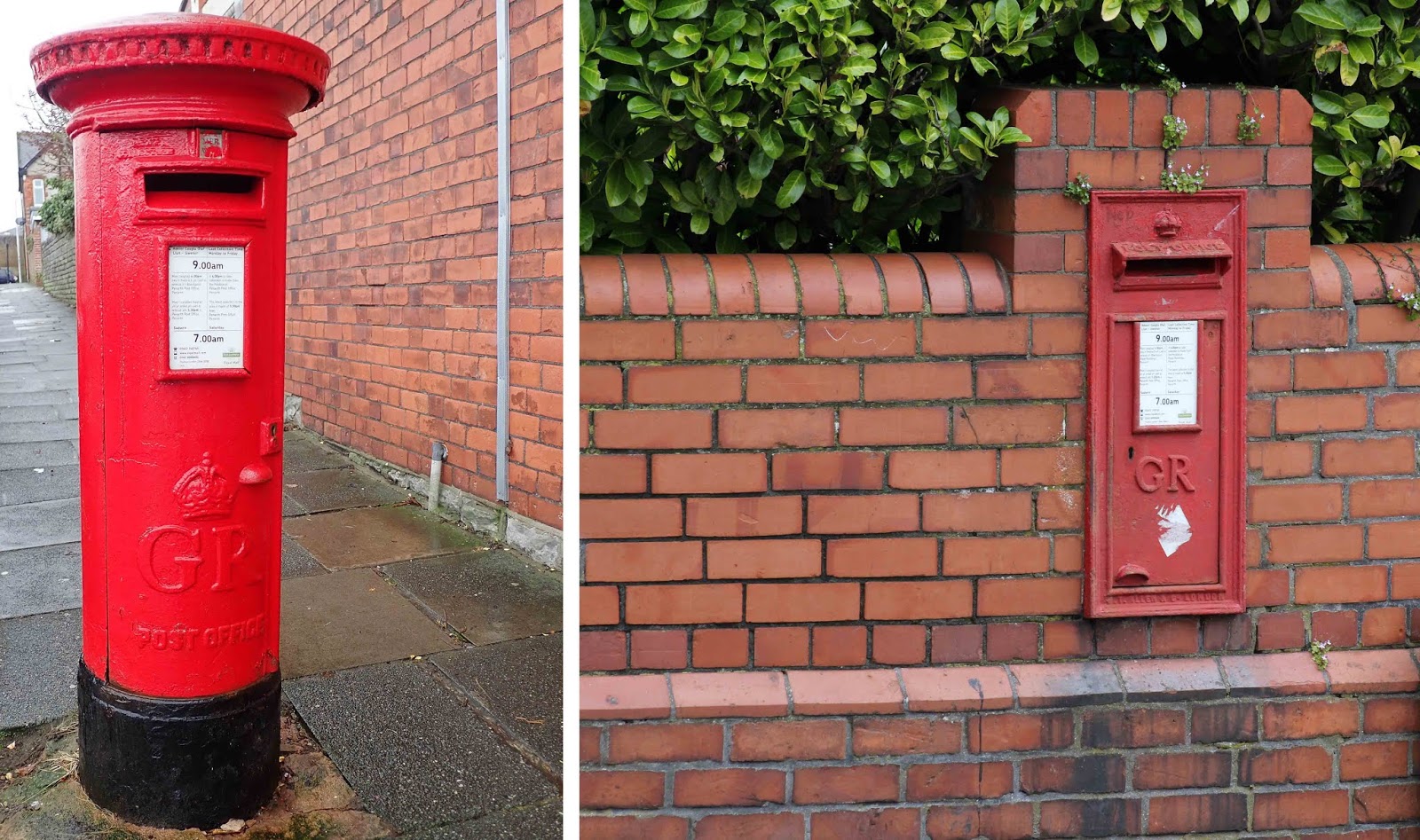
Next up was George V. Interestingly, his cypher does not include the Roman numeral V – it is simply GR. 

I have not discovered why this was. (The royal cyphers are apparently designed by the College of Arms and subsequently approved by the monarch.) Penarth has at least one pillar box and one wall box from this 25-year reign (1910 – 1936).


George V’s replacement was, of course, Edward VIII, the king who famously abdicated, after just 326 days on the throne, to marry American divorcee Wallis Simpson. 

Although post boxes were issued with his cypher, they are few and far between, and Penarth does not have one. (There is an Edward VIII pillar box in Cardiff though – see here.)


Replacing his brother, George VI became king on 11 December 1936 and served as monarch for the following fifteen years, until his death on 6 February 1952. Penarth has at least one pillar box and one wall post box from this period.


Last and longest of the British monarchs to be represented on the local post boxes is, of course, the current queen, Elizabeth II. Perhaps because of the length of her reign, Penarth boosts several different post boxes showing her royal cypher. I suspect, both from its design and its condition, that the pillar box on the right is the oldest of these. The box on the left was a ‘modern’ design that dates from 1980, but that type was replaced in 2000 by the pillar box shown in the centre, which has the words ‘Royal Mail’ emblazoned below the cypher instead of the more traditional ‘Post Office’. And that’s it until Britain gets its next monarch.