 |
| The lovely courtyard at my hotel |
By 7.15am I was on the bus
to Sucre. The woman in the seat next to me wanted the curtain shut against the
sun so she could snooze, so after a while I also snoozed, though I peeked out
occasionally. I saw enough to know we went up hill and down dale. It got
gradually greener, with real grass and a lot more trees – and that was my initial
impression of Sucre – it was very green. I stayed in the old, colonial part of
the city, where the government has decreed the buildings be painted every year.
And the hotel, Hostal Sucre, had a beautiful courtyard, with a central fountain
and lots of flowering geraniums.
After settling in at the
hotel, I had a sandwich and tea at a little café next door, and a chat to a
Canadian girl, who’s travelling around South America for a few months. Then, I
sat in the courtyard, enjoying the sunshine and surroundings until my city tour
at 2.30.
It was a great tour. Maribel,
the vibrant young tour guide was full of details about Sucre, and Bolivia in general,
the driver was a real gentleman, opening the door and providing extra
information, and, with my permission, a young language student also came along
to listen to our conversation. We were a chatty cheerful party!
 |
| A view over Sucre |
First stop was La Recoleta, an
area where lovers go in the evenings, for a fine view over the city. Next was
an artisan’s workshop and store nearby. There are two local indigenous peoples,
whose craftwork is quite distinct one from the other: one group produce
textiles only in red and black, the other’s are multi-coloured. I would have
liked to have bought something but it was beyond my budget – wall hangings were
several thousand pesos each (at the moment, there are about 6.5 pesos to the US
dollar). One of the women weavers was wearing a very ornately decorated hat,
which marked her as single and available!
Next was the Museo del
Convento de la Recoleta, once a cloistered convent, now partly a Franciscan
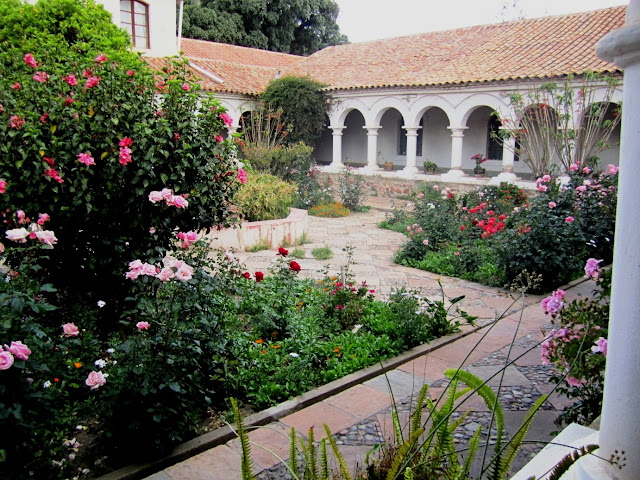
monastery, partly museum. It is a beautiful building, with three separate cloistered
courtyards each containing beautiful gardens – you could smell the roses and
jasmine as you walked in. It was a quiet peaceful place and easy to imagine
living there a life of prayer and contemplation – plus, I do like the Latino
way of inside-out living, of high solid walls facing outward to the world, with,
inside, rooms opening on to a cloister and courtyard for private enjoyment.

The
museum housed memorabilia of the monks, many religious paintings, and much
silver – gifts from the parents of sons and daughters who joined the religious
orders. Apparently, the family tradition in the past was for the first-born
daughter to become a nun and the first-born son a monk, at the age of 15, and
neither could ever leave. Now, though most Bolivians would say they were
Catholic if asked, few actively practice their religion. Many of the paintings
were in desperate need of restoration, but the Franciscans are self-supporting,
though tickets sales to the museum and some donations, so the restoration has
to wait till sufficient funds are accumulated. Outside, there was an orangery, which
used to the stable area when the monks used to ride around the countryside
spreading the word of God, and terraced gardens, still in use, with the excess produce
being donated to the school next door. In the chapel, a first communion was in
progress, which we observed from the upstairs area, which now houses
beautifully carved choir stalls. Most of the wood in the old buildings is
cedar. The trees used to cover the hills around Sucre, until the Spaniards cut
it all down for building purposes.
Next
was the city cemetery, a busy place just days after Todos Santos. Over the
entrance is a large ornate gateway, with the Latin inscription HODIE MIHI CRAS
TIBI: ‘It is my lot today, yours tomorrow’ or, more simply, ‘Today me, tomorrow you’. A sobering thought! It was a
beautifully landscaped and maintained cemetery, but it is subdivided by class.
Near the entrance are the tombs of the rich families, those with enough money
to buy a relatively large plot of land and build on it an ornate mausoleum to
house all family members. Next are the multi-storey graves of the middle class,
not grouped together by family but rather in random order. They are also well
maintained, with glass fronts like windows, with flower arrangements inside.
Some even have mini awnings to protect them from the sun! Some were decorated
with coloured streamers from the 1 November commemoration, blue and white for
boys, pink and white for girls, and purple and black for older people. At the
rear of the cemetery were the graves of the poor; the sort of burials we have
in Western countries, but huddled much closer together. Nearby were new
buildings where members of the same profession can choose to be buried
together; for example, there was one building for truck drivers, another for
teachers.
 |
| Tombs of the rich |
 |
| Graves of the middle class |
As we were leaving, a funeral procession was entering:
a hearse, with a group of people walking slowly behind. There is a small chapel
near the entrance gate where Mass is held, then the body is buried – no cremations
in this country – then close family and friends return to the house of the
deceased for food and drink. Another mass is held one month later, then a
further Mass – with food and rather a lot of drink and sometimes music – one year
later, at which time the women also stop wearing the black clothes of mourning.
 |
| Graves of the poor |
Next on the tour was a walk through the main city
park, Parque Simón Bolivar, where locals walk, play, sit and study. On
Saturdays and Sundays, it has lots of things to entertain children – mini roundabouts
and bouncy castles. In the centre the park has a mini Eiffel Tower – quite a bizarre
construction – and, at one end, a pool which has a fountain light display on
weekend evenings – equally bizarre, but apparently a favourite with lovers.
Next was a quick walk through the central market, just
one block from the main plaza and the place to buy anything. We bought bananas
and bread, gifts for the indigenous people we would visit the next day. There
were fruit and vegetable stalls, toiletries and electrical goods, nuts and
spices and flowers, as well as a whole floor of food stalls and juice makers. I
learnt there are two local food specialties: one is a pork dish which sounds
similar to Peru’s chicharon, and the other, various versions of spicy pork
sausage. Sadly, I didn’t get to try either.
Last stop of the day was the Convent of San Felipe
Nery, now a religious school for girls, and another beautiful old building.
From the rooftop, there was a glorious view both of the courtyards below and
the city skyline. Afterwards, I walked along to the main plaza to have tacos
and a coke for an early dinner. On the way back to the hotel, I took photos of
more lovely buildings. It had been a wonderful day. Sucre had a good feeling to it – I liked it there.
 |
| Convent of San Felipe Nery |
 |
| View from the rooftop |
 Kampot is a small town, an hour’s bumpy and
breezy tuk-tuk ride north of Kep. It doesn’t have a lot going for it: a
riverside setting; an economy based on pepper production and on the salt
gathered from large drying fields just outside of town; fruit, which it
celebrates with a statue of a giant durian in the middle of the town’s central roundabout;
and a rickety old bridge, which is a hodge-podge of 4 different architectural
styles and looks likely to collapse at any moment.


