Showing posts with label Cathays Cemetery. Show all posts

21 July 2019

The Tragedy of Mademoiselle Albertina


One hundred and twenty three years ago today, on 21 July 1896, a brave young woman lost in her life in an aerial stunt that should never have been allowed to happen.

I first became aware of the story of Louisa Maud Evans – her nom de theatre was Mademoiselle Albertina – when I lived in Cardiff and was a frequent visitor to nearby Cathays Cemetery. The inscription on her headstone intrigued me:

In memory of Louisa Maud Evans, aged 14 ½ years.
Who met with her death on July 21st 1896.
On that day she ascended in a balloon
from Cardiff, and descended by parachute
into the Bristol Channel. Her body was
found washed ashore near Nash (Mon) on
the 24th of July and was buried
here on the 29th.
To commemorate the sad ending of
a brave young life.
This memorial was erected by public subscription.
“Requiescat in Pace”   [presumably rest in peace]
‘Brave woman, yet in years a child
Dark death closed here they heavenward flight
God grant thee, pure and undefiled
To reach at last the light of light.’

I read an account of her death in the booklet Cathays Cemetery Cardiff on its 150th Anniversary, produced by the Friends of Cathays Cemetery in 2009, but it wasn’t until I read the contemporary newspaper reports that the real horror of Louie’s death was brought home to me.

Sketch of Louie Evans (left), South Wales Echo, 27 July 1896, and sketch of Louie with her foster parents (right),
Cardiff Times, 1 August 1896

This was a very public spectacle, an ascent by balloon followed by a descent by parachute, one of the many entertainments that accompanied the six-month run of the 1896 Cardiff Industrial and Maritime Exhibition. Long story short, Louisa (Louie) Maud Evans had been engaged by her foster parents the Crinks to work as a domestic servant for the manager of a circus and, perhaps craving a taste of the excitement she saw in that environment, became involved with Auguste Gaudron, a Frenchman who entertained the crowds with balloon stunts, often performed by young women.

Evening Express, 24 July 1896 and 22 July 1896

On 21 July, despite never having performed this stunt previously, Louie was dressed in a sailor suit, with a cork life vest for safety, and hoisted several thousand feet into the air, while hanging by ropes from a smoke-filled balloon. At a pre-arranged place, she was meant to detach herself from the balloon, parachute safely to earth, be collected by a horse and carriage, and driven back to much applause from the huge crowd at the exhibition. But it all went horribly wrong.

South Wales Echo, 22 July 1896
This ‘graphic interview with a boat-man’ was reported the next day in the Evening Express:

James Ware, boatman at the Pier-head, states: A little after eight o'clock on Monday I was standing on the East Moors, just above the signal box. I followed the course of the parachutist right from above the Exhibition to the moment she entered the water. I had with me an excellent pair of marine glasses and was able to distinctly follow every movement of the parachutist. A little while after it struck the water, the parachute remained extended above, and appeared to be keeping the young aeronaut up, but after two or at the most three minutes, it slowly toppled over in a northerly direction, and disappeared altogether. I saw no vessel near enough to pick her up, and I am sorry to have to say that in my opinion no boat did rescue the unfortunate lady ...

Gaudron denied that such an accident was possible: ‘it is an emphatical impossibility for the parachute to topple sideways’ and ‘it is utterly and completely impossible for anyone to sink when equipped with a lifebelt such as Mdlle. Albertina wore’. When asked how he had become acquainted with Louie, he replied: “I advertised for a young lady for balloon work, and she applied. I think she had been doing some public performances before somewhere. She first went up in a captive balloon with me at Dublin, and eventually started parachuting in Cornwall, at Redruth. Last night's ascent made the sixth. She has never fallen in the sea before, but was a good swimmer.” Sadly, none of Gaudron’s statements was true.

For several days, men in boats searched the waters off Cardiff for any sign of the poor young woman, and the newspapers were full of stories about the accident, Louie’s disappearance, and speculation as to whether or not she would be found alive. Sadly, she was not. On 25 July, the Evening Express was one of the first newspapers to report that Louie’s body had been found.

South Wales Echo, 27 July 1896
The body of Mdlle. Albertina was recovered about twelve o'clock last night at Nash, near Newport. It had been reported at an earlier hour at Goldcliffe that the body had been seen on the seashore at Nash, and a number of men set off with a view to the recovery of it ... They found that the body was that of the lost parachutist by her dress. The police were afterwards communicated with, and in the early hours of this (Saturday) morning the body was removed to the belfry of Nash Church. It bore no marks of violence, and there were no traces of the lost parachute to be seen, but the hooks for attaching the parachutist to the parachute were still fastened to the dress at the shoulders.

There was also a rather gruesome description of the body, which a reporter had travelled to Nash Church to view, and of the ‘excitement’ the news had caused in Cardiff. The inquest, held two days later, returned the following verdict (Evening Express, 27 July 1896):

The jury consulted in private, and returned the following verdict: "That deceased was accidentally drowned in the Bristol Channel on Tuesday last, whilst descending from a balloon," and the foreman, addressing the coroner, stated that the jury were unanimously of opinion that M. Gaudron displayed great carelessness and want of judgment in allowing so young and inexperienced a person to make a descent during such weather as prevailed on Tuesday last, and that they wished to censure him and caution him against allowing such a thing to occur again.

Evening Express, 25 July 1896

The newspaper also reported about Louie’s funeral:

Strong feeling has been manifested that the body of the unfortunate parachutist should be buried at Cardiff, and many offers of subscriptions towards the funeral expenses have been forthcoming. We understand, however, that Mr. Webster, on behalf of the Concessions Company, Cardiff Exhibition, by whom M Gaudron was employed, has undertaken to defray the expenses of the burial of the unfortunate girl. This clears the way for the devotion of the money subscribed by the public to the erection of a memorial tablet over the grave on which shall be inscribed an account of the poor girl's tragic death.

And so it was that on 3 December 1896 the South Wales Daily News reported:

IN MEMORY OF MDLLE. ALBERTINA.
THE ILL-FATED PARACHUTIST.
HEADSTONE IN CARDIFF CEMETERY
During the six months run of the Cardiff exhibition of 1896 there was one untoward incident which marred an otherwise clean sheet. This was the lamentable occurrence by which the so-called Mdlle. Albertina met an awful death in making a parachute descent. The fact that this was her first attempt—although quite unknown at the time to the organisers of the affair—taken in conjunction with her tender age—she was but 14—served to excite an intensity of public interest in Cardiff and the neighbourhood that has rarely, If ever, been paralleled. Nor was the excitement confined to this neighbourhood. The circumstances attracted the attention of Baroness Burdett-Coutts, who, wrote a long letter to the Times condemning such performances. The non recovery of the body of the poor girl for two or three days also contributed to the anxious excitement of the many thousands who had witnessed the aerial descent and of others and it was only after the corpse bad been washed up by the tide on the Nash side of the Usk mouth and the Coroner's 'quest had been duly held that public excitement became in some degree allayed. The peculiarly distressing circumstances, however, of the death of Louisa Maud Evans, whose nom de theatre, Mdlle. Albertina, was assumed by her once and once only, had stirred the warm sympathies of not a few Cardiff people, who determined that the girl's final resting-place in their midst should be marked with some suitable memorial. Thus, then, it happens that a handsome stone has been recently set up at the Cardiff Cemetery which shall serve to recall, for generations to come it may be, one of the most heartrending occurrences associated with the town of Cardiff. The preparation of the headstone was entrusted to Mr Button, sculptor, Neville-street, and his work has been excellently done.


30 October 2016

Grave matters: Stone birds

I learnt a new word recently, the Welsh word ‘mynwenta’, which translates roughly as ‘graveyarding’. It’s something I seem to spend a lot of my time doing, exploring my local cemetery, for the history and stories of its deceased, for the art and architecture of its monuments, for the wealth of its wildlife and the flourish of its flora.


Today’s post looks at birds in the cemetery – not the birds that fly overhead, perch on the crosses, hunt for worms in the grass or build nests in the trees but rather the birds that adorn the headstones and grave monuments – the stone birds.

Though some of these birds appear on headstones purely for their aesthetic value, chances are they also have a symbolic meaning as the Victorians were more than a little obsessed with symbolism. 

Birds that are depicted with outstretched wings, as if in flight, may represent souls, winging their way to heaven. Flying birds have also been interpreted as the messengers of God.


The most common bird found on grave monuments in Victorian cemeteries is the dove, that universal symbol of peace, in this case the everlasting peace of death. For Christians it is a biblical reference to Genesis 8:8 and the dove that was sent out from the ark by Noah to find land after the flood. Though it returned empty beaked the first time, it returned the second time with an olive leaf to show that trees had appeared above the flood waters as they receded, and many of the headstone doves are depicted with leaves in their beaks.

Though I found no examples in my local cemetery, other birds can be found on headstones and each has its own meaning. The eagle symbolises a career in the military and stands for courage and bravery; the owl has long been associated with wisdom so can appear on the headstones of scholars and those known for their wisdom and studious character; and the rooster, in Christianity, symbolises the Resurrection (hence the roosters commonly seen on the weathervanes of churches).

One rather intriguing headstone I found has a lovely carved relief of a swan, with outstretched wings, feeding one of two cygnets at its feet. The symbol appears in the centre of a Celtic cross and I have read in Celtic myth that ‘when inhabitants of the Otherworld required passage to the physical land of life ... they would take the shape of the swan’. 

However, this grave is amongst those in the Catholic section of the cemetery and very closely aligned with those of local bishops and priests so perhaps here the swan is more symbolic of a priest ministering to his flock. 

It may also be a reference to the ‘Seven swans a-swimming’ from the ‘Twelve Days of Christmas’ song, which I only recently learnt was, in fact, a rhyme created as a catechism for Catholics unable to practise their faith openly in Britain between 1558 and 1829. The swans in the song apparently represented the sevenfold gifts of the Holy Spirit: prophecy, serving, teaching, exhortation, contribution, leadership, and mercy.  

I also came across a rather delightful headstone inscription referring to our feathered friends: ‘May the birds sing their song on high in your loving praises.’ I rather like the idea of a chorus of birds singing when someone dies, a final serenade to the deceased – much more appealing that some of the songs people choose to play at funerals. 


04 July 2016

Grave matters: Death of a Cardiff “Giantess”

This was the sensational headline on the front page of The Cardiff Times on 13 March 1909:

  
The ‘giantess’ was obviously a woman of gigantic proportions but she was, in fact, not a giantess – at least not in the commonly accepted definition of a giant as an exceptionally tall person. Mrs J. H. Laubender was just very very fat. In the days when obesity wasn’t as prevalent as it is today, a woman like Mrs Laubender was most unusual, and The Times reporter is almost glowing in his description of her amplitude:

“The Birmingham giantess" was a lady of wonderful proportions, weighing in her prime just over 32 stone. She measured 2 feet 6 inches across the chest, while her waist circumference was close on three yards. Her right arm biceps were 28 inches across, forearm 24 inches, and the calf of the right leg spanned exactly 30 inches.

Such generous measurements meant Mrs Laubender was a novelty, such a novelty that she could earn her living from being a ‘freak’ – and that’s exactly what this ‘giantess’ did.

From wikimedia commons
But let’s backtrack a little.… My tale of Mrs Laubender begins on 15 July 1860 when she was christened at Rowley-Regis in Stafford. Her name was Mary Ann Green and she was the daughter of Emanuel Green and Elizabeth Green, née Bannister, both of whom haled from Brades Village. Nine months later, at the time of the 1861 census, Mary Ann was living with her parents in Bath Row, in Oldbury. Not unexpectedly, given their location in the heart of the Black Country, Emanuel Green was listed as a sheet mill shearer, so would have worked in a local ironworks, cutting sheets of metal to size for various manufacturing processes.

By the time of the 1881 census, the family had both expanded and moved. The Greens were then living at Dudley Port in Tipton, Staffordshire, and Mary Ann, then 21, was the oldest of five children (Joseph aged 15, Harry aged 13, Catherine aged 5, and Samuel aged 4). Also living with the family was 27-year-old Henry Royal, a friend from Birmingham. In fact, he was to become rather more than a friend as he and Mary Ann were married some time between 1881 and 1891, though I haven’t located a marriage record. A daughter, also named Mary Ann, was born in mid 1887.

Mary Ann’s father Emanuel died towards the end of 1887 and her mother remarried at the end of 1889, to John Briggs, a market gardener. The Briggs family, with young Samuel Green, lived in the appropriately named Celery Cottage in Clarborough, in Nottinghamshire.

M0015543 Show Bill, Barnum and Bailey's show.
Credit: Wellcome Library, London

By the time of the 1891 census Mary Ann had joined the circus. It’s impossible to tell whether she was always a large person or whether she simply increased in size as she grew older. In 1891, she is listed as Mary Ann Royal, she is married, aged 40, and her occupation is showwoman. Her husband (Harry Royal, married, 48, showman) and a daughter (Mary Ann Royal, single, 15, showgirl) are also listed. The Royals were living in a caravan at the fair ground in Deptford High Street, in London, with a group of other showground performers, headed by 69-year-old Henrietta Wilson, a showground proprietor and one of a famous fairground family.

The Royals are missing from the 1901 census but it appears Mary Ann’s husband, Henry, died in the final months of 1903, and just two years later Mary Ann was married for a second time, in the register office in Portsmouth, to John Henry Laubender, a 28-year-old bachelor and professional tattooist. Mary Ann was then aged 45, so there was a significant age difference. Perhaps her new husband was also in the circus profession – men and women with extensive tattooing were also considered performers and freaks in those days.

The Laubenders were not married long as Mary Ann passed away on 9 March 1909 in Cardiff, reportedly after suffering a long and painful illness. The funeral of such a noteworthy woman caught the attention of the local press and, through their reports, we can learn a little more about Mary Ann’s ‘giant’ life:

From The Cardiff Times, 13 March 1909, p.1:

The death took place on Tuesday at 3, Caroline-street, Cardiff, of “Madamoiselle Royal," who was known in private life as Mrs J. H. Laubender. The deceased was born in Birmingham about 48 years ago, and for about 14 years was on exhibition as a giantess with the leading showmen in the kingdom, and she had not only travelled throughout Great Britain, but had toured America and visited leading Continental cities.
In 1900-1 the “Birmingham Giantess," as she was professionally known, was one of the most interesting side shows connected with the famous Barnum and Bailey's “Greatest on Earth."
In the course of an interesting testimonial given the giantess when she left the show the manager wrote:-- “There are Stout Ladies and Stout Ladies, but you surpass anything I have shown before in your line. --Signed) Charles Seymour Bailey." …
Some few months ago the giantess took up her residence at Cardiff with her husband, Mr J. H. Laubender, a skilful tattooist, to whose pretty artistic designs the famous “giantess” bore tribute, having been tattooed practically all over the body.

From the Evening Express, 12 March 1909, p.4

Mary Ann Laubender, Evening Express, 12 March 1909
MADEMOISELLE ROYAL
Remarkable Funeral in Cardiff
The funeral of the lady professionally known as "Mademoiselle Royal," described as the biggest woman in the world, weighing upwards of 32 stone, whose death occurred on Tuesday, and whose remarkable career was described in our columns on Wednesday, took place on Thursday afternoon, thousands of townspeople and others witnessing the procession as it left the residence of the deceased, No. 3, Caroline-street, and wended its way to the New Cemetery, where the interment took place. The coffin was of extraordinary dimensions, probably the largest ever seen in Cardiff. It was six and a half feet in length, three feet in breadth, and nearly two feet in depth, and the weight of the coffin and body – which were carried out of the house to the funeral car by fully a dozen employees of Messrs. Bostock and Wombwell and Mr. John Lloyd, who acted as bearers – was nearly 6cwt.

The chief mourners were Mr. J. H. Laubender (husband of the deceased), Mr and Mrs. J. Priest, Mr. J. Lloyd, Mrs Cousins, Mrs Gass, and Mr. and Mrs. Scott, and amongst those who followed the remains to their last resting-place were a number of show-people from Bostock and Wombwell's Circus and other exhibitions in the town. The lid of the coffin was covered with handsome floral wreaths, placed thereon amongst others, by Mr Laubender, Mr. and Mrs Grimple, Mr. and Mrs. Lloyd, Mrs. Cousins. Mrs. Scott, Mrs. and Miss Gass, Mr. and Mrs. J. Priest, and Mrs. Cohen.

The officiating clergyman at the cemetery was the Rev. Gilbert Heaton, M.A., vicar of St. Mary's. To receive the coffin, which was lowered into its last resting-place by means of eight pairs of strong webs, the grave had to be made practically double its usual size. The deceased, who was a native of Birmingham, was about 48 years of age, and was described by Messrs. Barnum and Bailey, of whose great show she was one of the chief attractions for a considerable time, as the stoutest lady they had ever seen.

I have searched the grounds of Cathays Cemetery but, unfortunately, Mary Ann’s grave has no headstone. Let’s hope Cardiff Council will rectify that when they realise what a celebrity they have in their cemetery.

28 December 2015

Grave matters: The time of angels

Angels are a common sight in Christian cemeteries, carved in stone, standing tall at the heads of graves, carrying the wishes of the deceased’s family that their loved one has gone to heaven to dwell in peace forevermore.

Most of the angels guarding the graves at Cathays Cemetery in Cardiff are female, though depictions of two particular male angels are not uncommon elsewhere and can be indentified by the objects associated with them, Michael with his sword and Gabriel with a horn.


The female angels also appear with objects, often wreaths or flowers, or in specific poses with symbolic meaning. Some angels appear to weep, expressing grief over a life too soon cut short, others gaze sorrowfully skyward, perhaps appealing for God’s mercy. Occasionally, an angel will be shown carrying a child, or perhaps embracing the dead person as they escort them on their final journey to heaven. Angels can be young or old, and a grouping of several angels together is said to represent heaven itself.


Just as we would choose a particular type of headstone from a catalogue today, so the Victorians chose their grave markers from the catalogues of monumental masons. It is quite common, therefore, to find almost exact replicas of angel statues in one cemetery, as you can see from the photograph below. Usually no attempt is made to individualise these statues – most are ‘off-the-rack’ creations – but, occasionally, the faces are different. Whether these are an attempt to recall the deceased person or simply a reflection of each mason’s artistic skills, I’m not sure.


Without meaning to seem disrespectful to the dead, statues of angels always remind me of the television programme Doctor Who and one of its scariest alien races, the Weeping Angels. Resembling the stone statues of winged angels in draped clothing that are so common in Victorian cemeteries, these creatures have the ability to move metres in the blink of an eye, as long as no one is looking at them.

Doctor Who is recorded in Cardiff, and various locations around the city have been used in the filming of outdoor scenes, including Cathays Cemetery. So, I have just one piece of advice for you when looking at the photographs in this blog … don’t blink!


The features of the angels shown in the centre and at right appear more individual than most


06 December 2015

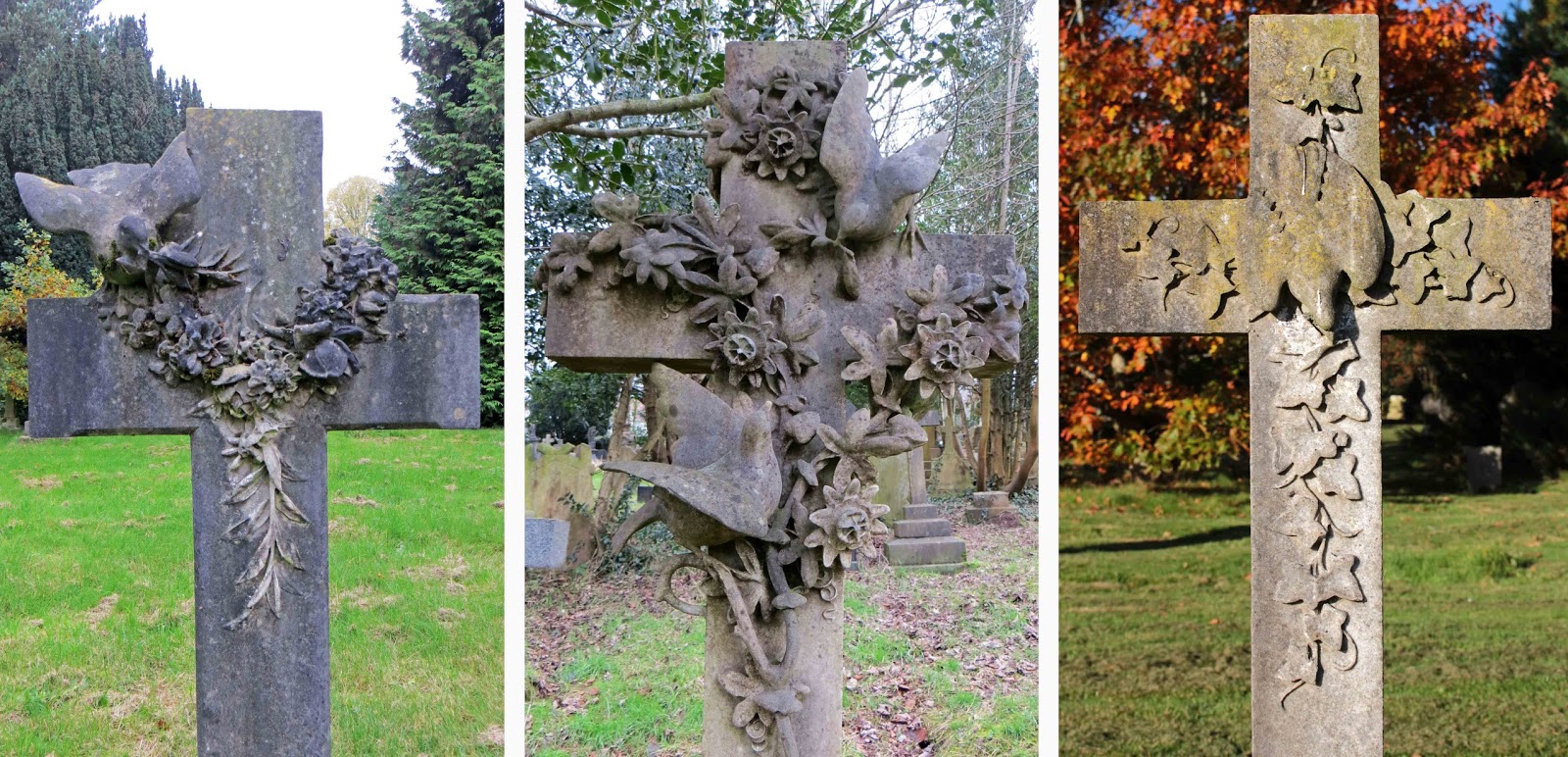
Grave matters: Ivy

Ivy seems almost to be ubiquitous in cemeteries. Either you’ll find it carved into the stone of a grave marker as decoration, or it will be smothering that same headstone so you can no longer read the details of who’s buried beneath, or both!

As you might easily deduce, when the evergreen and almost indestructible ivy is used as a decorative element on a headstone it is intended to symbolise immortality and eternal life, and perhaps also rebirth and regeneration – just think how resilient a plant ivy is and how, even when you think you’ve removed every last piece of it from a stone wall, it soon reappears as if by magic. Some people believe ivy is also symbolic of friendship, faithfulness and fidelity.

The plant itself can be seen both as a blessing and a curse in a cemetery. On the positive side, it is an important plant for the environment, providing nectar and berries, shelter and nesting places for insects, birds, bats and other beasties. A covering of ivy is also thought to protect monumental stonework from weather erosion. On the negative side, however, the roots of ivy can creep between gaps in stonework causing grave monuments and headstones to crack and become unstable; its weight can cause similar instabilities; it frequently covers headstone inscriptions making them impossible to read; and if inexpert attempts to remove ivy can lead to further headstone damage.


How to deal with ivy is an issue for all authorities who have responsibility for heritage buildings and monuments, not just those in charge of cemeteries. One of the problems is that ivy can usually only be effectively eradicated through the use of herbicides and many heritage authorities have policies not to use chemicals within their grounds.

I don’t have the answers to the problems caused by ivy so I’ll let that literary master Charles Dickens have the last word here. This is the poem that appeared in his novel, Pickwick Papers, which was originally published in serial form between March 1836 and November 1837.

‘The Ivy Green’

Oh, a dainty plant is the Ivy green,
That creepeth o’er ruins old!
Of right choice food are his meals, I ween,
In his cell so lone and cold.
The wall must be crumbled, the stone decayed,
To pleasure his dainty whim:
And the mouldering dust that years have made
Is a merry meal for him.
        Creeping where no life is seen,
        A rare old plant is the Ivy green.

Fast he stealeth on, though he wears no wings,
And a staunch old heart has he.
How closely he twineth, how tight he clings,
To his friend the huge Oak Tree!
And slily he traileth along the ground,
And his leaves he gently waves,
As he joyously hugs and crawleth round
The rich mould of dead men’s graves.
        Creeping where grim death has been,
        A rare old plant is the Ivy green.

Whole ages have fled and their works decayed,
And nations have scattered been;
But the stout old Ivy shall never fade,
From its hale and hearty green.
The brave old plant, in its lonely days,
Shall fatten upon the past:
For the stateliest building man can raise,
Is the Ivy’s food at last.
        Creeping on, where time has been,
        A rare old plant is the Ivy green.


22 November 2015

Grave matters: 'No way to run a laundry'

In a room above a laundry in Lower Cathedral Road
A lurid story of sex and drugs is ready to unfold.

Shock, horror, scandal – four found in a bed.
Three women are alive but the Chinaman is dead!


Had they smoked opium? Speculation raced!
Is that why the women are so yellow faced?

Three English lasses, brassy and bold,
And a Chinaman from Birmingham, or so we are told.

Western Mail photo, 22 November 1922: ‘The laundry in Lower Cathedral-road’

If they had smoked opium, where is the pipe?
Or is this yet another case of newspaper hype?

Now the story changes: they drank it in their tea.
But where is the opium? That’s the mystery!

Western Mail photo, 22 November 1922: ‘Removing the girl victims from the laundry in the ambulance’


The women have been drugged, of that, there is no doubt.
Now we need to wake them up to get the story out.

“First, take them outside. Lay them on the ground.
Next, strip them naked, walk them all around.

Pummel them, push them. Don’t let them rest.”
Are they up to questioning? That will be the test.

Western Mail, photo: Arthur E. Smith, 23 November 1922: ‘Rosetta Paul and Florence Paul, two of the three girls who were found unconscious at the Chinese Laundry in Lower Cathedral-road, Cardiff.’

Treatment continues; all is touch and go,
And even when they’re better, their brains are very slow.

Doctors and policemen try communication
But the girls can’t – or won’t! – explain the situation.

And what of the Chinaman? Little Yee Sing.
Was he really part of an opium ring?

His friends say “No.” A policeman does too.
“He said he was afraid.” But of what? Of who?

Western Mail photo, 23 November 1922: ‘Yee Sing’


A search reveals four bottles full of Chinese swill
Tests show opium but not enough to kill.

An inquest is held: it shows disease in Yee Sing’s heart.
Was it that or opium that caused him to depart?

Western Mail photos, 28 November 1922: [left] ‘Our photograph shows Chinese and a white girl mourner (on the right) at the graveside.’ [right] ‘The Rev. W. Harris, of Clive-street Baptist Church, conducted the short service at the graveside.’


We will never really know what happened in that room,
Neither how three women were so drugged, nor Yee Sing met his doom.

The Chinaman is buried in the cemetery at Cathays
To lie in peace beneath the trees the rest of his days.

Yee Sing's grave at Cathays Cemetery

20 November 2015

Gather ye waxcaps while ye may

Okay, that’s not really how the 17th-century poem (‘To the Virgins, to Make Much of Time’, by English Cavalier poet Robert Herrick) begins but, when it comes to gathering waxcaps, you really do need to seize the day because

Old Time is still a-flying;
And this same [fungi] that smiles today
To-morrow will be dying.

This blog was supposed to be full of deliciously luscious photographs of waxcap fungi taken somewhere up a hill in the wilds of the Welsh valleys after an outing with my new friends from the Glamorgan Fungi Group. Then Storm Abigail decided to sweep across Britain, with her whistling winds, hail showers and torrential rain. Though some of the dedicated – some might say mad! – followers of fungi still braved the hill, I chose to remain indoors.

Luckily, I have a magnificent and very abundant source of waxcaps much closer to home, at Cathays Cemetery. The fact that its 110-acre grounds have remained largely undisturbed since the cemetery closed to new burials about 35 years ago means the grassy spaces between and around the graves are ideal for waxcaps, as the hygrocybe species are sensitive both to pollution and to agricultural chemicals.

I am still very much a novice when it comes to identifying fungi – if you’ve ever tried it, you will know what a difficult process it can be. Is the fungus slimy or dry? Where is it growing? Is it alone or in a cluster? What is the texture of the cap? How are the gills attached to the stem? What colour are the spores? These are just a few of the myriad questions you must answer. It is at once frustrating, entrancing, infuriating, captivating … and highly addictive!

I think I know the identities of all the waxcaps in these photographs but, just in case I’m wrong, let’s just focus on how beautiful they are and not bother about what they’re called. Enjoy!


For more facts and an identification guide to waxcaps in particular and fungi in general, check out the First Nature website.