09 March 2014

Round the Bays 2014

Round the Bays has been an annual event in Auckland since 1972. The event was initiated by jogging pioneer Don Walker and former Mayor of Auckland, Colin Kay, both members of the Auckland Joggers' Club. The first run attracted 1200 participants, though only 793 of them had paid to compete.


They walked to the start line, they came on ferries and they came in trucks

Around 5 years after it started, walkers joined runners in the event and, these days, those who are wheelchair-bound and those who are still in pushchairs also join in the fun.

The first competitor who appeared was a gorilla in a wheelchair!
Then came the runners - Jonathan Jackson, in the orange shirt, led them from start to finish


In 2012, on the event’s 40th anniversary, there were 70,000 participants, making Round the Bays one of the world’s biggest fun runs and the largest mass participation event in New Zealand.

At first there weren't many ... but that soon changed


I remember watching my first Round the Bays run from the porch of the flat where I was living way back in 1978. Me, my boyfriend of the time and our flatmate were enjoying some good strong coffee after a late night out at the pub but managed to stumble outside to cheer on the runners and walkers.

Beginning on Quay St in the central city and finishing on the waterfront at St Heliers Bay, the course is 8.4km long and follows the coastline of Auckland's Waitemata Harbour. I’ve never actually taken part in the event but I’ve walked the flat course many times for pleasure. Having the sea on one side of the road makes it a very pleasant walk.


And they just kept on coming ... and going


Employees of companies and organisations large and small form teams of walkers to help raise money for whatever cause or causes are being supported each year. This year funds raised have been dedicated to Radio Lollipop, Cystic Fibrosis Auckland Branch, The Hearing House, Crohn’s and Colitis New Zealand, Raukatauri Music Therapy Trust, Kidsline and Fairfax First Books.


With most particpants dressed in company colours and displaying their organisations' logos or slogans, the t-shirt makers must make a fortune from this annual event but not everyone dresses in tees or sports gear. People also dress up in crazy outfits – this year I saw Tarzan and Jane, a banana man and lots of fairies, as well people in costumes related to their work: firemen and toothpaste men, amongst others.
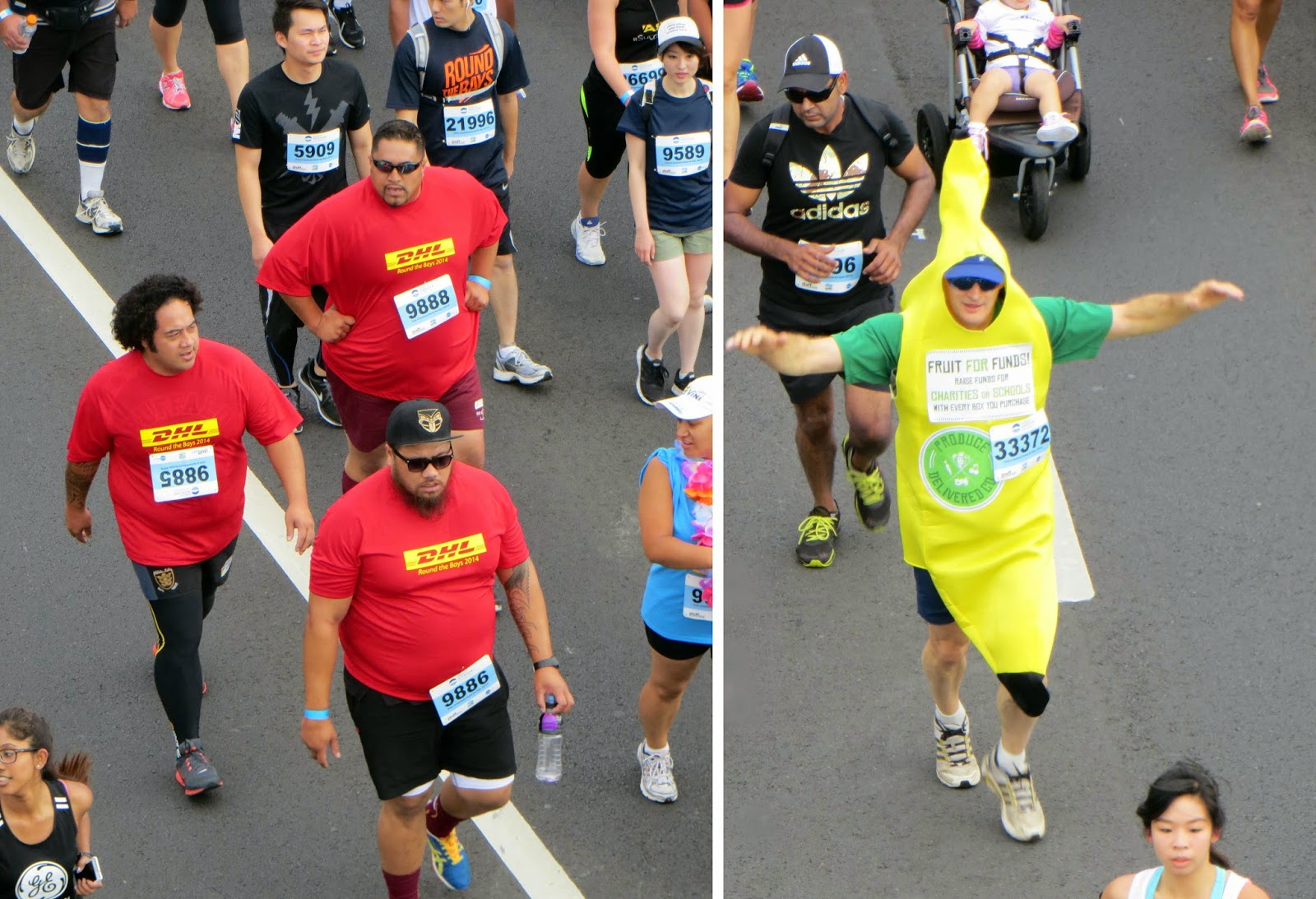


It was fairly obvious that a lot of the participants only do a walk like this once a year so I’m sure there’ll be many sore muscles tomorrow. It was fun to watch and cheer everyone on but I’m glad I wasn’t in with the masses.


28 February 2014

Auckland’s Sky Tower

Auckland skyline from North Head


I remember quite well all the grumbling and groaning when it was announced that the Sky Tower would be built in central Auckland: ‘It will ruin the city skyline’, as if the skyline was something worth preserving; ‘It will be a huge concrete eyesore’, as if the skyscrapers built during the 1980s and 1990s weren’t themselves huge concrete eyesores; and ‘It will destroy the city’s heritage’, as if the developers hadn’t already done that when they indiscriminately tore down or preserved only the facades of many of Auckland’s heritage buildings.

From Westhaven marina and from St Stephen's church in Judges Bay
Twenty years later, the tower has become an icon, a major tourist attraction and the best way to locate yourself when out and about in the city and suburbs, as it is so tall it can be seen from far and wide.

Old and new - the tower of the old Auckland Art Gallery and the Sky Tower
If, like me, you enjoy weird and wacky facts and figures, here’s a bunch from the Sky Tower website:  
The Sky Tower took 2 years and 8 months to build during which time the more than 1000 people (from several different companies) who helped build it are estimated to have eaten 545,000 pies and drunk 1.245 million cups of tea.

The main structure of the tower is a concrete shaft 12 metres in diameter, which is supported at the base by eight concrete legs. These legs are connected to the shaft by a concrete collar which is designed to spread the load.

A good reflection and a tasty meal?
The Sky Tower weighs 21 million kgs which is the equivalent of 6000 elephants, 30 million pavlovas (the pavlova is another New Zealand icon, though Australians claim to have invented it!), or 8,765,903 gumboots filled with concrete (men’s size 9 – not proven, but thereabouts).

At 328 metres tall (from the ground to the top of its mast), the Sky Tower is the tallest freestanding structure in the Southern Hemisphere – it is approximately 23 metres taller than the Sydney Tower (we had to beat those Aussies!). On a worldwide scale, the Sky Tower is approximately the 25th tallest tower in the world – that list keeps changing as more towers and skyscrapers get built. The height of the Sky Tower would be the same as putting 37 buses end to end – who works out these things?

From Viaduct harbour

The tower provides amazing views from its three observation decks and its revolving restaurant. From the top deck, the Skydeck, which is immediately below the main communications antenna and 220 metres from the ground, you can see up to a distance of 82 kilometres on a clear day. On a not-so-clear day, the tower’s top is often shrouded in low cloud and mist, so visibility is practically zero.

From Albert Park and from the Domain

To get to those upper levels of the tower, there are 3 glass-fronted lifts which travel at approximately 5 metres per second so the ride only takes about 40 seconds. If you suffer from vertigo, you might want to face the doors – and when you get to the observation decks, you might also want to avoid walking on the areas of glass flooring that give a view directly down to the ground.

If being up so high causes you concern about your personal safety, you will be reassured to know that the tower has been designed to survive a magnitude 8 earthquake occurring 20 kilometres away and it can withstand wind in excess of 200 kilometres per hour. The tower will, in fact, sway up to one metre in extremely high winds – this is a good thing – better to sway than to bend and break!

From Rangitoto Island and from Mt Eden
As well as enjoying the viewing and eating entertainment, those who are brave enough can also walk around and / or jump off the tower. Walking around might not sound scary but the Skywalk is 192 metres from the ground, with no walls or windows to shield you and no handrails. Just two thin cables connect you to the building to prevent you from falling. 

Been there, done that? Then you can also try the Skyjump, leaping off the main observation deck, controlled by guide cables so you don’t collide with the tower during a wind gust. It’s certainly not my cup of tea but American singing superstar BeyoncĂ© proved she had nerves of steel, jumping not once but twice off the Skytower when she visited Auckland back in October 2013. 

The tower is admired by tourists
In the daytime, the Sky Tower is a beacon to aid the navigationally challenged and at night it lights up the skyline, in colours to promote causes – pink for Breast Cancer Awareness month, for example, and to celebrate events – red and green at Christmas time and blue for the birth of Prince George in July 2013. Love it or hate it, the Sky Tower is now synonymous with Auckland.


22 February 2014

Auckland Lantern Festival

Last weekend’s Lantern Festival was the 15th to be celebrated in Auckland and it was touted as the biggest and best so far. I’ve only been to a couple so I can’t really testify to the truth or otherwise of that claim but it was certainly popular and attracted the biggest crowds I’ve ever seen in Albert Park. In fact, the park was so jam-packed on Friday and Saturday nights that you couldn’t really enjoy – or easily photograph – all the wonderful displays.

Luckily, one of the features of this year’s festival was a lantern-only night on Thursday night, which attracted less people – a photographer’s dream. As I live just around the corner, I also visited several times during the previous week as displays were being erected so shot a lot of daytime photos as well.

The Lantern Festival is timed to coincide with the first full moon following Chinese New Year and has formed an important part of New Year celebrations in China since the Han Dynasty (from 206BC to 221AD). Apparently, the festival also has some of the attributes of the Western Valentine’s Day as, in centuries past, it was one time that young Chinese could venture out in the evening without a chaperone. I suspect that idea persists today as there were a huge number of young people amongst the crowds in Albert Park.


The lanterns are hand-crafted, made to order in a factory in China. Fish and birds, masks and teapots hang in Albert Park’s huge trees and, on the ground, there’s an eclectic mix of traditional Chinese street scenes, traditionally dressed women and sword-carrying warriors, buffalos, dragons and, bizarrely, a flock of sheep and their sheep dog. They are beautifully colourful and quite spectacular once illuminated.


As well as the lanterns, there are exhibitions of martial arts, and dance and live music performances by local and international artists, as well as demonstrations of traditional dragon and lion dances – always entertaining to watch and a great favourite with the crowds.


Princes Street, which borders one side of Albert Park, is closed to traffic for the duration of the festival and turns in to a food alley, with all kinds of delicious Asian food for sale. The smells are divine, the tastes delectable, especially the traditional Lantern Festival called tang yuan – round glutinous rice dumplings with sweet and spicy fillings. The spicy dumplings were particularly delicious.


This year, Albert Park wasn’t the only location for festivities. Queen’s Wharf was home to child- and family-friendly events, from outdoor movies and puppet shows to paper-lantern-making workshops. Auckland Museum also got in to the spirit of the season. The exterior of the museum was lit in the colours of China for the week, and they also held related activities: a display of Chinese art and calligraphy, expert discussions on Chinese and Maori culture, plus kite-making workshops followed by a kite flying display on the lawn in front of the museum.


The finale to the highly successful festivities was a spectacular fireworks display from the Sky Tower at 10.30pm on the Sunday night. So, Happy Chinese New Year and welcome to the Year of the Horse, the character that symbolises graciousness, dignity and momentum.