05 June 2012

Arequipa, white city of churches


Arequipa, Peru’s second city, is famous for its white stone buildings, made of sillar, the local volcanic stone – I guess there are some advantages to having a volcano on your back doorstep – well, one anyway!

The buildings are beautiful, and Marianne and I had two whole days to wander around the inner city exploring them. Our first visit was to the Convent of Santa Teresa – or, more correctly, the Monastery of the Unshod Carmelites of Saint Joseph and Saint Theresa. The monastery was founded in 1710 and only partially opened to the public in 2005, as a museum containing hundreds of works of art from the 16th to the 18th centuries. The brochure says that the doors of the bell room are closed at noon ‘to allow one of the nuns to pass unseen to ring the bells for the Angelus, as has been done since 1710’ and ‘from the De Profundis room, one can hear the chant of the nuns praying the sixth hour’. The nuns still make traditional products, which they sell to visitors - Marianne bought some delicately scented rose soap.


The Monastery of San Francisco was originally built in the 16th century but has been badly damaged by several of the large earthquakes that have struck Arequipa over the centuries. There is still a large crack in the cupola but other damage is not easily noticeable. It has a beautiful inner courtyard, and many fine religious artworks and murals. The inner structure of the church is made of brick, giving it a very different, more austere look than the other church interiors.


The Convent of Santa Catalina is like a small town within the city. Founded in 1579 and only opened to the public in 1970, it has whole streets of private cells and apartments built for the cloistered nuns by their families. Part of its beauty lies in the colours of its walls – in some places they have been painted a paprika red, in others a vibrant sky blue, while much is still the white of the sillar stone. The gardens are beautifully planted and the streets, alleyways and window boxes are filled with red geraniums. It was fascinating to explore – around every turning was a new window to look out of, another doorway to peer through – and so many photo opportunities that I took over a hundred pictures.


At the end of our first day of exploring Arequipa, which luckily coincided with National Museums Day so entrance was free, we visited the Santuarios Andinos UCSM Museum and saw there the mummy ‘Juanita’, a young Inca girl who had been sacrificed near the top of the Ampato volcano and was only rediscovered in 1995. I have no photos of that amazing sight but the museum’s website has some images if anyone is interested in learning more of Juanita’s story.

The next morning we began with a small local church dating back to 1582, the Church of Santa Marta. It has exquisite paintings on its ceiling, as you can see from the photo.


We arrived at La Compañίa (the Jesuit Church) from the rear, entering through the cloisters of beautifully carved stone, which now house retail shops and a first-floor café where we enjoyed a cold juice. We also visited the church’s Cúpula Policromada, a stunning chapel with a vividly painted jungle of flowers and birds, and patterns covering its entire surface. Photographs were not permitted but I have to confess that I took a couple surreptitiously. The church itself was in use for a wedding when we first arrived so we returned later in the afternoon for a look. To be honest, although I haven’t included a photo here, I thought the external façade of the building was its most interesting feature.


We had a tour of Arequipa’s Cathedral with a lovely young woman, who came originally from Cusco. It’s a huge building, which has been damaged by fire and earthquakes over the centuries and, climbing up to roof, we were shown the damage to one of the bell towers. Its interior is more simply decorated than many of the other churches – it almost looks like the icing on a cake. The twelve columns surrounding the high altar represent the twelve apostles and are made of Italian marble, and it has the largest organ in South America, now unplayable due to earthquake damage.


The last religious building we visited was the Church and Convent of Santo Domingo, the first convent to be built in Arequipa. It is richly decorated, with an altar framed in gold and many ornate paintings hung on its walls, but by that point we’d seen enough churches to last us a long while, and were happy to head off for a cold beer and dinner before taking overnight buses in separate directions, Marianne to continue her journey through Peru and me to return to Cusco, for work the following Monday. We had enjoyed a delightful two days sightseeing in the beautiful white city of Peru.


03 June 2012

The flight of the condors


We were up early on the fourth day of our holiday – early enough to see the sunrise on the snow-capped mountains visible from the hotel. It was freezing – literally. I was wearing 4 layers of clothing and was glad I had bought new gloves the previous day.


From Choraque, we drove to the little village of Maca, where some young girls dressed in their colourful traditional costume were dancing around a fountain in the plaza to entertain the tourists and earn themselves some money before heading off to school. We also checked out the quaint local church.


From Maca we headed in to Colca Canyon, the deepest canyon in the world, along a gravel road which, at times, had a very steep drop off to one side. Being a wimp when it comes to heights, I was glad I wasn’t sitting on that side of the tour bus! The scenery was impressive though – huge areas of terraces, created by the indigenous people who have lived in this canyon since ancient times, to make farming on a steep slope easier.


We reached Cruz del Condor, 1000 metres above the canyon floor, at about 8.30 am and scrambled over the rocks of the viewpoint to find a good spot to wait. Condors are big birds, weighing up to 15 kgs and with a wingspan of around 3 metres, so they need the thermals to glide up the canyon each morning, before flying off for up to 250 kms in search of their day’s food – dead animals! 


Patience is required – how quickly they come depends on what the weather’s like, when the sun hits the bottom of the canyon, how quickly the air warms up … But, eventually, we saw some small birds a long way below and kept watching until, by 10.30am, they had reached our level and were gliding past us just metres away.


There were several adult birds and two brown-feathered juveniles. The young birds seemed to tire and settled for a while on a rock very close to the canyon edge – a rare treat to have them so close to us. And the whole spectacle was marvellous to watch – I filled up a 2gb memory card with photos but eventually stopped clicking and stood enthralled by the condors’ seemingly effortless flight. One of nature’s miracles!


Still buzzing from witnessing such beauty, we headed back to Chivay for a delicious buffet lunch with all sorts of local delicacies, and then it was all aboard our minibus for the 3-hour drive to Arequipa. The scenery was again spectacular: large herds of llama and smaller groups of vicuña, as well as snow-covered mountains and the three volcanoes which surround Arequipa. Only one, Misti, is active and at 5300 metres it looms menacingly over Peru’s second largest city. The inhabitants seem unfazed by its frequent stirrings and earthquakes, even though parts of the city are in the path of potential lava flows.


After dropping off our bags at our hotel, Marianne and I headed out to get our bearings before the sun set. The Plaza de Armas was only a few blocks away – close enough to find a first-floor balcony restaurant for beer o’clock while watching the sun set behind the cathedral. But, as soon as the sun had gone down, the air turned chilly so we moved to another restaurant to sample Arequipa’s famous freshwater prawns. We wanted another balcony for the view and, luckily, the restaurant had warm ponchos available for the crazy tourists who choose that option. When in Peru …


23 May 2012

On the road from Puno to Chivay


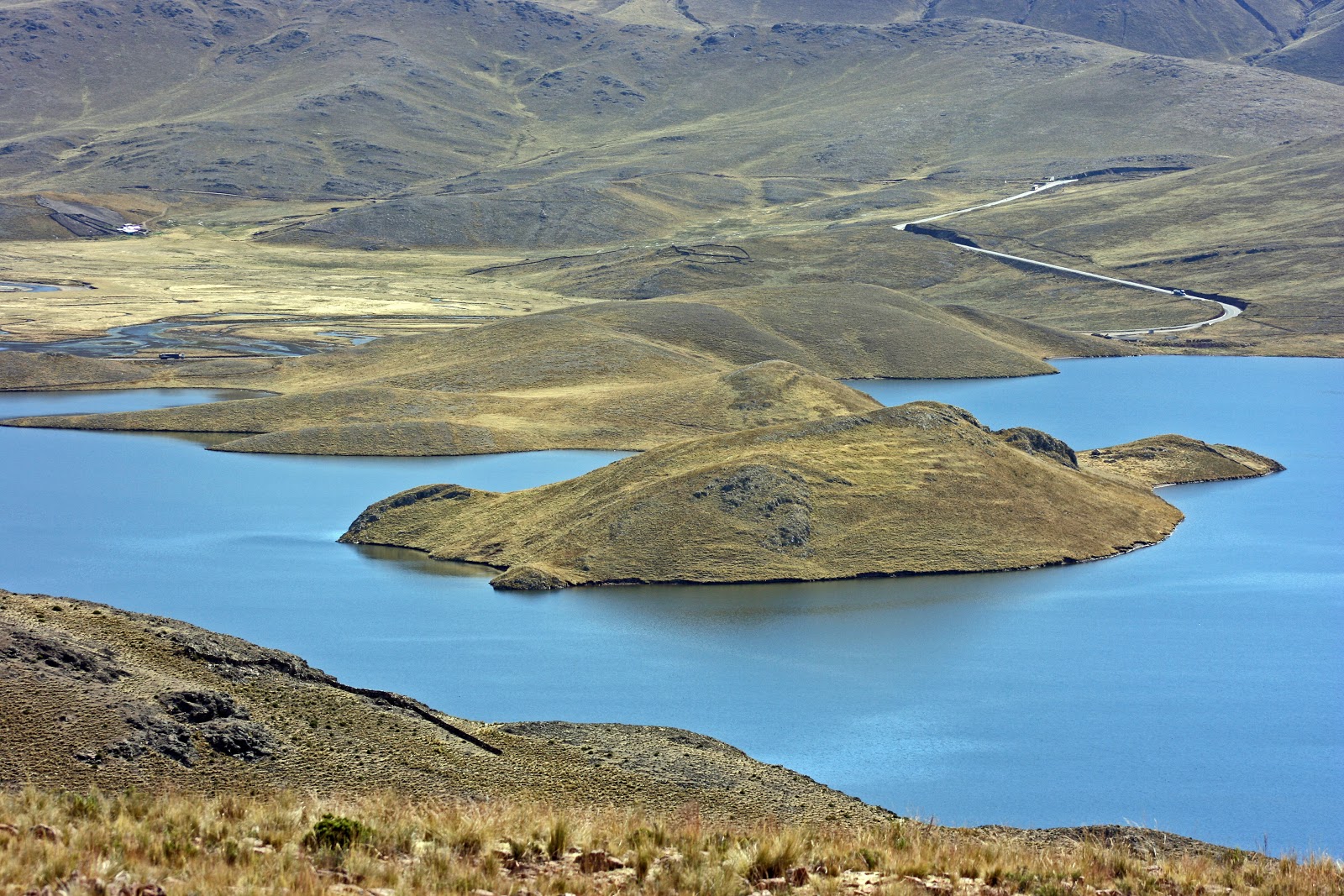
I had no idea how impressive the scenery would be as we drove out of Puno in the chilly early morning, heading for the little town of Chivay in the Colca Valley.

Our first stop was at Lagunillas Lake, where the blues of the lake and the sky competed for our attention – which was more blue? The sky was sprinkled with the whispiest of clouds and the lake surface peppered with flamingos – so pretty.


Soon after Lagunillas, we had our first sight of Misti, the active volcano that looms menacingly over Peru’s second largest city, Arequipa. Its shape echoes the cone-like perfection of Japan’s Mt Fuji, and Mt Egmont, in my native New Zealand.


At Pampa Cañahuas, in the Aguada Blanca National Park, we turned off the main Puno-Arequipa highway and made a short stop for a mid-morning snack. On the other side of the highway, there was a huge rocky outcrop, with ancient rock formations that reminded me of Cappadocia, in Turkey.


As we rode on, the skies were breathtakingly huge, the llamas and vicuña dwarfed by the grandeur of the big country that surrounded them. One herd of llamas played follow the leader down a steep hillside.


We stopped again at Patapampa, at 4800 metres, the highest point on our journey. As well as the ubiquitous roadside souvenir sellers, the ground was littered with artificial piles of small rocks. The bus company’s pamphlet said these were placed ‘by travellers and local residents, who place them as part of a ritual related to resting, strength to continue with the trip, protection, health and permission to enter somewhere new.’ I added a small rock to one pile.


At Chivay, we joined Luis the guide and a small group of travellers who would be our companions for the next day and a half. At our charming hotel in the nearby village of Choraque, we ate a delicious lunch and met the local guard 'dog', a llama/alpaca-cross, a critter with attitude. I got spat at quite early on, as did one of the men when he tried to persuade the beast to move away from the entrance gate. ‘My, what big teeth you have!’


In Chivay, after lunch, we explored the town, enjoying the beautiful paintings in its lovely old church, the bartering and banter of the sellers in the local market, the delicately embroidered and very colourful traditional dress of the local women. My friend Marianne and several of our group also enjoyed a warming soak in the local hot pools and, returning to the hotel, we ate a delicious meal and retired quite early to a heated room and comfy beds. What a superb day!